The Ultimate Verdict: Lenovo Legion Pro 7i and Asus ROG Strix SCAR 16 dominate S-tier. Gigabyte Orus Master series falls to D/E-tier.
Price Range: $950 – $5,000+
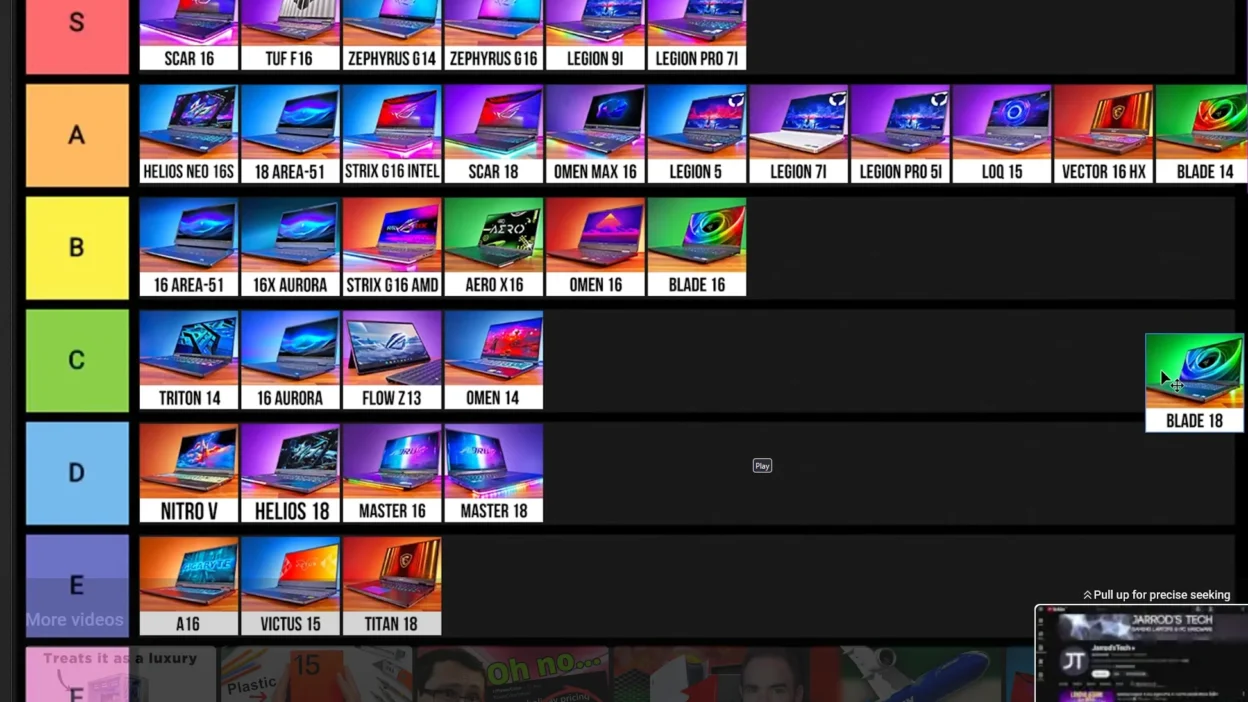
I tested 35 gaming laptops in 2025 and ranked them all using a seven-tier system: F (worst) to S (superb).
The S-Tier Winners (Best of the Best):
- Lenovo Legion Pro 7i — Best overall
- Lenovo Legion 9i — Best 18-inch
- Asus ROG Strix SCAR 16 — Best premium 16-inch
- Asus ROG Zephyrus G14 — Best 14-inch
- Asus ROG Zephyrus G16 — Best thin-and-light
- Asus TUF F16 — Best budget (RTX 5060)
The D/E/F-Tier Losers (Avoid These):
- Gigabyte Orus Master 16 & 18 — Overpriced, underwhelming
- MSI Titan 18 — Worst touchpad ever, $5,000 for no G-Sync
- Asus Helios 18 — Thermal throttles despite being 18 inches
- Acer Nitro V16S — Battery drains while gaming
Key Takeaway: Don’t always buy the most expensive laptop. The $1,300 MSI Vector 16 with RTX 5070 Ti outperforms $5,000 options.
How the Tier System Works
Seven tiers ranked from worst to best:
- F-tier: Avoid completely
- E-tier: Major flaws, not recommended
- D-tier: Below average, buy only on deep discount
- C-tier: Average, has significant compromises
- B-tier: Good, solid choice with minor issues
- A-tier: Very good, easily recommended
- S-tier: Superb, the best in class
Important disclaimers:
- These rankings are one reviewer’s opinion based on hands-on testing
- S-tier doesn’t mean perfect — no laptop is perfect
- Rankings consider trade-offs — find what has the least compromises for YOUR needs
- Price changes constantly — sales can make lower-tier laptops competitive
D-Tier: Not Recommended (Unless Desperate)
Acer Nitro V16S — The Battery Drain Disaster
Starting Price: ~$800-$1,000
Fatal Flaw: Battery drains while gaming
The Good
Better screen than competitors. Budget laptops usually cut the screen first, but the Nitro V16S has a decent display.
Good battery life (when not gaming).
Thin and portable thanks to plastic build.
Bright keyboard lighting — something Lenovo failed at this year.
The Fatal Flaw
Only comes with a 135W charger.
Run it in highest turbo mode while gaming? Battery drains in 2 hours, then performance automatically drops.
Run it in performance mode (one level lower)? Fellow reviewer Just Josh reported battery still drains.
Other Issues
- No Advanced Optimus (can’t disable integrated graphics for FPS boost)
- Plastic chassis flexes
Verdict
D-tier. Would be C-tier without the battery drain issue.
Asus Helios 18 — Thermal Throttling in an 18-Inch Laptop
Starting Price: ~$2,000+
Fatal Flaw: Thermal throttles despite being huge
The Good
Massive upgradability: Four RAM slots, three M.2 SSD slots.
Mini-LED screen looks pretty good.
Dual screen mode: 4K 120Hz normally, reboot into 1080p 240Hz for esports.
Optional mechanical keys for WASD and arrow keys.
The Embarrassing Problems
Fans are insanely loud.
Still thermal throttles despite being an 18-inch laptop with room for cooling.
Gaming performance was one of the lowest for the specs tested.
Low battery life (typical for 18-inch, but still).
USB-C charging didn’t work on the review unit.
Verdict
D-tier. This isn’t an 18-inch model to recommend.
Gigabyte Orus Master 16 — Overpriced Mediocrity
Starting Price: ~$2,000+
Fatal Flaw: Nothing stands out
The Positives (Sort Of)
OLED screen is nice.
Decent performance.
The Problems
Plastic build wobbles and flexes more than competitors.
More expensive than laptops with better build quality.
Gigabyte software is messy compared to other brands.
Doesn’t look as good as top-end competition (subjective).
Verdict
D-tier. Not worth recommending.
Asus ROG Strix G16 (AMD Version) — Last-Gen Chassis Holds It Back
Starting Price: ~$1,500+
The Problem: Uses 2024 chassis while Intel version gets 2025 redesign
The Good
AMD Ryzen 9 9955HX3D — Only laptop CPU this gen with 3D V-Cache. Gives decent gaming boost at 1080p.
Solid build quality.
Runs very cool — Lowest keyboard hotspot of all 35 laptops tested.
The Bad
Gaming on battery didn’t work — Stuttering issues.
Maxes out with RTX 5070 Ti — Intel version gets RTX 5080.
Last-gen design — Intel version has better features.
No 360° RGB light ring like the Intel model.
Verdict
B-tier. Still very good, but Intel version is better in almost every way.
C-Tier: Average (Significant Compromises)
Asus ROG Flow Z13 — Niche Tablet Gaming
Starting Price: ~$2,000+
The Concept: 13-inch tablet with snap-on keyboard
When It’s S-Tier
If you need maximum portability, this is incredible.
Performance in a 13-inch device is impressive.
Decent build quality.
When It’s F-Tier
If you don’t want a 13-inch screen, this is useless.
Basically no upgrade options due to size.
Dim keyboard lighting.
Very expensive.
Very niche product.
Verdict
C-tier. Compromising between extremes.
Asus ROG Zephyrus Duo 16 (Triton 14) — Touch Features Don’t Save It
Starting Price: ~$2,500
The Problem: Just launched, no sales yet
The Good
Premium all-metal and glass design.
Thin and portable with great battery life.
Nice OLED screen.
Only laptop tested with a touchscreen.
Touchpad with stylus support — Great for creators.
The Bad
Soldered RAM and single M.2 slot (typical for 14-inch).
Fans get quite loud in turbo mode.
Lid is hard to open.
Smaller 140W USB-C charger means less performance.
$2,500 for RTX 5070 — Not great value yet.
Verdict
C-tier. Solid, but nothing makes it stand out over other 14-inch options.
Alienware 16 Aurora (Non-X) — Budget Dell with a Terrible Screen
Starting Price: ~$1,000+
Fatal Flaw: Slowest screen response time of all 35 laptops
The Good
Extremely good battery life.
Great thermals.
Solid build.
The Deal-Breaker
27-millisecond response time — Slowest screen tested all year.
However, many Best Buy buyers seem happy and don’t notice. You might not notice unless you’ve used better screens.
Other Issues
RTX 5060 limited to 80W — Less performance than full-power 5060 laptops like HP Omen 16 or Asus TUF F16.
Slow Dell software after first boot.
Not the cheapest despite being “budget-friendly”.
Verdict
C-tier. Decently solid entry-level laptop if the price is right.
HP Omen Transcend 14 — Last Place in 14-Inch Comparison
Starting Price: ~$1,800+
The Problem: Lost the 14-inch comparison test
The Good
Nice metal build, light and portable.
Amazing battery life.
Decent speakers.
Nice OLED screen.
The Bad
Worse upgrade options than other 14-inch laptops — M.2 slot struggled to fit drives with chips on both sides.
Must remove cooler to upgrade Wi-Fi — Not the case with other 14-inch laptops.
Smaller 140W USB-C charger means less performance.
No MUX switch or G-Sync — Strange for an Omen-branded gaming laptop.
Lost the 14-inch comparison.
Verdict
C-tier. Below the Triton 14, though Triton was generally better.
B-Tier: Good (Solid Choice with Minor Issues)
Alienware Area-51 m16 — Heavy But Powerful
Starting Price: ~$2,000+
The Trade-Off: Performance vs portability
The Good
Performs really well.
Three M.2 storage slots — Rare for 16-inch.
Solid build.
Optional mechanical keyboard.
Glass panel on bottom lets you see inside.
The Bad
One of the biggest 16-inch laptops — Heavier than some 18-inch models.
Glass panel slides off your lap easily.
No Mini-LED or OLED option — IPS only. Decent IPS, but at Alienware prices, should be an option.
No Ethernet — Weird for a big 16-inch.
Soldered Wi-Fi — Can never upgrade (Wi-Fi 7 though).
Speakers aren’t great.
Dell software loads slowly after first boot.
Verdict
B-tier. Good performance and decent overall, but F-tier if you travel a lot.
Alienware 16X Aurora — Better Than Non-X, Still Expensive
Starting Price: ~$1,500+
The Improvement: All-around upgrade over the non-X version
The Good
Solid build quality.
Way better screen — 3-millisecond response time (vs 27ms on non-X).
Brighter too.
Decent battery life for Intel HX processor.
The Weird Problem
5060 version had louder fans than 5070 version despite performing worse. Doesn’t make sense. Might be fixed in updates.
Other Issues
Dim keyboard lighting.
Slow Dell software.
Way too expensive to justify. Rarely competitive even on sale.
Verdict
B-tier. Solid laptop with few bad downsides, but find it at a good price first.
Gigabyte Aero X16 — Lightweight with Interior Flex
Starting Price: ~$1,500+
The Trade-Off: Portability vs build rigidity
The Good
Very lightweight and portable.
Runs very cool despite quieter fans than competitors.
Impressive battery life.
Great for on-the-go use.
Pretty good sales on the deals website, making it competitive.
The Bad
Interior plastic flexes quite a bit. Not bad unless you push on it, but noticeable.
USB 2.0 on one Type-A port. Probably not a big deal unless you use all ports.
MUX switch only accessible in BIOS.
Verdict
B-tier. Decent all-around laptop with not too many major problems.
HP Omen 16 — Budget Option with Amazing Battery
Starting Price: ~$1,000+
Best Feature: Longest battery life of all 35 laptops tested
The Good
Amazing battery life — Longest runtime tested all year.
Full-powered RTX 5060 (115W).
Great prices on sale — Cheaper than other 5060 laptops with only 80W.
Internals run relatively cool.
Fan noise quieter than many competitors.
The Bad
Feels cheaper than previous Omens.
No Advanced Optimus.
Lower performance mode doesn’t reduce fan noise much.
Wi-Fi upgrade requires removing entire cooler — Stupid design only HP does.
Battery drain possible under heavy load — But HP software lets you limit this.
Verdict
B-tier. Solid mid-range laptop if you find it at the right price.
Razer Blade 16 — Premium Build, Power-Limited GPU
Starting Price: ~$3,000+
The Trade-Off: Thinness vs GPU power
The Good
Best feeling premium 16-inch laptop tested all year.
Solid all-metal build — Milled from a single block of CNC aluminum.
Thinner and lighter than competitors.
Excellent thermals despite thinness.
New keyboard feels much nicer than last gen.
The Bad
GPU is power-limited due to thinness. RTX 5090 version often performs worse than RTX 5080 laptops.
RAM can’t be upgraded.
Very expensive.
Verdict
B-tier. Build quality feels nicer than Zephyrus, but Zephyrus has more value.
A-Tier: Very Good (Easily Recommended)
Asus ROG Helios Neo 16S — Thin and Powerful
Starting Price: ~$1,600 (on sale with RTX 5070 Ti)
Best Feature: Great sales make this competitive
The Good
Thinner and lighter design.
Nice OLED screen.
CPU and GPU don’t get too hot.
Keyboard areas you touch while gaming stay cool.
5070 Ti model drops to $1,599 on sale — Great value.
The Not-As-Good
GPU power isn’t quite full on the 5070 Ti model.
Touchpad not as good as Razer Blade or Asus Zephyrus.
Some bloatware installed.
Verdict
A-tier. Kind of like a budget-friendly Zephyrus for people who want something thin but powerful.
Alienware Area-51 m18 — Second-Best 18-Inch
Starting Price: ~$3,000+
Best Feature: Came in 2nd place in the 18-inch comparison
The Good
Excellent gaming performance.
Keyboard stays cool under load.
Optional mechanical keyboard.
Solid build.
5Gb Ethernet — Extremely rare in gaming laptops.
Amazing sales this year on the deals website.
The Bad
No Mini-LED upgrade option.
Very heavy — Heaviest laptop tested all year.
Glass panel underneath slides off your lap.
Soldered Wi-Fi 7.
Speakers aren’t amazing.
Fans can get quite loud.
Verdict
A-tier. Solid 18-inch laptop worth considering.
Asus ROG Strix SCAR 18 — Good, But Alienware’s Better
Starting Price: ~$3,500+
The Problem: Not quite as good as smaller SCAR 16
The Good
Toolless upgrades — No screwdrivers needed.
360° RGB light bar.
Very bright Mini-LED screen.
Feels very cool under load.
The Bad
Quite heavy for 16-inch gaming laptops.
Ports in bad spot for left-handed mouse users.
Crazy expensive.
Gaming performance slightly lower than expected.
Verdict
A-tier. For 16-inch, SCAR is one of the best. For 18-inch, there are better options.
HP Omen Max 16 — Premium with Crazy Sales
Starting Price: ~$2,000+ (insane sales earlier this year)
Best Feature: Had the cheapest RTX 5090/5080 deals months ago
The Good
Nice OLED screen.
Great performance.
Clean design doesn’t look over-the-top gamery.
Crazy sales — Best 5090/5080 prices seen 6 months ago.
The Bad
Heavier side for 16-inch.
Internals can run hot.
SSD and Wi-Fi upgrade needs cooler removed.
Screen wobbles a bit.
Verdict
A-tier. Good enough, not quite S-tier.
Lenovo Legion 5 — Portable with Bright OLED
Starting Price: $950 (on sale with RTX 5060 + OLED!)
Best Feature: Above-average screen brightness at 500 nits
The Good
Smaller 15.1-inch OLED screen makes it more portable.
Nice, clean design.
Decent performance.
All Lenovo OLED laptops have 500-nit brightness.
Amazing battery life.
Insane deals — $950 for RTX 5060 with OLED screen.
The Bad
No G-Sync, FreeSync, or Adaptive Sync.
No Advanced Optimus.
Speakers aren’t amazing.
Performance on battery quite low.
Verdict
A-tier. Great portable laptop with good performance and above-average screen.
Lenovo Legion Pro 5i — Only Worth It with 5070 Ti
Starting Price: ~$1,500+
The Catch: Don’t buy with RTX 5060 or 5070
The Recommendation
Only worth buying with RTX 5070 Ti — Not available in smaller Legion 5.
If you’re considering RTX 5060 or 5070, get the smaller Legion 5 instead.
The Good
Nice build quality.
Above-average OLED brightness.
Great all-around gaming laptop.
The Bad
Weaker Wi-Fi.
No Thunderbolt 5.
Rear ports removed this generation.
Keyboard lighting underwhelming.
Verdict
A-tier (with RTX 5070 Ti). Comparable to Asus ROG Strix series.
Lenovo LOQ 15 — Best Budget Option
Starting Price: ~$800-$1,000
Best Feature: Features its competition doesn’t have
The Good
Advanced Optimus and G-Sync — Competition doesn’t have these.
Quieter fans than competitors.
Decent build quality despite all-plastic.
Can fix battery drain issue — Customize to get 245W charger for $15.
Decent screen.
The Bad
Slower Wi-Fi 6. Can upgrade to Wi-Fi 7 for $20.
Verdict
A-tier (was S-tier last year). Lost detailed 5060 comparison to Asus TUF F16.
MSI Vector 16 — Insane Value for RTX 5070 Ti
Starting Price: $1,300 (with RTX 5070 Ti!)
Best Feature: Cheapest 5070 Ti laptop by $200
The Insane Deal
$1,300 for RTX 5070 Ti — Typically RTX 5070 pricing.
5070 Ti is 30%+ faster than 5070 at 1440p.
Thunderbolt 5 — Something Lenovo’s Legion Pro 7 in S-tier is missing.
The Good
Above-average battery life.
Most BIOS customization out of any brand.
The Bad
No Advanced Optimus or G-Sync.
Hard to access rear ports.
Touchpad had issues.
Heavier side for 16-inch.
Fans can get loud.
Watch out for low-quality 1920×1200 screen option.
Verdict
A-tier. Great price-to-performance ratio.
Razer Blade 14 — Premium 14-Inch Option
Starting Price: ~$2,000+
Best Feature: Finally competitive pricing with recent sales
The Good
Solid all-metal CNC aluminum build.
Thin, light, very portable.
OLED screen.
Good battery life.
Better keyboard lighting than most competitors.
Fans don’t get too loud.
Gaming performance similar to bigger 16-inch laptops.
The Bad
15 levels of keyboard brightness — Have to press 15 times to go from max to min.
Maxes out with RTX 5070 — No 5070 Ti option.
Synapse software not as good as G14.
Limited upgrades.
Razer support is allegedly bad.
Verdict
A-tier. Solid 14-inch laptop, ahead of Omen, not quite as good as G14.
Razer Blade 18 — Fourth Place in 18-Inch Comparison
Starting Price: ~$4,000+
The Problem: Limited upgrades for an 18-inch
The Good
All-metal design feels really premium.
Thinner and lighter for 18-inch.
Same screen as Legion 9i — Above 4K at 240Hz, but matte instead of glossy.
First Blade 18 with a numpad.
Glass panel on bottom doesn’t slide off legs.
The Bad
Only two RAM sticks and two M.2 slots — Same upgradability as 16-inch laptops.
Razer says PCIe Gen 5 support, but doesn’t let you choose when ordering.
Ships with DDR5-5600, supports DDR5-6400, but you have to upgrade yourself.
RGB turns off when lid closes.
Synapse software needs updates.
Verdict
A-tier. Very good 18-inch laptop, scored just behind Alienware.
S-Tier: Superb (The Best in Class)
Asus TUF F16 — Best Budget Gaming Laptop
Starting Price: ~$900-$1,100
Why It’s S-Tier: Won the budget-to-mid-range RTX 5060 comparison
The Good
Decent build quality.
Good performance — One of the few RTX 5060 laptops with full 115W power limit.
Doesn’t feel hot.
Decent screen for gaming — Fast response time, okay colors.
Big 280W charger — Battery doesn’t drain like competitors.
The Bad
Fans get loud in turbo mode. Lower modes still get decent performance.
Verdict
S-tier. SCAR is best maxed-out 16-inch. TUF is best budget mid-range option.
Asus ROG Zephyrus G14 — Best 14-Inch Gaming Laptop
Starting Price: ~$1,800+ (crazy sales this year)
Why It’s S-Tier: Easily the best 14-inch
The Good
Premium CNC chassis — Solid build.
Very portable and lightweight.
OLED screen looks great.
Amazing battery life.
Only 14-inch laptop with RTX 5070 Ti graphics.
Excellent speakers.
On sale, 5070 Ti G14 provides better cost-per-frame than all 5070 14-inch laptops.
The Bad
Limited upgradability (all 14-inch laptops have soldered RAM).
Middle of keyboard feels hot while gaming.
Keyboard is one-zone RGB — Limited customization is pathetic.
Verdict
S-tier. Out of 14-inch laptops, this has the least problems.
Asus ROG Zephyrus G16 — Reviewer’s Personal Laptop
Starting Price: ~$3,000+ ($4,700 AUD spent by reviewer)
Why It’s S-Tier: Lightest and thinnest gaming laptop available
Why Reviewer Bought It
Portability is very important when traveling.
Available with higher-tier GPUs despite thin size.
Solid build quality.
Best speakers from a 16-inch laptop this year.
Epic battery life.
Nice OLED screen.
The Compromises
No RAM upgrades. 32GB enough for reviewer. Available with 64GB if you get higher-tier GPU.
Touchpad felt a little loose.
CPU improvement only minor compared to last gen.
Crazy stupid prices.
Verdict
S-tier. No other brands do this style except Razer Blade 16 (even more expensive).
Asus ROG Strix G16 (Intel Version) — Better Than AMD
Starting Price: ~$2,000+
Why It’s S-Tier: Better than AMD version in almost every way
The Major Upgrades
Full 360° RGB light ring.
Toolless upgrades — Slide a notch, bottom panel comes off.
Great performance.
Solid build quality.
Runs very cool under load, especially keyboard.
The Downsides
No major downsides.
One of the more expensive options.
Verdict
A-tier (would be S-tier with Mini-LED or OLED screen).
Asus ROG Strix SCAR 16 — One of the Best 16-Inch Laptops
Starting Price: ~$3,500+
Why It’s S-Tier: Asus’s highest-end gaming laptop
The Excellence
Toolless upgrades like Strix G16.
360° light bar.
Excellent performance.
Very bright Mini-LED screen. Halo/bloom effect can be disabled. Asus is the only brand giving you this choice.
Feels very cool under load.
The Downsides
Quite heavy for 16-inch.
Ports in bad spot for left-handed mouse users.
Crazy expensive.
Verdict
S-tier. Possibly the best Asus made all year.
Lenovo Legion 9i — Best 18-Inch Gaming Laptop
Starting Price: ~$3,600+ (record low price currently)
Why It’s S-Tier: Came first in 18-inch comparison
The Upgradability King
Most upgradability of any gaming laptop this year.
Four RAM slots + four M.2 SSD slots — Only laptop that can take four SSDs and four RAM sticks.
The Excellence
Solid build quality.
Excellent speakers.
Great battery life for 18-inch.
Lots of BIOS customization.
4K screen at 240Hz — Highest 4K refresh rate tested all year.
Optional reboot into 1080p mode at 440Hz.
Only 18-inch with glossy screen.
Optional 3D screen.
IPS screen — Better for gaming than Mini-LED.
The Downsides
Fans can get loud.
Above-average battery drain while asleep.
Populate all four RAM slots = DDR5-4000 speed.
Heavy laptop.
Very expensive — Currently record low price though.
Verdict
S-tier. Best 18-inch gaming laptop tested all year.
Lenovo Legion Pro 7i — Best Overall Gaming Laptop
Starting Price: ~$2,000+
Why It’s S-Tier: One of the best laptops all year
The Excellence
Excellent gaming performance — Better than most other laptops with same specs.
Above-average OLED brightness.
Great all-around gaming laptop.
Plenty of RGB lighting.
Removable WASD keycaps — Can replace with ceramic keys.
If you want RTX 5080 or 5090, must get Pro 7 over Pro 5.
The Missing Premium Features
No Thunderbolt 5 — Weird for premium laptop.
No IR for Windows Hello face unlock.
Ports moved to back this generation.
Less portable with gigantic 400W charger.
Verdict
S-tier. Easy S-tier, one of the best all year.
Final Rankings Summary
S-Tier (Superb)
- Lenovo Legion Pro 7i — Best overall
- Lenovo Legion 9i — Best 18-inch
- Asus ROG Strix SCAR 16 — Best premium 16-inch
- Asus ROG Strix G16 (Intel) — Toolless, cool, excellent
- Asus ROG Zephyrus G16 — Thinnest/lightest
- Asus ROG Zephyrus G14 — Best 14-inch
- Asus TUF F16 — Best budget (RTX 5060)
A-Tier (Very Good)
- Razer Blade 18
- Razer Blade 14
- MSI Vector 16
- Lenovo LOQ 15
- Lenovo Legion Pro 5i
- Lenovo Legion 5
- HP Omen Max 16
- Asus ROG Strix SCAR 18
- Alienware Area-51 m18
- Asus ROG Helios Neo 16S
B-Tier (Good)
- Razer Blade 16
- HP Omen 16
- Gigabyte Aero X16
- Alienware 16X Aurora
- Alienware Area-51 m16
C-Tier (Average)
- HP Omen Transcend 14
- Alienware 16 Aurora
- Asus ROG Flow Z13
- Asus ROG Zephyrus Duo 16 (Triton 14)
D-Tier (Not Recommended)
- Asus ROG Strix G16 (AMD)
- Gigabyte Orus Master 16
- Asus Helios 18
- Acer Nitro V16S
E-Tier (Major Flaws)
- MSI Titan 18
- Gigabyte Orus Master 18
- Gigabyte Gaming A16
- HP Victus 15
Key Takeaways for Buyers
Don’t Overspend
The $1,300 MSI Vector 16 with RTX 5070 Ti outperforms many $5,000 laptops.
The $950 Lenovo Legion 5 with RTX 5060 + OLED demolishes $1,000+ E-tier options.
Upgradability Matters
Lenovo Legion 9i: Four RAM slots + four M.2 slots.
Most 14-inch laptops: Soldered RAM, one M.2 slot.
VRAM Will Matter in 2026+
RTX 5070 has 8GB VRAM — Will struggle in future games at 1440p+.
RTX 5070 Ti has 12GB VRAM — Better future-proofing.
Screen Response Time Matters
Alienware 16 Aurora: 27ms — Slowest tested.
Asus TUF F16: ~3ms — Much better for gaming.
Which gaming laptop would you pick? Sound off in the comments below!