TL;DR – Quick Summary:
The Samsung Galaxy Z TriFold at $2,500 has serious problems: it’s borderline impossible to keep clean (six fingerprint-magnet surfaces), weighs 309g (50% heavier than Z Fold 7), has TWO prominent display creases, uses soft screen protector that gouges easily, and costs more than an iPad Pro + Galaxy S25 Ultra combined. First-gen reliability concerns, worse cameras than Z Fold 7, and impractical pocket size make this a tech enthusiast’s toy, not a practical daily driver.
Bottom Line: Unless you’re a Samsung ultra-fan with $2,500+ to burn on experimental tech, skip this and buy Galaxy Z Fold 7 ($2,000) or wait for Gen 2.
Samsung just launched the world’s most ambitious foldable smartphone.
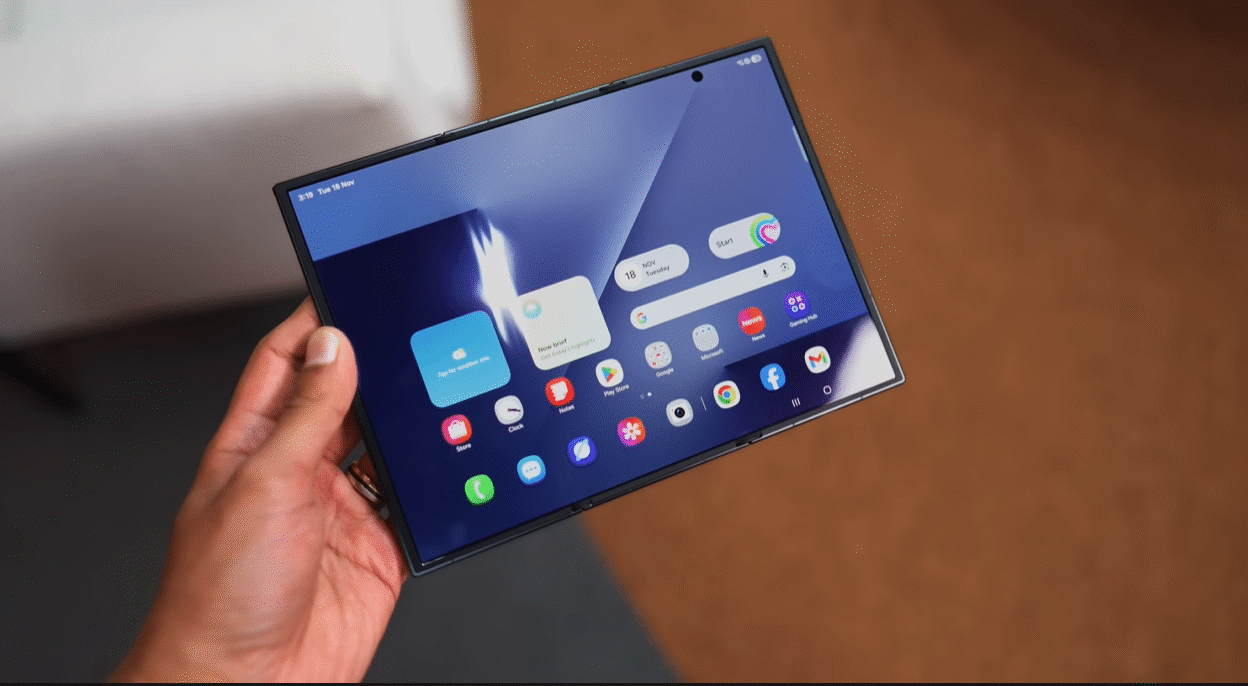
The Galaxy Z TriFold opens twice to reveal a 10-inch tablet display—basically three phones glued together that fold into (sort of) pocket size. On paper, it’s revolutionary. In reality? It’s a $2,500 experiment with massive compromises that most buyers will regret.
After analyzing hands-on reviews, real-world testing, and honest assessments from early users, here are the top 5 reasons you should absolutely avoid the Samsung Galaxy Z TriFold—no matter how cool it looks.
1. The Fingerprint Nightmare – Six Surfaces of Frustration
This is the TriFold’s most annoying daily reality that nobody talks about enough.
The Material Problem
Samsung uses fiberglass composite material across the entire TriFold body. The decision makes sense engineering-wise—you need strength-to-weight ratio when trying to achieve 3.9mm thinness at the slimmest point.
But in practice? This material is a disaster.
The texture is:
- Vinyl-like and sticky
- Shiny and reflective
- Fingerprint-magnet extraordinaire
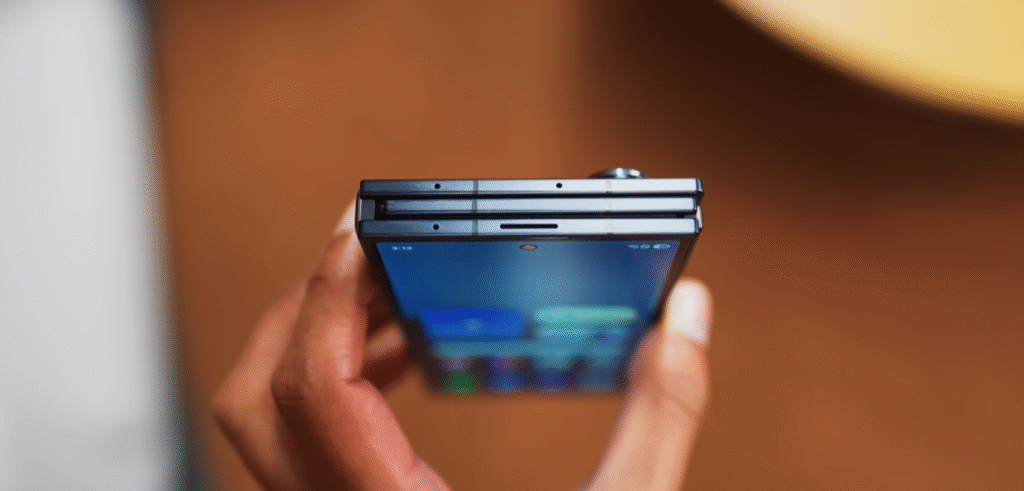
Six Faces, Six Problems
Unlike normal phones with two surfaces (front/back) or even Z Fold 7’s four surfaces, the TriFold has six distinct faces when folded:
- Outer cover screen surface 2-4. Three rear panel surfaces 5-6. Inner folding panel surfaces
Every single one picks up fingerprints constantly.
The Real-World Reality
It is borderline impossible to hold this phone and unfold it without persistently messing something up.
Think about the unfolding process:
- Grab the phone (fingerprints on back)
- Reach around to pull outer panels (fingerprints on sides)
- Lift middle panel (fingerprints on inner surface)
- Touch screen to use it (smudges on display)
You cannot avoid it. Physics makes it impossible.
The Cleaning Futility
“Just wipe it clean,” you think. Sure. Except you’ll need to wipe it:
- After every phone call
- After every unfolding
- After every folding
- After every pocket insertion/removal
- Multiple times per hour during active use
One reviewer noted needing “a wipe or seven” to clean it. That’s not hyperbole—that’s daily life with this device.
Why This Matters
This isn’t cosmetic annoyance. Constant fingerprints affect:
- Usability: Smudged screens harder to read
- Photography: Fingerprints on camera lenses degrade shots
- Professional image: Handing someone a smudge-covered $2,500 phone looks bad
- Mental load: Constant awareness of cleanliness becomes exhausting
The Comparison:
- iPhone 16 Pro: Glass back, occasional wipe needed
- Galaxy S25 Ultra: Matte finish, resists fingerprints well
- Z Fold 7: Four surfaces manageable
- TriFold: Six sticky surfaces = daily nightmare
For a $2,500 device, this is unacceptable. Premium phones should feel premium, not require constant maintenance.
2. The Weight Problem – 309 Grams of Pocket Pain
The TriFold weighs 309 grams. Let that sink in.
What That Actually Means
Comparison:
- Galaxy Z Fold 7: 215g (TriFold is 44% heavier)
- iPhone 16 Pro Max: 227g
- iPad Mini: 297g
- Galaxy Z TriFold: 309g (heavier than most tablets)
The TriFold weighs more than an iPad Mini. You’re carrying a tablet in your pocket that pretends to be a phone.
The Physical Reality
At 309g, this device:
Pulls down your pants: Seriously. Pocket sag is real. Dress pants, jeans, shorts—everything droops noticeably.
Creates thigh fatigue: Sitting with this in your pocket for hours creates genuine discomfort. The weight presses on your leg, restricting movement.
Ruins jacket symmetry: One pocket bulges heavily while the other hangs normally. Your entire outfit becomes asymmetrical.
Damages clothing: Heavier devices wear out pockets faster, stretch fabric, and stress seams.
The Bulk Factor
Weight combines with thickness to create impossible carry:
When folded: Even with Z Fold 7’s 6.5-inch cover screen form factor, the extra thickness from three layers makes this absolutely cannot pass as a normal phone.
Think about it: You’re carrying something roughly the size of three stacked phones. That’s not slipping unobtrusively into skinny jeans or dress pants.
Suit jacket pockets: Maybe manageable
Regular jeans: Uncomfortable
Skinny jeans: Forget it
Workout shorts: Laughable
Purse/bag: Admits defeat on “pocket-sized” claim
The Table Wobble Disaster
The TriFold’s weight combined with Samsung’s typical top-corner camera placement creates another problem: table instability.
Place it on a flat surface and tap the screen. Every tap produces a “resounding thunk” as the heavy, unbalanced device rocks on its camera bump.
This makes:
- Typing on flat surfaces frustrating
- Reading while lying down awkward
- Desk use inferior to lighter devices
The included case mostly fixes this (explaining why Samsung includes it), but that adds even more bulk and weight to an already over-heavy device.
Why 50% More Weight Matters
44% heavier than Z Fold 7 isn’t just a number. It’s the difference between “I barely notice this” and “I’m constantly aware I’m carrying something.”
For a device you’ll have on your person 12-16 hours daily, that weight becomes oppressive. After a week, you’ll find yourself leaving it on your desk more than carrying it—defeating the entire “portable tablet” value proposition.
Bottom Line: At 309g, the TriFold crosses the line from “heavy phone” to “small tablet that fits in some pockets.” That fundamentally changes the ownership experience in negative ways most people won’t anticipate until living with it daily.
3. TWO Display Creases – Because One Wasn’t Enough
Foldable phones have creases. We’ve accepted this reality. But the TriFold doubles down—literally.
The Double Crease Reality
Because there are two hinges, you get two creases running across your 10-inch display.
Each crease is “fairly prominent.” The moment any kind of light hits your screen, you’re reminded of their lurking presence.
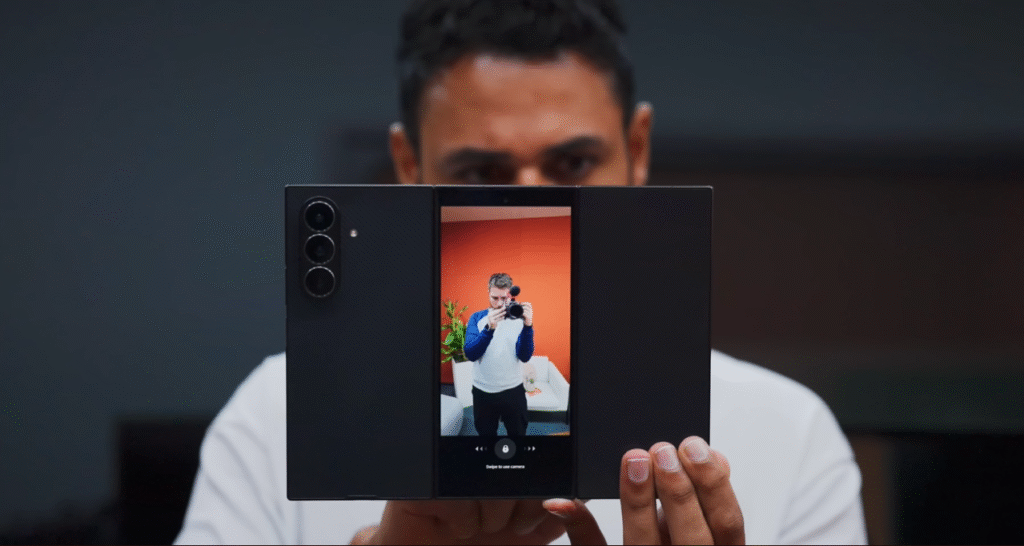
What “Prominent” Actually Means
These aren’t subtle:
Visually: Light reflects differently off crease areas, creating visible lines running across your screen during use.
Tactically: You feel them. Swiping across the screen, your finger catches slightly on each crease. It’s not dramatic, but it’s persistent and noticeable.
Content disruption: Watching video, reading text, viewing photos—the creases are there, bisecting your content.
The Light Problem
The creases become most noticeable under certain conditions:
- Office lighting: Overhead fluorescents highlight every crease angle
- Outdoor use: Sunlight casts shadows along creases
- Dark mode: Ironically, viewing dark content makes creases more visible as light reflects differently
- Video content: Movie watching constantly reminds you these lines exist
Multiplying = Worsening
One crease (Z Fold 7, Flip 7) becomes background after time. Your brain adapts.
Two creases? Harder to ignore. They create visual reference points that constantly draw attention. Instead of one line you learn to ignore, you have two lines creating a grid-like effect across your display.
The Comparison
Z Fold 7: One crease down the middle, fairly subtle, you adapt
Z Flip 7: One horizontal crease, same adaptation process
TriFold: Two creases creating visual interruption across entire display
Content Experience Impact
Reading: Text flows across creases awkwardly
Video: Creases run through actor faces, important visual elements
Photos: Editing photos means creases bisect your subject
Gaming: UI elements often land on creases, making them harder to see/tap
Productivity: Spreadsheets, documents—everything has lines running through it
Why This Matters More Than You Think
Samsung makes excellent displays. The TriFold’s 10-inch AMOLED is bright, colorful, and responsive. But those two creases undermine the premium visual experience you’re paying $2,500 to get.
Yes, every foldable has creases. But doubling them doesn’t just add one more annoyance—it fundamentally changes how intrusive they feel during use.
Reality: After 7 generations of foldables, Samsung still hasn’t eliminated creases. The TriFold doesn’t just inherit this problem—it doubles it.
4. The Screen Protector Catastrophe – Soft, Irreplaceable, Expensive
This might be the TriFold’s most expensive ongoing problem.
The Screen Protector Reality
The TriFold’s massive inner screen ships with a pre-installed screen protector. This protector is:
So soft it gets deep gouges from minimal contact
Irreplaceable without sending phone to Samsung
Essential for protecting the actual display underneath
How Soft Is “So Soft”?
One reviewer managed to get deep gouges just by leaning the phone against a vase. Not dropping it, not scratching it with keys—literally just resting it against a ceramic vase created permanent damage.
Think about what that means for daily use:
- Setting it on a table with grit/dust
- Pulling it from a pocket with lint/particles
- Using it with slightly dirty hands
- Accidental contact with any hard surface
All of these will mark, scratch, or gouge that ultra-soft protector.
The Replacement Nightmare
Unlike normal phone screen protectors you buy for $10-30 and self-install, the TriFold’s protector requires:
- Sending phone to Samsung (you’re without your $2,500 device for days/weeks)
- Paying Samsung’s service fee (likely $150-$300+ based on Z Fold precedent)
- Hoping they have stock (new device = supply chain unknowns)
- Repeat every few months if you actually use the device
The Particle Problem
Foldables have always struggled with particles getting between screens. The TriFold makes this worse:
Two hinges = more entry points
Larger unfolded surface = more area to trap debris
Six surfaces = more opportunities for pocket lint, dust, particles to transfer
All of these particles end up pressed between screens when you fold the device, gradually wearing down that soft protector—or worse, scratching the actual display underneath.
The Cover Screen vs Inner Screen
Interestingly, the 6.5-inch cover screen is protected by Gorilla Glass Victus 2—tough, durable, scratch-resistant.
But the massive 10-inch inner screen—the entire reason you’re buying this device—has a soft-as-butter protector that damages if you breathe on it wrong.
This creates bizarre usage psychology where you’re afraid to actually use the main feature you paid for.
The Maintenance Paranoia
Owning a TriFold means:
- Constantly worried about scratching the inner screen
- Babying a $2,500 device like it’s made of tissue paper
- Avoiding using it unfolded in “risky” situations
- Living with scratches/gouges because replacement is expensive/inconvenient
Why This Is Unacceptable
Premium devices should be confidently usable. The iPhone 16 Pro, Galaxy S25 Ultra, Pixel 10 Pro—you use these without paranoia because their screens can handle normal life.
The TriFold? You’re constantly tip-toeing around its fragility, which fundamentally undermines the ownership experience.
Bottom Line: A $2,500 flagship that requires extreme care not to damage its screen during normal use is a fundamentally flawed product. This isn’t a minor concern—it’s a daily anxiety that colors your entire relationship with the device.
5. The Price Reality – $2,500 For Compromises
Let’s talk money. Real money.
The Official Pricing
Samsung Galaxy Z TriFold: $2,500 (US pricing, based on KRW 3,590,400 Korean launch price)
That’s not a typo. Two thousand, five hundred US dollars for a smartphone.
What $2,500 Actually Buys
Let’s do the math on alternatives:
Option A: Best-of-Both Worlds
- iPad Pro 11″ (M4, 256GB): $999
- Galaxy S25 Ultra (512GB): $1,419
- Total: $2,418 (both devices for LESS than TriFold alone)
You get: Best-in-class tablet with M4 processor, best Android camera phone, TWO devices that excel at specific tasks, no compromises on either.
Option B: Galaxy Ecosystem Maximum
- Galaxy Z Fold 7: $1,899
- Galaxy Tab S10+: $599
- Total: $2,498 (basically same price, TWO Samsung devices)
You get: Proper foldable phone, proper tablet, both optimized for their form factors, no experimental first-gen concerns.
Option C: Apple Ecosystem Elite
- iPhone 16 Pro Max (512GB): $1,399
- iPad Mini (7th gen, 256GB): $649
- Total: $2,048 (save $450+)
You get: Best phone camera system, compact tablet, both devices at peak performance, $450 left over for accessories.
The Compromise Reality
That $2,500 doesn’t buy best-in-class anything. It buys:
Worse cameras than Galaxy Z Fold 7 (identical 200MP main, mediocre 10MP 3x zoom, average 12MP ultrawide)
Older processor (Snapdragon 8 Elite, not latest Elite Gen 5 that new flagships already ship with—lagging from day one)
Lower brightness (1,600 nits peak vs 2,600 nits on Z Fold 7—significantly dimmer main display)
First-gen reliability concerns (new form factor = unknown failure modes, untested durability over time)
Worse water resistance (IP48 vs IP68 on bar phones—mediocre protection for a premium device)
Heavier, bulkier, more fragile than either a dedicated phone or tablet
The Value Proposition Fails
At $2,500, the TriFold competes with:
- High-end laptops (MacBook Air M3, excellent Windows ultrabooks)
- Full iPad Pro + iPhone combos
- Multiple devices that each do their job better
The TriFold’s “all-in-one” promise sounds good until you realize you’re paying ultra-premium pricing for a device that compromises in every direction.
The Opportunity Cost
$2,500 isn’t just money. It’s:
850 cups of coffee (daily coffee for 2+ years)
10 months of average car payment
Round-trip flights to Europe
12 months of gym membership + personal training
Full year of quality meal prep service
For most people, that money has better uses than an experimental foldable that you’ll replace in 1-2 years anyway.
Who This Price Makes Sense For
Realistically, three buyer types:
- Ultra-wealthy tech enthusiasts: Money is no object, want bleeding edge
- Samsung brand loyalists: Will buy anything with the logo regardless of value
- Content creators: Can write off as business expense, use for unique content
For everyone else? The price-to-value equation doesn’t compute.
The Depreciation Reality
Experimental first-gen devices depreciate faster than established products. The TriFold will likely lose 40-50% of value in year one.
That $2,500 purchase becomes a $1,250 device within 12 months. You’re paying $1,250 annual “rental fee” to own this experiment.
Bottom Line: At $2,500, the Galaxy Z TriFold costs more than an iPad Pro + Galaxy S25 Ultra combined while delivering inferior experiences compared to either device used separately. Unless you’re wealthy enough that $2,500 feels like pocket change, this price is indefensible.
Who Should Actually Skip This?
After analyzing these five critical problems, here’s who should absolutely avoid the Galaxy Z TriFold:
❌ Anyone on a budget (obviously)
❌ People wanting daily driver reliability (first-gen = risks)
❌ Buyers prioritizing camera quality (worse than Z Fold 7)
❌ Anyone sensitive to weight (309g is oppressive)
❌ Users wanting low-maintenance tech (constant cleaning required)
❌ People with smaller pockets (literally won’t fit comfortably)
❌ Buyers wanting best value (price-to-performance fails)
❌ Anyone concerned about durability (soft screen, two creases, six surfaces)
❌ Users wanting latest/greatest specs (using older Snapdragon 8 Elite)
❌ People planning to keep phone 3+ years (first-gen won’t age well)
Who Might (Maybe) Consider It?
The only buyers who should even think about the TriFold:
✅ Ultra-wealthy tech collectors ($2,500 is pocket change)
✅ Samsung brand fanatics (must own every flagship regardless)
✅ Content creators (business expense, creates unique content angles)
✅ Productivity extremists (actually will use 3-app multitasking + DeX daily)
✅ Early adopters comfortable with risk (understand trade-offs, willing to experiment)
That’s maybe 5% of potential buyers. Everyone else will be happier with alternatives.
Better Alternatives for $2,500 or Less
Option 1: Galaxy Z Fold 7 + Accessories
Galaxy Z Fold 7: $1,899
Galaxy Buds 3 Pro: $249
45W Charger + Case: $150
Total: $2,298 (save $200, avoid all TriFold problems)
You get: Established, refined foldable with better brightness, proper pocket size, proven reliability, same Dex capability with external monitor.
Option 2: iPhone 16 Pro Max + iPad Pro
iPhone 16 Pro Max (256GB): $1,199
iPad Pro 11″ M4 (256GB): $999
Total: $2,198 (save $300)
You get: Best phone cameras, best tablet processor, zero compromises on either device, Apple ecosystem integration.
Option 3: Galaxy S25 Ultra + Galaxy Tab S10 Ultra
Galaxy S25 Ultra (512GB): $1,419
Galaxy Tab S10 Ultra (256GB): $1,199
Total: $2,618 (spend $118 more for BETTER experience)
You get: Best Samsung phone camera (10x optical zoom), massive 14.6″ tablet with S Pen, both devices excel at their purpose.
Option 4: Wait for Gen 2
Galaxy Z TriFold 2 (2026): Price TBD
Probable improvements:
- Crease reduction technology
- Better screen protector durability
- Weight reduction
- Brighter display
- Latest Snapdragon processor
- $500-700 price reduction as production scales
First-gen buyers are beta testers. Let them find the problems. Buy the refined version.
The Honest Final Verdict
The Samsung Galaxy Z TriFold is engineering porn—a technical achievement that’s impressive to witness but impractical to live with.
What Samsung Got Right
Innovation: Nobody else is mass-producing tri-folds (Huawei doesn’t count—China-only)
Dex Integration: First phone where DeX actually works standalone
Software optimization: 3-app multitasking genuinely works well
Build quality: Feels solid despite extreme thinness when unfolded
What Samsung Got Wrong
Weight: 309g is too heavy for daily pocket carry
Fingerprints: Six surfaces that constantly show smudges
Creases: Two prominent lines across your display
Screen fragility: Soft protector that gouges easily, expensive to replace
Price: $2,500 for compromises instead of excellence
Brightness: 1,600 vs 2,600 nits—significantly dimmer than Z Fold 7
Specs: Using older Snapdragon 8 Elite (already outdated at launch)
The Bottom Line
Unless you’re a wealthy Samsung superfan or content creator who can expense this, skip the Galaxy Z TriFold and buy:
- Galaxy Z Fold 7 if you want refined foldable now
- iPhone 16 Pro Max + iPad if you want best of both worlds
- Nothing if you’re waiting for TriFold Gen 2 in 2026
The TriFold represents where foldables are heading—eventually. But this first-gen execution asks $2,500 for the privilege of beta testing Samsung’s experimental form factor with significant daily-use compromises.
MyPitShop Recommendation: Skip this generation. Buy Z Fold 7 or wait for the TriFold 2.
Afford =/ should buy. Even if $2,500 feels affordable, you’re paying premium pricing for a first-gen experiment with known problems. Better value exists even at this price point.