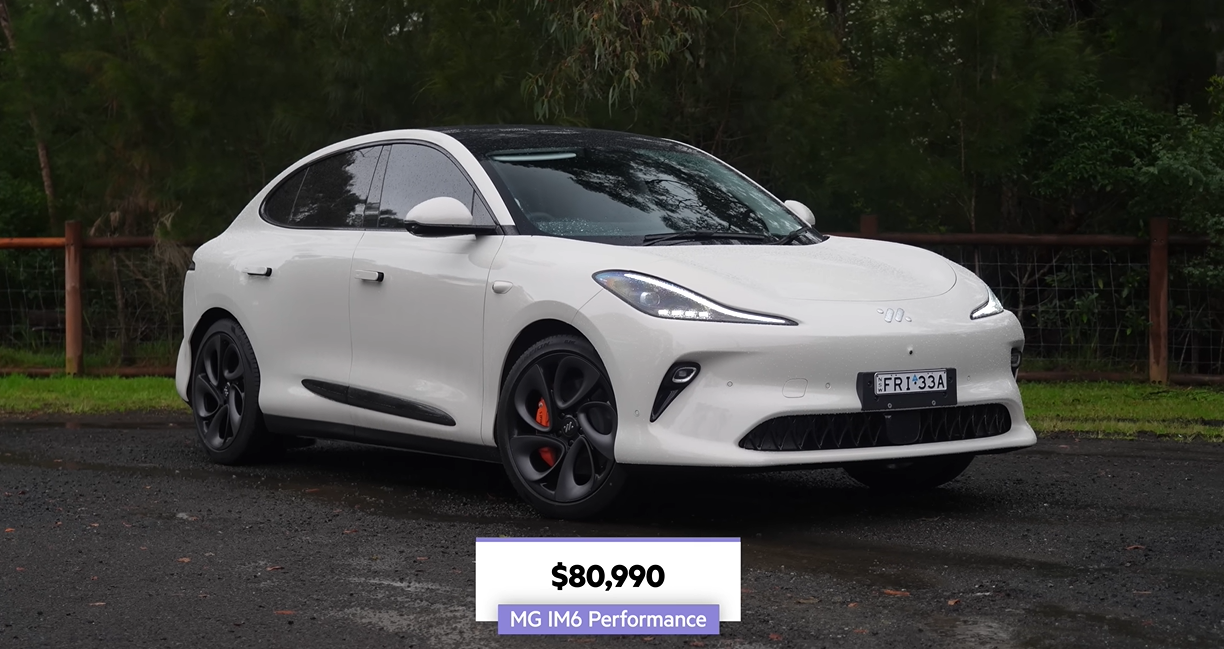
TLDR: The 2026 MG IM6 is a genuinely confusing vehicle that delivers supercar acceleration (0-100 km/h in 3.5 seconds), premium luxury features, and aggressive pricing (starting at £48,000/$60,990) but suffers from poor software, annoying safety systems, and terrible efficiency. It’s 80% brilliant but the remaining 20% ruins the daily driving experience. Buy the Long Range, skip the Performance.
What Is The MG IM6? Understanding The Brand Confusion
Before diving into the car itself, let’s clear up the biggest confusion: the IM6 isn’t actually an MG. It’s an IM (Intelligence in Motion) vehicle—a separate premium brand under SAIC Group, which also owns MG.
Think of it like Genesis to Hyundai or Lexus to Toyota. IM is attempting to be the premium offshoot, using MG’s established dealer network to piggyback into Western markets. In Australia, it’s marketed as “IM Motors by MG” or “Powered by MG,” which adds to the identity crisis.
This branding confusion perfectly mirrors the car itself: genuinely premium hardware that can’t quite decide what it wants to be.
Design & Exterior: When Copying Aston Martin Actually Works
Exterior Styling That Commands Attention
The IM6 is massive—4.9 meters long with a 2,950mm wheelbase (nearly 3 meters). To put this in perspective, it’s slightly wider than the 7-seat Kia EV9 and only marginally shorter.
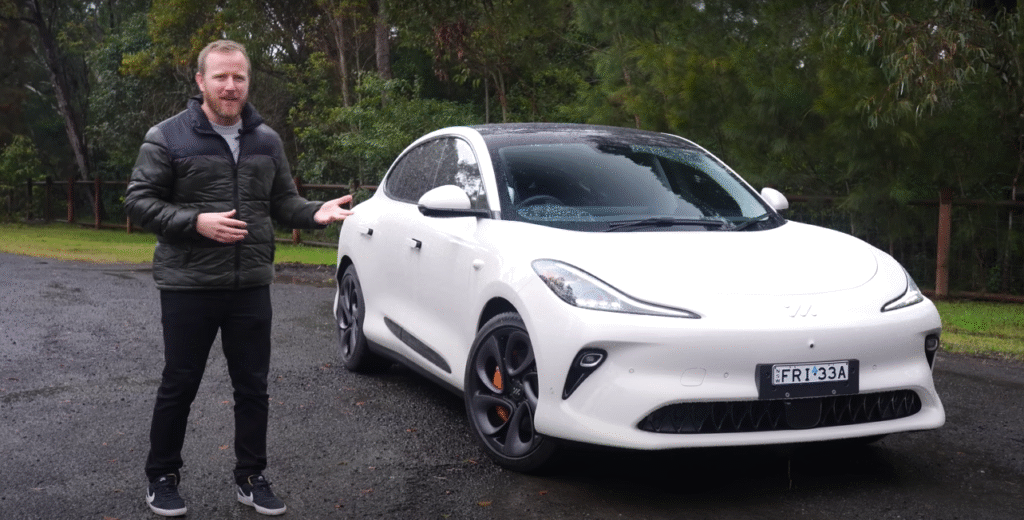
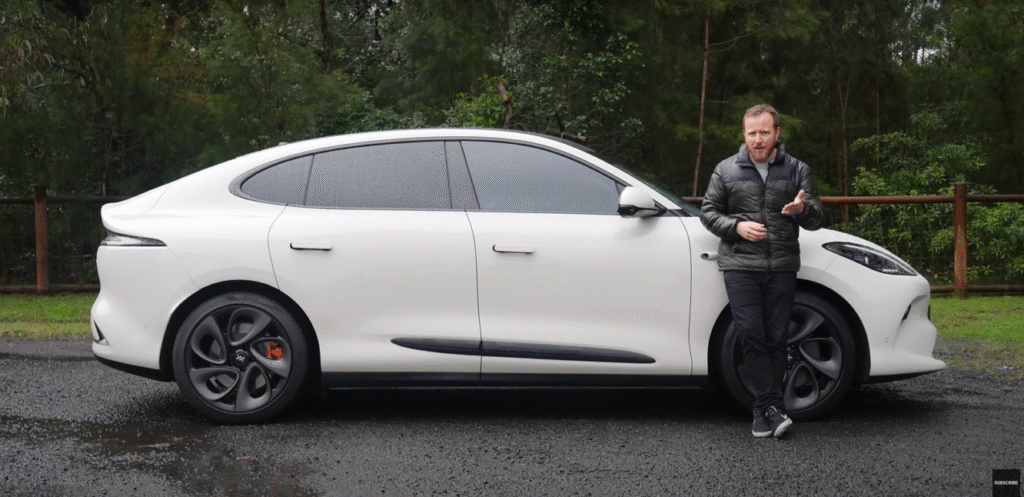
Front Design:
- Striking elongated LED daytime running lights with crystalline elements
- Fully closed EV grille for aerodynamic efficiency
- Active cooling flaps in the lower intake
- Prominent “IMHR HP” (High Performance) sensors front and center
- Sophisticated IM badge
Side Profile:
- Massive doors revealing cavernous interior space
- 21-inch alloy wheels wrapped in Pirelli Scorpion tires (arguably under-spec’d for 578kW)
- Staggered wheel setup (wider rears)—typically reserved for sports cars
- Pop-out door handles (rub the sensor, don’t pull)
- Frameless double-glazed windows with dark privacy glass
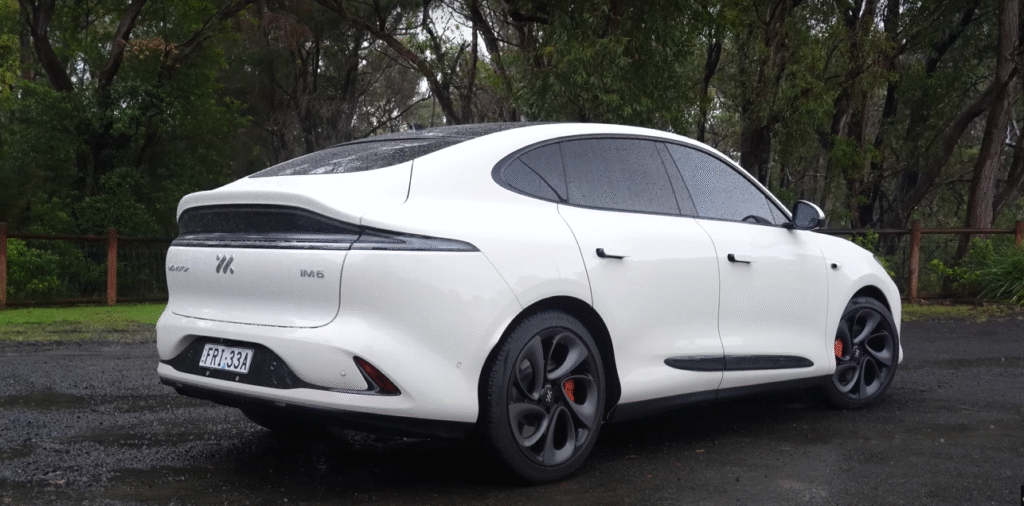
Rear Design: The controversial element: the massive light bar directly mimics the Aston Martin DBX. But surprisingly, it works. The design has enough character to avoid feeling like a cheap knockoff, with illuminated patterns adding sophistication and a proudly spelled-out “IM6” badge.
Verdict on Design: For an SUV—which are rarely attractive—the IM6 looks genuinely impressive. This is its best angle, creating road presence that belies its mid-range pricing.
Interior: Luxury Materials Meet Questionable Execution
The Wow Factor (That Fades Quickly)
Step inside and there’s an undeniable premium feel:
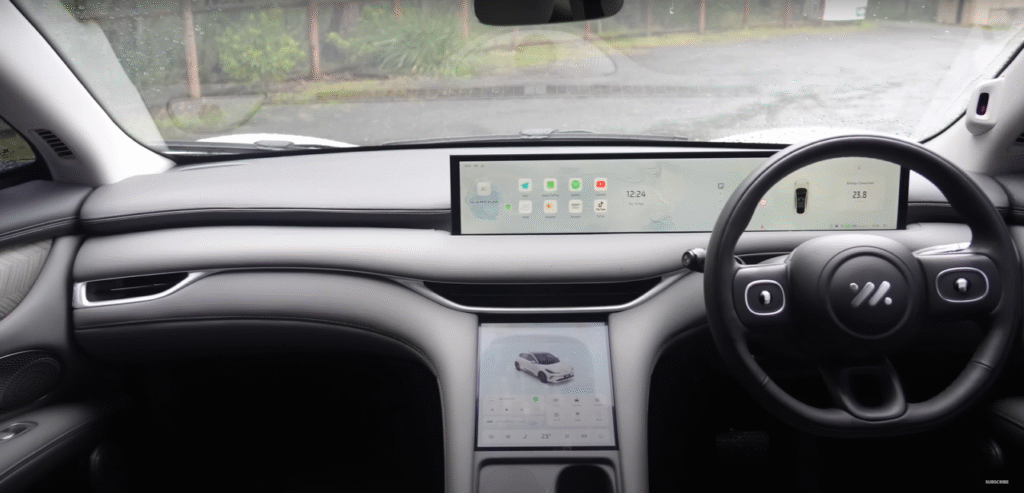

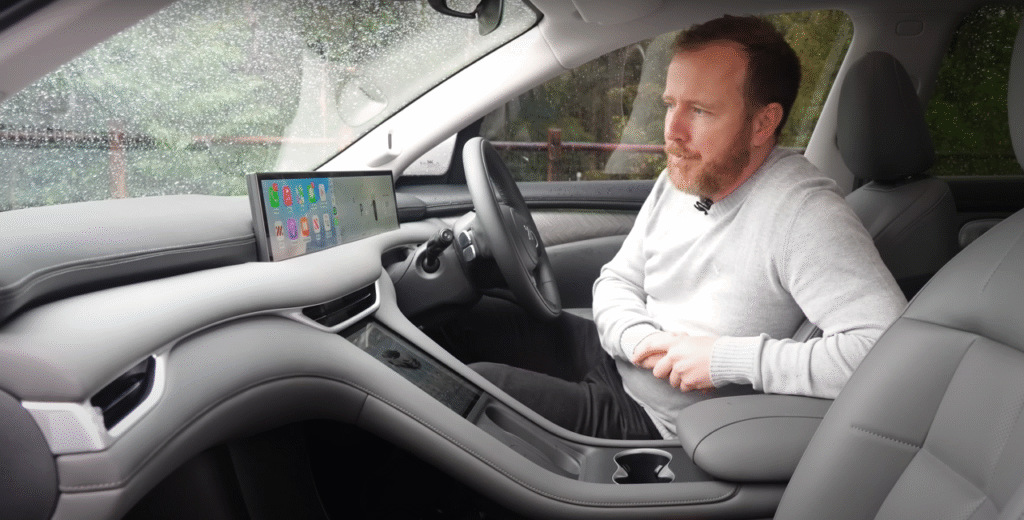
- Soft-touch materials throughout (described as “pleather” and “kitchen laminate” by some)
- Supremely comfortable seats with extensive adjustment and massage functions
- Panoramic glass roof with reactive UV tinting
- Multiple high-quality displays
The seats deserve special praise—exceptionally bolstered with a curious checkered pattern that “looks like a six-pack.” They’re a massive improvement over typical MG products and provide excellent long-journey support.
Technology Showcase
Display Setup:
- Large central touchscreen with wireless Apple CarPlay/Android Auto
- Comprehensive digital instrument cluster
- Dedicated climate control screen
- All displays are surprisingly snappy and responsive
The Audio Disaster: 20-speaker sound system that should be excellent but features bizarre speaker positioning—some fire at your legs, others reflect uselessly off the windscreen. It’s acoustic engineering gone wrong.
Storage: The Glove Box Scandal
Here’s where practicality falls apart:
- NO GLOVE BOX (seriously, none)
- Massive soft-close center armrest (requires surprising force to open)
- Only ONE USB-C fast charger in front (unacceptable for a £48k+ car)
- Center console with no rubber lining and low lip (items fly out under braking)
- 12V socket
- Huge door bins
- 32L frunk (adequate but nowhere near Tesla Model Y capacity)
- 646L rear cargo (1,600L with seats down)
Rear Passenger Space: At 5’11”, rear legroom is generous, toe room acceptable, headroom excellent. Flat floor maximizes comfort. However, only ONE USB port for rear passengers.
The Dangerous IM Mag System
Multiple MagSafe-compatible mounting spots throughout the cabin—dashboard, rear seats, and a removable handbag accessory.
Critical Safety Concerns:
- Front dashboard mount sits directly where airbags deploy
- Magnetic hold is dangerously weak—one finger dislodges a phone
- Under hard braking, these unsecured objects (several hundred grams) become face-seeking projectiles
- Seems designed for Chinese market without proper safety consideration
The Folding Mirror Mystery
You can completely fold away the rearview mirror. While there’s a digital camera option, it only displays briefly before disappearing. That this passed Australian safety regulations is baffling—though the tiny physical mirror offers limited visibility anyway.
Software & Technology: Where Everything Falls Apart
The Typo Nightmare
When a vehicle’s interface misspells “energy” as “engry” in “New Energy Vehicle,” it raises serious questions. These aren’t just translation issues—they’re signs of rushed development.
Other Software Gremlins:
- “Rammed on” instead of “Random” for air vent positioning
- “Customize” instead of clear “Turn All On” for safety systems
- Confusing menu structures requiring multiple steps for simple actions
- TikTok app built-in (why?)
- Everything controlled via touchscreen with no physical buttons
Safety Systems: “Possibly The Worst In Any Car”
This is the IM6’s biggest flaw. The safety systems are genuinely nightmarish:
Problems Include:
- Overly aggressive warnings that can’t be permanently disabled
- Lane-keeping and adaptive cruise control not calibrated for Western roads
- System slows excessively around corners, causing traffic pile-ups
- Forward collision warnings for non-existent threats
- Eye-tracking system triggers constantly when looking at the touchscreen to adjust climate
The Only Saving Grace: A “Close All” quick button disables everything, but systems reset with every drive cycle.
360° Camera: Merely “Okay”
For a luxury Chinese EV in 2026, the 360° camera is disappointingly average. Combined with poor rear visibility due to the stylish body design, parking requires more caution than expected.
Performance: Supercar Speed With Inadequate Everything Else
Acceleration That Defies Belief
Top-Spec IM6 Performance:
- 578kW (775 horsepower)
- 802Nm torque
- 0-100km/h in 3.5 seconds (manufacturer claim)
- 0-100km/h in 3.65 seconds (real-world tested with 2 people + camera gear)
This is 100 more horsepower than a Lamborghini Huracán STO. In a family SUV. For £51,000.
Long Range Model:
- 407 PS (300kW)
- Still “nutso” fast according to reviewers
- More than adequate for real-world use
The Critical Problems
1. Tires Can’t Handle The Power Pirelli Scorpion tires break traction effortlessly in any drive mode. The staggered wheel setup doesn’t solve the fundamental problem—this vehicle needs better rubber.
2. Brakes Don’t Match The Performance Stopping requires significant pedal effort. Emergency braking works but catches drivers out. This is nowhere near adequate for a 750hp vehicle.
3. It’s Got Too Much Power Like the MG4 X Power before it, the IM6 Performance has “too much power for what the chassis, suspension, and brakes can cope with.” It’s like bolting a washing machine-sized turbo to a Ford Fiesta.
Handling Characteristics
The Good:
- Rear-wheel steering (up to 6° turn) improves maneuverability
- Can perform “crab walk” party tricks (useless but fun)
- Air suspension surprisingly firm in Sport mode
- Corners “weirdly okay” for a 2.4-ton vehicle
- Dual motor all-wheel drive
The Bad:
- Massive steering disconnect—overly light with no road feel
- Floaty at high speeds (concerning)
- Wallows despite air suspension
- 2.4 tons is felt during aggressive driving
Verdict: The hard product—suspension, steering, drivetrain—is actually very good. It’s everything around it that fails to gel. Like the BYD Seal Performance, it’s too much power for the chassis.
Ride Quality: 80% Excellent, 20% Crashy
The air suspension delivers impressive comfort most of the time with automatic or manual adjustment. However:
- Very firm initial impacts before suspension activates
- Crashy, jolty behavior over certain bumps
- The “rebound” over speed bumps can launch occupants slightly airborne
It’s a ride that’s 80% excellent but that remaining 20% feels unfinished.
Battery, Charging & Efficiency: The Range Reality Check
Battery Options
Entry Level (IM6 Standard):
- 75kWh LFP (Lithium Iron Phosphate)
- Excellent for regular 100% charging
- 153kW DC fast charging (impressive for LFP)
Mid & Top Spec (IM6 Max & Performance):
- 100kWh NMC (Nickel Manganese Cobalt)
- 396kW DC fast charging (fastest in the world)
- 15-80% in 17 minutes (tested)
AC Charging
11kW maximum (22kW would’ve been better for luxury positioning)
The Efficiency Disaster
Real-world testing in 6-12°C weather revealed shocking inefficiency:
Performance Model:
- 26kWh/100km (Australian testing)
- 2.0 miles per kWh (UK testing during regular commuting)
- About 220 miles (354km) real-world range despite 100kWh battery
Long Range Model:
- Estimated 2.6 miles per kWh
- Around 250 miles (402km) real-world range
For Comparison:
- Tesla Model Y Long Range: 3.5 miles per kWh
- Hyundai Ioniq 6 N: 21kWh/100km (despite MORE power)
- Polestar 4: 340+ miles in similar conditions
The Cost Reality
At UK fast-charging prices (89p/kWh at Gridserve):
- IM6 Performance: £80+ for a full charge (220-mile range)
- Tesla Model Y: £35 for similar range (using Tesla Supercharger at 39p)
The IM6 Performance is equivalent to a petrol car doing 17 miles per gallon. That’s Mercedes-AMG C63 territory.
Charging At Home Changes Everything
At home electricity rates (around 7p/kWh off-peak):
- IM6 Performance: 3p per mile
- Tesla Model Y: 2p per mile
If you charge exclusively at home, the efficiency penalty is manageable. If you do long motorway journeys, this becomes expensive quickly.
Features & Equipment: Where The Value Truly Shines
For £48,000-£53,000, the equipment level is genuinely mind-blowing:
Standard Features Include:
- Air suspension with multiple modes (typically £200k+ car territory)
- Rear-wheel steering
- 20+ speaker sound system
- Panoramic reactive-tinting glass roof
- Heated and ventilated front seats with massage
- Heated steering wheel
- Wireless charging pad
- Wireless Apple CarPlay & Android Auto
- Multiple displays (instrument, infotainment, climate)
- 360° camera system
- Blind spot cameras
- Double-glazed windows throughout
- Active noise cancellation
- 21-inch alloy wheels
- Continental brakes
- Frameless doors
This is extraordinary value on paper—features that typically require £120,000-£150,000 in European luxury EVs.
Pricing & Value: UK vs Australia
UK Pricing
- Long Range: £48,000 (discounted to £44,000 at some dealers)
- Performance: £51,000
- Launch Edition: £53,000 (Performance + air suspension + extras)
- Luxury Car Tax: £425/year (over £40k threshold)
Australian Pricing
- Base Model: $60,990 drive-away
- Performance: $80,000
Lease Comparison (UK – 3 years, 10,000 miles, 1 month initial)
- IM6 Long Range: £547/month
- BYD Sea Lion: £462/month
- Kia EV5: £491/month
- Cupra Tavascan: £430/month
- Renault Scenic Long Range: £417/month
- Polestar 4 Dual Motor: £526/month
- Tesla Model Y RWD: £700/month
Value Verdict: On paper, extraordinary. In reality, the frustrating daily experience undermines the value proposition.
Comparison: How Does It Stack Up?
vs. Tesla Model Y Performance (£96,000 / $96,000)
IM6 Advantages:
- £45,000 cheaper
- Faster acceleration
- More luxury features
- Better interior materials
Model Y Advantages:
- Better software and efficiency
- Proven reliability
- Superior charging network
- More practical storage
- Better resale value
vs. BYD Seal Performance (£65,000)
Similar Issues:
- Both have “too much power for chassis” problem
- BYD has better software integration
- IM6 offers more luxury and space
- Both struggle with efficiency
vs. Hyundai Ioniq 6 N (£115,000)
IM6 Advantages:
- £64,000 cheaper
- More space
Ioniq 6 N Advantages:
- More power but better efficiency
- Superior software and safety calibration
- More refined overall package
vs. Polestar 4 (£526/month lease)
Similar Pricing:
- Both around 100kWh battery
- Polestar achieves 340+ miles vs IM6’s 220-250
- Polestar more efficient and refined
- IM6 has rear-wheel steering advantage
vs. Renault Scenic (£417/month lease)
Renault Advantages:
- £130/month cheaper
- More efficient (87kWh goes further)
- Better software
- Under £40k (no luxury tax)
- “Never felt it needed 500 extra horsepower.”
The Verdict: 80% Complete, 20% Broken
What Works ✅
- Genuinely impressive performance (3.5s 0-100km/h)
- Stunning exterior design with road presence
- Luxurious interior materials
- Outstanding seat comfort
- Excellent feature list for the price
- Spacious cabin with great rear legroom
- World-leading fast charging (396kW)
- Rear-wheel steering
- Quiet, well-insulated cabin
- Reactive tinting panoramic roof
What Doesn’t ❌
- Software full of typos and translation errors
- Worst safety system calibration in any recent car
- Adaptive cruise control dangerous on UK/Australian roads
- Terrible efficiency (26kWh/100km)
- Tires inadequate for the power
- Brakes inadequate for performance
- IM Mag system is a safety hazard
- No glove box
- Only one USB-C port in front
- Speakers positioned poorly
- Inconsistent, crashy ride quality
- Brand identity confusion
- Poor rear visibility
- Eye-tracking system constantly triggers
The Core Problem
The IM6 feels like a product that’s 80% complete. The hardware is exceptional—chassis, drivetrain, suspension, and interior quality all punch well above the price point. But the software integration, safety system calibration, and attention to detail needed another 6-12 months of development.
It’s as if they rushed to market with an impressive foundation but didn’t refine the experience. The result is a vehicle that can be genuinely nightmarish to drive despite being fundamentally good.
Should You Buy One?
Buy If:
✅ You prioritize value and features over refinement
✅ You’re willing to disable safety systems every drive
✅ You want supercar acceleration in SUV packaging
✅ You charge exclusively at home
✅ You appreciate luxury interiors at accessible prices
✅ You’re comfortable being an early adopter
✅ You mainly do city/suburban driving
Avoid If:
❌ You need reliable, well-calibrated safety systems
❌ You do lots of highway/motorway driving with adaptive cruise
❌ Software refinement matters to you
❌ You want proven reliability and support
❌ You need excellent efficiency for long-range driving
❌ You rely on public fast charging regularly
❌ You want a car with actual storage solutions
Reviewer Consensus: “Good On Surface, Not Underneath”
The Fish and Chips Analogy: “It looks amazing, but afterwards you feel rotten about yourself. It’s like pod lard down your throat.”
The Budget Premium Paradox: “Can you have budget premium? No, you can’t. Half of what you buy is the badge and the stuff you don’t see. You buy a BMW, you might not see where the money goes, but you can feel it when you drive.”
The Target Buyer: “It’s for somebody who’s going to get an ID.4, looking at the price, hasn’t looked at Tesla for various reasons, and then spots one of these. But once you start delving into it… it’s nice on the surface but not so good underneath.”
Final Thoughts: Confusion Justified
The title “Even IM Confused” perfectly captures this vehicle. It’s simultaneously one of the best value propositions in the EV market and one of the most frustrating to live with daily.
The Core Issue: MG/IM has proven they can build excellent hardware. What they haven’t proven is the ability to integrate these elements into a cohesive, refined package.
The Recommendation: Skip the Performance model entirely. Get the Long Range at £44,000 (with dealer discount). You still get 407 PS (plenty fast), the same 100kWh battery, better efficiency, and all the luxury features—without the tire/brake inadequacy and slightly improved range.
If MG/IM can fix the software, properly calibrate the safety systems, address efficiency concerns, and remove safety hazards like the weak IM Mag system, they’ll have a genuine luxury EV competitor at a disruptive price.
Until then, the IM6 remains a confused but capable vehicle that asks buyers to tolerate significant flaws in exchange for exceptional value. Some will find that trade-off worthwhile. Many should wait for updates—or look elsewhere.
Rating: 3.5/5 Stars
Hardware: 4.5/5
Software: 2/5
Value: 5/5
Overall: 3.5/5
The hard product earns 4.5 stars. The software experience and safety system calibration drag it down to 3.5. With updates, this could easily become a 4.5-star vehicle.
Final Word: The MG IM6 is luxury that can’t quite pull itself together. It’s almost great, which somehow makes its flaws more disappointing.
Around 505 km WLTP for the Performance model, but real-world testing shows 220-250 miles (354-402km) depending on conditions and driving style.
0-100 km/h in 3.5 seconds officially, 3.65 seconds tested—faster than many sports cars and 100 horsepower more than a Lamborghini Huracán.
Yes, if you want premium EV features at lower prices than European rivals and charge at home. No, if you need refined software, efficient long-range driving, or reliable safety system
5 Reasons to Avoid MG IM6 2026
7 Strong Reasons You Should Buy MG IM6
Around 505 km WLTP on the Performance model.
0–100 km/h in 3.4 seconds, faster than many sports cars.
Yes, if you want premium EV features at a lower price than German rivals.
Yes, with an 800V architecture allowing 398 kW DC charging.
The IM6 is faster, more feature-rich, and cheaper, but Tesla has better brand recognition and charging network integration.
Too early to tell. As a new model from a relatively new brand, long-term reliability is unknown. The SAIC/MG group has mixed reliability records.
Author Section: Australia’s #1 auto editorial YouTube, CarsGuide has the latest car news, reviews, and advice!