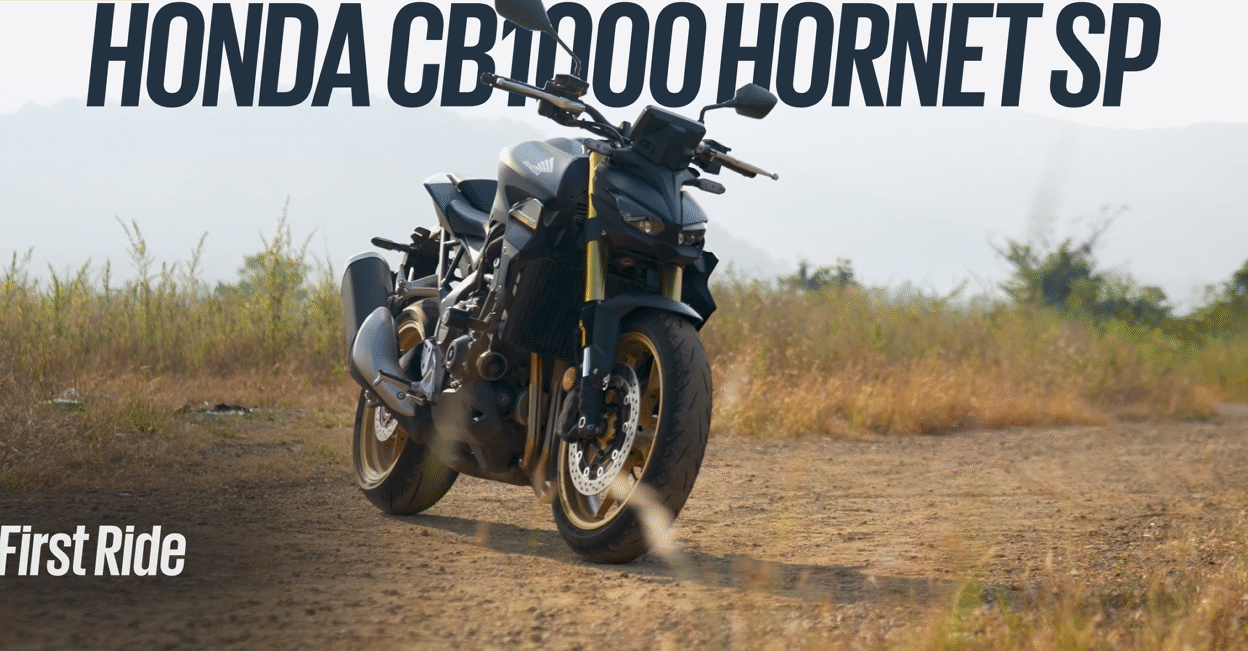
Honda has shattered expectations with the CB1000 Hornet SP, proving that competitively priced litre-class motorcycles don’t have to compromise on quality or performance. At ₹13.3 lakh rupees (ex-showroom), this represents a seismic shift in Honda’s big bike pricing strategy, offering a bona fide 1000cc four-cylinder super naked with premium components like Brembo brakes, Öhlins suspension, and comprehensive electronics.
Breaking the Mould: Honda’s Aggressive Pricing Strategy
Value That Rewrites the Rules
Honda historically struggled with competitive pricing in India’s premium motorcycle segment, with models like the CBR1000RR Fireblade and CB500X launching at prohibitive price points. The CB1000 Hornet SP marks a polar opposite approach, undercutting nearly every comparable motorcycle in its class.
At ₹13.29 lakh (ex-showroom Delhi), the Hornet SP costs approximately $15,900 USD or €14,800 EUR based on current exchange rates. In the United States, Honda priced it at a stunning $10,999 MSRP, making it cheaper than the CB1000R Black Edition it replaces and undercutting rivals by significant margins. The UK market sees it starting at £9,099, nearly £2,000 less than its nearest competitor.
For reference, this pricing positions the Hornet SP below bikes like the Ducati Scrambler Full Throttle and Triumph Street Triple RS, neither of which match the Honda’s raw power or specifications. Its only direct rival is the Kawasaki Z1100 priced at ₹12.79 lakh, though the Honda offers more power, less weight, and superior cycle parts.
Engine Performance: Fireblade DNA Meets Street Sensibility
The Heart of a Superbike
The CB1000 Hornet SP employs a 999cc liquid-cooled inline-four DOHC engine derived from the previous generation CBR1000RR Fireblade. This powerplant produces 157.17 PS (115.6 kW) at 11,000 rpm and 107 Nm of torque at 9,000 rpm, paired with a six-speed gearbox featuring a bidirectional quickshifter.
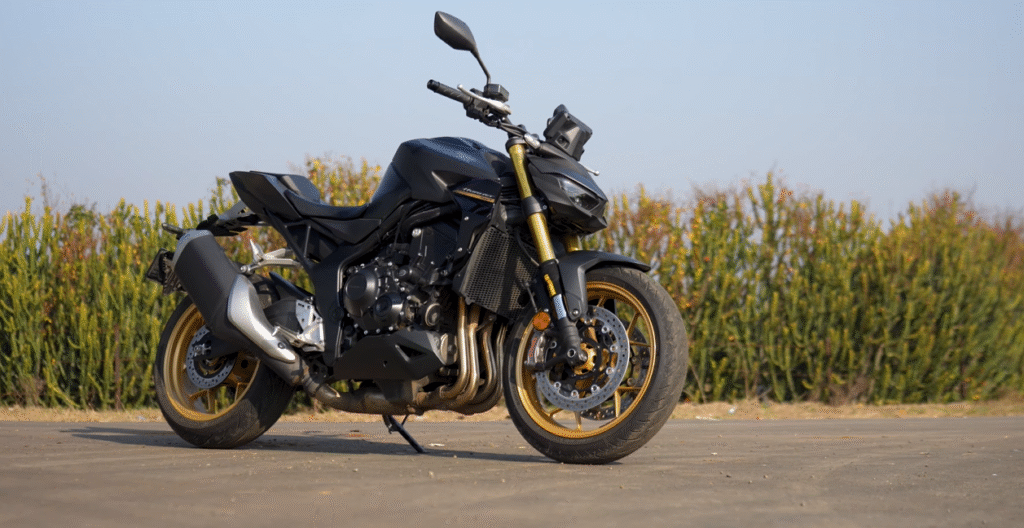
The engine’s character reveals two distinct personalities. Below 4,000-6,000 RPM, power delivery remains smooth, progressive, and surprisingly docile for a litre-class motorcycle. The clutch operates without excessive heaviness, making urban riding manageable despite the bike’s 212-kilogram kerb weight with its 17-litre tank fully fueled.
Above 6,000 RPM, the engine transforms into an absolute screamer. An exhaust valve opens at this threshold, unleashing both audible fury and genuine performance. The bike comfortably exceeds 200 km/h with two gears remaining, achieving a top speed of 230 km/h. While high-frequency vibrations appear past 6,000 RPM, they manifest during triple-digit speeds where they become inconsequential.
Comparative Performance Dynamics
Compared to the Kawasaki 1100cc motor in the Ninja 1100, Honda’s powerplant feels substantially more eager and excitable. Where the Kawasaki prioritises mid-range delivery, the Hornet excels with a searing top-end rush that rewards high-revving enthusiasm. The engine peaks at 11,000 RPM, reflecting its superbike heritage.
The Hornet produces notably more power than its Kawasaki Z1100 rival, which generates 136 PS at 9,000 RPM and 113 Nm at 7,600 RPM. This translates to a power-to-weight ratio of 740.56 hp/tonne for the Honda versus 615.38 hp/tonne for the Kawasaki.
Fuel Compatibility and Real-World Usability
Despite CBU import stickers denoting EU fuel compliance, the Hornet remains compatible with Indian E20 fuel, though high-octane petrol is recommended for optimal performance. The bike’s cooling system proved exceptional during testing, never overheating despite Mumbai traffic conditions. Some warmth emanates from the right shin area, but remains tolerable—particularly impressive given Honda’s reputation for excellent heat management across its big bike range.
Riding Experience: Surprisingly Approachable
Ergonomics That Work for Indians
The CB1000 Hornet SP defies super naked stereotypes by offering genuinely approachable ergonomics. With a seat height just over 800mm (officially 809mm), riders at 5’11” can flat-foot the motorcycle comfortably. For average-height Indian riders (approximately 5’7″-5’8″), testing revealed the ability to get the balls of the feet firmly planted, instilling confidence when manoeuvring this heavy, powerful machine.
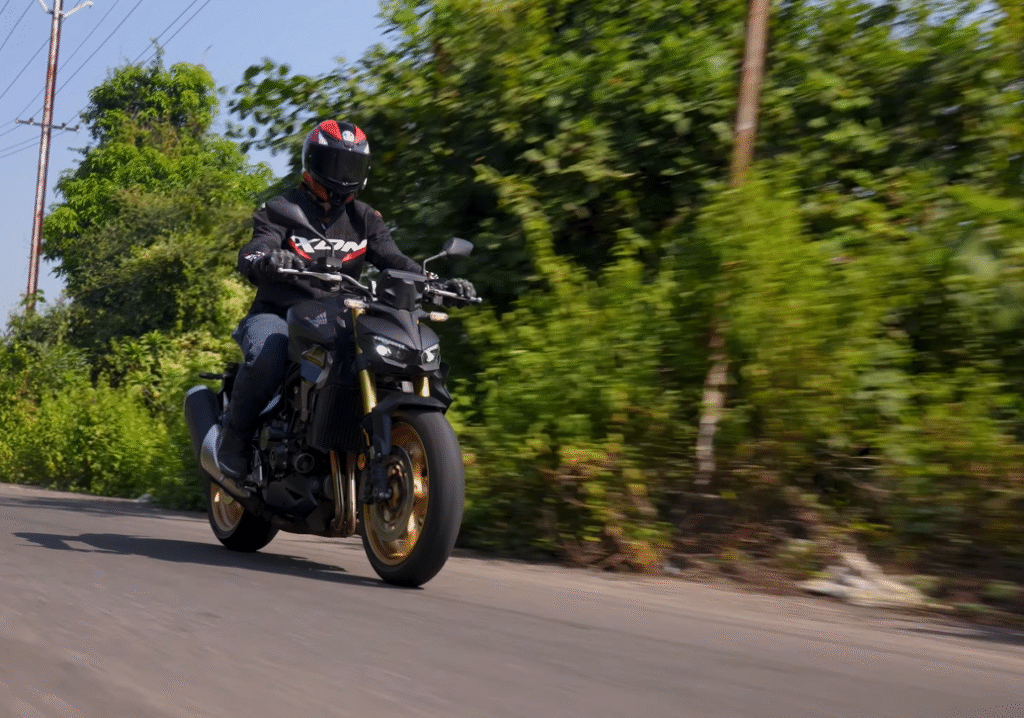
The riding position strikes a balance between sporty engagement and long-distance comfort. A slight forward lean to the handlebars provides sporting intent without excessive commitment, making this a motorcycle suitable for touring applications. This represents a departure from more extreme European super nakeds that prioritise aggression over practicality.
Subjective Ergonomic Considerations
Two ergonomic quirks emerged during testing, though both prove subjective based on rider physiology. First, the tank design creates a small gap, preventing some riders from properly latching their upper thighs against it for maximum control. Second, riders with size 12 or larger feet may experience occasional contact between their foot and the exhaust heat shield when riding with their toes on the pegs.
The pillion accommodations follow the super naked convention: functional for short bursts but not designed for extended passenger comfort. The rear seat measures barely larger than a hand, and pillion footpegs mount quite high. This limitation affects virtually every bike in this category, so the Hornet receives no special criticism here.
Exhaust Note: Stock Perfection
Euro 5 Compliance That Sounds Glorious
One of the Hornet’s most impressive achievements involves its stock exhaust system. In an era where Euro 5 emissions regulations typically neuter motorcycle soundtracks, Honda engineered an exhaust that delivers genuine acoustic pleasure without aftermarket modifications.
The system features a valve opening at 6,000 RPM, dramatically increasing volume and intensity. Below this threshold, the Hornet produces a deep, bassy growl that provides satisfying feedback without offending neighbours or drawing unwanted attention. Above 6,000 RPM, the sound transforms into an angry, raspy wail accompanied byan aggressive intake howl.
This represents a rare instance where the stock exhaust genuinely satisfies enthusiast demands, eliminating the immediate need for expensive aftermarket systems.
Chassis and Handling: Belying Its Budget Price
Steel Frame Performance
On paper, the Hornet’s one-piece steel frame might suggest compromise compared to more exotic European rivals employing aluminum or composite construction. In reality, this represents a complete non-issue during road riding. The chassis delivers planted stability at high speeds and tips into corners with surprising eagerness.
Credit for the nimble handling partially belongs to the well-judged 180-section rear tyre. While most super nakeds employ 190 or 200-section rears, the Hornet’s narrower tyre enhances agility without sacrificing stability. Bridgestone S22 tyres come standard, providing excellent grip for a machine producing nearly 160 horsepower.
The chassis setup proves so effective that the 212-kilogram weight virtually disappears once rolling. The bike maintains acceptable manoeuvrability even at parking lot speeds, featuring a reasonable turning radius for its size.
Premium Suspension Components
Honda equipped the Hornet SP with suspension components typically reserved for significantly more expensive motorcycles. Up front, fully adjustable Showa SFF-BP forks provide excellent compliance over broken pavement while maintaining control during spirited riding.
The rear features an Öhlins TTX 36 monoshock—the same top-flight equipment found on premium Ducati Panigale models. In stock settings, the suspension strikes an impressive balance, absorbing Mumbai’s challenging road conditions while remaining composed during aggressive cornering. Full adjustability allows riders to tailor both ends to personal preferences, riding style, and weight.
Braking Performance
Brembo Stylema four-piston callipers grip 310mm floating double discs at the front, representing top-drawer braking hardware. Compared to European super nakeds from Ducati or Triumph, the Hornet’s initial bite feels slightly gentler—likely due to pad compound and ABS calibration rather than hardware limitations.
Once riders apply firm pressure, stopping power proves abundant. The progressive feel actually benefits newer big bike riders, providing a more welcoming introduction to litre-class performance than razor-sharp initial bite. Dual-channel ABS provides safety without intrusiveness.
Ground Clearance: The Practical Limitation
Real-World Concerns
The CB1000 Hornet SP offers 135mm of ground clearance—typical for the super naked category but requiring vigilance on Indian roads. The conical sump shape sits particularly low, potentially becoming the first contact point over severe bumps or road imperfections.
This limitation isn’t unique to the Hornet; the related Transalp and CB750 Hornet share similar sump configurations. Riders must remain mindful of obstacles, speed bumps, and potholes that wouldn’t concern typical street bike owners. Protecting the rims and undercarriage over bad road sections becomes essential.
Electronics and Features: Comprehensive Without Complexity
Five Riding Modes
The Hornet provides five riding modes covering diverse scenarios. Two modes offer full adjustability for power delivery, engine braking, and traction control levels, allowing riders to create custom profiles. Three preset modes eliminate fiddling for those preferring plug-and-play operation.
Honda Selectable Torque Control (HSTC) provides traction management, while a bidirectional quickshifter enables clutchless upshifts and downshifts. Quickshifter sensitivity is adjustable—a thoughtful detail rarely found in this price bracket.
Notable Omission: No IMU
The Hornet lacks an Inertial Measurement Unit, meaning its electronics aren’t lean-sensitive or IMU-assisted. For most riders on public roads, this proves inconsequential. Only professional-level riders exploiting extreme lean angles on track will notice the absence of cornering ABS or lean-sensitive traction control.
User Interface Excellence
Honda nailed the user experience with straightforward, intuitive controls. The 5-inch color TFT display shares its design with Honda’s 500cc, 650cc, and 750cc models, featuring identical left-hand switch cubes across the range. This parts-sharing reduces costs without compromising functionality.
A four-way joystick provides navigation through clean, logically organized menus. The reviewer mastered every setting within two days—a stark contrast to competitors requiring IT technician-level expertise to decipher their systems. The display includes Honda RoadSync Bluetooth connectivity, navigation, call/SMS alerts, and comprehensive trip computer functions.
Design and Styling: Understated Aggression
Muscular But Not Shouty
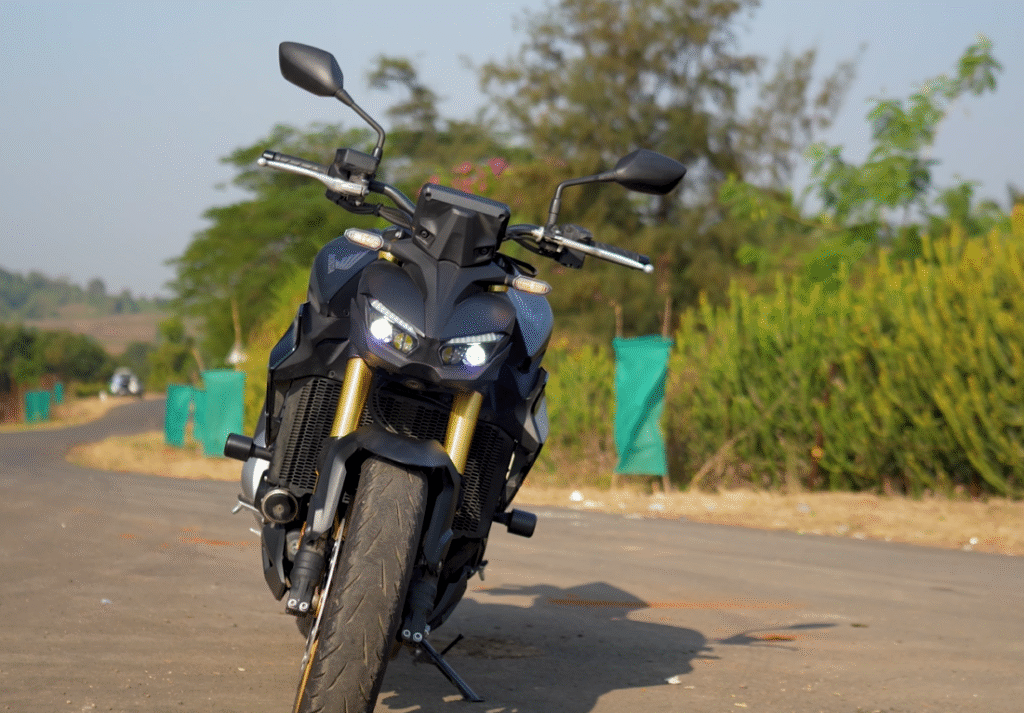
When parked, the CB1000 Hornet SP draws attention through muscular proportions rather than garish graphics. Internet commentators initially drew parallels between the headlight design and Ducati’s Streetfighter, noting resemblance at the front. However, the rest of the design stands independently with clean, sharp lines and a mass-forward aesthetic.
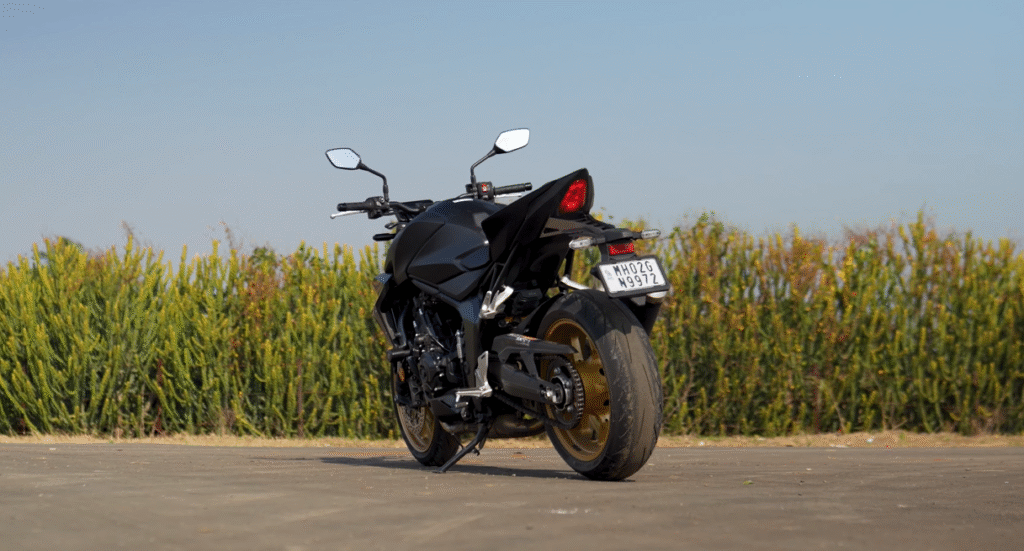
The overall design projects stealth and sophistication. Available exclusively in matte black for the Indian market (only the SP variant is sold here), the Hornet looks purposeful without screaming for attention. This muted approach suits riders seeking quality without ostentation.
The sharp, pointy taillight design is shared across multiple Honda models including the NX500, CBR500R, CBR650R, and CB650R. While some might criticize this parts-sharing, it contributes to the aggressive pricing strategy.
Service Costs and Ownership
Honda Reliability Advantage
One of the Hornet’s most compelling ownership arguments involves Honda’s legendary reliability and reasonable service costs. The owner who loaned the test bike shared his first service bill: just ₹6,475 including ₹2,300 for labor—remarkably affordable for a litre-class motorcycle.
Compared to Italian super nakeds requiring specialized maintenance and expensive parts, Honda’s service costs represent a fraction of comparable big bikes. The bulletproof reliability Honda is known for means the Hornet should provide years of trouble-free operation with lower running costs than European rivals.
Value Proposition: Redefining the Segment
Undercutting the Competition
At ₹13.3 lakh (approximately $15,900 USD / €14,800 EUR), the Honda CB1000 Hornet SP represents exceptional value. This pricing positions it below several middleweight nakeds while delivering genuine litre-class performance with premium components.
For context, similar money buys:
- Ducati Scrambler Full Throttle
- Triumph Street Triple RS (₹10.86-12.07 lakh)
- Kawasaki Z1100 (₹12.79 lakh)
None match the Hornet’s combination of power, weight, and premium cycle parts. The Kawasaki Z1100 serves as the only direct rival, but detailed comparison reveals the Honda’s advantages: 21 PS more power, 9 kg less weight, Brembo brakes, and Öhlins suspension unavailable on the Kawasaki.
Even after potential GST increases, the Hornet SP remains a value-for-money proposition in India’s big bike segment.
Real-World Usability: Daily-Rideable Performance
The Super Naked You Can Actually Use
Unlike some exotic rivals prioritizing track performance over practicality, the Hornet functions as a realistic daily rider. The approachable seat height, manageable weight once rolling, excellent heat management, and comfortable riding position enable everyday use.
The 17-liter fuel tank provides decent range, while the claimed 17 km/l fuel economy seems achievable during moderate riding. The bike even handles touring duty, with ergonomics suitable for long-distance travel.
This usability extends to urban environments where the Hornet navigates traffic without excessive complaint. The friendly low-RPM character and manageable clutch effort prevent the fatigue often associated with high-performance motorcycles in stop-and-go conditions.
The Verdict: Value That Demands Attention
Changing the Game
Honda created an absolutely awesome machine in the CB1000 Hornet SP—a sentiment strengthened when considering its stellar pricing. This represents a well-specced, well-built rocket ship that doesn’t require selling appendages to afford.
There are genuinely no major standout flaws. Minor nitpicks about tank grip gaps, foot placement, and ground clearance affect virtually every bike in this category. The absence of an IMU matters only to expert-level riders exploiting track limits.
The Hornet delivers:
- 157 horsepower from a Fireblade-derived engine
- Brembo Stylema brakes
- Öhlins TTX 36 rear shock
- Showa premium forks
- Comprehensive electronics with five riding modes
- Bidirectional quickshifter
- Glorious stock exhaust
- Honda reliability and affordable service costs
All for ₹13.3 lakh—pricing that rewrites expectations for litre-class motorcycles.
Competition’s Wake-Up Call
The reviewer hopes other manufacturers take notice of the Hornet’s impressive value proposition, potentially sparking a beneficial price war for motorcyclists. If Honda’s aggressive pricing forces rivals to sharpen their pencils, the entire big bike segment benefits.
For buyers seeking a 1000cc super naked that balances real-world usability with exhilarating performance, premium components, and Honda reliability—all without breaking the bank—the CB1000 Hornet SP stands alone. It proves that big bikes need not remain exclusive toys for the wealthy, democratizing litre-class performance in unprecedented fashion.
Current Pricing:
- India: ₹13.29-13.3 lakh (ex-showroom)
- USA: $10,999 MSRP
- Europe/UK: £9,099 / €10,800 approximately
- On-road price (major Indian cities): ₹15.27-16.33 lakh
The Honda CB1000 Hornet SP represents the start of a new era: flagship performance at middleweight prices.