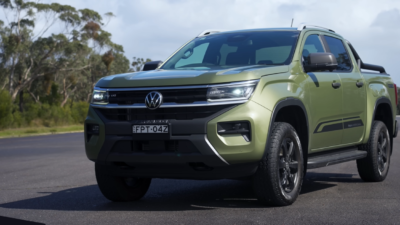
Price: $79,990 drive-away (PanAmericana V6 tested) | Launch: On sale now | Available: VW dealers Australia-wide
TL;DR Should You Buy the VW Amarok V6?
YES, if you want:
- Same vehicle as the Ford Ranger, but with less traffic on the road
- 184kW/600Nm diesel V6 power (perfect for towing 3.5 tonnes)
- Trailer Backup Assist (makes reversing caravans idiot-proof)
- Premium interior that feels more upscale than the Ranger
- Full-size digital display (Ranger needs top-spec for this)
- Harman Kardon sound system as standard
MAYBE NOT, if you need:
- Better tires (standard all-terrains have poor stopping distance)
- Lower price (Ranger often has better deals)
- Strong resale value (Ranger holds value better)
- Aftermarket support (Ranger has more accessories)
Bottom Line: The VW Amarok shares its platform, engine, and most components with the Ford Ranger. But sales charts show it’s practically forgotten. That’s a shame because it’s arguably the smarter-looking of the two, has a more premium interior, and VW dealers are doing decent deals. If you’re car shopping, add this to your shortlist.
Introduction: The Ranger Twin Nobody Talks About
The Volkswagen Amarok. We haven’t driven it for a while, but I thought we’d have a spin today, not only to do a review, but also to show you a trailer assist feature that makes reversing caravans and trailers incredibly easy.
The Context: My folks just got back from a 13,000km road trip around Australia with their caravan. This trailer assists technology? It comes in handy when you’re trying to back your caravan into a very tight space at the caravan park with everyone watching.
I’ll show you how that works, plus we’re doing a bit of light off-roading to test the Amarok’s capabilities.
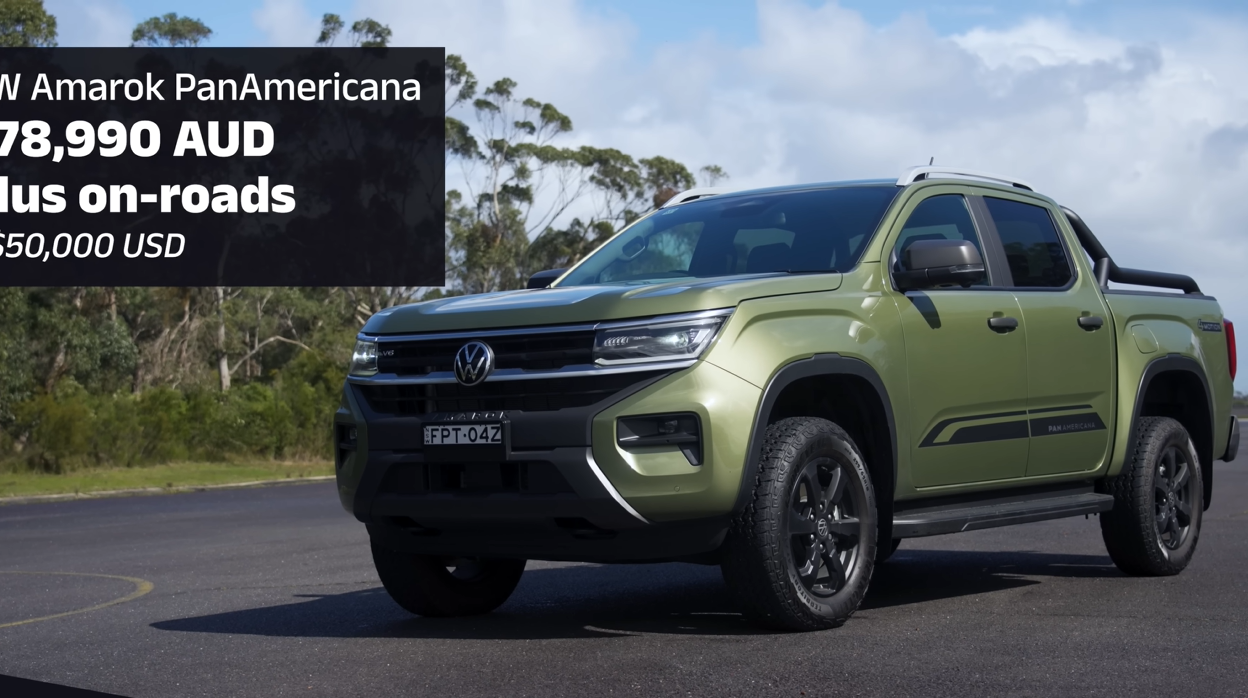
What’s Changed: Pricing has shuffled. The top-spec petrol version pricing has changed. This PanAmericana (one down from top-spec) with the V6 diesel is priced at just under $80,000 drive-away. Big chunk of coin.
Design Still Looks Really Good
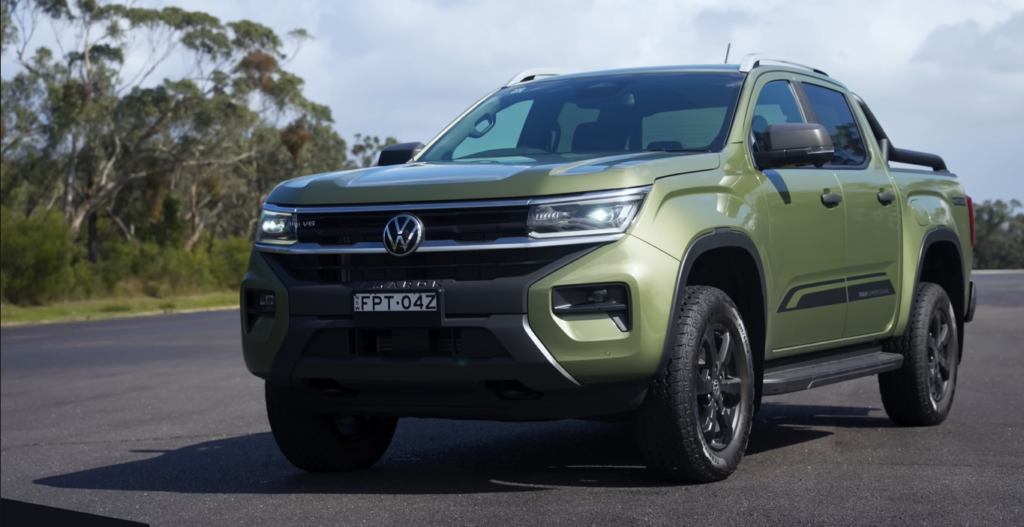
I still think the Amarok looks really good. This and the Ranger came out a while ago, but when you see both on the road, they carry a really decent presence. The Amarok is probably the smarter-looking of the two.
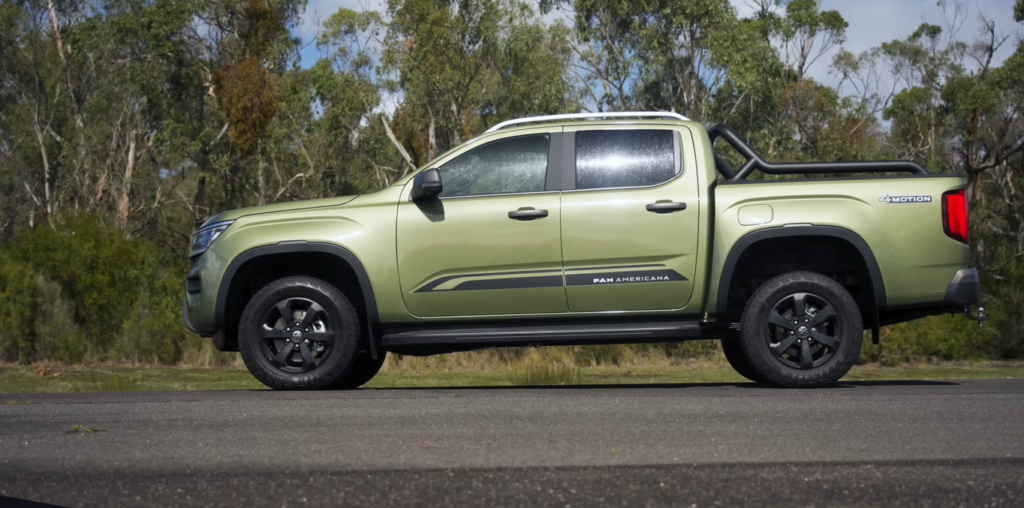
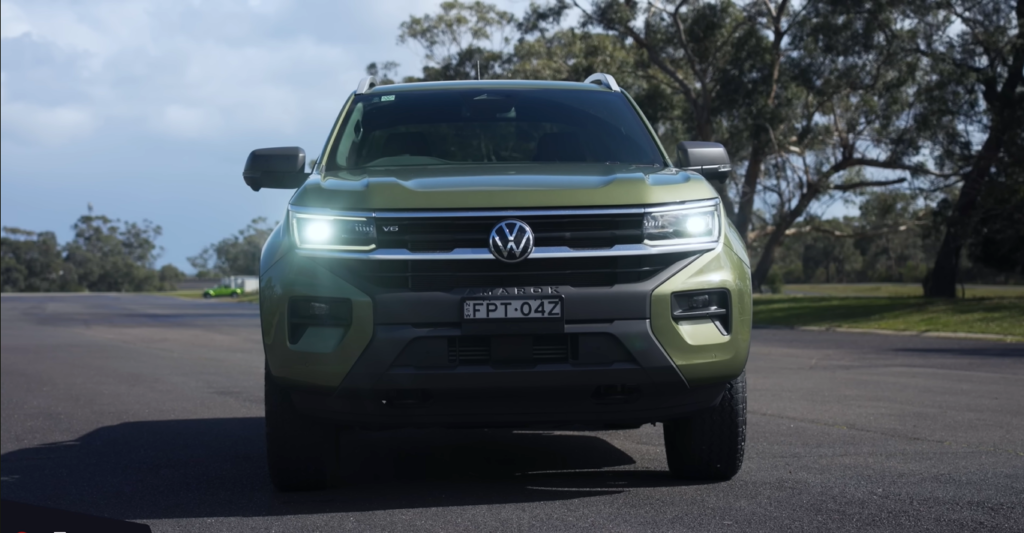
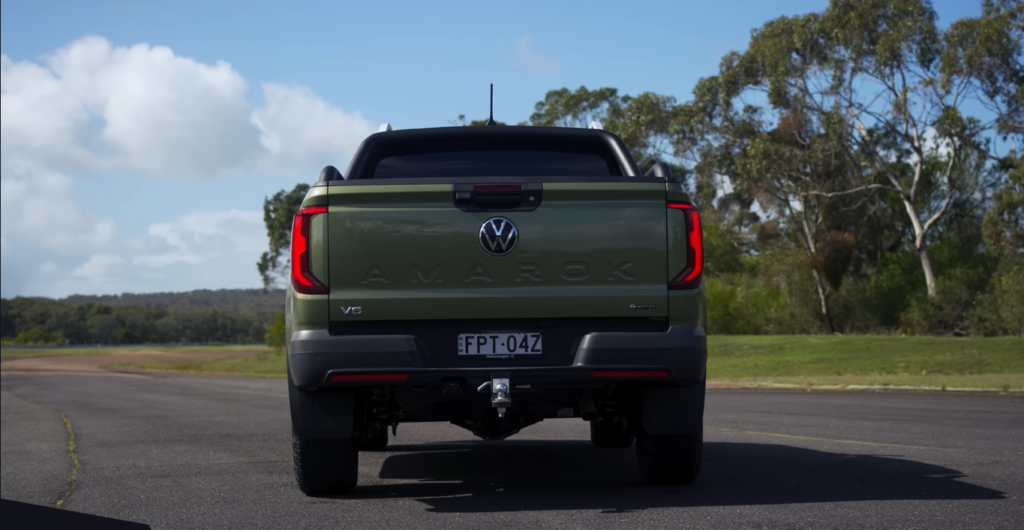
The New Green Metallic: I love this new color VW launched. It just makes it stand out nicely and really turns heads. Sean’s been driving this over the weekend and said he’s had a lot of very interested tradies come up to him, some asking about the color specifically.
Front End:
- Big Volkswagen logo
- V6 badge off to the side
- 360-degree camera with zone lighting system
- Fog lights at the bottom
- Rugged-looking grille
Side Profile:
- 18-inch wheels with matte finish
- All-terrain tires (more on those later, not great)
- Lifted stance looks really good from a distance
- Wheel arch cladding
- Big wing mirrors with a camera on the side
- Plastic side steps (I’d change these; they get bashed up off-road)
- PanAmericana stencil package down the side
- Privacy glass, roof rails
- Sports bar with 4Motion (VW’s terminology for full-time four-wheel drive in 4A mode)
Rear End:
- Amarok badging with V6 and 4Motion
- Zone lighting system under the tailgate
- Camera for a 360-degree view
- The torsion bar makes the tailgate easier to open/close
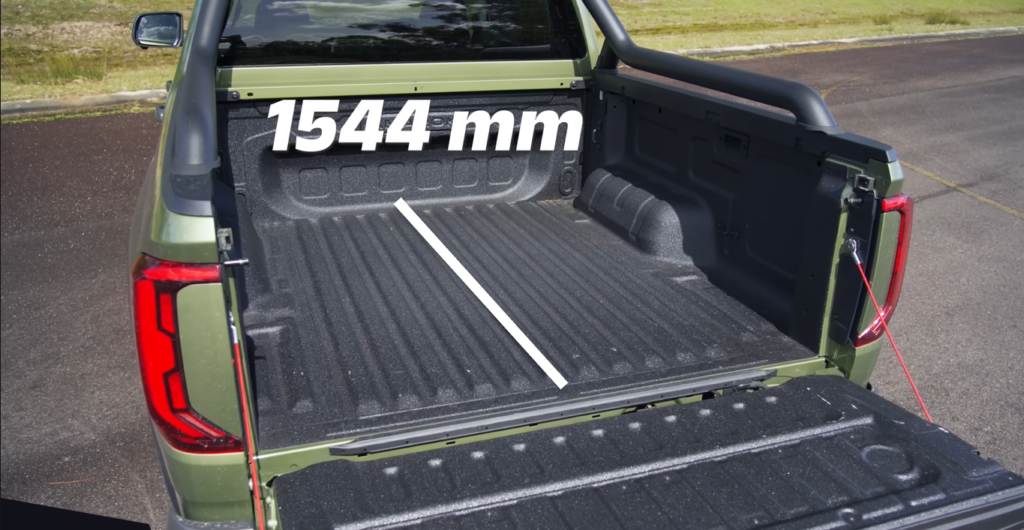
- 240V outlet in the tray (supports up to 400W)
- Tray lights, spray-in bed liner (Ranger stopped doing this)
Tray Dimensions:
- Load length: 1,500mm+
- Load width: 1,200mm+
- Load depth: 530mm
- Payload: Just under 1 tonne (V6 Amarok)
- Towing capacity: 3,500kg (3.5 tonnes)
Interior More Premium Than Ranger
This is where the Amarok separates itself from the Ranger.
Key: Proximity-sensing key with unlock/lock buttons and VW logo on the back. Push-button start inside.
What’s Changed: Minor trim changes, and this cluster has changed to accommodate the trailer backup assist feature. Outside of that, it’s pretty much the same as before.
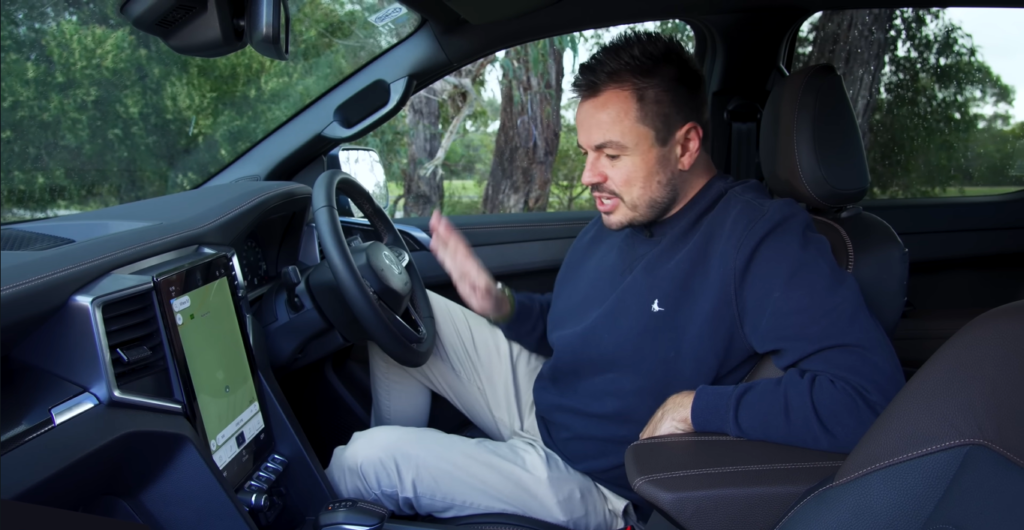
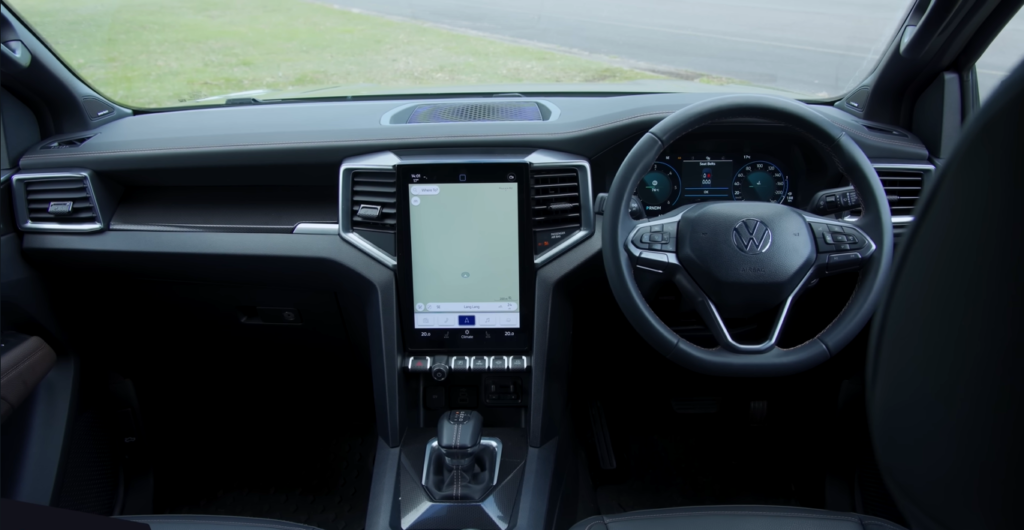
What You Get:
- Wireless phone charging down below
- USB ports (one up top for dashcam)
- Trailer brake controller (I don’t love the placement it gets in the way)
- No cup holders in front of air vents (missed opportunity with this high center console)
Interior Colors: Different color trims through the doors, center console, and seats. Gives the interior character and makes it feel more premium than the Ranger.
Tech:
- Infotainment system with Apple CarPlay and Android Auto (both wireless)
- Built-in satellite navigation
- Dual-zone climate control
- Electrically adjusted seats (driver and front passenger forwards/backwards, backrest angle, lift front/back of seat)
- Full-size digital display ahead of driver (big advantage over Ranger, you need the top-spec Ranger for this)
- Harman Kardon-branded sound system
Verdict: Nice place to be seated up front. Feels more upscale than the Ranger.
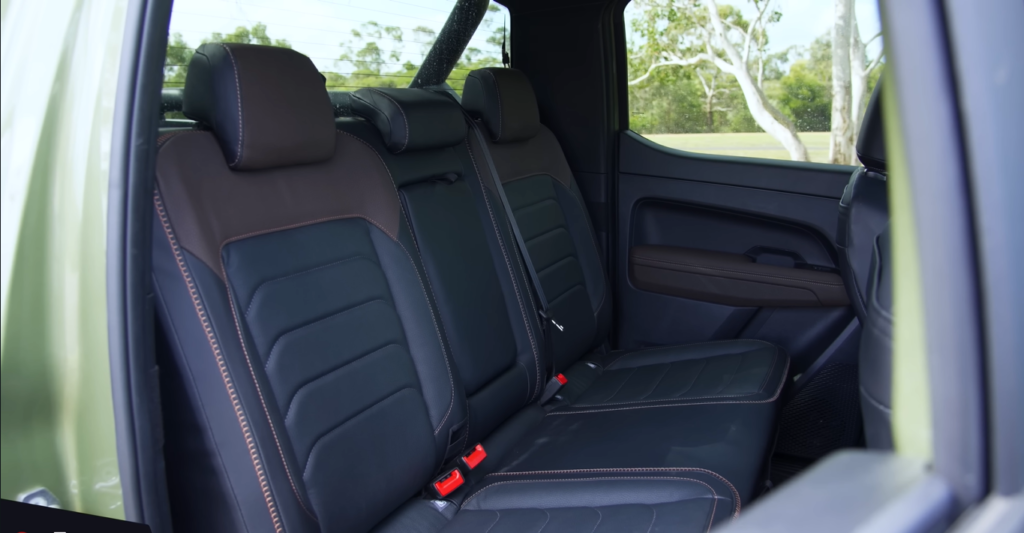
Second Row Space is OK, Not Amazing
Adult Space:
- Knee room: OK
- Toe room: OK
- Headroom: OK
Not quite as expansive as some new Chinese utes like the GWM Cannon or LDV Terron, those are quite big because they’re genuinely larger dual-cab utes.
Storage:
- Storage beneath the seats
- Storage behind the seats
- Two top tether points
- Center armrest with a pair of cup holders
- No USB connectivity in the back (strange omission)
- 12V outlet
- 230V outlet (similar to the one in the tray)
Verdict: Nice cabin, great for long-distance drives. But newer Chinese utes have more space.
Engine & Performance V6 Diesel Done Right
This shares a 3.0L diesel V6 with the Ford Ranger:
- 184kW (247hp) of power
- 600Nm (443 lb-ft) of torque
- Paired with a 10-speed automatic
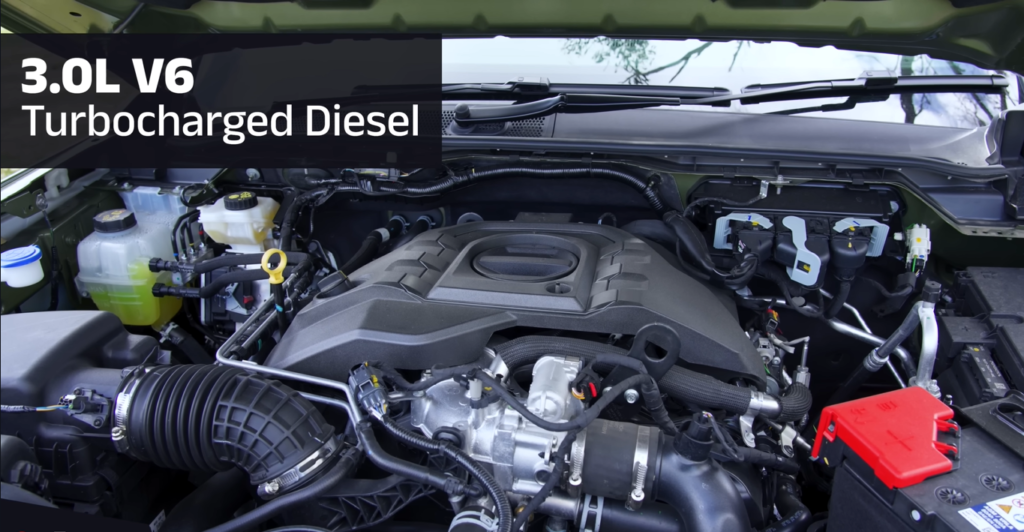
Why V6 Over Four-Cylinder: It’s just a good-sized engine for this type of vehicle, especially if you’re towing. You notice you have a bit more headroom over the four-cylinder. You’re more confident when applying the throttle.
It gives you that understanding behind the wheel that everything is just going to work. Not that the four-cylinder is inadequate, you just don’t want to be left wishing you got the V6 when you actually need it.
Performance Feel: Kick it, and it pushes you nicely in the back of the seat. Nothing outrageous, but it definitely feels punchier than the four-cylinder.
4Motion Advantage: Unlike the four-cylinder, you can run this in four-wheel drive auto on sealed surfaces. The advantage? Added traction. When you have plenty of traction, you can drive back to two-wheel drive high range to save fuel.
Fuel Economy:
- Claimed: 8.4L/100km combined
- Real-world: Just over 10L/100km
That’s what we’ve found universally with the V6 diesel. Unless you’re strictly doing highway driving with no towing or hard acceleration, it’ll be closer to 10L/100km mark.
No AdBlue Required: Thankfully, you don’t need to worry about AdBlue with this tune of the engine. (If you get this engine in an Everest, it does come with AdBlue.)
Acceleration & Braking Tested
0-100 km/h: 8.27 seconds 80-120 km/h: 6.07 seconds (overtaking test)
Pretty reasonable times. This is where you notice the difference between a V6 and a four-cylinder.
For Context: The Kia Tasman four-cylinder did 0-100 in ~9 seconds despite having much less torque. Pretty impressive for a four-banger.
Braking (100-0 km/h):
- Distance: 45 meters
- Time: 3.19 seconds
Analysis: Between 35-40m is where you want to be. Dual-cab utes you allow a little extra, but 45m is a fair bit. You feel in that initial bite when you hit the brakes, it feels like nothing is happening. It takes a while to hook up and slow down.
The Problem? The tires. They just really aren’t very good.
Reverse Speed: 38 km/h
Ride & Handling Softer Than Ranger
There’s a different feel between Amarok and Ranger. Those two teams worked together but separately when it came to things like ride.
To Me: The Amarok feels like it rides a bit nicer than the Ranger. It’s more softly sprung.
Around Town: It’s actually quite nice, especially on these all-terrains. They’re just a bit more forgiving and give you that flexibility when it comes to harsh bumps, potholes, and all that stuff.
The Downside: It does come at the cost of body control. At 130 km/h (the maximum Australian speed limit) on undulations, we were well and truly almost leaving the ground.
Where You’ll Notice It:
- More weight in the vehicle = more amplified
- Highway undulations at 100 km/h feel unsettling
- With no load or trailer, it’s noticeable
- Throw a trailer on, it really starts feeling amplified
- Overtaking feels pretty sketchy
Bumpy Road Test (90 km/h): Fairly comfortable. It’s moving around a bit, but it’s not jarring or harsh.
Condensed Sine Wave: Nice. Feels composed over rougher terrain. Not floating, fairly composed.
Fast Driving:
- These tires are not very good (one thing I don’t like about the vehicle, but easily fixed)
- Steering feels great feels really predictable
- Nice and composed especially on faster stuff
- You’d never pick you’re driving a dual-cab ute
The Platform: You can see how they’ve extracted so much from this platform. Outside of VW with the Amarok, you’ve got:
- Ford Everest
- Ford Ranger Raptor
- Ford Super Duty
It’s a platform that’s achieved a fair bit.
Road Noise: It’s fine. Quite windy during testing, so getting a fair bit of wind noise. On coarse chip roads, you notice tire noise coming into the cabin. But these tires aren’t overly noisy compared to some aggressive all-terrains.
Off-Road Performance Capable and Composed
Hardware:
- Two-wheel drive high range
- Four-wheel drive auto (for sealed surfaces)
- Four high and four low (for unsealed surfaces)
- Mechanical rear diff lock (switchable)
- Hill descent control
- Ground clearance: 220mm+
- Wading depth: 800mm
- Approach angle: 30°
- Departure angle: 25°
Traction Control Test (Two-Wheel Drive High): Kicked the rear right wheel into the air on the offset mogul. Rolled onto the throttle, heard traction control biting, sending torque to the wheel with traction. Bob’s your uncle. Gets over there without dramas.
Four-Wheel Drive High Test: Splitting torque between front and rear axles. Unloaded the rear right and front left. Rolled onto throttle, traction control biting, and over it goes. Very good.
Hill Climb (Four-Low + Rear Diff Lock): The hill was very mushy and muddy from recent rain. Popped it into low range, locked the rear diff. Drive modes available: Normal, Eco, Tow Haul, Slippery, Mud Ruts.
Result: Rear diff lock helped us climb up. It was struggling a little initially once we gained momentum, those all-terrain tires helped dig in and get up there.
Hill Descent Control: Activated the button, engaged the camera to see over the front. Came to a stop, rolled out of the brake. With cruise control, we could adjust vehicle descent speed. Pretty controlled and straightforward.
Hill Hold Test: Came to a stop mid-climb. Let go of the brake. Nice. It’s holding. Rolling onto throttle, and we’re moving. Very good.
Rocks: Clambered over rocks, riding the brake with the throttle. Felt pretty comfortable. Good clearance. One touch down, but nothing major.
This is where those plastic side steps would get absolutely murdered. If you’re doing this sort of stuff, I’d be putting a set of rock sliders on.
Water Crossing (Wading Depth 800mm): Our water crossing had about 450-500mm. Water lapping around the sills. Little climb out. Very straightforward.
Trailer Backup Assist The Feature That Makes Reversing Easy
A lot of people are self-conscious when it comes to reversing big trailers. It takes years of experience to know how to properly reverse a trailer.
If You’re Going Around Australia with a New Caravan: A) Definitely do a towing course to understand what you need to do B) Have a feature like this to help you back into tight spots
How It Works:
- Calibration: Go through the process of calibrating everything so the vehicle knows where the trailer’s located
- Marker: Once done, you see a little marker that dictates where the trailer is in reference to the vehicle
- Drive Selector Knob: Use it to position the trailer just turn the stick into the direction you want the trailer to go
- Brake Pedal: Only control you need car does the rest at slow speed
- Let Go: Once comfortable with position, let go of joystick and it starts reversing, keeping the trailer as straight as possible
My Test: I tried to reverse the trailer into a marked box on the road (pretending it’s a caravan park bay). Used a combination of mirrors and looking over my shoulder. You want a spotter there as well just to be on the safe side.
Result: We backed into that spot fairly straight and comfortably without making absolute deals of ourselves at the caravan park.
Verdict: Pretty good system. Easy to use and idiot-proof, which is what you want.
The Tire Problem You Need to Know
The Issue: These standard all-terrain tires aren’t amazing. They’re the same as on the Ranger, and they’re probably one of the things I’d be changing if you’re touring or doing longer-distance driving.
Why They’re Bad:
- Poor stopping distance (45m vs 35-40m ideal)
- Don’t do anything exceptionally well
- The tires fitted standard to the Tasman did a much better job stopping not only in the wet, but in the dry as well
Off-Road Performance: They’re OK for light off-roading but nothing special.
The Good News: They aren’t overly noisy. You get the benefit of a fairly aggressive tire without the compromise of huge road noise.
My Recommendation: Change them if you’re doing serious touring or off-roading. Upgrade to better all-terrains or mud-terrains depending on your needs.
VW Amarok Full Specs
SpecDetailsEngine3.0L V6 turbo dieselPower184kW (247hp) @ 3,250rpmTorque600Nm (443 lb-ft) @ 1,750-2,250rpmTransmission10-speed automaticDrivetrain4Motion AWD (selectable 2WD/4WD-Auto/4H/4L)0-100 km/h8.27 seconds (tested)80-120 km/h6.07 seconds (tested)100-0 km/h45m / 3.19s (tested)Fuel Consumption10L/100km (real-world)Fuel Tank80LTowing Capacity3,500kg (braked)PayloadUp to 974kgGround Clearance220mm+Wading Depth800mmApproach Angle30°Departure Angle25°Wheelbase3,270mmLength5,350mmWidth1,910mmHeight1,886mmKerb Weight2,406kgSafety Rating5-star ANCAP
Pricing How Much Does It Cost?
Model Tested: VW Amarok PanAmericana V6 TDI600 Price: $79,990 drive-away (just under $80,000)
Full 2025 Amarok Range:
- Core TDI405 4Motion: $55,490+
- Life TDI500: $63,900+
- 10 Deserts Edition: $69,990+
- Style TDI500/600: $66,990-$73,740+
- PanAmericana TDI600: $79,990+ (tested)
- Aventura TDI600: $82,990+ (top-spec)
- TSI452 (Petrol V6): $77,000-$80,000+ (various trims)
For Context:
- Ford Ranger Wildtrak V6: Similar price
- Toyota HiLux GR Sport: $70K+
- Mazda BT-50 Thunder: $65K+
Warranty: 5 years / unlimited km Service Interval: 12 months or 15,000km
VW Amarok vs Ford Ranger Which Should You Buy?
They share the platform, engine, and most components. But there are differences.
FeatureVW AmarokFord RangerInterior QualityMore premium feelGood, but less upscaleDigital DisplayFull-size (PanAmericana+)Top-spec onlySound SystemHarman KardonBang & Olufsen (top-spec)Ride QualitySofter, more comfortableSlightly firmer, better controlLooksSmarter, more EuropeanRugged, AmericanSales VolumeLow (forgotten)High (popular)Resale ValueLowerHigherAftermarketLess supportMore accessoriesDealsVW doing decent offersOften better dealsBed LinerSpray-in standardStopped doing this
Buy Amarok If:
- You want something different (less traffic on the road)
- You prefer more premium interior
- You like the European styling
- VW dealers have better deals
Buy Ranger If:
- You want best resale value
- You need more aftermarket support
- You prefer firmer ride for towing
- You want to follow the crowd (not a bad thing it’s popular for a reason)
Common Mistakes to Avoid
Mistake #1: Keeping the Standard Tires They’re not good. Change them for better all-terrains if you’re touring or doing serious off-roading.
Mistake #2: Not Test Driving Where You’ll Actually Drive Drive it where you’ll normally drive. Don’t just drive around the dealership. Highway? Take it to the highway. Country roads? Take it to country roads.
Mistake #3: Ignoring the Plastic Side Steps If you’re going off-road, you’ll bash these up quickly. Budget for rock sliders.
Mistake #4: Comparing Only to Ranger Also compare to HiLux, Triton, D-Max, BT-50, and new Chinese utes (GWM Cannon, LDV Terron, Kia Tasman). The market is bigger than Ranger vs Amarok.
Final Verdict Is the Amarok Worth Buying?
If you look at the sales charts, the Amarok is kind of forgotten sometimes. And I find it really strange given they sell so many Rangers and this is virtually the same vehicle.
Why Amarok Sales Are Low:
- Ranger has stronger brand presence in Australia
- Better resale value
- More aftermarket support
- Dealers often have better stock
Why You Should Consider It:
- Not only are VW doing decent deals
- You’re getting the same thing as a Ranger
- But there’s just not as many around (less traffic)
- More premium interior
- Trailer assist is standard on this trim
- Full-size digital display (don’t need top-spec)
The Refresh: This car must be due for a refresh soon. They haven’t really changed a great deal. Same goes for Ranger. They just do incremental updates, but there must be something on the horizon.
My Recommendation: It’s worth test-driving one of these, seeing what you think, and keeping your eye on the news. Add it to your shortlist alongside Ranger, HiLux, and the others.
My Rating: 8/10
The Amarok is a genuinely good dual-cab ute that deserves more attention. It’s not perfect (those tires, the soft ride for towing), but it’s a solid choice that’s often overlooked.
Top 5 Reasons to AVOID the VW Amarok V6
The Amarok shares its platform and V6 diesel engine with the Ford Ranger, which has proven reliable.
The VW Amarok V6 ranges from $73,740 (Style TDI600) to $82,990 (Aventura TDI600).
Got questions? Drop them in the comments. Want help deciding between Amarok and Ranger? Let me know your specific needs.