TL;DR – Airsoft FPS Calculator Essentials
What is FPS in Airsoft? Feet Per Second—the speed your BB travels when it leaves the barrel. Higher FPS = more range and impact force, but strict field limits apply for safety.
Quick Reference: Safe FPS Limits by Gun Type
| Gun Type | FPS Limit (0.20g BB) | Max Joules | Minimum Engagement Distance |
|---|---|---|---|
| Pistols | 350 FPS | 1.14J | 0-10 feet |
| AEGs (Rifles) | 400 FPS | 1.49J | 50-100 feet |
| DMRs | 450 FPS | 1.88J | 100 feet |
| Bolt Action Sniper | 500-550 FPS | 2.32-2.81J | 100-150 feet |
Note: Limits vary by field—ALWAYS check your local field rules before playing
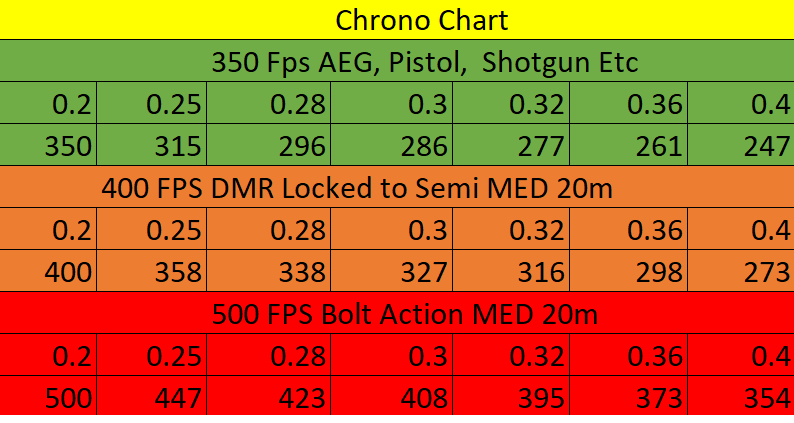
Key Conversions You Need:
- 350 FPS (0.20g) = 328 FPS (0.25g) = 309 FPS (0.28g) = 1.14 Joules
- 400 FPS (0.20g) = 376 FPS (0.25g) = 354 FPS (0.28g) = 1.49 Joules
- 450 FPS (0.20g) = 423 FPS (0.25g) = 398 FPS (0.28g) = 1.88 Joules
Why This Matters:
✅ Safety: Too high FPS = injury risk (welts, bruising, eye damage)
✅ Field Compliance: Get chronoed over limit = banned from play
✅ Performance: Optimize your setup for your role (CQB, outdoor, sniper)
✅ BB Weight Selection: Heavier BBs = lower FPS but better accuracy/range
What You’ll Learn:
- How to calculate FPS, joules, and energy
- Why BB weight affects FPS measurements
- Field limit standards worldwide
- How to measure your gun’s FPS accurately
- Legal considerations and safety guidelines
- Upgrade paths to hit specific FPS targets
Bottom Line: Understanding FPS isn’t just about power—it’s about safety, field compliance, and optimizing your airsoft gun’s performance for your playstyle. Use this guide to calculate, measure, and adjust your setup legally and safely.
What is FPS in Airsoft?
FPS Definition
FPS = Feet Per Second
This measures how fast your airsoft BB travels when it exits the barrel.
Example: If your gun shoots at 400 FPS, the BB travels 400 feet in one second (approximately 273 mph or 439 km/h).
Why FPS Matters
1. Safety
Higher velocity = greater impact force = higher injury risk. This is why fields enforce strict FPS limits.
Injury Risks by FPS (approximate):
- Below 300 FPS: Minor sting, minimal bruising
- 300-400 FPS: Noticeable impact, potential welts
- 400-500 FPS: Painful impact, welts common, eye protection CRITICAL
- Above 500 FPS: Serious injury risk, skin penetration possible, eye/teeth damage likely without protection
2. Field Compliance
Every airsoft field has maximum FPS limits based on gun type and engagement distances. Exceeding these limits results in:
- Denied entry to games
- Being asked to downgrade your gun
- Potential ban from the field
3. Performance Optimization
FPS affects:
- Range: Higher FPS generally = longer effective range
- Accuracy: BUT too high FPS can reduce accuracy
- BB Weight Selection: Your FPS determines optimal BB weight
4. Legal Requirements
Some countries/regions have legal FPS limits:
- UK: 350 FPS (automatic), 500 FPS (bolt action) legal maximum
- Germany: ~330 FPS (0.5J) without restrictions, higher requires licensing
- Australia: Varies by state, often heavily regulated
- USA: Varies by state/municipality, no federal limit
Understanding Joules: The True Energy Measurement
Why Joules Matter More Than FPS
The Problem with FPS: It changes based on BB weight.
Example:
- 400 FPS with 0.20g BB
- 376 FPS with 0.25g BB
- 354 FPS with 0.28g BB
All three have the SAME energy (1.49 joules), but different FPS readings.
What Are Joules?
Joule (J) = Unit of energy
In airsoft, it measures the kinetic energy of your BB:
Joules = (Mass × Velocity²) ÷ 2
Where:
- Mass = BB weight in kilograms
- Velocity = BB speed in meters per second
Why Fields Use Joules Limits
Modern Approach: Many fields now chrono in joules rather than FPS because:
- Joules remain constant regardless of BB weight
- Prevents players from gaming the system (using light BBs for chrono, heavy BBs in game)
- More accurate safety measurement
Example Field Rule:
- “1.49J limit for rifles”
- This equals 400 FPS with 0.20g, 376 FPS with 0.25g, 354 FPS with 0.28g
Airsoft FPS Calculator: How to Convert
FPS to Joules Formula
Joules = (0.5 × BB Mass in grams × (FPS × 0.3048)²) ÷ 1000
Simplified: Use the calculator below or reference tables.
Quick Reference Conversion Table
0.20g BBs (Most Common Chrono Weight)
| FPS | Joules | Energy Level |
|---|---|---|
| 300 | 0.84J | Low (CQB pistol) |
| 328 | 1.00J | Standard CQB |
| 350 | 1.14J | Maximum CQB rifle |
| 400 | 1.49J | Standard outdoor rifle |
| 450 | 1.88J | DMR level |
| 500 | 2.32J | Sniper minimum |
| 550 | 2.81J | High-power sniper |
0.25g BBs (Common Outdoor Weight)
| FPS | Joules | Equivalent 0.20g FPS |
|---|---|---|
| 280 | 0.84J | 300 FPS |
| 307 | 1.00J | 328 FPS |
| 328 | 1.14J | 350 FPS |
| 376 | 1.49J | 400 FPS |
| 423 | 1.88J | 450 FPS |
| 469 | 2.32J | 500 FPS |
| 516 | 2.81J | 550 FPS |
0.28g BBs (Precision Shooting Weight)
| FPS | Joules | Equivalent 0.20g FPS |
|---|---|---|
| 265 | 0.84J | 300 FPS |
| 290 | 1.00J | 328 FPS |
| 309 | 1.14J | 350 FPS |
| 354 | 1.49J | 400 FPS |
| 398 | 1.88J | 450 FPS |
| 442 | 2.32J | 500 FPS |
| 486 | 2.81J | 550 FPS |
0.30g BBs (Heavy Outdoor Weight)
| FPS | Joules | Equivalent 0.20g FPS |
|---|---|---|
| 258 | 0.84J | 300 FPS |
| 282 | 1.00J | 328 FPS |
| 301 | 1.14J | 350 FPS |
| 344 | 1.49J | 400 FPS |
| 387 | 1.88J | 450 FPS |
| 430 | 2.32J | 500 FPS |
| 473 | 2.81J | 550 FPS |
Standard Airsoft FPS Limits by Gun Type
Universal Field Standards (Typical)
These are GENERAL guidelines—your local field may differ.
1. Pistols & SMGs
FPS Limit: 300-350 FPS (0.20g) | 0.84-1.14J
Engagement Distance: 0 feet (full contact range)
Typical Use: CQB, secondary weapon
Why Lower Limits:
- Close-quarters combat weapons
- No minimum engagement distance
- Safety priority in tight spaces
2. AEGs (Assault Rifles, Carbines)
FPS Limit: 350-400 FPS (0.20g) | 1.14-1.49J
Engagement Distance:
- Below 350 FPS: 0 feet
- 350-400 FPS: 50-100 feet minimum
Typical Use: Primary rifle for outdoor and indoor
Why This Range:
- Balanced between range and safety
- Effective at most engagement distances
- Safe with minimum engagement distance rules
3. DMRs (Designated Marksman Rifles)
FPS Limit: 400-450 FPS (0.20g) | 1.49-1.88J
Engagement Distance: 100 feet minimum
Special Rules:
- Semi-auto ONLY (no full auto)
- Must maintain minimum engagement distance
- Often requires special field approval
Typical Use: Mid-to-long range precision shooting
4. Bolt Action Sniper Rifles
FPS Limit: 450-550 FPS (0.20g) | 1.88-2.81J
Engagement Distance: 100-150 feet minimum
Special Rules:
- Manual action only (bolt action, pump action)
- Strict minimum engagement distance enforcement
- May require special field check-in
Typical Use: Long-range precision, overwatch positions
Regional FPS Limit Variations
United States
General: No federal regulations, varies by field
Typical Field Limits:
- CQB: 350 FPS
- Outdoor: 400 FPS (rifles), 500-550 FPS (snipers)
Legal Considerations: Some cities/states ban airsoft or require orange tips
United Kingdom
Legal Maximum:
- Automatic: 350 FPS (1.3J)
- Single-shot: 500 FPS (2.5J)
Requirements:
- UKARA registration for realistic imitation firearms (RIFs)
- Must be over 18 to purchase
Field Limits: Often lower than legal maximums (330-350 FPS for automatics)
European Union
Varies by Country:
Germany:
- Under 0.5J: No license required
- Over 0.5J: Requires F-stamp and license
- Typical limit: ~330 FPS with 0.20g
France:
- Maximum 2J for general use
- Fields typically limit to 350-400 FPS
Netherlands:
- Maximum 360 FPS for full auto
- Higher for semi-auto with engagement distances
Canada
Legal Requirements:
- Minimum 366 FPS to be legal (classified as uncontrolled firearm)
- Maximum 500 FPS (becomes actual firearm)
Field Limits:
- Usually 400-450 FPS for AEGs
- 500 FPS for bolt actions
Australia
Highly Regulated:
- Varies by state
- Some states ban airsoft entirely
- Where legal, strict licensing and field membership required
- Typical limits: 350 FPS
Asia
Japan:
- 0.98J maximum (approximately 320 FPS with 0.20g)
- Very strict regulations
Hong Kong:
- 2J maximum
- Registration required
How to Measure Your Gun’s FPS
Equipment Needed
1. Chronograph
Types:
- Optical Chronographs: Use light sensors ($40-100)
- Doppler Chronographs: Use radar technology ($150-300)
- Acoustic Chronographs: Use sound sensors ($30-60)
Recommended Models:
- Caldwell Ballistic Precision Chronograph (~$100)
- Competition Electronics ProChrono (~$90)
- XCORTECH X3200 (~$80)
2. Testing BBs
Critical: Use the SAME BB weight your field uses for chrono
Standard: 0.20g BBs are universal chrono standard
Your Game BBs: If you use different weight in-game, calculate joule equivalent
3. Testing Environment
Requirements:
- Indoor or windless outdoor space
- Consistent temperature
- No obstructions between gun and chrono
How to Chrono Your Gun (Step-by-Step)
Step 1: Prepare Your Gun
- Fully charge battery (for AEGs)
- Fill gas magazine completely (for GBBs)
- Load with chrono BBs (usually 0.20g)
Step 2: Set Up Chronograph
- Place on stable surface
- Ensure clear line of fire
- Position 6-10 feet from muzzle (check chrono manual)
Step 3: Fire Test Shots
- Fire 3-5 shots through chrono
- Discard first 1-2 shots (often inconsistent)
- Record all subsequent shots
Step 4: Calculate Average
- Add all FPS readings together
- Divide by number of shots
- This is your average FPS
Example:
- Shot 1: 398 FPS (discard—warm-up shot)
- Shot 2: 405 FPS
- Shot 3: 402 FPS
- Shot 4: 407 FPS
- Average: (405+402+407) ÷ 3 = 404.67 FPS
Step 5: Apply Safety Margin
- Fields typically enforce limits strictly
- Aim for 5-10 FPS BELOW the limit
- Example: 400 FPS limit → target 390-395 FPS
Why Safety Margin?
- Temperature affects FPS (cold = lower, hot = higher)
- Battery voltage affects FPS (AEGs)
- Gas pressure varies (GBBs)
- Field chronos may read differently
Factors That Affect FPS
1. Barrel Length
General Rule: Longer barrel = higher FPS (to a point)
Optimal Lengths by Gun Type:
- Pistols: 100-150mm
- SMGs/PDWs: 200-250mm
- Rifles: 300-450mm
- Snipers: 450-650mm
Diminishing Returns: Beyond optimal length, FPS gains become minimal or reverse
Why: Longer barrels allow more time for BB acceleration, but excessive length creates drag
2. Cylinder Volume
Critical Ratio: Cylinder volume must match barrel volume
Mismatched Volume Issues:
- Too much volume = over-voluming = joule creep (higher FPS with heavier BBs)
- Too little volume = under-voluming = lower FPS, inconsistency
Cylinder Types:
- Full cylinder: Long barrels (450mm+)
- Type 1 cylinder: 350-450mm barrels
- Type 2 cylinder: 250-350mm barrels
- Type 3 cylinder: Short barrels (under 250mm)
3. Spring Strength
Spring Rating: M90, M100, M110, M120, etc.
Meaning: M100 = approximately 100 m/s = ~328 FPS with 0.20g
Common Springs:
- M90: ~280-300 FPS (CQB)
- M100: ~320-330 FPS (CQB/Outdoor)
- M110: ~350-360 FPS (Outdoor)
- M120: ~380-400 FPS (DMR)
- M130: ~420-450 FPS (Sniper)
- M140+: 450+ FPS (High-power sniper)
Note: Actual FPS depends on other factors (barrel, compression, etc.)
4. Air Seal Quality
Critical Components:
- Piston head O-ring
- Cylinder head O-ring
- Nozzle alignment with hop-up
- Hop-up bucking seal
Poor Air Seal Symptoms:
- Inconsistent FPS (large variance shot-to-shot)
- Lower than expected FPS for spring rating
- Hissing sound when firing
Solution: Replace worn O-rings, ensure proper component alignment
5. Hop-Up Setting
Effect: Hop-up affects FPS slightly
General Impact:
- More hop = slightly lower FPS (BB contacts bucking more)
- Less hop = slightly higher FPS
Practical Range: 5-15 FPS difference from no hop to maximum hop
When to Measure: Always chrono with hop-up set to your game setting
6. BB Weight
Critical Understanding: Heavier BBs = lower FPS, SAME energy (joules)
Example (1.49J setup):
- 0.20g BB: 400 FPS
- 0.25g BB: 376 FPS
- 0.28g BB: 354 FPS
- 0.30g BB: 344 FPS
Why This Matters:
- Fields chrono with 0.20g BBs
- You might play with 0.28g BBs
- Same gun, different FPS, SAME impact force
7. Temperature
Cold Weather: Lower FPS
- Springs stiffen
- Gas pressure drops (GBBs severely affected)
- Lubricants thicken
Hot Weather: Higher FPS
- Springs compress easier
- Gas pressure increases
- Components expand slightly
Practical Impact: 10-30 FPS variance between winter and summer
8. Battery Voltage (AEGs Only)
Higher Voltage = Higher FPS (slightly)
Typical Impact:
- 7.4V LiPo: Baseline
- 11.1V LiPo: 5-15 FPS increase
Why: Higher voltage = faster motor = faster piston cycle = slightly higher compression
9. Gas Type (GBBs Only)
Gas Pressure Ratings:
- Duster/134a: Lowest pressure (~45-60 PSI) | 250-300 FPS
- Green Gas: Medium pressure (~100-115 PSI) | 300-350 FPS
- Red Gas: High pressure (~120-140 PSI) | 350-400 FPS
- Black Gas: Very high pressure (~150+ PSI) | 400+ FPS
Temperature Sensitivity: Gas guns are HIGHLY affected by ambient temperature
Joule Creep: The Sneaky FPS Phenomenon
What is Joule Creep?
Definition: When heavier BBs produce MORE joules than lighter BBs at chronograph-predicted levels.
The Problem: Your gun passes chrono with 0.20g BBs at 400 FPS (1.49J), but shoots 0.30g BBs at 350 FPS (1.65J instead of expected 1.49J).
Impact: You’re shooting HOTTER than allowed, even though you passed chrono.
What Causes Joule Creep?
Cylinder Over-Voluming:
- Cylinder volume exceeds optimal ratio for barrel
- Excess air “pushes” heavier BBs longer
- Heavier BBs accelerate more than physics predicts
Long Barrel + Heavy BBs:
- Extended barrel allows prolonged acceleration
- Heavier BBs resist acceleration initially but benefit from sustained push
- Results in higher-than-expected energy
How to Detect Joule Creep
Test Protocol:
- Chrono with 0.20g BBs → record FPS and calculate joules
- Chrono with your game BBs (e.g., 0.28g) → record FPS and calculate joules
- Compare joule readings
Example:
- 0.20g @ 400 FPS = 1.49J ✅
- 0.28g @ 360 FPS = 1.64J ❌ (should be 1.49J)
- Joule Creep Detected: 0.15J over expected
How to Fix Joule Creep
Solution 1: Reduce Spring Strength
- Install weaker spring to lower overall energy
- Test with game BBs to ensure compliance
Solution 2: Cylinder Port Matching
- Use correctly-volumed cylinder for barrel length
- Reduces over-voluming effect
Solution 3: Shorter Barrel
- Reduces acceleration time for heavy BBs
- Brings energy closer to chrono prediction
Solution 4: Use Lighter BBs
- Not ideal (usually want heavier for outdoor)
- Ensures no joule creep by definition
Why Fields Care About Joule Creep
Safety Risk: Player thinks they’re shooting 1.49J (field limit), actually shooting 1.7J (over limit)
Modern Field Response: Many now require chronoing with your GAME BBs, not just 0.20g
Choosing the Right FPS for Your Setup
CQB (Close Quarters Battle)
Recommended FPS: 300-350 FPS (0.84-1.14J)
Why:
- Close engagement distances (5-50 feet)
- Safety priority in indoor/tight spaces
- Faster trigger response > range
Optimal BB Weight: 0.20-0.25g
Upgrades to Prioritize:
- Trigger response (high-speed motor, 11.1V LiPo)
- Tight-bore barrel (accuracy)
- Good hop-up bucking
Outdoor Field (General Infantry)
Recommended FPS: 380-400 FPS (1.35-1.49J)
Why:
- Engagement distances 50-150 feet
- Balance between range and safety
- Standard field limit compliance
Optimal BB Weight: 0.25-0.28g
Upgrades to Prioritize:
- Consistent compression (better range consistency)
- Quality hop-up bucking (accuracy)
- Barrel length optimization
DMR (Designated Marksman)
Recommended FPS: 420-450 FPS (1.64-1.88J)
Why:
- Mid-to-long range role (100-200 feet)
- Semi-auto only (reduces safety concern)
- Requires accuracy over volume of fire
Optimal BB Weight: 0.28-0.32g
Upgrades to Prioritize:
- Precision barrel (tight-bore, quality)
- R-hop or flat-hop (range/accuracy)
- Heavy spring guide for consistency
Bolt Action Sniper
Recommended FPS: 480-550 FPS (2.14-2.81J)
Why:
- Long-range precision (150-250+ feet)
- Manual action = low rate of fire = lower injury risk
- Minimum engagement distance enforced
Optimal BB Weight: 0.30-0.43g (some use 0.48g+)
Upgrades to Prioritize:
- Heavy-duty spring and cylinder
- Precision barrel (6.01mm or tighter)
- Advanced hop-up system (R-hop, flat-hop)
- Quality compression components
How to Increase FPS (Safely and Legally)
Method 1: Stronger Spring (Easiest)
Process:
- Disassemble gearbox
- Replace spring with higher rating
- Reassemble and test
FPS Increase: 10-50 FPS per spring rating
Cost: $10-30
Difficulty: Intermediate (requires gearbox opening)
Caution: Ensure gearbox can handle stronger spring (may need reinforced parts)
Method 2: Barrel Upgrade (Accuracy + FPS)
Process:
- Remove old barrel
- Install tight-bore barrel (6.03-6.01mm)
- Test FPS
FPS Increase: 10-30 FPS
Cost: $30-80
Difficulty: Easy to Intermediate
Bonus: Improved accuracy
Method 3: Air Seal Improvement (Consistency)
Process:
- Replace piston head O-ring
- Replace cylinder head O-ring
- Ensure nozzle alignment
- Test FPS
FPS Increase: 10-40 FPS (if seals were poor)
Cost: $15-40
Difficulty: Intermediate
Bonus: More consistent FPS shot-to-shot
Method 4: Cylinder Volume Matching
Process:
- Calculate barrel volume
- Install correctly-ported cylinder
- Test FPS
FPS Increase: 10-30 FPS (if previously mismatched)
Cost: $20-50
Difficulty: Intermediate
Bonus: Eliminates joule creep, better efficiency
Method 5: Full Upgrade Package (Professional)
Components:
- High-quality spring
- Precision barrel
- Better compression parts
- Upgraded hop-up system
- Reinforced gearbox components (if needed)
FPS Increase: 50-150+ FPS
Cost: $150-400+
Difficulty: Advanced (or hire tech)
Bonus: Maximum performance, reliability, accuracy
How to Decrease FPS (For Field Compliance)
Method 1: Weaker Spring (Easiest)
Process: Install lower-rated spring
FPS Decrease: 10-50 FPS per rating
Cost: $10-30
Difficulty: Intermediate
Method 2: Cut Existing Spring (Quick Fix)
Process:
- Remove spring
- Cut 1-2 coils from spring
- Reinstall and test
FPS Decrease: 5-15 FPS per coil cut
Cost: Free
Difficulty: Easy
Caution: Permanent modification, can’t undo
Method 3: Short-Stroke Kit
Process: Install sector gear delayer chip to reduce piston travel
FPS Decrease: 10-30 FPS
Cost: $20-50
Difficulty: Intermediate
Bonus: Faster trigger response, higher ROF
Method 4: Lower Voltage Battery (AEGs)
Process: Use 7.4V LiPo instead of 11.1V
FPS Decrease: 5-15 FPS
Cost: Battery price ($20-40)
Difficulty: Easy
Downside: Slower trigger response, lower ROF
Method 5: Weaker Gas (GBBs)
Process: Use duster gas (134a) instead of green gas
FPS Decrease: 50-100 FPS
Cost: $10-20 per can
Difficulty: Easy
Downside: Less reliable cycling in cold weather
Legal and Safety Considerations
Eye Protection is NON-NEGOTIABLE
Minimum Standard: ANSI Z87.1+ rated
Recommended: Full-seal goggles rated for ballistic impact
NEVER:
- Use mesh goggles (BBs can shatter and penetrate)
- Wear glasses alone (no side protection)
- Remove eye pro during game (even when “safe”)
Eye Injuries: Permanent blindness from airsoft BBs is REAL and DOCUMENTED
Minimum Engagement Distances (MED)
Purpose: Prevent injuries from high-velocity close shots
Enforcement: Must transition to sidearm or call “bang bang” when inside MED
Typical MEDs:
- 350-400 FPS: 50 feet
- 400-450 FPS: 100 feet
- 450+ FPS: 100-150 feet
Violation Consequences: Field ban, potential legal liability
Transport and Storage
Legal Requirements (vary by region):
- Locked container during transport
- Separated from ammunition (BBs)
- Orange tip required (USA federal law)
- Concealed from public view
Best Practices:
- Use gun cases/bags
- Never brandish in public
- Store away from children
- Clear hop-up/magazine before storage
Age Restrictions
Common Requirements:
- 18+ to purchase in most regions
- 16+ to play with parental consent
- Under 16 requires parent supervision at field
Verify Local Laws: These vary significantly by country/state
Public Use Restrictions
NEVER:
- Use airsoft guns in public spaces
- Shoot at people not wearing protective gear
- Modify to exceed legal limits
- Remove orange tips (where required)
Consequences:
- Criminal charges (brandishing, assault)
- Civil liability (injury lawsuits)
- Confiscation of equipment
FPS Testing Troubleshooting
Problem: Inconsistent FPS (Large Variance)
Possible Causes:
- Poor air seal (most common)
- Worn hop-up bucking
- Inconsistent gas pressure (GBBs)
- Battery voltage fluctuation (AEGs)
Solution:
- Replace O-rings (piston head, cylinder head)
- Replace hop-up bucking
- Use fresh gas/fully charged battery
Problem: Lower FPS Than Expected
Possible Causes:
- Weak battery/low gas
- Air leak somewhere
- Hop-up set too high
- Wrong cylinder volume
Solution:
- Test with fresh power source
- Check all O-rings and seals
- Reduce hop-up temporarily for test
- Verify cylinder matches barrel length
Problem: FPS Drops Over Multiple Shots
AEG Causes:
- Battery draining during test
- Motor overheating
GBB Causes:
- Gas cooling (gas expansion = cooling)
- Magazine warming up slowly
Solution:
- Use fully charged battery
- Let GBB magazine warm to room temp
- Space out shots (10-15 seconds between)
Problem: Higher FPS in Cold Weather
Rare but Possible:
- Spring temporarily stiffens and compresses more efficiently
- Typically, cold weather LOWERS FPS
More Likely: Your chrono is malfunctioning or miscalibrated
Solution: Test with known-FPS gun to verify chrono accuracy
Depends on your role and field limits. 380-400 FPS is ideal for general outdoor play, 330-350 FPS for CQB. Always check your local field rules first.