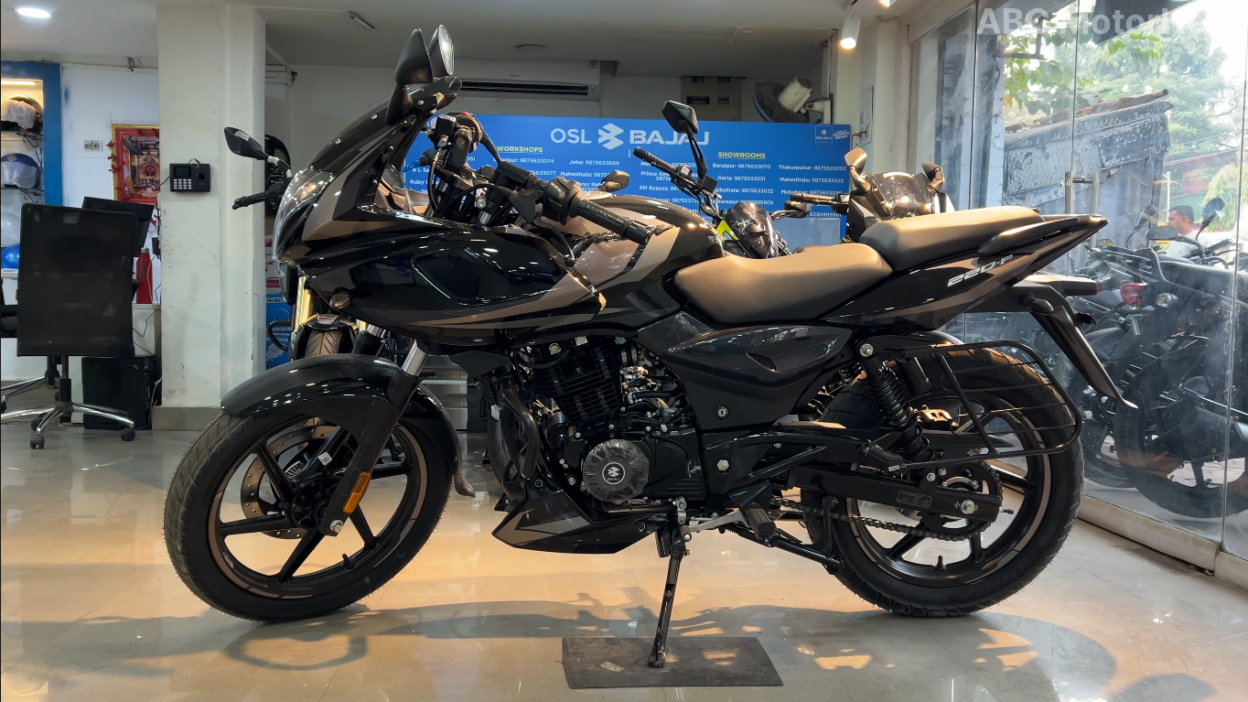
The Bajaj Pulsar 220F has been an icon in Indian motorcycling for nearly two decades. While competitors have come and gone, the 220F continues to hold its ground. For 2026, Bajaj has introduced five key updates to keep this legendary sports tourer relevant. But are these changes enough, or is the 220F finally showing its age? After an extensive hands-on review, here’s everything you need to know.
Quick Overview: At a Glance
Price: ₹1,38,000 (ex-showroom) | ₹1,60,000 (on-road, approx.)
Engine: 220cc oil-cooled, single-cylinder, fuel-injected
Power: 20.9 PS @ 8,500 RPM
Torque: 18.55 Nm @ 7,000 RPM
Transmission: 5-speed gearbox
Fuel Tank: 15 liters
Weight: 160 kg
The 5 Major Updates for 2026
- Fully LED Turn Signals (front and rear)
- New Graphics Package (copper, silver, carbon fiber texture)
- Updated Seat Texture (improved comfort)
- New Color Options (Black Copper Beige and others)
- Enhanced Instrument Cluster Features
Update #1: Fully LED Turn Signals (Finally!)
What’s Changed
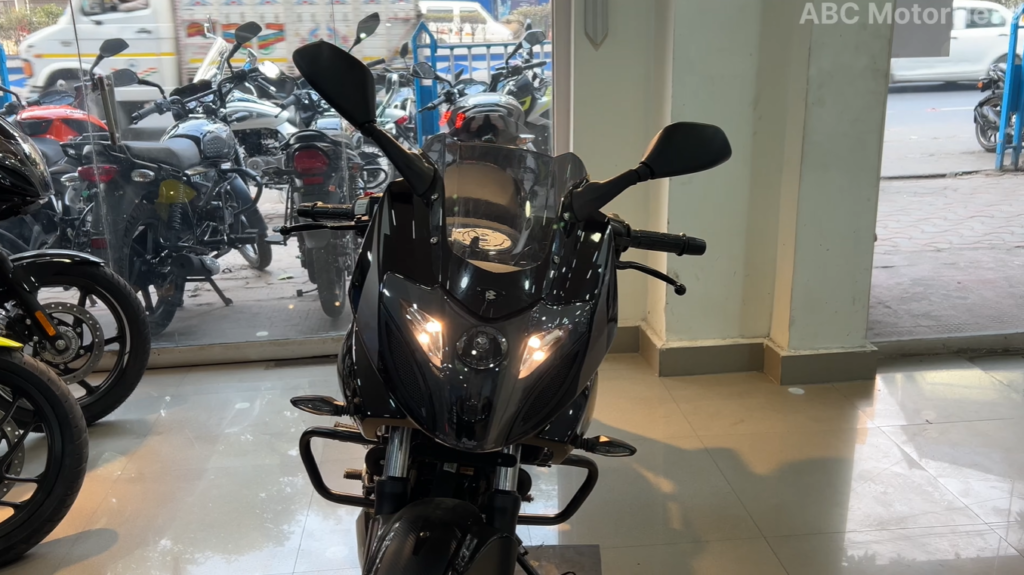
The most noticeable update is the switch from conventional bulb-type turn signals to fully LED turn signals at both the front and rear.
Previous Model: Halogen bulb indicators
2026 Model: Full LED indicators (front + rear)
Why This Matters
Visibility: LED indicators are significantly brighter and more visible in all lighting conditions, improving safety.
Modernity: This brings the 220F in line with contemporary motorcycles where LED lighting is standard.
Durability: LEDs last longer than conventional bulbs, reducing maintenance.
Energy Efficiency: LEDs consume less power, reducing load on the electrical system.
What’s Still Missing
No Hazard Light Function: Despite the LED upgrade, Bajaj still hasn’t included a hazard light feature, which many competitors offer at this price point.
Headlight Still Halogen: The main headlight remains a halogen setup:
- Projector-based low beam (halogen)
- Reflector-based high beam (halogen)
- No LED headlight upgrade
The Verdict: It’s a welcome update but feels incremental. In 2026, a full LED headlight should have been included, especially when bikes like the TVS Apache RTR 160 4V offer full LED lighting at a lower price point.
Update #2: Stunning New Graphics Package
The Visual Transformation
Bajaj has completely refreshed the graphics on the 2026 Pulsar 220F with a modern, aggressive design language featuring:
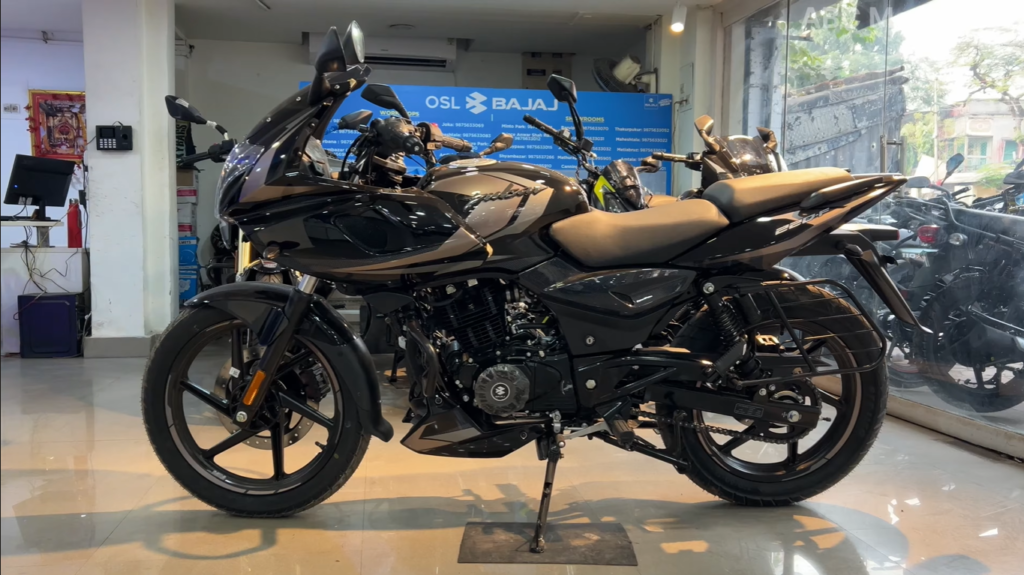
Color Palette:
- Copper accents
- Silver highlights
- Carbon fiber texture patterns
- Matte black elements
- Glossy black surfaces
Where You’ll See the New Graphics
Front Fairing:
- Copper and silver graphics on both sides
- Carbon fiber texture detailing
- 3D chrome Pulsar badge with black border
- Mesh texture elements with matte black finish
Fuel Tank:
- Prominent copper and silver graphics
- Carbon fiber texture integration
- Glossy black base with contrasting graphics
- Tank capacity: 15 liters
Side Panels:
- Copper, silver, and carbon fiber texture graphics
- “220” branding with beige and copper stickers
- Glossy black under-seat cowl
Engine Cowl:
- Silver, copper, and carbon fiber texture graphics
- Company-fitted engine cowl in glossy black
Alloy Wheels:
- Copper and silver stickers on rims (front and rear)
- 17-inch black alloy wheels
The Impact
The new graphics give the Pulsar 220F a significantly more premium and sporty appearance. The copper accents, in particular, add a touch of sophistication that was missing in previous iterations.
Attention to Detail: The mesh textures on various body panels and the carbon fiber texture elements show Bajaj has paid attention to making this bike look contemporary.
Update #3: Redesigned Seat Texture for Better Comfort
What’s New
The seat texture has been completely redesigned for the 2026 model.
Seat Specifications:
- Split design (rider + pillion separate)
- Wide and long profile
- Matte black color finish
- New texture pattern (updated from previous model)
- Very soft cushioning
Comfort Assessment
Rider Comfort: The long, wide seat with soft cushioning provides excellent comfort for extended rides. The seating position is upright and relaxed, suitable for both city commuting and highway touring.
Pillion Comfort: The split design ensures the pillion gets dedicated space with good cushioning. The wide seat means the pillion won’t feel cramped even on longer rides.
Material Quality: The seat material feels durable and well-finished. The new texture pattern not only looks better but should also provide better grip and heat dissipation.
Ergonomics
Tank Pad: Company-fitted tank pad provides knee grip and prevents scratches.
Footpeg Position: Both rider and pillion footpegs get proper rubber padding. The positioning is comfortable for long-distance riding.
Handlebar Position: Clip-on handlebars with a wide and upright position. Not too aggressive, not too relaxed—perfect for a sports tourer.
Update #4: Fresh Color Options (Black Copper Beige Leads)
2026 Color Palette
Bajaj offers four color options for the 2026 Pulsar 220F:
- Black Copper Beige (featured in review – new for 2026)
- Black Ink Blue
- Black Cherry Red
- Green Light Copper
Black Copper Beige: The Star
This new color option stands out with:
- Sophisticated copper accents
- Premium beige highlights
- Carbon fiber texture elements
- Excellent contrast with black base
- Modern, upscale appearance
The Black Copper Beige colorway gives the 220F a premium cruiser vibe while maintaining its sporty character. It’s the pick of the lot and likely to be the most popular choice.
What Hasn’t Changed
The body panels, fairings, and overall design language remain the same as the previous model. These are primarily cosmetic updates through graphics and colors rather than fundamental design changes.
Update #5: Enhanced Instrument Cluster Features
Display Technology
The 2026 Pulsar 220F continues with the Bluetooth-enabled fully digital reverse LCD instrument cluster, but with enhanced features and better integration.
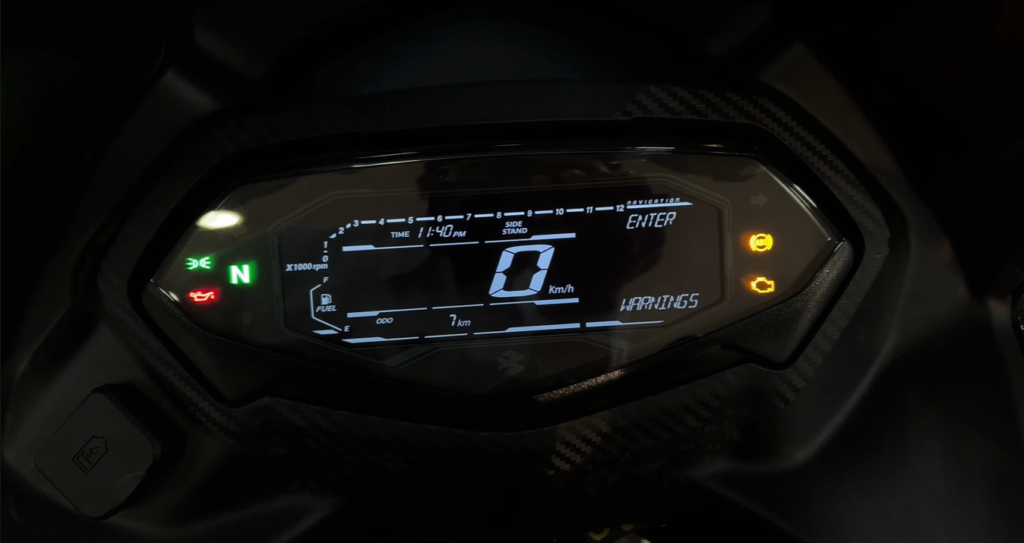
What’s Displayed
Primary Information:
- Speedometer (digital)
- Tachometer (digital)
- Fuel gauge
- Clock
Trip Information:
- Trip A
- Trip B
- Total kilometer (odometer)
- Average fuel economy (Trip A)
- Average fuel economy (Trip B)
- Instant fuel economy
Connectivity Features (via Bluetooth):
- Call alerts
- SMS alerts
- Missed call alerts
- Turn-by-turn navigation
- Music control (via connected phone)
Warning Indicators:
- Side stand reminder indicator
- Neutral indicator
- Engine malfunction light
- ABS indicator
- Check engine oil indicator
- Engine temperature indicator
- Refuel warning
- Service due reminder indicator
What’s Still Missing
No Gear Position Indicator: In 2026, this is a glaring omission. Even budget 160cc bikes now offer this feature, and on a bike that costs ₹1.6 lakh on-road, this should have been standard.
Connectivity Assessment
The Bluetooth connectivity works well when paired with Bajaj’s mobile app. Turn-by-turn navigation is particularly useful for touring, though the small screen size can make it slightly difficult to read at a glance.
USB Charging: A USB Type-C charging port is provided on the left side of the instrument cluster for on-the-go charging—a practical addition for daily commuters and tourers.
What Hasn’t Changed (And Should Have)
The Disappointments
While the updates are welcome, several aspects remain unchanged that desperately need attention:
1. Still Single-Channel ABS
- Single-channel ABS (rear wheel sensor only)
- No dual-channel ABS option
- Competitors like TVS Apache and Yamaha R15 offer dual-channel ABS
- At ₹1.6 lakh on-road, this is unacceptable
2. Telescopic Front Suspension
- 37mm telescopic front forks from Endurance
- No USD (upside-down) fork upgrade
- Feels dated compared to competition
- Suspension performance is adequate but nothing special
3. Halogen Headlight
- Projector low beam (halogen)
- Reflector high beam (halogen)
- No LED headlight upgrade
- Visibility is good but not exceptional
- Competitors offer full LED at lower prices
4. No Slipper & Assist Clutch
- Bajaj offers slipper clutch even on the NS160
- The 220F still uses a conventional clutch
- Clutch action is on the harder side
- Would significantly improve ride quality
5. No Kick Start Option
- Only electric start available
- Battery failure means you’re stranded
- A kickstart backup would provide peace of mind
Design & Build Quality: Timeless But Aging
Overall Aesthetic
The Pulsar 220F maintains its iconic semi-faired design that made it famous. The bikini fairing, split seats, and aggressive stance still turn heads, but the design is clearly showing its age.
Dimensions:
- Length: 2,035mm
- Width: 750mm
- Height: 1,165mm
- Wheelbase: 1,350mm
- Ground Clearance: 165mm
- Kerb Weight: 160kg
Build Quality Assessment
Frame: Double-cradle down-tube type frame provides good rigidity and stability.
Materials:
- Front mudguard: Fiber finish with carbon fiber texture
- Body panels: Mix of glossy and matte black finishes
- Fairings: Good quality plastics
- Overall fit and finish: Solid but not exceptional
Company-Fitted Accessories:
- Crash guards (split-type, matte black)
- Engine cowl (glossy black)
- Mudguard extender (front)
- Tank pad
Attention to Detail
Bajaj has focused on small touches:
- Mesh textures on multiple panels
- Color-coordinated graphics throughout
- Glossy/matte dual-tone finishes
- Orange reflectors on front suspension
- Tinted meter shield
Engine & Performance: The Heart Remains Strong
Engine Specifications
Type: 220cc oil-cooled, single-cylinder, fuel-injected
Compliance: BS6 Phase 2 with OBD2B
Technology: DTSi (Digital Twin Spark Ignition)
Max Power: 20.9 PS @ 8,500 RPM
Max Torque: 18.55 Nm @ 7,000 RPM
Transmission: 5-speed gearbox with toe shifter only
Fuel System: Fuel injection (E20 compatible)
Performance Character
Low-End: Adequate torque delivery but not as punchy as you’d expect from 220cc. The lack of bottom-end grunt is noticeable in city traffic.
Mid-Range: This is where the DTSi engine shines. Between 4,000-7,000 RPM, the bike pulls cleanly with good urgency.
Top-End: The engine revs enthusiastically to redline. Power delivery remains linear, making it easy to exploit on highways.
Refinement: The oil-cooled engine is reasonably refined at cruising speeds but does get buzzy beyond 7,000 RPM. Vibrations are noticeable at the handlebar and footpegs at higher revs.
Real-World Usability
City: Manageable in traffic despite the heavier clutch action. The upright riding position helps in urban conditions.
Highway: Where the 220F truly excels. Comfortable cruising at 90-100 km/h with enough power in reserve for quick overtakes.
Touring: The combination of comfortable seat, decent wind protection from the fairing, and fuel-efficient engine makes this a capable tourer.
Fuel Economy Expectations
While official figures aren’t provided, real-world expectations:
- City: 35-40 km/l
- Highway: 45-50 km/l
- Combined: 40-45 km/l
The 15-liter fuel tank provides a touring range of 600+ kilometers on the highway.
Brakes & Suspension: Adequate But Not Exciting
Braking Setup
Front:
- 280mm disc brake
- Black twin-piston floating caliper
- Good bite and feel
Rear:
- 230mm disc brake
- Black single-piston floating caliper
- Adequate stopping power
ABS: Single-channel (rear wheel sensor only)
Braking Performance: The braking setup is adequate for the bike’s performance. The front brake provides good initial bite and progressive feel. However, the lack of dual-channel ABS is concerning, especially during hard braking in low-grip conditions.
Suspension Setup
Front:
- 37mm telescopic forks from Endurance
- Travel: Adequate for road use
- Damping: Slightly soft, can bottom out over sharp bumps
Rear:
- Multi-step adjustable twin gas-charged hydraulic shock absorbers from Endurance
- Adjustability is useful for different load conditions
- Generally compliant but can feel harsh over sharp bumps
Ride Quality: The suspension setup favors comfort over sportiness. It soaks up most road imperfections well, making it suitable for Indian road conditions. However, enthusiastic cornering reveals the limitations—the bike can feel a bit wallowy.
Features & Equipment: The Checklist
What You Get
✅ Bluetooth-enabled digital instrument cluster
✅ USB Type-C charging port
✅ Turn-by-turn navigation
✅ Call/SMS alerts
✅ Split LED tail lamp
✅ Fully LED turn signals (new for 2026)
✅ Company-fitted crash guards
✅ Engine cowl
✅ Both side and center stands
✅ Side stand engine cut-off
✅ Dual horn setup (very loud)
✅ Rubber padding on footpegs
✅ Tubeless tires (front and rear)
✅ Backlit switchgear
What’s Missing
❌ Dual-channel ABS
❌ LED headlight
❌ Slipper & assist clutch
❌ Gear position indicator
❌ Hazard light function
❌ Kickstart backup
❌ Rear ladies footrest (company-fitted)
❌ Adjustable levers
Riding Experience: Comfort Meets Performance
Ergonomics
Riding Position: The clip-on handlebars combined with mid-set footpegs create a sporty yet comfortable riding triangle. It’s not as aggressive as a full-on sportbike but more committed than a standard commuter.
For City Use: The upright position and wide handlebars make filtering through traffic easy. The bike is manageable at low speeds despite the 160kg weight.
For Highway: The slight forward lean and wind protection from the fairing reduce fatigue on long rides. You can comfortably maintain 90-100 km/h for hours.
For Two-Up Riding: The split seat design, proper pillion footpegs with rubber padding, and substantial grab rails make it pillion-friendly. The soft seat cushioning ensures both rider and pillion remain comfortable on extended rides.
Handling Character
Stability: The 1,350mm wheelbase and 160kg kerb weight provide good straight-line stability, especially at highway speeds.
Cornering: The 17-inch wheels and decent ground clearance (165mm) allow for spirited cornering. However, the bike feels heavier in direction changes compared to modern rivals.
Low-Speed Maneuverability: The weight is noticeable at parking lot speeds and during U-turns.
Competition Comparison
TVS Apache RTR 200 4V
Apache Advantages:
- Lighter and more nimble
- Better features (ride modes, traction control on Race Edition)
- Sharper handling
- More modern design
220F Advantages:
- Better highway stability
- More comfortable for touring
- Proven reliability
- Better pillion comfort
Yamaha FZ25
FZ25 Advantages:
- More torque (20.1 Nm at lower RPM)
- Better low-end punch
- More refined engine
- Modern design
220F Advantages:
- Better top-end performance
- Fairing provides wind protection
- More aggressive styling
- Better touring capability
Hero Xtreme 200S
Xtreme 200S Advantages:
- More affordable
- Full fairing
- Lighter weight
220F Advantages:
- More powerful engine
- Better brand image
- Superior build quality
- Better equipment
Should You Buy the 2026 Pulsar 220F?
Buy If You:
✅ Want a proven, reliable platform – The 220F has been refined over years
✅ Prioritize highway touring comfort – Excellent for long-distance riding
✅ Value brand heritage – The Pulsar badge still carries weight
✅ Need pillion-friendly ergonomics – Genuinely comfortable for two-up riding
✅ Appreciate understated performance – Not flashy but competent
✅ Want decent features at reasonable price – Bluetooth, navigation, USB charging
Skip If You:
❌ Want cutting-edge features – Single-channel ABS and halogen headlight feel dated
❌ Prioritize sharp handling – Modern 200cc bikes handle better
❌ Need strong low-end torque – Engine lacks punch below 4,000 RPM
❌ Want modern design – The styling is clearly from another era
❌ Expect premium quality – Build quality is good but not exceptional
❌ Desire sporty riding dynamics – It’s more tourer than sport
Value Proposition: Worth the Price?
Price Breakdown
Ex-Showroom: ₹1,38,000
On-Road (approx.): ₹1,60,000
What you’re paying for:
- 220cc oil-cooled engine with proven reliability
- Semi-faired touring package
- Bluetooth connectivity
- LED turn signals (new)
- Updated graphics and colors (new)
- Bajaj’s after-sales network
The Verdict
At ₹1.6 lakh on-road, the 2026 Pulsar 220F faces stiff competition from more modern alternatives. However, it still offers:
Strong Points:
- Proven reliability
- Highway touring capability
- Comfortable ergonomics
- Adequate performance
- Accessible service network
Weak Points:
- Dated design philosophy
- Missing modern features (dual-channel ABS, LED headlight)
- Could use more power/torque
- Feels heavier than modern rivals
Is it worth it? If you’re specifically looking for a comfortable, reliable touring bike with proven credentials, yes. If you want the latest features and sharpest performance, look elsewhere.
The 5 Updates: Do They Matter?
Let’s assess whether the 5 updates for 2026 actually improve the Pulsar 220F:
Update #1: LED Turn Signals
Impact: Medium – Improves visibility and modernity
Should Have Been: Full LED lighting including headlight
Update #2: New Graphics
Impact: High – Significantly improves visual appeal
Execution: Excellent – Copper and carbon fiber textures look premium
Update #3: Redesigned Seat
Impact: Medium – Comfort was already good, texture update is minor
Execution: Good – Soft cushioning maintained, new texture looks better
Update #4: New Colors
Impact: High – Black Copper Beige is stunning
Execution: Excellent – Fresh color palette revitalizes the design
Update #5: Enhanced Instrument Features
Impact: Low – Most features were already present
Missing: Gear position indicator should have been added
Final Verdict: The Legend Survives, But For How Long?
Rating: 3.5/5 Stars
The 2026 Bajaj Pulsar 220F is a motorcycle caught between two worlds. It wants to honor its legendary status while remaining relevant in 2026. The five updates help, but they’re largely cosmetic improvements that don’t address fundamental shortcomings.
What Works
✅ The engine remains torquey and reliable
✅ Touring comfort is genuinely good
✅ New graphics make it look fresh
✅ Bluetooth features are useful
✅ Pricing is still competitive
✅ Bajaj’s service network is extensive
What Doesn’t
❌ Single-channel ABS is unacceptable in 2026
❌ Halogen headlight feels dated
❌ No slipper clutch despite heavier action
❌ Design is clearly showing its age
❌ Missing gear position indicator
❌ Suspension setup is adequate but uninspiring
The Bottom Line
The Pulsar 220F isn’t the best 200cc motorcycle you can buy in 2026. But it’s still a solid, reliable choice for riders who prioritize proven performance, touring comfort, and Bajaj’s legendary after-sales support over having the flashiest features.
For first-time buyers: Look at more modern alternatives
For existing Pulsar fans: This update keeps the legend alive
For touring enthusiasts on a budget: Still one of the best options
The 220F has earned its place in Indian motorcycling history. These 5 updates ensure it survives another year, but Bajaj needs to do more if this icon is to remain relevant beyond 2026.
Expect 35-40 km/l in city, 45-50 km/l on the highway, and around 40-45 km/l combined.
What do you think of the 2026 Pulsar 220F? Are these 5 updates enough, or should Bajaj have done more? Let us know in the comments!
Stay tuned to My Pit Shop for more honest motorcycle reviews that tell you what manufacturers won’t!