If you’re in the market for a premium luxury electric sedan that can go the farthest on a single charge, look no further than the Lucid Air. When this California-based company first showed up in America nearly 5 years ago, they essentially beat Tesla at their own range game with the Air sedan—traveling well over 500 miles on a full charge.
Fast forward to 2026, and the electric sedan segment continues to evolve rapidly, with competitors constantly raising the bar. So how has Lucid responded? With strategic updates that make the Air even more compelling, especially in the sweet-spot Touring trim.
After spending a full week with the 2026 Lucid Air Touring—testing everything from 0-60 acceleration to real-world highway range—I can confidently say this: For those of you shopping for a premium all-electric sedan for longer road trips in style and comfort, Lucid has made enough changes to keep the Air not just competitive, but leading the pack.
Let me show you why.
What’s New for 2026: Evolution, Not Revolution
The Big Changes
Tesla Supercharger Access
The biggest news? The Air can now charge at Tesla’s vast Supercharger network using a NACS (North American Charging Standard) adapter, which Lucid includes for $250. This dramatically expands charging options across North America.
Increased Range
The Touring trim receives a 25-mile range bump from 406 to 431 miles EPA-estimated—thanks to higher-density battery cells in the 92 kWh pack.
Improved HVAC System
A revised air conditioning compressor (borrowed from the new Gravity SUV) improves cabin cooling while reducing ambient noise.
Wireless CarPlay & Android Auto
Finally! The Air now offers wireless Apple CarPlay and Android Auto—something desperately needed to compete with the segment.
Mobile Charging Cable
All 2026 models now include a 40-amp mobile charging cable kit as standard, allowing 240V charging that adds up to 40 miles of range per hour.
What Hasn’t Changed (And That’s Good)
The core elements that made the Air special remain intact:
- Industry-leading aerodynamics (0.197 coefficient of drag)
- Spacious interior with futuristic design
- Massive 34-inch curved OLED display
- Segment-best cargo capacity (32 cubic feet total)
- That silky-smooth dual-motor powertrain
Exterior Design: Controversial But Aerodynamic
The Front: Purposeful Efficiency
Let’s start with the most impressive feature you’ll see before even opening a door: the front trunk (frunk).
Pop the power-operated hood—via button or smartphone app—and you’re greeted with approximately 10 cubic feet of storage space. This is still the biggest frunk you’ll find in the sedan segment.
But wait, there’s more. Lift the floor panel, and there’s an even deeper storage well underneath. It’s crazy to think this front trunk is bigger than many vehicles’ rear trunks.
Front Fascia Details:
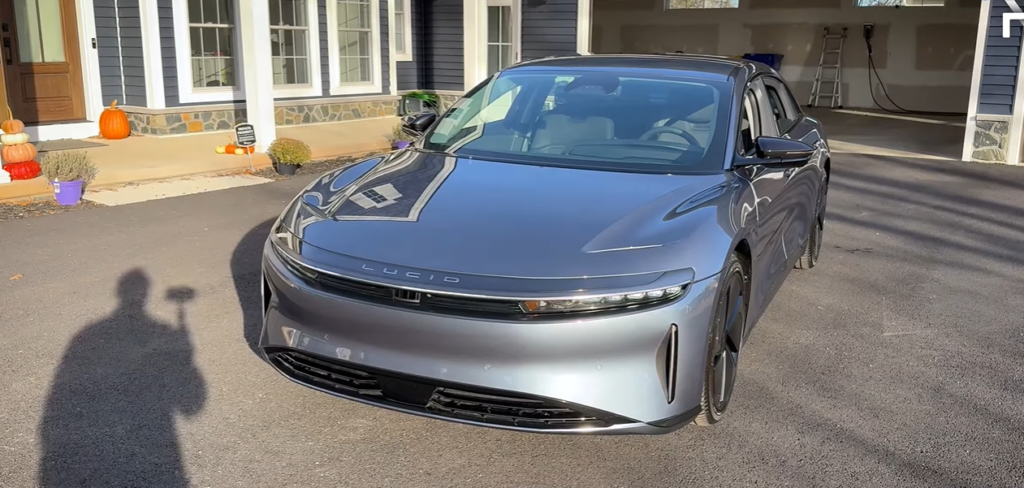
- MLA (Micro Lens Array) LED headlights with trendy illuminated light bars
- Illuminated Lucid badge
- Functional aerodynamic vents throughout
- Active grille shutters for optimal airflow management
- Integrated parking sensors
My test car wore the Stealth Appearance Package ($1,750), which blacks out all chrome with black chrome accents—a much cleaner, more contemporary look.
The Side Profile: Sleek Midsize Proportions
Dimensions:
- Length: 196 inches
- Wheelbase: 116.5 inches
- Slightly shorter than Tesla Model S
- Similar size to BMW i5 and Mercedes EQE
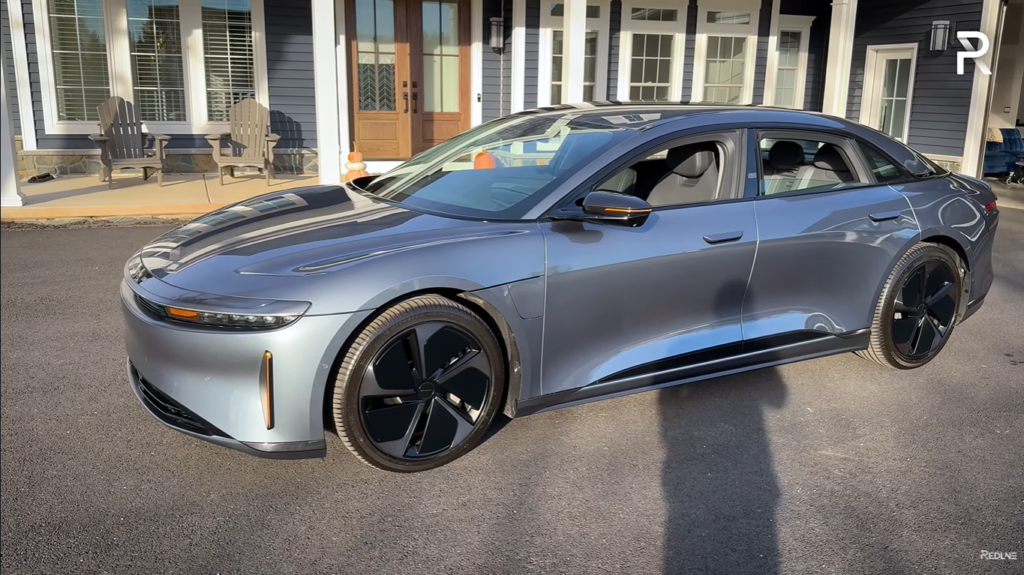
The Fathom Blue Pearl color on my tester is fascinating—it’s technically blue, but appears more like a grayish-blue that beautifully showcases the car’s aerodynamic proportions in sunlight.
Wheel Options: My test car featured optional 20-inch Aerolite Stealth wheels ($1,800) with aerodynamic blades. These look fantastic but reduce range from 431 to 396 miles. The base 19-inch wheels maximize efficiency.
Tires: Michelin Pilot Sport EV (245/40 R20 front, 265/40 R20 rear)
Mirrors: Power-folding with cameras and integrated turn signals (part of the 32-sensor array)
Safari Snorkel: Standard Safari-Designed Snorkel
Yes, you read that right. Every Super Duty gets a sealed snorkel as standard, enabling 850mm wading depth. This isn’t an aftermarket add-on—it’s professionally integrated with full warranty coverage.
The Rear: Love It or Hate It
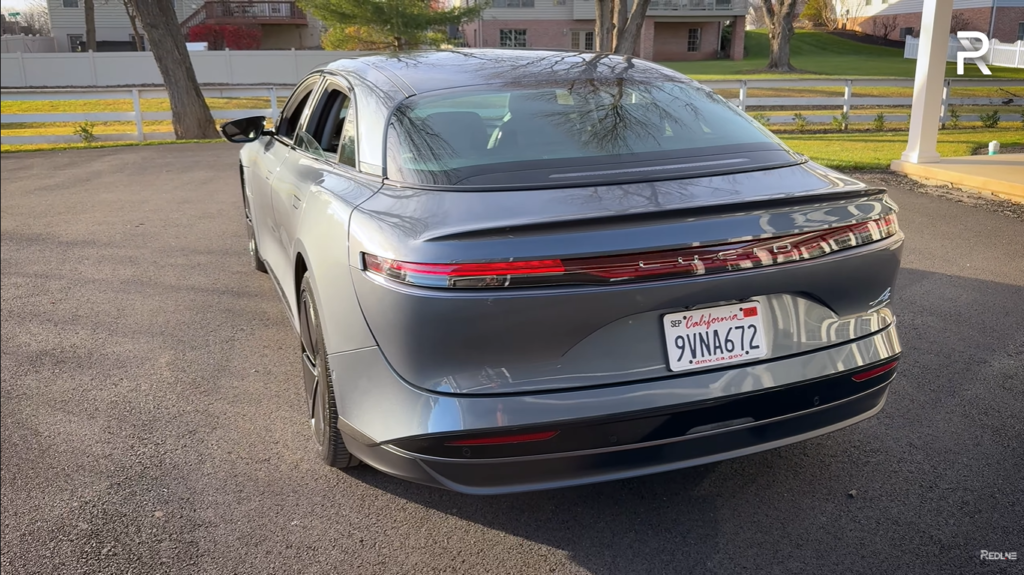
This is probably the most controversial angle of the Air. Some compare it to a Buick or Lincoln. I see where they’re coming from.
What I Notice:
- Massive panel gap where the trunk opens (functional, but visually polarizing)
- Some fit-and-finish issues with panel alignment
- Built-in deck lid spoiler aids aerodynamics
- Full LED tail lights with sequential turn signals and 3-dimensional effect
- Trendy LED light bar with elegant “Air Touring” script in cursive
Trunk Access: Push the button, and that massive cut line reveals its purpose: a huge opening for easy loading. Lucid says you get around 22 cubic feet here.
Inside the trunk:
- Wide, deep storage (not very tall)
- 60/40 split-folding rear seats with pass-through
- Side storage compartments
- Underfloor storage with 12V power outlet
- Space for the included NACS-to-CCS1 adapter
Total cargo: 32 cubic feet (expandable to ~64 cubic feet with seats folded)
My take: I still wish this were a liftback like the Tesla Model S or Audi S6 e-tron, but the practicality is undeniable. And for those needing more space, there’s always the new Gravity SUV.
Build Quality: Getting Better, But…
Look, Lucid is a relatively new automaker (5 years in), and it shows in places:
- ✅ Overall build quality is good—no squeaks or rattles
- ❌ Panel gaps are larger than ideal (especially that rear trunk gap)
- ❌ Some trim pieces don’t fit perfectly
- ❌ A few misaligned exterior panels
For a six-figure luxury vehicle, I’d expect tighter tolerances. But remember: Tesla had similar issues early on, and they’ve improved. Lucid will too.
Interior: Spaceship Meets Luxury Lounge
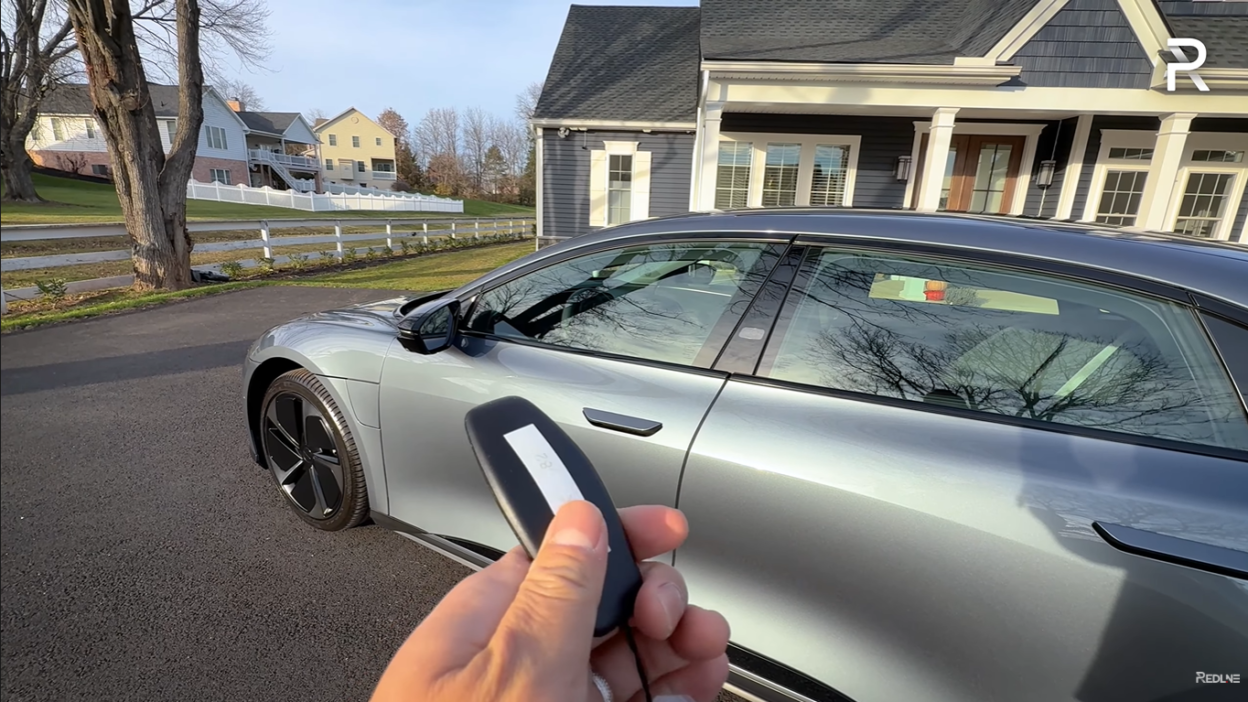
Key Fob: Minimalist Tech
The key is a sleek plastic fob with no buttons—shaped like an aerodynamic car. It comes with a key card backup. But realistically, most owners will use their smartphone as the key via the Lucid app.
The pop-out door handles retract flush for aerodynamics and look appropriately futuristic.


First Impressions: Premium, But Not Perfect
Opening the door reveals my test car’s Mojave leatherette interior (PurLuxe material—leather-free). You can upgrade to real leather for $3,000, but honestly, this material is surprisingly convincing.
What immediately stands out:
- Floating 34-inch curved OLED display (actually three displays)
- 12.5-inch portrait touchscreen below
- Dark wood trim accents
- Recycled fabric materials
- Soft-touch upper surfaces
- Aluminum window switches (one-touch, high quality)
Interior Color Options:
- Mojave (tan/beige)
- Santa Cruz (light gray)
- Tahoe (shown here—black)
- Mojave PurLuxe
My honest opinion: I would’ve preferred the brown (Mojave) interior over this black. It would’ve showcased the cabin’s spaceship aesthetic better.
The Steering Wheel: My Only Design Miss
I don’t particularly love this steering wheel. It reminds me of a Lincoln Town Car from two decades ago—thick rim, traditional design. It’s not bad, just… uninspired for such a futuristic vehicle.
The Displays: Impressive But Imperfect
34-Inch Curved OLED
This massive screen spans the entire dashboard and technically comprises three separate displays. The resolution is excellent, colors are vibrant, and it’s undeniably impressive.
12.5-Inch Portrait Touchscreen
Positioned vertically in the center console, this handles climate controls, drive modes, and vehicle settings. The new Gravity SUV switched to landscape orientation—I think that’s the better choice.
What’s New: Wireless Apple CarPlay and Android Auto finally arrive for 2026! My phone wasn’t connected during filming, but I tested it extensively.
The Problem: CarPlay displays in the top-left portion of the 34-inch screen, cut off and not utilizing the full width. It reminds me of the Cadillac Escalade’s 38-inch display—great when it works, but the implementation needs refinement.
Performance: The system is still a bit slow and laggy at times. It’s improved over the 2023 model I tested, but compared to Tesla’s snappiness or BMW’s iDrive 8, there’s room for improvement.
Infotainment Features
Native System Includes:
- Embedded GPS navigation (works well)
- Satellite radio
- Spotify, Tidal, TuneIn, iHeartRadio
- Bluetooth connectivity
- Podcasts (Pocket Casts)
Drive Modes (accessible via touchscreen):
- Smooth: Comfort-oriented, relaxed throttle response
- Swift: Balanced performance
- Sprint: Maximum performance, launch control enabled
You can also adjust regenerative braking levels (Off, Standard, High) and steering weight through the menus.
The Seats: 20-Way Luxury
My test car included the $3,000 20-way massaging front seats. These are genuinely impressive:
Adjustments:
- 20-way power adjustment
- Memory function
- Heating
- Ventilation (cooling)
- Massage (5 different types, including vibrating)
- Power-adjustable bolsters
- Forward/backward headrest adjustment
Massage Function: Lasts 20 minutes, offers three intensity levels, and genuinely works well. It’s a nice luxury touch for long road trips.
Comfort: Even the “fake leather” PurLuxe material feels very convincing and supportive. No complaints for all-day comfort.
Climate & Convenience
Climate Control: Dual-zone or quad-zone functionality (depending on package)
My Complaint: Heated/cooled seat controls and heated steering wheel buttons are buried in the lower 12.5-inch touchscreen. This requires taking your eyes off the road while driving—annoying and potentially unsafe.
What I’d prefer: Either place these controls on the upper display or (better yet) provide hard buttons for frequently-used functions.
Storage & Charging
Center Console:
- Aluminum-trimmed sliding cover
- Two cup holders
- USB-A and USB-C ports
- Wireless phone charging pad (one side only)
- Hidden pull-out storage cubby beneath
Wireless Charging Issue: I found the wireless pad unreliable—it didn’t charge my phone unless I removed the case. Newer systems handle cases better.
Additional Features:
- Glove box: Power-operated via touchscreen, damped, felt-lined
- 12V and 400W household outlet in rear seat area
- USB charging in front (no USB-C in rear—oversight)
Audio System
My test car featured the upgraded 20-speaker Surreal Sound system ($2,900). It sounds excellent—highly recommended for audio enthusiasts.
The base 9-speaker system is adequate, but if you appreciate high-quality audio, the upgrade is worth it.
Technology: DreamDrive Pro & Advanced Safety
Standard Safety Features (All Air Models)
- 3D Surround View Monitoring
- Blind Spot Display
- Adaptive Cruise Control
- Automatic Park In & Out
- Front & Rear Cross Traffic Protection
- Blind Spot Warning
- Automatic Emergency Braking
- Traffic Sign Recognition
- Driver Attention Monitor
DreamDrive Pro: $6,750 Optional Upgrade
My test car included DreamDrive Pro, which adds:
Hardware:
- LiDAR sensor
- 32 total sensors around the vehicle
- Future-capable advanced driver-assist hardware
- Front-facing camera and radar
Software Features:
- Hands-Free Highway Assist (Lane Centering + Adaptive Cruise)
- Hands-Free Lane Change Assist (signal, and it changes lanes)
- 3D three-lane visualization on display
- Extended stop-and-go functionality
- Traffic jam assist
- Active curve speed control
- Curb rash alert
My Experience With DreamDrive Pro
What Works Well:
- ✅ True hands-free driving on highways
- ✅ Smooth lane centering in most conditions
- ✅ Excellent 3D visualization shows surrounding vehicles
- ✅ Blind spot cameras activate when signaling (clever feature)
- ✅ Generally confident and capable
What Needs Work:
- ❌ System “freaks out” when lane markings disappear or are imperfect
- ❌ Once steered toward the middle of the road when lines faded—scary!
- ❌ Requires constant attention (as it should, but some interventions are abrupt)
- ❌ Not as refined as Tesla’s Full Self-Driving or Mercedes Drive Pilot
Is it worth $6,750?: Honestly, probably not for most buyers. The standard adaptive cruise control is excellent. Unless you do extensive highway commuting and value hands-free driving, save the money.
Missing Features
No Sentry Mode / Dash Cam: Despite having 32 cameras, the Air lacks Tesla-style sentry mode or built-in dashcam recording. Lucid should add this via software update—the hardware is already there.
No Digital Rearview Mirror: The frameless auto-dimming mirror is nice, but a digital camera mirror option would improve visibility.
Rear Seat: Executive-Class Comfort
Space & Comfort
Legroom: Up to 38 inches (Lucid’s claim)
My experience (5’11” tall): Very generous legroom—I can stretch out and cross my legs comfortably.
Why it’s spacious: The Touring’s smaller 92 kWh battery pack (vs. 118 kWh in Grand Touring) isn’t double-stacked, giving you an extra inch of legroom. Nice bonus!
Headroom: Without the optional glass roof ($4,000), headroom is excellent. The glass roof would add airiness but reduces headroom slightly.
Floor: Completely flat—no center tunnel hump. Fantastic for middle-seat passengers.
Rear Seat Features
Standard:
- Rear air vents
- Map pockets
- Three-level heated seats
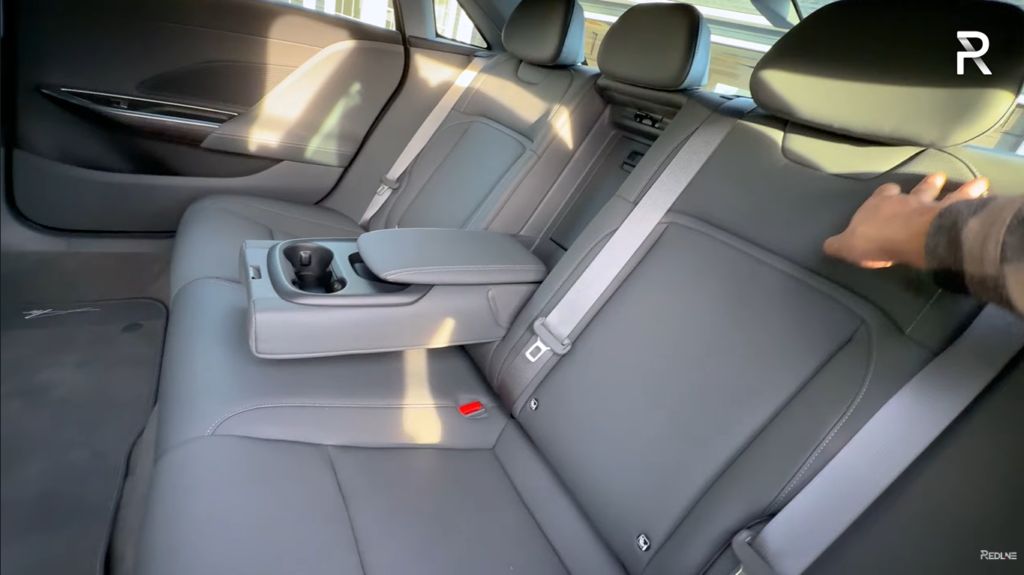
- Fold-down center armrest with cup holders
- Pass-through to trunk
- Storage cubby in armrest
Optional (Comfort & Convenience Package – $3,000):
- Retractable privacy shades for rear and side windows
- Rear center console display and storage bin
- Creates an executive rear seat feeling
When you extend all three shades, it genuinely feels like a chauffeur-driven luxury sedan. Very impressive for family or business use.
Material Quality
Same high-quality PurLuxe material as front, soft-touch upper surfaces, wood trim accents. The seats are comfortable with plenty of thigh support, and the headrests are well-positioned.
Bottom line: If you plan to use this as a family car or regularly have rear passengers, they’ll be very happy back here.
Powertrain: 620 HP of Silky-Smooth Fury
Specifications
Motor Configuration: Dual electric motors (front + rear)
Total Power: 620 horsepower
Total Torque: 885 lb-ft
Drivetrain: Electronic all-wheel drive
Battery: 92 kWh lithium-ion pack
EPA Range: 431 miles (with 19″ wheels) / 396 miles (with 20″ wheels)
How It Compares
Lucid Air Lineup Power:
- Pure RWD: 430 hp (88 kWh battery)
- Pure AWD: 480 hp (88 kWh battery)
- Touring AWD: 620 hp (92 kWh battery) ⬅️ We’re testing this
- Grand Touring AWD: 819 hp (118 kWh battery)
- Sapphire AWD: 1,234 hp (118 kWh + third motor)
Competitor Comparison:
- Tesla Model S Dual Motor: ~670 hp, 402 miles range
- BMW i5 M60 xDrive: 593 hp, ~256 miles range
- Mercedes EQE 500 4MATIC: 402 hp, ~300 miles range
- Porsche Taycan 4S: 469-590 hp, ~250 miles range
The Touring sits in a sweet spot: more range than most competitors, more power than base models, and significantly cheaper than the Grand Touring.
Performance Testing: Faster Than Advertised
0-60 MPH Acceleration
Lucid’s Claim: 3.4 seconds
My Best Time: 3.14 seconds (with launch control)
Without Launch Control: 3.4 seconds
How to activate Launch Control:
- Put vehicle in Sprint mode
- Brake torque (hold brake, press throttle)
- Display shows a bear icon 🐻
- Release brake
Result: Holy smokes. This thing takes your breath away. The surge of instant torque is addictive, smooth, and relentless. It just keeps pulling with the kind of immediacy you associate with expensive luxury EVs.
Context: The Grand Touring I tested 2.5 years ago had 819 hp and did 0-60 in 3.05 seconds. This Touring has only 620 hp (199 hp less!) but achieved 3.14 seconds. That’s remarkable consistency and power delivery.
Comparison:
- ✅ Quicker than Tesla Model S Dual Motor (~3.1-3.2 sec)
- ✅ Quicker than BMW i5 M60 (~3.6 sec)
- ✅ Quicker than Mercedes EQE 500 (~4.3 sec)
- ❌ Slower than Tesla Model S Plaid (~1.99 sec)
- ❌ Slower than Lucid Air Sapphire (~1.89 sec with Track package)
Top Speed: Approximately 140 mph (governor-limited)
Bottom line: This is unbelievably quick performance for what’s essentially the “mid-tier” power option. Most people will never need more.
Real-World Range: The Efficiency King
EPA vs. Reality
EPA Rating (with 20″ wheels): 396 miles
My Real-World Result: ~325 miles in mixed driving
On initial charge: Displayed ~360-385 miles
Driving Conditions:
- Mix of highway (70-75 mph), city, and spirited driving
- California roads with hills and elevation changes
- Some aggressive acceleration testing (multiple 0-60 runs)
- Climate control in use
Context & Comparison
Grand Touring (which I tested 2.5 years ago):
- 118 kWh battery vs. Touring’s 92 kWh
- Achieved approximately 425 miles real-world range
- That’s 100 miles more than the Touring
So the question is: Is that extra 100 miles worth $35,000 more?
For most buyers, absolutely not. Here’s why:
325 miles of real-world range means:
- 4-5 hours of highway driving before charging
- Sufficient for 95% of daily use cases
- Competitive with any EV on the market
- Better than Tesla Model S (by about 20-30 miles)
When you’d want the Grand Touring:
- Regular 400+ mile road trips
- Minimal charging infrastructure in your area
- You absolutely must have 500+ miles rated range
- Money isn’t a concern
For everyone else: The Touring is the smart value pick.
Charging Capabilities
DC Fast Charging: Up to 250 kW (Touring-specific; Grand Touring does 300 kW+)
10-90% Charge Time: Approximately 35 minutes (on 350 kW charger)
200-Mile Recovery: ~12-15 minutes (under optimal conditions)
New for 2026: Access to Tesla Supercharger network via included NACS adapter ($250)
- Charge at up to 50 kW at Superchargers
- Adds approximately 200 miles per hour of charging
- Massively expands charging options nationwide
Home Charging (included 40-amp mobile charger):
- 240V charging adds up to 40 miles per hour
- Convenient overnight charging at home
On-Road Driving Experience: Luxury Redefined
Ride Quality: Shockingly Smooth
This is where the Lucid Air absolutely shines.
Despite weighing around 5,000 lbs (lighter than Grand Touring’s ~5,200 lbs), this car rides incredibly well. I’m genuinely shocked at how smooth, quiet, and refined it feels.
Suspension Setup:
- Adaptive suspension (not air suspension)
- Tuned perfectly for luxury comfort
- Stays flat through corners despite plush ride
Real-world test: I drove on some of California’s worst roads—rough, potholed, uneven surfaces. The Air soaked up imperfections like a vehicle twice its price.
It feels like: A Mercedes S-Class or BMW 7 Series in terms of ride comfort, but with instant EV torque.
Handling: Surprisingly Sporty
For a 5,000-lb luxury sedan, the Air handles shockingly well:
✅ Quick, direct steering (responsive and communicative)
✅ Minimal body roll in corners
✅ Confidence-inspiring at speed
✅ Low center of gravity (battery placement helps)
It’s not a sports car, but it’s far more engaging than you’d expect from a luxury EV sedan.
Throttle Calibration: Needs Work
Here’s my biggest dynamic complaint: throttle and regenerative braking calibration.
The Issue:
- In Standard regen mode, it’s difficult to maintain smooth forward progress
- Too much pressure = too much regen (car slows abruptly)
- Too little pressure = backs off regen too quickly, surges forward
- Creates a jerky driving experience until you adapt
The Fix: Lucid needs a software update to improve throttle mapping. Tesla nailed this years ago—smooth, linear, predictable.
Workaround: Use Low regen mode on highways for smoother driving. Save High regen for city driving or one-pedal enthusiasts.
Dashboard needle: The instrument cluster shows a needle swinging back/forth indicating power/regen. I found this distracting and it highlights the throttle calibration issue.
Visibility: Mixed Bag
Front visibility: Excellent—low hood, good sightlines
A-pillars: Very thick (typical of aerodynamic designs)
Rear visibility: Okay, but not great
Side visibility: Good with large mirrors
What’s missing: No digital rearview camera mirror option (Tesla, BMW, Cadillac offer this)
What helps: The blind spot cameras that activate when signaling are fantastic.
Noise Levels: Whisper Quiet
Wind noise, road noise, and tire noise are all excellently controlled. This is a genuinely quiet cabin at highway speeds.
The upgraded air conditioning compressor (borrowed from Gravity) reduces HVAC noise as well.
Ergonomics & Usability: Room for Improvement
What Works
✅ Comfortable seating position
✅ Excellent outward visibility (despite thick A-pillars)
✅ Intuitive steering wheel controls for most functions
✅ Physical toggle for air vents (better than electronic)
✅ Wiper controls on traditional stalk
✅ Headlight controls easily accessible
What Doesn’t Work
❌ Heated/cooled seat controls buried in touchscreen (requires looking down while driving—unsafe)
❌ Heated steering wheel also in touchscreen (same issue)
❌ Drive mode changes require multiple taps (should be one-button access)
❌ Massage controls in touchscreen (less critical, but still annoying)
❌ No physical HVAC temperature buttons (all touchscreen)
DreamDrive Pro irony: The system yells at you to keep eyes on road, but you have to look at the touchscreen to adjust heated seats!
My recommendation to Lucid: Add hard buttons for heated/cooled seats and steering wheel. These are frequently-used functions that shouldn’t require menu diving.
CarPlay/Android Auto Implementation
The Good: It finally exists! Wireless connectivity works (when it wants to).
The Bad:
- ❌ CarPlay doesn’t fill the entire 34-inch screen (cut off at top-left)
- ❌ Connection is unreliable—sometimes refuses to connect
- ❌ Laggy performance at times
- ❌ Should display on the lower 12.5-inch screen instead (better ergonomics)
Tesla comparison: Tesla doesn’t offer CarPlay, but their native system is faster and more responsive. Lucid offers CarPlay, but the implementation needs refinement.
Value Proposition: The Sweet Spot
Pricing Breakdown
2026 Lucid Air Touring: Starting at $81,400 (including $1,500 destination)
My Test Car Options:
- Stealth Appearance Package: $1,750
- Fathom Blue Pearl paint: $1,800
- 20-inch Aerolite Stealth wheels: $1,800
- 20-way massaging seats (Comfort Package): $3,000
- Upgraded 20-speaker audio: $2,900
- DreamDrive Pro: $6,750
As-Tested Price: ~$102,000
Current Incentives (December 2025)
Lucid is offering $12,500 cash on the hood as of my test, bringing the effective price to around $86,000 for a base Touring. That’s a significant discount and makes this car much more tempting.
Lease deals: Also available—check Lucid’s website for current offers.
How It Compares
| Vehicle | Starting Price | Real-World Range | Power |
|---|---|---|---|
| Lucid Air Touring | $81,400 | ~325 mi | 620 hp |
| Tesla Model S Dual Motor | ~$76,000 | ~300 mi | ~670 hp |
| BMW i5 M60 xDrive | ~$85,000 | ~230 mi | 593 hp |
| Mercedes EQE 500 | ~$80,000 | ~270 mi | 402 hp |
| Porsche Taycan 4S | ~$112,000 | ~230 mi | 590 hp |
| Lucid Air Pure AWD | $72,400 | ~320 mi | 480 hp |
| Lucid Air Grand Touring | $114,400 | ~425 mi | 819 hp |
The Touring’s value proposition:
- ✅ Better range than Tesla (by ~25 miles)
- ✅ Much better range than BMW/Mercedes/Porsche (by 50-95 miles!)
- ✅ More power than most competitors
- ✅ Significantly cheaper than Grand Touring (saves $35,000)
- ✅ Only $9,000 more than base Pure (worth it for AWD, more power, more range)
My recommendation: Skip the DreamDrive Pro ($6,750), skip the fancy wheels ($1,800), and get it with the glass roof instead. That brings the as-tested price to around $95,000—still expensive, but excellent value in the luxury EV segment.
Should You Buy the 2026 Lucid Air Touring?
Buy It If:
✅ You want maximum range in a luxury EV (~400 miles EPA)
✅ You prioritize ride comfort and refinement over outright performance
✅ You need real cargo space (32 cu ft total—best in segment)
✅ You want futuristic tech and spaceship aesthetics
✅ You’re tired of seeing Teslas everywhere
✅ You do regular road trips and need charging flexibility
✅ You appreciate American innovation and want to support new automakers
Skip It If:
❌ You want the fastest EV (get Tesla Plaid or Lucid Sapphire)
❌ You prioritize software polish over hardware (Tesla still wins here)
❌ You need three rows of seating (get the Lucid Gravity instead)
❌ You want a true hatchback design (get Audi e-tron GT or Tesla Model S)
❌ You’re on a tight budget (this is still a $80K+ vehicle)
❌ You demand perfect build quality (some panel gap/fit issues remain)
The Grand Touring Question
Should you spend $35,000 more for the Grand Touring?
My answer: No, unless you absolutely need that extra 100 miles of real-world range.
Here’s the math:
- Grand Touring: $114,400, ~425 miles real-world, 819 hp
- Touring: $81,400, ~325 miles real-world, 620 hp
- Difference: $33,000 for 100 miles range and 199 hp
That’s $330 per mile of range. Not worth it for most buyers.
When it makes sense:
- You regularly drive 300+ miles without charging
- You live in an area with sparse charging infrastructure
- You tow regularly (need the extra battery capacity)
- Money genuinely isn’t a concern
For 95% of buyers: The Touring is the smarter choice. Take that $35,000 savings and:
- Install a home charger ($1,500)
- Buy the glass roof option ($4,000)
- Upgrade the sound system ($2,900)
- Still have $26,600 left over for road trip hotels!
Competitors Worth Considering
1. Tesla Model S Dual Motor (~$76,000)
Choose if: You want the best software, Supercharger network access without adapters, and slightly lower price.
Trade-offs: Less range (380 mi), less luxurious interior, you’ll see 50 of them on every highway.
2. BMW i5 M60 xDrive (~$85,000)
Choose if: You prioritize driving dynamics and traditional luxury brand heritage.
Trade-offs: Significantly less range (256 mi), less cargo space, slower charging.
3. Mercedes-Benz EQE 500 4MATIC (~$80,000)
Choose if: You want Mercedes brand prestige and MBUX Hyperscreen tech.
Trade-offs: Much less range (~300 mi), less power, interior space compromised by ICE-based platform.
4. Porsche Taycan 4S (~$112,000)
Choose if: You want the best handling and Porsche driving experience.
Trade-offs: Significantly more expensive, much less range (~250 mi), less practical.
5. Lucid Air Pure AWD ($72,400)
Choose if: You want Lucid but on a tighter budget.
Trade-offs: Less power (480 hp vs. 620 hp), slightly less range (420 mi vs. 431 mi), fewer luxury features.