TL;DR – Quick Summary
The Alfa Romeo Junior (formerly Milano) is a stylish compact SUV with distinctive Italian design and a mild hybrid powertrain. Priced at $45,990 (before on-road costs), it offers unique Alfa Romeo character but falls short on practicality, fuel efficiency, and value compared to rivals like the Skoda Kamiq, Mitsubishi ASX, and Renault Duster. While the driving dynamics are engaging and the design is eye-catching, limited rear seat space, expensive servicing ($700+ per visit), and disappointing real-world fuel consumption make it a tough sell in Australia’s competitive small SUV segment.
Verdict: 6.5/10 – Buy it for the badge and driving experience, not for practicality or value.
Introduction: Is Alfa Romeo Still Relevant in Australia?
Surprise! Alfa Romeo is still selling cars in Australia, and they’ve just launched their newest model—the Alfa Romeo Junior. This compact crossover SUV aims to bring Italian flair to the crowded small SUV market, offering a mild hybrid powertrain wrapped in distinctive Alfa Romeo styling.
But in a segment dominated by practical, value-focused competitors, can a €46,000 stylish Italian SUV justify its premium price tag? After extensive testing on Australian roads, this comprehensive review reveals the truth about the Alfa Romeo Junior Ibrida (hybrid model).
Alfa Romeo Junior Price & Specifications Australia
Pricing Breakdown
The Alfa Romeo Junior comes in two variants for the Australian market:
Alfa Romeo Junior Ibrida (Hybrid): $45,990 (before on-road costs)
- Approximately $50,000+ drive-away depending on your state
Alfa Romeo Junior Elettrica (Electric): $57,990 (before on-road costs)
- A $12,000 premium over the hybrid model
For a vehicle measuring less than 4.2 meters in length, this pricing positions the Junior firmly in premium territory—competing against larger, more practical SUVs with superior specifications.
Technical Specifications
| Specification | Details |
|---|---|
| Engine | 1.2L 3-cylinder turbo petrol + electric motor |
| Hybrid System | 48V mild hybrid, 0.89 kWh lithium-ion battery |
| Power Output | Petrol engine + 21kW electric motor |
| Transmission | 6-speed dual-clutch automatic (DCT) |
| Drivetrain | Front-wheel drive (FWD) |
| 0-100km/h | 8.9 seconds |
| Towing Capacity | 500kg (braked) |
| Fuel Tank | Small capacity (specific size not disclosed) |
| Ground Clearance | 150mm+ |
| Curb Weight | Under 1,300kg |
| Payload Capacity | 510kg (surprisingly good) |
| Dimensions | Under 4.2m long (compact SUV) |
Design & Exterior: Unmistakably Alfa Romeo
Distinctive Italian Styling
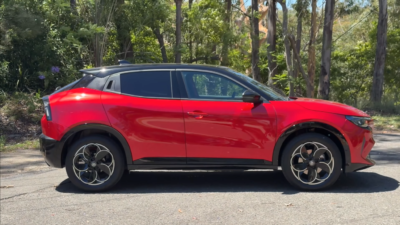
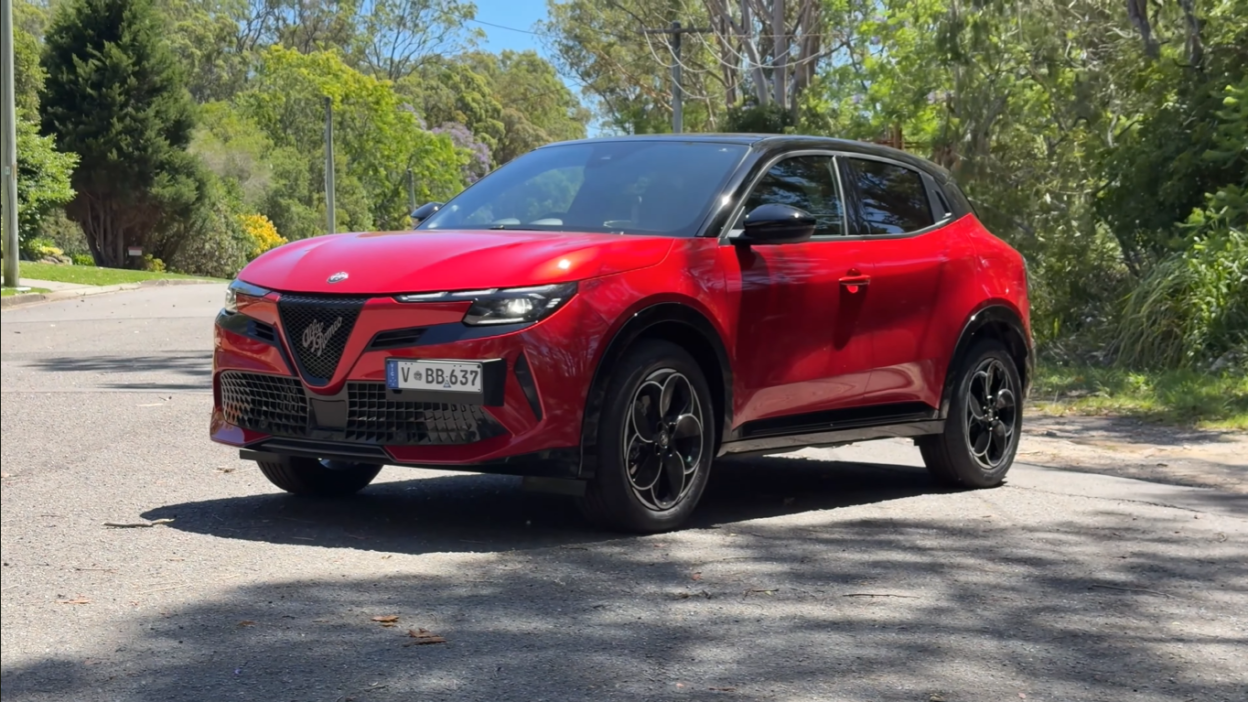
The Alfa Romeo Junior immediately catches your eye. This isn’t just another generic small SUV—it screams Italian design language from every angle. Despite sharing its platform with the Peugeot 2008, Opel Mokka (in Europe), and Jeep Avenger, the Junior manages to look uniquely Alfa Romeo.
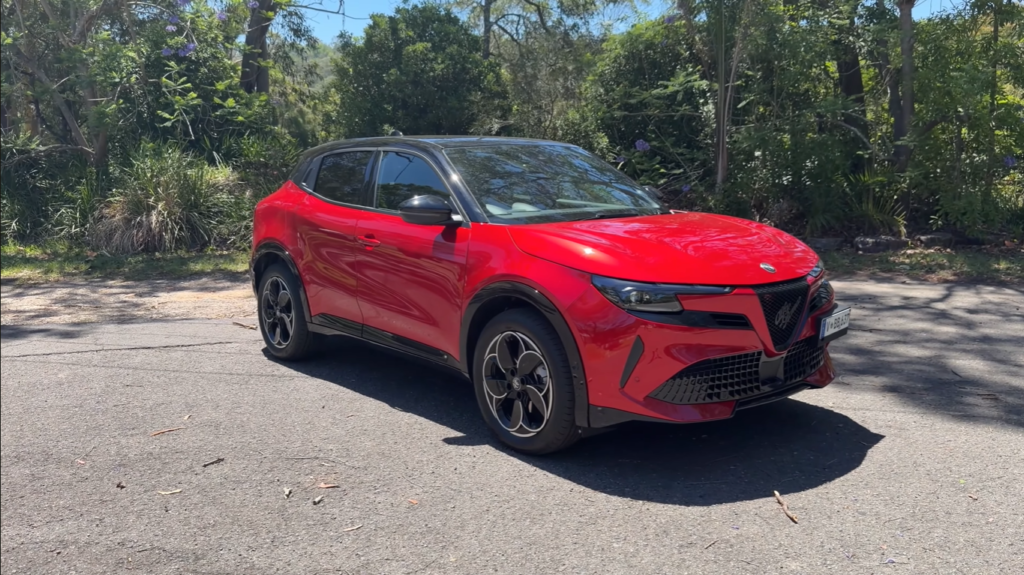
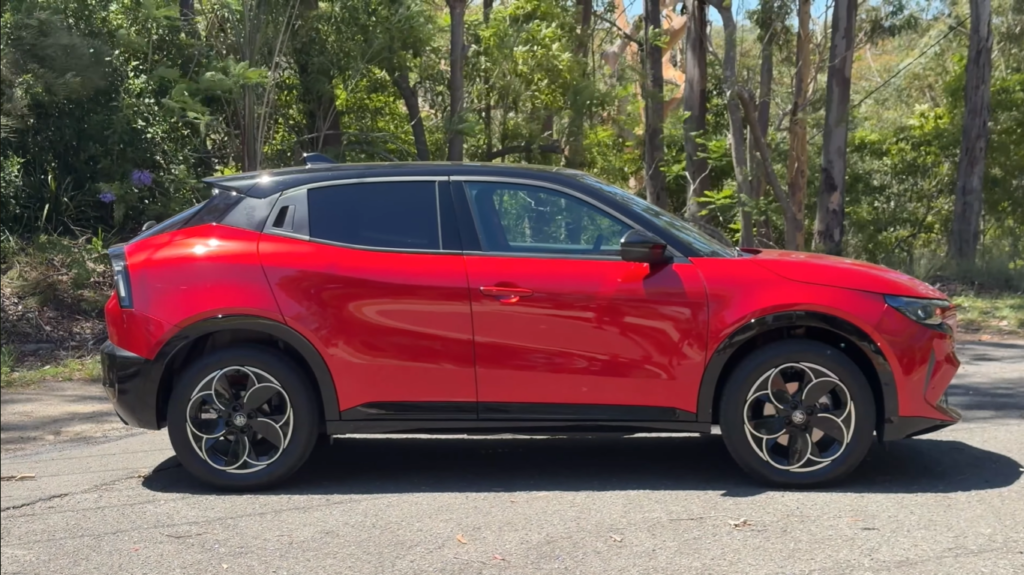
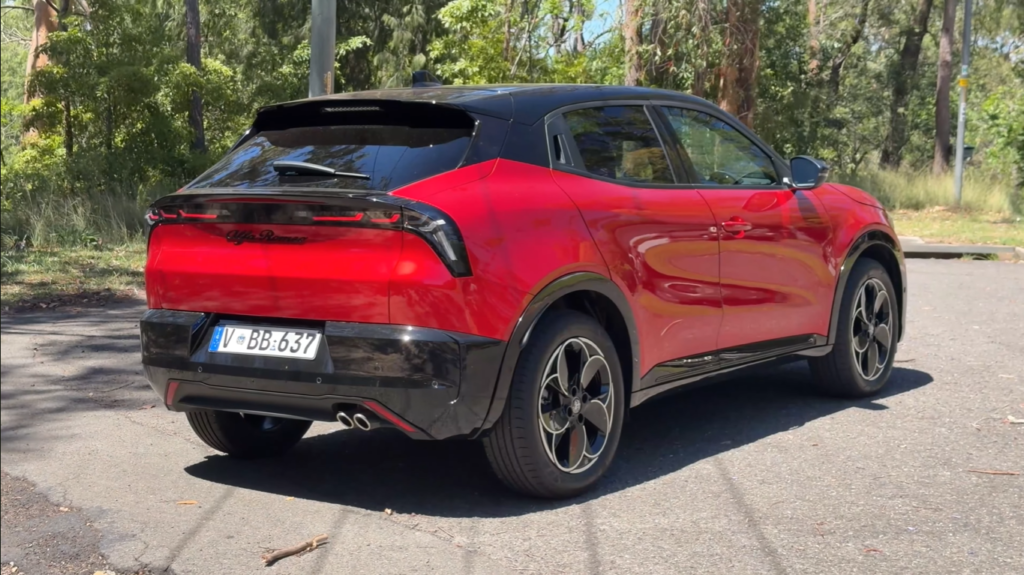
Design Highlights:
- ✅ Signature Alfa Romeo Front Grille – The distinctive shield-shaped grille is instantly recognizable
- ✅ Matrix LED Headlights – Modern lighting technology adds premium appeal
- ✅ Compact Footprint – Under 4.2m length makes it perfect for urban environments
- ✅ Hidden Rear Door Handles – High-mounted handles create a coupe-like silhouette
- ✅ Hands-Free Power Tailgate – Convenient for loading groceries
- ✅ 18-inch Alloy Wheels – Standard equipment, though Australian spec differs from European options
Design Quirks:
- ❌ Awkward Number Plate Placement – The front license plate sits in an odd position, disrupting the clean front-end design
- ❌ Rear Light Garnish – The rear taillight treatment divides opinion
- ❌ No “Junior” Badging – Strangely, the car doesn’t display its model name anywhere
- ❌ Keyless Entry on Driver’s Side Only – A bizarre cost-cutting measure on a $46K car
Why Was It Almost Called Milano?
Originally slated to be called the Alfa Romeo Milano, the name was changed to “Junior” before launch. The Milano name would have paid homage to Alfa Romeo’s historic connection to Milan, Italy, but regulatory or trademark issues likely forced the change. Interestingly, the car bears no “Junior” badging anywhere on the exterior.
Lightweight Construction Benefits
One significant advantage of the shared platform with Peugeot and Jeep is the lightweight construction. Weighing under 1,300kg, the Junior is significantly lighter than many competitors, which benefits handling, acceleration, and fuel efficiency (in theory, at least—more on that later).
Interior Quality & Features: A Mixed Bag
First Impressions – Premium Materials Meet Cost-Cutting
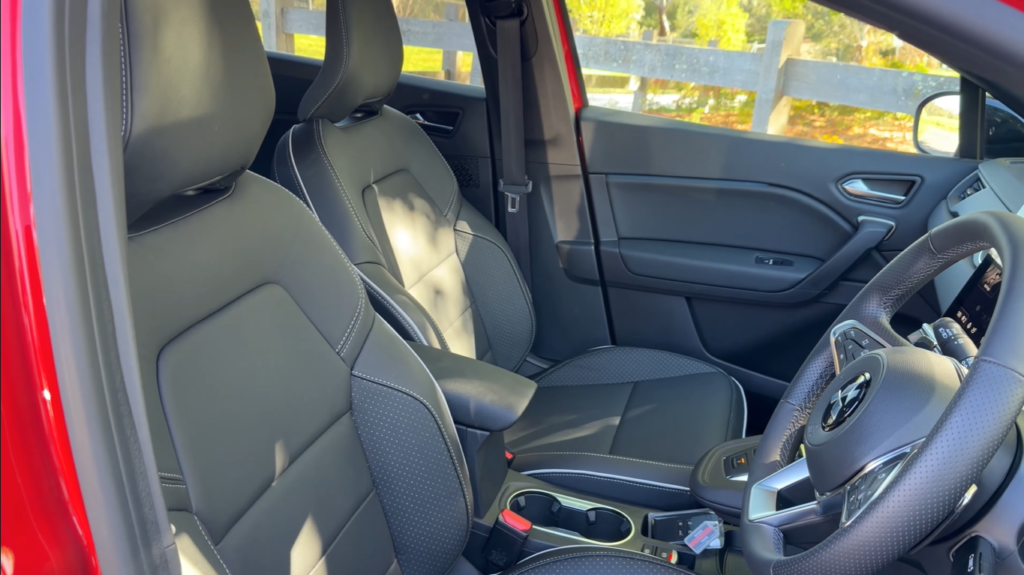
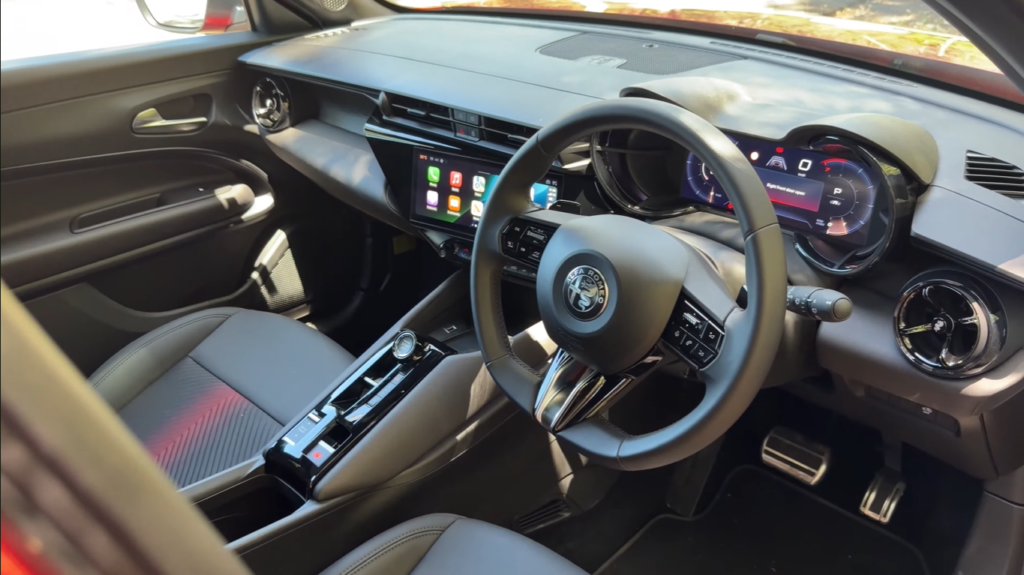
Stepping inside the Alfa Romeo Junior reveals a cabin that’s trying hard to justify its premium price tag. There’s clear evidence of Alfa Romeo branding throughout—from the headrests to the wireless charging pad to the digital displays. However, the shared DNA with Peugeot products is impossible to ignore.
Standard Features (Ibrida Model)
The Junior Ibrida comes surprisingly well-equipped:
Technology & Infotainment:
- 10.25-inch digital instrument cluster
- 10.25-inch central touchscreen
- Wireless Apple CarPlay and Android Auto
- Built-in satellite navigation
- Digital radio (DAB+)
- 6-speaker sound system
- Wireless phone charger
- USB-C ports
Comfort & Convenience:
- Leatherette and cloth upholstery
- Heated front seats (controlled via touchscreen)
- Massaging driver’s seat with power adjustment
- Manually adjustable passenger seat (disappointing at this price)
- Single-zone climate control (not dual-zone—another cost-cutting measure)
- 8-color ambient lighting
- Leather-wrapped steering wheel with paddle shifters
- Aluminum pedals
Optional Extras:
- Panoramic sunroof: +$2,000 (included in test vehicle, but extremely noisy at highway speeds)
Dashboard & Controls – Peugeot DNA Showing
The interior layout is competent but unmistakably borrowed from Peugeot. The 10.25-inch touchscreen uses the same interface, fonts, and menu structure as Peugeot models—even the sliding menu system is identical, just with a slightly different color palette.
What Works Well:
- ✅ Physical Climate Controls – A row of matte black buttons below the screen provides quick access to climate functions without diving into menus
- ✅ Non-Reflective Finishes – The matte black control panel doesn’t show fingerprints or create glare
- ✅ Simple Climate Toggles – Temperature and fan speed adjusters are intuitive
- ✅ Quick Menu Buttons – Physical buttons above the climate controls let you jump between screen menus
- ✅ Steering Wheel Quality – The leather-wrapped wheel feels premium and properly weighted
What Doesn’t Work:
- ❌ Seat Heating Via Touchscreen Only – No physical buttons for a frequently used feature
- ❌ Tight Sun Visor Clips – Comedically over-tensioned, making them difficult to adjust
- ❌ Non-Illuminated Vanity Mirrors – Missing on a $50K vehicle
- ❌ Noisy Panoramic Sunroof – Significant wind noise at highway speeds makes it hard to recommend
DNA Drive Mode Selector
Alfa Romeo’s trademark DNA system (Dynamic, Natural, Advanced Efficiency) controls the driving character:
- Dynamic Mode – Sharpens throttle response, holds gears longer, prioritizes performance
- Natural Mode – Balanced everyday driving (most usable mode)
- Advanced Efficiency Mode – Maximizes hybrid system efficiency, reduces air conditioning power, prioritizes EV driving
Most drivers will find Natural mode perfectly adequate. Advanced Efficiency feels sluggish and compromises comfort by reducing climate control effectiveness.
Interior Space & Practicality: Where It Falls Short
Front Seat Comfort – Mixed Experience
The front seats offer decent comfort for shorter journeys, with good bolstering and adjustability for the driver. The massaging function is a nice touch, though it feels more like a gimmick on a car this size. However, the manually adjustable passenger seat feels cheap on a vehicle approaching $50,000 drive-away.
Rear Seat Space – Compromised
This is where the Alfa Romeo Junior really struggles. As a small SUV measuring under 4.2 meters, rear seat space is predictably tight:
Rear Seat Reality Check:
- ❌ Knee Room – With the driver’s seat set for an average-height adult (around 180cm), rear passengers’ knees press hard against the front seatbacks
- ❌ Limited Legroom – Foot space is minimal; taller passengers will feel cramped
- ❌ Adequate Headroom – Acceptable but not generous
- ❌ Hard Armrests – Uncomfortable door armrests with no padding
- ❌ No Directional Air Vents – Rear passengers get no dedicated climate control
- ❌ Single USB-C Port – Only one charging point for rear passengers
- ❌ No Grab Handles – Nowhere to hold on during spirited driving
- ❌ Basic Door Pockets – Minimal storage, won’t hold much beyond a phone
- ❌ No Center Armrest – No fold-down armrest with cupholders
Child Safety:
- ISOFIX points in both rear window seats
- Three top-tether anchor points
- Reasonable space for child seats, but adults will be uncomfortable
Verdict: If you regularly carry adult rear passengers, the Alfa Romeo Junior will frustrate them quickly. Competitors like the Mitsubishi ASX, Skoda Kamiq, and Renault Duster offer significantly more rear seat space.
Boot Space – Surprisingly Practical
Given the compact dimensions, the boot is actually quite useful:
- ✅ Adjustable Boot Floor – Raise or lower the floor to optimize space
- ✅ Removable Floor Panel – Create even more depth when needed
- ✅ Underfloor Storage – Hidden compartment for storing smaller items
- ✅ 12V Power Outlet – Useful for inflators or small electronics
- ✅ Shopping Bag Hooks – Prevent grocery bags from sliding around
- ✅ LED Lighting – Properly illuminated cargo area
- ✅ Rear Wiper – Keeps the rear window clear (missing on some modern SUVs)
Major Disappointment:
- ❌ No Spare Wheel – Not even a space-saver spare is included
- ❌ Space For Spare Exists – There’s clearly room under the floor, suggesting cost-cutting
- ❌ Repair Kit Only – You get a puncture repair kit, which may not work for all tire damage
For a vehicle that may appeal to adventurous buyers who appreciate Alfa Romeo’s heritage, the lack of a spare wheel is frustrating. Dealerships might sell you one separately, but it should be standard.
Powertrain & Performance: Character Over Efficiency
1.2L Turbo 3-Cylinder Mild Hybrid System
The Alfa Romeo Junior Ibrida features an interesting but compromised powertrain:
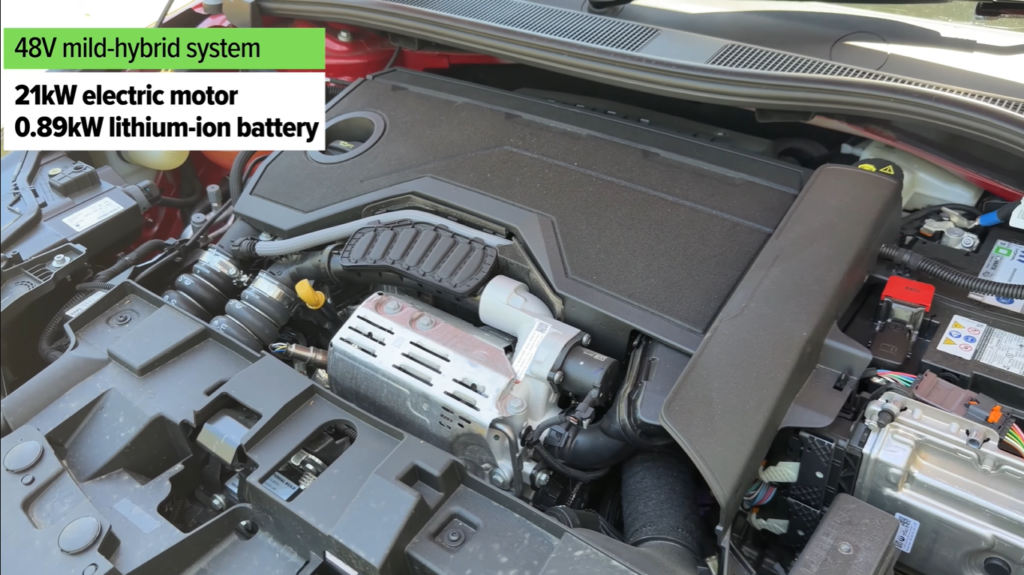
How The Hybrid System Works:
The heart of the system is a 1.2-liter turbocharged 3-cylinder petrol engine paired with a 48-volt mild hybrid system. An electric motor producing 21kW assists the petrol engine during acceleration and can propel the car solely on electricity at very low speeds (parking lots, slow traffic).
The small 0.89 kWh lithium-ion battery stores energy recovered through regenerative braking. When you lift off the accelerator, the system harvests kinetic energy and recharges the battery, similar to how full hybrids and EVs operate, but on a much smaller scale.
Key Powertrain Characteristics:
- ✅ Characterful 3-Cylinder – The three-cylinder engine has personality, with a thrummy, vocal character that many enthusiasts will appreciate
- ✅ Responsive DCT – The 6-speed dual-clutch automatic is generally smooth and quick to respond
- ✅ Paddle Shifters – Manual control is available when you want more involvement
- ✅ Light Curb Weight – Under 1,300kg helps the modest power feel adequate
- ✅ Can Drive in EV Mode – Briefly, at low speeds, for silent operation in car parks
- ❌ Slow Acceleration – 8.9 seconds to 100km/h is leisurely by modern standards
- ❌ Contradictory Character – The vocal 3-cylinder clashes with the silent hybrid system’s philosophy
- ❌ Minimal Electric Assistance – The 21kW motor provides only brief assistance
- ❌ Small Battery – 0.89 kWh is tiny compared to proper hybrids (Toyota Camry Hybrid has 4.3 kWh)
Driving Experience – Actually Quite Fun
Despite the modest specifications, the Alfa Romeo Junior delivers an engaging driving experience that prioritizes feel and involvement over outright performance:
What Makes It Fun:
🏁 Light, Agile Feel – The low curb weight and short wheelbase create a nimble, darty character in urban environments
🏁 Accurate Steering – Light at low speeds for parking, but precise and communicative at higher speeds
🏁 Firm But Controlled Ride – The suspension is on the firmer side, transmitting road surface information without being uncomfortable
🏁 Engaging Engine – The 3-cylinder turbo has character and makes enjoyable noises when you push it
🏁 Grounded Feeling – Low-profile tires and well-tuned suspension create confidence through corners
Ride Quality:
The relatively short wheelbase and firm suspension setup mean the Junior can feel busy over broken pavement. The 18-inch wheels with low-profile tires don’t help, picking up lumps and bumps and transmitting them to the cabin. However, it never crosses the line into uncomfortable—it just reminds you that you’re driving an Italian sports brand, not a soft-riding Japanese crossover.
Brake Pedal Feel:
The regenerative braking system affects brake pedal feel, creating a slightly artificial sensation. There’s a learning curve as you adapt to how the pedal responds, especially during the first few days of ownership. Some drivers will adapt quickly; others may find it annoying long-term.
Fuel Efficiency: The Hybrid Disappointment
Claimed vs. Real-World Fuel Consumption
This is where the Alfa Romeo Junior’s mild hybrid system shows its limitations. As a 48-volt mild hybrid, it’s nowhere near as efficient as full hybrid systems from Toyota, Honda, or even Hyundai/Kia.
Manufacturer’s Claim: Approximately 4-5 L/100km (specific claim not disclosed in review, but typical for this class)
Real-World Testing: 7-8 L/100km in mixed driving (urban, highway, freeway, stop-start)
What This Means:
- ❌ 40-60% Higher Than Claimed – Real-world consumption is significantly worse than official figures
- ❌ Premium Fuel Required – The engine needs 95 RON or higher, increasing running costs
- ❌ Small Fuel Tank – Combined with poor efficiency, expect frequent fuel stops
- ❌ Not a True Fuel-Saver – The characterful 3-cylinder engine prioritizes sound over efficiency
Why Is It So Inefficient?
Several factors contribute to the disappointing fuel economy:
- 3-Cylinder Engine Character – The vocal, thrummy engine isn’t optimized for maximum efficiency
- Minimal Electric Assistance – The tiny 0.89 kWh battery provides only brief EV operation
- 48V Mild Hybrid Limitation – Can’t drive purely on electricity for meaningful distances like full hybrids
- DCT Transmission – Dual-clutch automatics can be less efficient than CVTs in hybrid applications
- Low-Profile Performance Tires – The 18-inch wheels create more rolling resistance
Bottom Line: If fuel efficiency is a priority, look elsewhere. The Toyota Corolla Cross Hybrid, Honda HR-V e:HEV, or even the Suzuki Vitara offer significantly better real-world fuel consumption.
Safety Features & Rating
No ANCAP or Euro NCAP Rating Yet
The Alfa Romeo Junior hasn’t been crash-tested by ANCAP (Australasian New Car Assessment Program) or Euro NCAP at the time of this review. The reviewer suggests it probably wouldn’t achieve a 5-star rating because it lacks some technologies required for maximum scores in modern testing protocols.
Standard Safety Technology
Despite the lack of official rating, the Junior includes:
- ✅ Autonomous Emergency Braking (AEB) – Detects vehicles, pedestrians, and cyclists
- ✅ Adaptive Cruise Control – Maintains distance from the car ahead on highways
- ✅ Lane Keeping Assist – Nudges you back into lane (can be annoying and intrusive)
- ✅ Blind Spot Monitoring – Warns of vehicles in your blind spot
- ✅ Rear Cross Traffic Alert – Detects approaching cars when reversing
- ✅ 360-Degree Surround View Camera – Low quality but functional
- ✅ Front & Rear Parking Sensors – Standard equipment
Airbag Configuration:
- 6 airbags total: Dual front, front side, and curtain airbags covering both rows
- No front center airbag – Could be a concern in side-impact collisions given the narrow cabin
Annoying Safety “Features”
- ❌ Overspeed Warning Chimes – Beeps constantly if it thinks you’re speeding (must be disabled every drive)
- ❌ Inaccurate Speed Sign Recognition – Frequently misreads speed limit signs, triggering false warnings
- ❌ Intrusive Lane Keep Assist – The steering interventions are overly aggressive and must be disabled for comfortable driving
- ❌ No Driver Monitoring Camera – Interestingly absent, which actually improves the driving experience
Missing Modern Safety Tech:
The Junior lacks some features found on competitors:
- Front center airbag (available on many rivals)
- Driver attention monitoring
- Advanced junction assist
- Evasive steering assist
Warranty & Service Costs: The Hidden Catch
Warranty Coverage – Actually Competitive
Alfa Romeo offers a respectable warranty package for the Australian market:
✅ 5-Year Unlimited Kilometer Warranty – Competitive with most mainstream brands ✅ 5-Year Roadside Assistance – Included with the warranty ✅ 12-Month/15,000km Service Intervals – Reasonable service frequency ✅ 10-Year/150,000km Capped Price Servicing – Long-term cost transparency
On paper, this looks excellent—matching or exceeding brands like Mazda, Toyota, and Volkswagen.
Service Costs – The Shocking Reality
Here’s where Alfa Romeo ownership becomes expensive:
- ❌ Average Service Cost: $700+ – Each scheduled service averages over $700
- ❌ Among The Most Expensive – More costly to maintain than SUVs costing 5x as much
- ❌ Premium Parts Pricing – Alfa Romeo parts command premium prices
- ❌ Specialist Knowledge Required – Not all mechanics can service these vehicles
Cost Comparison:
For perspective, many luxury SUVs costing $150,000+ have average service costs under $700. The Alfa Romeo Junior’s maintenance expenses are disproportionately high for its purchase price.
Real-World Ownership Costs:
Over 5 years/75,000km, you’re looking at approximately $3,500-$4,000 in scheduled servicing alone. Factor in the premium fuel requirement and poor real-world fuel efficiency, and the running costs become a significant consideration.
Alfa Romeo Junior Competitors & Alternatives
The Junior faces stiff competition in Australia’s crowded small SUV segment. Here are better-value alternatives:
1. Skoda Kamiq – The Practical European
Why It’s Better:
- Significantly cheaper (from $32,000)
- More rear seat space and cargo room
- 3-cylinder or 4-cylinder turbo petrol options
- 7-year warranty beats Alfa’s 5-year coverage
- Lower service costs
- Proven VW Group reliability
Who Should Choose It: Buyers wanting European quality without the premium price, with superior practicality for families.
2. Mitsubishi ASX (Renault Captur) – The Value Proposition
Why It’s Better:
- Much cheaper pricing (from $30,000)
- More interior space despite similar footprint
- Better equipment levels
- Mitsubishi brand reliability and dealer network
- Lower running costs
- Strong resale values in Australia
Who Should Choose It: Budget-conscious buyers who want a small SUV with surprising space and Mitsubishi’s reputation for longevity.
3. Renault Duster – The Adventurer
Why It’s Better:
- Priced from $32,000-$46,000 (more value at all levels)
- Available with 4WD and manual transmission
- More rugged capability
- Superior cargo space
- Practical interior design
- Lower service costs
Who Should Choose It: Buyers wanting genuine off-road capability and adventure-ready features without the premium price.
Other Strong Alternatives:
Toyota Corolla Cross Hybrid – Legendary Toyota reliability, excellent fuel economy, lower running costs
Honda HR-V e:HEV – Brilliant hybrid system, clever interior packaging, better efficiency
Mazda CX-30 – Premium feel, excellent driving dynamics, better value
Suzuki Vitara – Budget-friendly, surprisingly capable, low running costs
Should You Buy The Alfa Romeo Junior?
Who Should Buy It:
- ✅ Alfa Romeo Enthusiasts – Those who appreciate the badge and brand heritage
- ✅ Urban Drivers – Perfect for city driving with limited rear passenger needs
- ✅ Style-Conscious Buyers – Willing to pay premium for distinctive Italian design
- ✅ Driving Engagement Fans – Those who prioritize handling and feel over practicality
- ✅ Singles or Couples – With no regular rear passengers to accommodate
Who Should Avoid It:
- ❌ Families – Rear seat space is too compromised for regular adult passengers
- ❌ Value Seekers – Competitors offer more for less money
- ❌ Efficiency Focused – Real-world fuel consumption disappoints
- ❌ Budget-Conscious – High service costs add up over ownership
- ❌ Long-Distance Drivers – Noisy sunroof and firm ride aren’t ideal for highway cruising
Final Verdict: Style Over Substance
Rating: 6.5/10
The Alfa Romeo Junior is a car that prioritizes emotional appeal over rational decision-making. It looks fantastic, drives with genuine character, and offers that intangible Italian flair that you simply can’t get from a Suzuki Vitara or Mitsubishi ASX.
However, at $50,000+ drive-away, it’s expensive for what you get. The cramped rear seats, disappointing fuel efficiency, lack of spare wheel, and eye-watering service costs make it hard to recommend as a smart purchase.
Alfa Romeo Junior Review 2026: 10 Reasons to Buy (or Not)
The Bottom Line
Buy the Alfa Romeo Junior if: You value style, badge prestige, and driving enjoyment above all else, and you don’t regularly carry rear passengers.
Skip the Alfa Romeo Junior if: You need practicality, efficiency, value for money, or low running costs.
The Junior proves Alfa Romeo is still alive in Australia, but whether it should be is another question entirely. It’s a niche product for a niche audience—and if you’re part of that audience, no amount of rational argument will change your mind. For everyone else, there are simply better small SUVs available.
Would you buy an Alfa Romeo Junior, or would you choose one of the more practical alternatives? Share your thoughts in the comments below!
The hybrid Ibrida model costs $45,990 before on-road costs (approximately $50,000 drive-away). The electric Elettrica model is $57,990.
No. Rear seat space is very limited, with adults’ knees pressing against front seats. It’s better suited to singles or couples.
Real-world testing showed 7-8 L/100km in mixed driving, significantly higher than manufacturer claims. It also requires premium 95 RON fuel.
Disclaimer: Pricing and specifications are accurate as of January 2026 for the Australian market. Always confirm current pricing, availability, and specifications with your local Alfa Romeo dealer.