MyPitShop | January 2026 | Australia
Kia has just dropped something genuinely different into the Australian EV market — and for once, it is not an SUV. The Kia EV4 is a full-blooded electric sedan, arriving with a compelling price tag, surprisingly strong range numbers, and a cabin that feels a cut above what you might expect at this price point. But it also comes with some quirky design choices and a few compromises that deserve an honest look before you sign anything.
We have driven it across country roads, freeways, and city streets in Victoria. Here is everything you need to know.
What Is the Kia EV4, and Why Should You Care?
In an Australian car market absolutely drowning in electric SUVs, the EV4 stands out simply by being a sedan. It slots into the same rough footprint as a Toyota Camry — classified as a medium sedan — which means it is a genuinely usable, daily-driver-sized car, not some compact runabout you have to fold yourself into.
Kia has positioned it as the practical, value-driven alternative to the Tesla Model 3 and the BYD Seal. And on paper, it already stacks up well. The question is whether the real-world experience backs up the spec sheet — and whether the design and practicality trade-offs are ones you can live with.
Pricing and Trim Levels: What Are You Actually Getting?
The EV4 arrives in Australia in three distinct trims, each with its own personality:
Kia EV4 Air (Entry-Level)
- Starting price: Under $50,000 (before on-road costs)
- Battery: 58.3 kWh NMC
- Range: 456 km (WLTP)
- Key gear: 12.3-inch touchscreen with wireless Apple CarPlay and Android Auto, 12.3-inch digital instrument cluster, dual-zone climate control, LED lighting, 17-inch alloy wheels, Google-integrated sat nav, Kia Connect telematics, cloth upholstery
The Air is leaner and lighter than the other two, which actually makes it the quickest to 100 km/h in the range — more on that shortly.
Kia EV4 Earth (Mid-Range)
- Battery: 81.4 kWh NMC (long-range pack)
- Range: 612 km (WLTP)
- Key upgrades: 19-inch alloys, larger brakes, auto-dimming rear-view mirror, 10-way power driver’s seat with lumbar adjustment, heated front seats, artificial leather trim, vehicle-to-load capability built in
The 612 km range claim alone is enough to make most Australians sit up and take notice. That is serious long-range territory.
Kia EV4 GT Line (Top of the Range)
- Battery: 81.4 kWh NMC (long-range pack)
- Range: 612 km (WLTP)
- Key upgrades: Harman Kardon 8-speaker audio, head-up display, wireless phone charger, ventilated front seats, glass sunroof, electric tailgate, rear privacy glass, surround-view camera, blind-spot view monitor, rear auto braking, sportier exterior styling with unique wheels and headlights
The GT Line is where Kia has really gone all out on the premium feel. It is sharper, more tech-laden, and frankly, the best-looking version of the three.
The Design: Love It or Hate It, You Will Talk About It
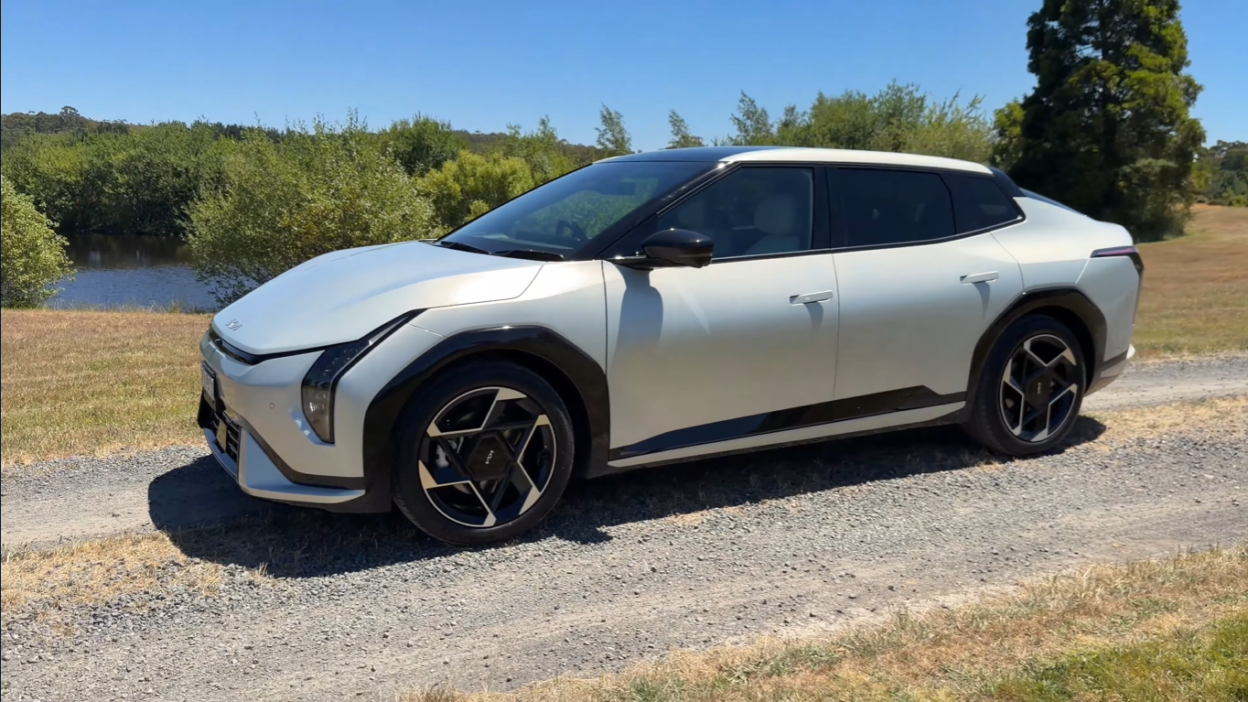
Let us be blunt: the Kia EV4 is not conventionally beautiful. It does not have the clean three-box sedan silhouette that generations of buyers have come to expect, and it is not a traditional hatchback either. It exists somewhere in between — an odd, angular shape that some will find bold and futuristic, and others will find just plain strange.
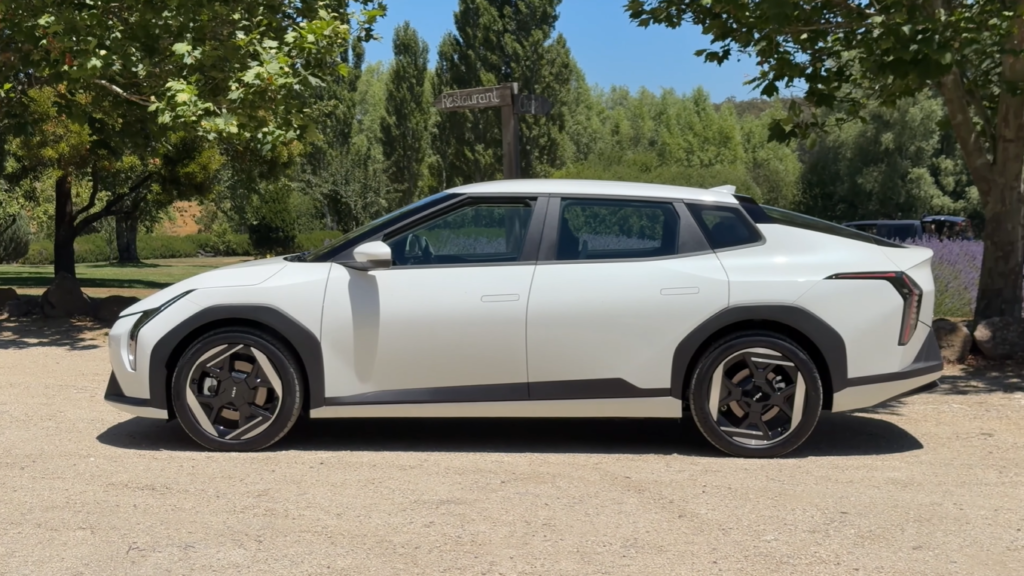
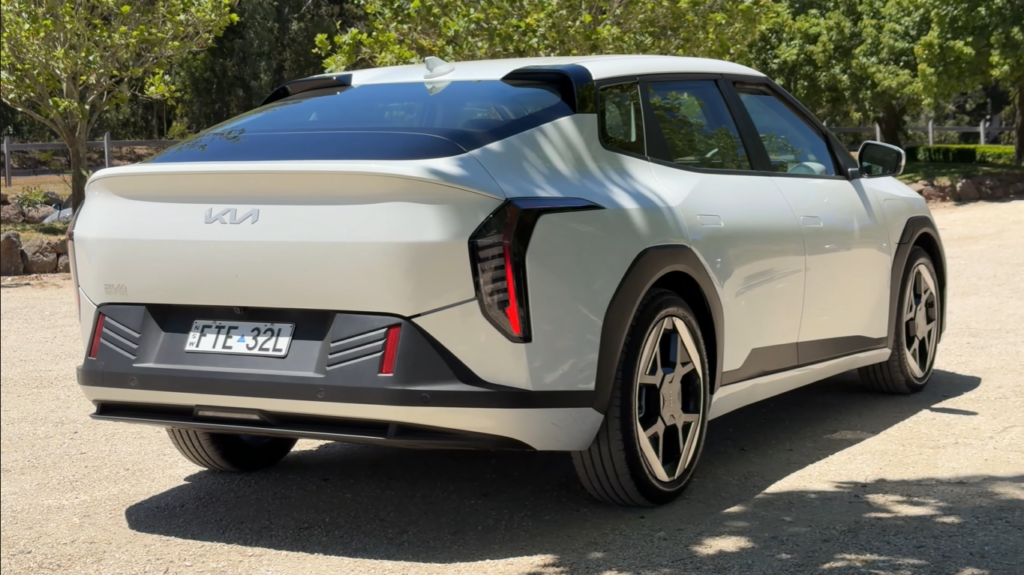
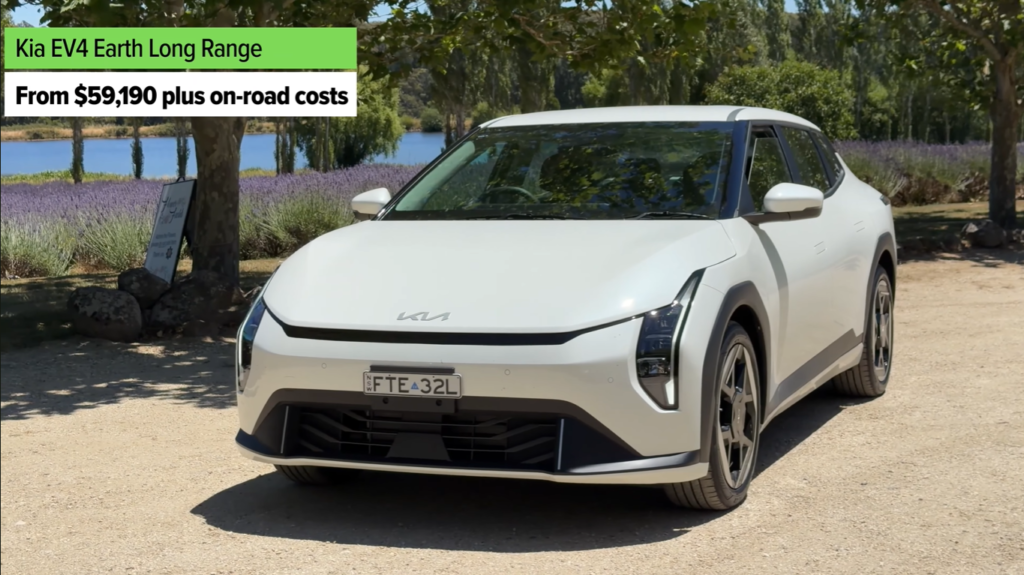
The pop-out door handles are another talking point. They look sleek and flush, but they only appear on the front doors — the rears have a traditional setup, which feels inconsistent. The rear end, in particular, has drawn comparisons to cartoon characters, and while beauty is subjective, there is no denying the EV4 has a polarising rear profile.
The two-tone paint finish, however, is genuinely striking. It gives the car a sense of visual depth and presence that softens some of the stranger design decisions. If you can find a colour combination you love, the EV4 can look properly impressive in the flesh.
Inside: Where the EV4 Starts to Shine
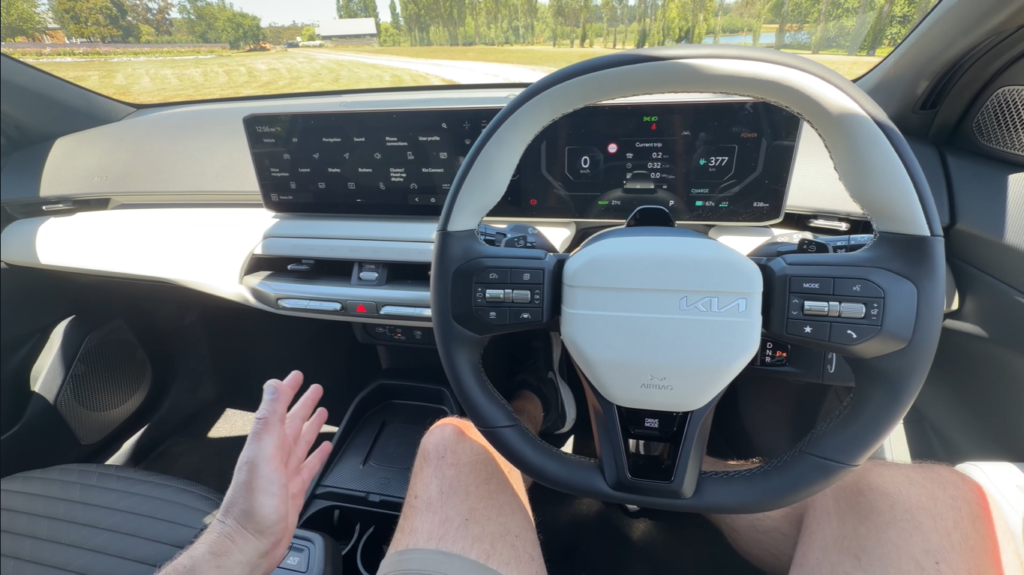
Step inside and the cabin tells a very different story to the exterior. The interior is well-designed, tidy, and feels complete in a way that budget EVs often do not manage.
The Front Cabin
The two-tone finish carries through from the doors to the dashboard and even onto the steering wheel, creating a cohesive, premium feel. The seats in the GT Line are plush, with a mesh-style headrest and embossed detailing, and they benefit from both heating and ventilation — a genuine comfort win on long drives.
Storage is thoughtful. You get a conventional glove box (increasingly rare in EVs), decent-sized bottle holders, a storage box between the seats, and adjustable cup holders that tuck away when you need more centre console space. The wireless phone charger, unfortunately, is only available on the GT Line, which feels like an oversight given that all models already support wireless Apple CarPlay.
The climate controls are a mixed bag. There is a small 5-inch touchscreen panel dedicated to the climate system, but it is positioned awkwardly — hard to see from the driver’s position without leaning forward. The saving grace is that Kia has kept physical buttons for temperature, fan speed, and mode selection below the main screen. That is a sensible compromise that many other EV makers have abandoned entirely.
The Tech Setup
The 12.3-inch main touchscreen is genuinely good. It is responsive, well-organised, and integrates Google Search directly into the sat nav. You can find nearby EV charging stations, monitor your battery health, set departure temperatures remotely via the Kia Connect app, and access weather information — all without feeling like you are navigating a maze of menus.
Wireless Apple CarPlay and Android Auto are standard across the range, which is exactly how it should be. The instrument cluster is another 12.3-inch digital unit, clean and easy to read.
One minor gripe: the volume and media controls sit on semi-touch buttons near the main screen, and if you rest your hand while reaching for the touchscreen, you will accidentally bump them. It is a small annoyance, but it adds up over time.
The Back Seat
Rear headroom is adequate for adults up to around 6 feet tall, though the dark headliner creates a slightly enclosed feeling. Knee room is generous, but toe room is tighter than ideal — you end up in more of a “knees up” position than you would like on longer trips.
The rear seats are well thought out in terms of amenities: directional air vents, USB charging ports built into the backs of the front seats, a vehicle-to-load power outlet (on long-range models), map pockets, and ISOFIX anchor points in both window seats with three top tethers. The flat floor also makes three-across seating viable, though child seats will reduce that to two practical positions.
The rear lighting is basic — just a single on/off light in the centre — which could be frustrating if you have young kids and are frequently getting them in and out after dark.
The Boot: Practical Enough, But Not Perfect
This is where the EV4’s unusual shape creates its most noticeable compromise. The boot is long and deep, but the aperture — the opening you use to load things — is an odd shape, partly eaten into by the tailgate hinges. The sides are also slightly narrowed, which limits how you can arrange larger items.
There are no shopping bag hooks, no mesh side pockets, and no rubberised lining on the storage tray above the boot floor. Under the boot floor, there is space for your charging cable and a tyre repair kit, but Kia says there is no room for a spare wheel. Whether that is strictly true or just a cost-saving decision is debatable.
The electric tailgate (GT Line only) is a nice touch for convenience, but it does not change the fundamental shape of the space. If boot capacity is a priority for you, the Deepal E07 multi-truck is worth considering as an alternative — its hatch-style rear opens up significantly more practical space.
Performance: Punchy Enough for Everyone
Every single Kia EV4 — regardless of trim — comes with the same powertrain: a 150 kW, 283 Nm single-speed electric motor driving the front wheels.
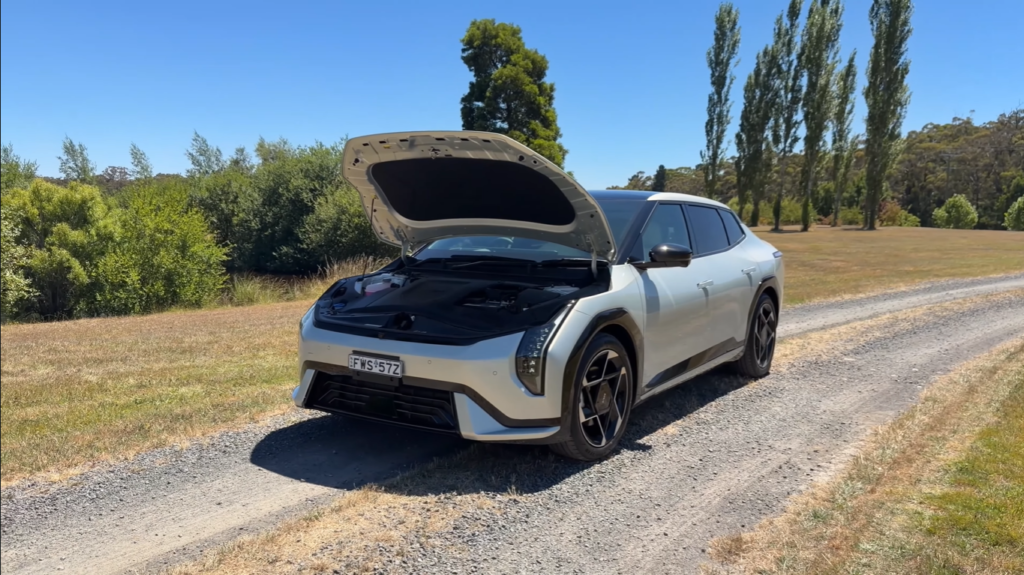
That might sound modest on paper, but in practice it delivers exactly what you expect from an EV. The instant torque means the car pulls away with confidence and authority every time you press the accelerator. It is not going to pin you back in your seat like a sports car, but it is more than urgent enough for merging onto freeways, overtaking on country roads, and keeping up with traffic at any speed.
Interestingly, the base Air model is actually the quickest to 100 km/h — 7.4 seconds — compared to 7.8 seconds for the heavier Earth and GT Line. The lighter kerb weight of the shorter-range battery makes a genuine difference.
Towing capacity is limited on the Air, but the Earth and GT Line can tow up to 1,000 kg on the brakes — useful to know if you ever need to tow a trailer or a small boat.
Driving Experience: The Real Highlight
If there is one area where the Kia EV4 truly delivers, it is in how it feels to drive day after day.
Kia Australia has applied a local ride and handling tune to this car. The suspension, anti-roll bars, and steering maps have all been reworked specifically for Australian roads and driving preferences. When we asked the local ride and handling chief what he changed, his answer was simple: everything.
And it shows. The steering is weighted and predictable, though it leans slightly on the heavier side — there is not much of a “wow” factor when you push it hard into a corner. This is not a hot hatch, and you would be doing yourself a disservice to expect one. What it is, however, is an exceptionally well-mannered, composed, and comfortable cruiser.
The suspension soaks up most road imperfections with minimal fuss. Potholes, speed bumps, and patchy bitumen are handled with a quiet, composed ride that makes long-distance driving genuinely pleasant. There is a slight tendency for the rear to push up over larger bumps, but for the 90% of driving you will do daily — commuting, school runs, weekend trips — it is genuinely impressive.
The cabin refinement backs this up. Road noise and wind noise intrusion are both well controlled, whether you are crawling through inner-city traffic or cruising at highway speeds. For a car at this price point, the overall refinement level is a genuine achievement.
Regenerative Braking
The regen braking system is one of the better implementations we have experienced. It is smooth, predictable, and — crucially — adjustable. You can use the paddle shifters to cycle through different regen levels, from full single-pedal driving (where the car will bring itself to a complete stop) right down to a feather-light setting that mimics the coasting feel of a conventional petrol car. That flexibility is rare and genuinely useful.
Battery, Range, and Charging: The Numbers That Matter
Range
- Air (58.3 kWh): 456 km WLTP
- Earth / GT Line (81.4 kWh): 612 km WLTP
The 612 km figure on the long-range models is genuinely impressive and puts the EV4 in serious contention for road-trip duty, not just city commuting.
Charging
- AC charging: Up to 10.5 kW (compatible with three-phase home charging)
- DC fast charging: Up to 128 kW (do not be misled by the 350 kW figure on some spec sheets — the car does not support that)
- Charging port location: Front driver’s side — something to consider if you are a street parker, as it limits which side of the kerb you can charge from
Vehicle-to-Load
The Earth and GT Line models come with built-in vehicle-to-load capability, with a proper power outlet on the outside of the car. You can run a laptop, phone chargers, or small appliances directly from the battery. The Air can also do this with an optional adapter purchased separately.
Real-World Efficiency
The official efficiency numbers are strong on paper, and real-world testing confirms that the EV4 delivers on that promise. Driving a mix of country roads, highway, and urban streets in Victoria, the numbers held up well and were genuinely impressive for a car of this size and weight.
Safety: Solid Across the Board
The Kia EV4 has earned Euro NCAP ratings — four stars in standard form, and five stars with the safety pack. Australian models are expected to carry the five-star ANCAP rating, as they all come with the safety pack as standard.
Standard safety features include:
- Autonomous emergency braking with pedestrian, cyclist, and junction detection
- Adaptive cruise control with stop, start, and steer capability
- Lane keep assist and lane trace assist
- Speed sign recognition
- Driver monitoring camera
- Blind-spot monitoring and rear cross-traffic alert
GT Line adds:
- Surround-view camera
- Blind-spot view monitor camera
- Rear auto braking
The rear auto braking feature, in particular, feels like something that should be standard on every model — it is the kind of safety net that could genuinely prevent an accident in a car park.
Airbag coverage is comprehensive: seven airbags total, including dual front, front side, a front-centre airbag to prevent occupant clash, and full curtain coverage for both rows.
Warranty and Servicing: The Fine Print
Kia Australia backs the EV4 with a 7-year, unlimited-kilometre warranty on the vehicle, and has upgraded the battery warranty to 8 years / 160,000 km — up from the previous 7-year / 150,000 km standard. That battery warranty now sits at the class benchmark, which is reassuring.
Service intervals are every 12 months or 15,000 km. That is more frequent than many EV competitors, which typically offer 2-year / 30,000 km intervals. It is not a dealbreaker, but it is worth factoring into your running cost calculations.
There is no traditional capped-price servicing plan, but Kia does offer prepaid plans across 3, 5, and 7 years. Rolling one of those into your finance repayments is a smart move — it smooths out the cost and removes the guesswork. Service with Kia also earns you up to 8 years of roadside assistance; otherwise, you only get the first 12 months.
The Competition: How Does the EV4 Stack Up?
Tesla Model 3
The benchmark electric sedan in Australia. Incredibly space-efficient, great range options, and strong performance. The catch is that Tesla asks you to adapt the way you interact with the car — almost everything is on one giant touchscreen, which not everyone loves. The Model 3 is a harder car to live with on a daily basis for some people, even though it is technically impressive.
BYD Seal
Starts at around $46,000, which undercuts the EV4 Air. It has conventionally attractive styling — arguably more appealing than the EV4’s polarising shape — and packs in strong features for the money. Long-range versions are available at a price premium. A genuinely strong competitor that deserves serious consideration.
Deepal E07 Multi-Truck
A wild card, but a smart one. It is a ute-style electric vehicle with a hatch at the rear that opens up significantly more practical space than the EV4’s boot. If you want something bigger, more versatile, and with genuinely impressive driving dynamics, the E07 is worth a test drive. It is available in both rear-wheel-drive and all-wheel-drive variants — a big advantage over the EV4’s front-wheel-drive only setup.
Verdict: Should You Buy the Kia EV4?
The Kia EV4 is not a perfect car. The design will divide opinion, the boot is compromised by its unusual shape, and the service intervals are more frequent than the competition. The wireless phone charger really should be standard, and the surround-view camera should not be reserved for the top trim only.
But here is the thing: none of those flaws are dealbreakers for the right buyer.
If you are looking for an electric sedan — not an SUV — that is genuinely pleasant to drive, impressively refined, packed with technology, and backed by one of the best warranties in the business, the Kia EV4 deserves a very serious look. The 612 km range on the long-range models removes the anxiety that still plagues a lot of EV buyers. The cabin feels complete and well-considered in a way that punches above its price point. And the driving experience, thanks to Kia Australia’s thorough local tune, is one of the most agreeable we have encountered in this segment.
The GT Line, in particular, represents outstanding value for what you are getting — sporty looks, premium tech, long range, and genuine daily-driver comfort, all in one package.
If you want an EV that actually feels finished — this is one of the best in the business.
Quick Specs at a Glance
| Spec | Air | Earth | GT Line |
|---|---|---|---|
| Starting Price | Under $50,000 | TBD | TBD |
| Battery | 58.3 kWh | 81.4 kWh | 81.4 kWh |
| Range (WLTP) | 456 km | 612 km | 612 km |
| Power / Torque | 150 kW / 283 Nm | 150 kW / 283 Nm | 150 kW / 283 Nm |
| 0–100 km/h | 7.4 sec | 7.8 sec | 7.8 sec |
| Max Towing | Limited | 1,000 kg | 1,000 kg |
| DC Fast Charge | Up to 128 kW | Up to 128 kW | Up to 128 kW |
| Drive | FWD | FWD | FWD |
| Warranty | 7 yr / unlimited km | 7 yr / unlimited km | 7 yr / unlimited km |
| Battery Warranty | 8 yr / 160,000 km | 8 yr / 160,000 km | 8 yr / 160,000 km |
MyPitShop — Honest Reviews. Smarter Choices.