MyPitShop | January 2026 | India
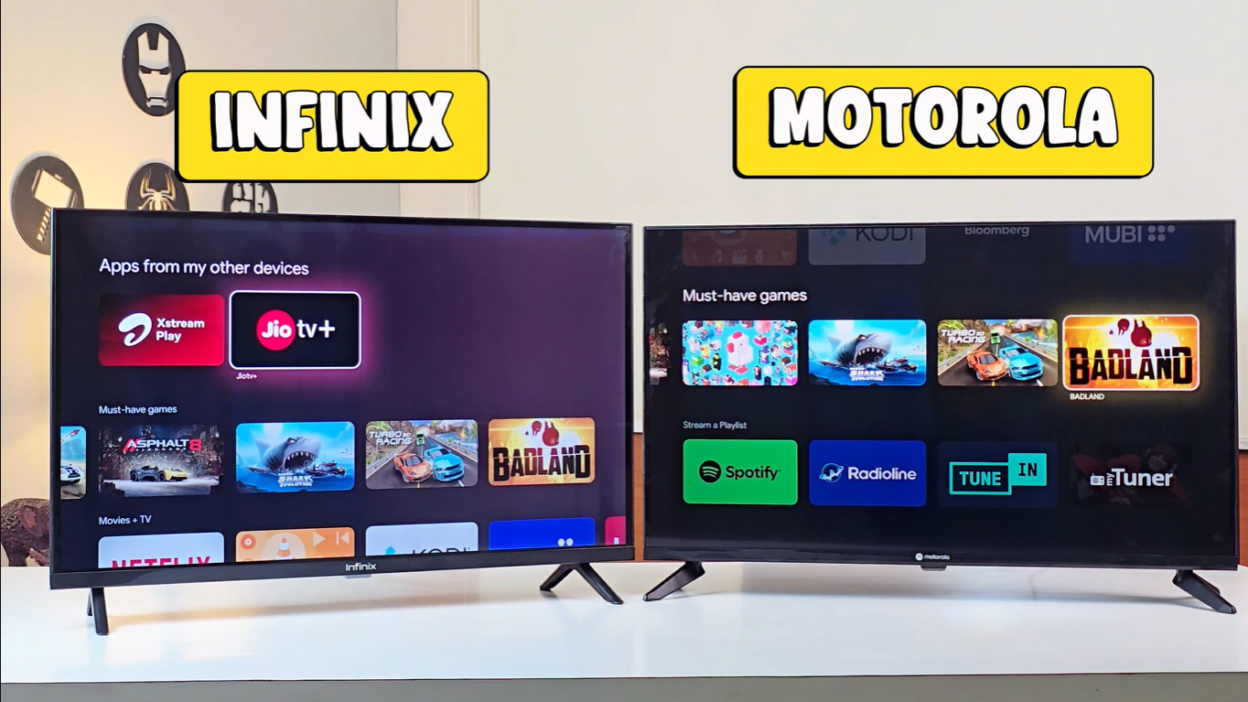
The budget smart TV market in India is absolutely packed right now, and two names keep showing up in every “best TV under ₹10,000” conversation: Infinix and Motorola. Both brands have launched 32-inch QLED smart TVs that are priced almost identically — one at around ₹8,000 to ₹9,000, the other at ₹9,500. On paper, they look nearly identical. In real-world use, they are very different.
We put both TVs side-by-side for weeks — testing the display quality, speakers, UI speed, build, ports, and everything in between. Here is the honest, no-nonsense breakdown of which one is actually worth your money.
Quick Comparison at a Glance
| Feature | Infinix 32-Inch QLED | Motorola 32-Inch QLED |
|---|---|---|
| Price | ₹8,000 – ₹9,000 | ₹9,500 |
| Display | 32-inch QLED, HD Ready | 32-inch QLED, HD Ready |
| Resolution | 1366 x 768 (HD Ready) | 1366 x 768 (HD Ready) |
| HDR Support | Yes | Yes |
| Viewing Angle | 178° | 178° |
| Speakers | 20W (10W + 10W) | 40W (20W + 20W) |
| USB Ports | 2 | 2 |
| HDMI Ports | 2 | 3 |
| Operating System | Android 14 (Google TV) | Android 14 (Google TV) |
| RAM / Storage | 1GB / 8GB | 1GB / 8GB |
| Remote Hotkeys | Netflix, YouTube, Prime, Hotstar | Netflix, YouTube, Prime |
| Energy Rating | 1 Star (60W/year) | 1 Star (60W/year) |
| Best For | Natural colours, tight budget | Speed, sound, extra HDMI port |
Build Quality and Design: Nearly Identical, But One Small Detail Matters
At first glance, both TVs look almost identical. They are both 32-inch panels with fiber body construction, similar stand designs, and wall-mounting support on the back. The height is nearly the same, though the Infinix is marginally taller. If you wall-mount either TV, they will look and feel almost indistinguishable.
But there is one small design detail that actually matters: the gap between the screen and the bezel edge.
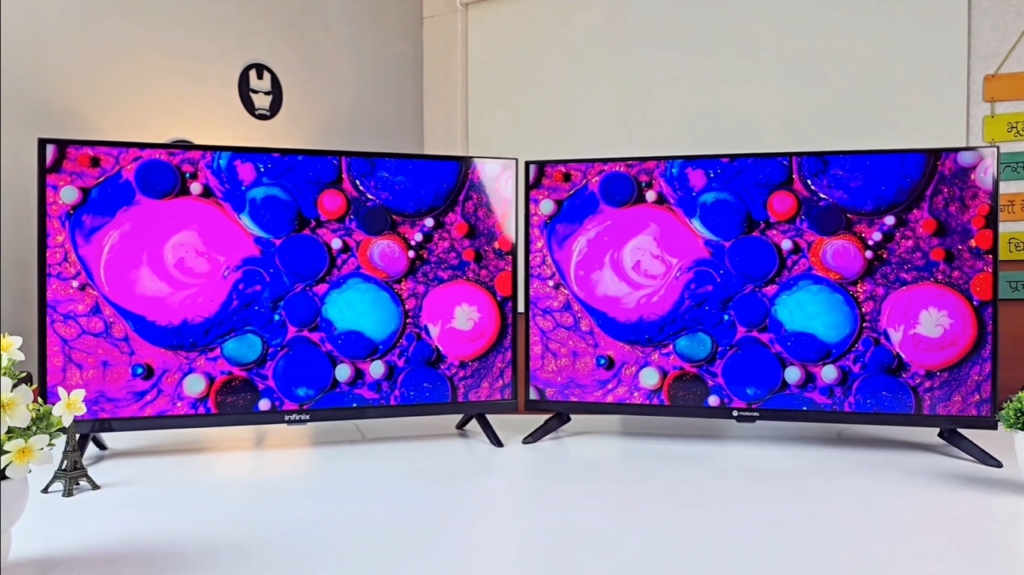
On the Motorola, the screen sits flush against the edge with almost no gap. That looks cleaner, but it also means any impact on the edge could transfer directly to the screen, potentially causing damage.
On the Infinix, there is a small gap between the screen and the bezel edge. That gap acts as a buffer. If the edge takes an impact, it is less likely to transfer directly to the screen. For a budget TV that might get moved around a lot, that is actually a smart design choice.
Verdict: Nearly identical build, but Infinix has a slight edge in impact protection.
Ports and Connectivity: Motorola Wins with an Extra HDMI Port
Both TVs offer:
- 2x USB ports
- AV input
- RJ45 Ethernet port
- Headphone jack
- Optical audio out
But the HDMI port count is where they differ:
- Infinix: 2x HDMI ports
- Motorola: 3x HDMI ports
That extra HDMI port on the Motorola is genuinely useful. You can connect a laptop, a PlayStation or Xbox, and a streaming stick — all at the same time — without needing to swap cables. For a lot of users, that is the kind of small convenience that adds up over time.
Verdict: Motorola wins on connectivity.
Display Quality: Saturated vs Natural — Pick Your Preference
Both TVs use 32-inch QLED panels with HD Ready resolution (1366 x 768). Both support HDR content and offer a 178° viewing angle, which means colours stay consistent even when you are watching from the side. On YouTube, both can play videos up to 1440p resolution.
But the colour tuning is where they genuinely differ.
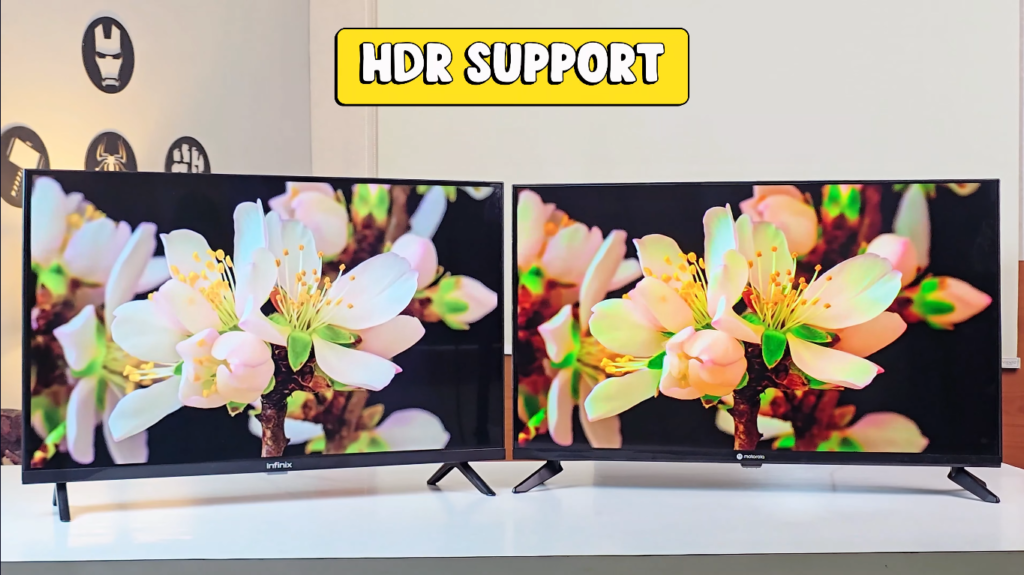
Motorola: Saturated, Sharp, Punchy
The Motorola panel delivers saturated colours — reds look redder, blues look bluer, and the overall image has a punchy, vibrant feel. It also offers better sharpness and clarity, which means content looks crisper and more defined. If you are watching movies, music videos, or sports, the Motorola’s display has more visual impact.
The trade-off is that colours can sometimes feel a bit oversaturated. Reds, in particular, can look a touch too intense. But you can dial down the saturation level in the settings if you prefer a more neutral look.
Infinix: Natural, Softer, Less Sharp
The Infinix panel delivers more natural colours — the kind of balanced, realistic tones that feel closer to what you would see in real life. For some viewers, that is a big advantage. The colours are not artificially boosted, which means skin tones and natural scenes look more accurate.
The downside is that the sharpness and clarity are slightly lower than the Motorola. Content does not feel as crisp or defined, especially when you compare them side-by-side. The overall image can also feel a bit duller, though that is partly a function of the more neutral colour tuning.
Which One Is Better?
It depends on what you prioritise:
- Want punchy, vibrant, sharp visuals? Go with Motorola.
- Want natural, balanced, accurate colours? Go with Infinix.
Both TVs let you adjust colour modes (Cinema Mode, Movie Mode, Game Mode, News Mode) in the settings, so you can tweak the image to your preference.
Verdict: Motorola for sharpness and vibrancy. Infinix for natural colour accuracy. Personal preference wins here.
Speakers: This Is Not Even Close — Motorola Destroys Infinix
This is the one category where there is no debate. Motorola absolutely crushes the Infinix when it comes to audio.
- Infinix: 20W total speaker output (10W + 10W)
- Motorola: 40W total speaker output (20W + 20W)
That is a 20W difference, and you can hear it immediately. Motorola delivers significantly louder, fuller, and richer sound. It is genuinely impressive for a budget TV — to the point where you do not need a soundbar for a single room. The audio is clear, punchy, and has enough bass to make movie dialogue and music sound engaging.
The Infinix, by comparison, sounds thin and weak. It is fine for casual TV watching, but if you are planning to watch movies, sports, or play games, the audio will leave you wanting more.
Verdict: Motorola wins by a landslide. The 40W speakers are a massive upgrade.
Remote Control: Nearly Identical, But Infinix Has a Magic Trick
Both remotes are nearly identical in layout and functionality:
- Infinix hotkeys: Netflix, YouTube, Prime Video, Hotstar
- Motorola hotkeys: Netflix, YouTube, Prime Video
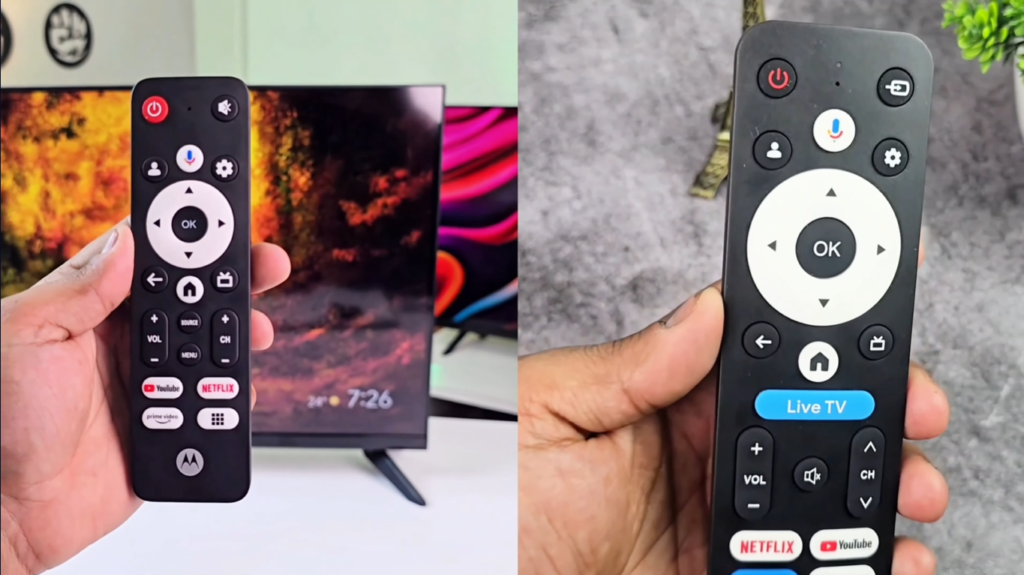
Both remotes support voice commands, which makes searching and navigating much easier. Just press the mic button and speak your query.
But here is a funny quirk we discovered: the Infinix remote can control both TVs. The Motorola remote, however, only controls the Motorola TV. We are not sure if that is intentional or just a strange compatibility quirk, but it is worth noting if you end up owning both brands.
Verdict: Nearly identical, with a slight edge to Infinix for the extra Hotstar button.
User Interface and Speed: Motorola Is Noticeably Faster
Both TVs run Android 14 with Google TV, so the interface layout is identical. You get the same app library, the same Google Play Store access, and the same ability to download Netflix, Prime Video, Hotstar, and other streaming apps.
But the performance and speed are noticeably different.
Motorola: Fast, Smooth, Responsive
Motorola opens apps quickly, closes them smoothly, and navigates the UI without lag or stutter. It genuinely feels snappy and responsive, which makes day-to-day use far more pleasant. Whether you are switching apps, browsing menus, or scrolling through content, the Motorola keeps up without frustrating delays.
Infinix: Slower, Occasional Lag
The Infinix, on the other hand, feels slower and occasionally stutters. Apps take a bit longer to open and close, and there is a noticeable lag when navigating menus. It is not unbearable, but it is frustrating enough that you notice it regularly. If you are someone who switches between apps frequently or gets impatient with slow interfaces, the Infinix will annoy you.
Verdict: Motorola is significantly faster and smoother. If UI speed matters to you, this is a big advantage.
Specifications: Identical RAM and Storage
Both TVs come with:
- 1GB RAM
- 8GB internal storage
When you first boot up the TV, the available storage drops to around 4.1 to 4.3 GB after accounting for the pre-installed UI and system files. That is enough for a few apps, but you will need to manage storage carefully if you download a lot of games or streaming apps.
Both TVs also have the same energy consumption rating — 1 Star with 60W per year. Your electricity bill will be identical regardless of which TV you choose.
Verdict: Completely identical specs. No difference here.
Price and Value: Which One Is Worth Your Money?
Here is where it all comes together:
- Infinix 32-Inch QLED: ₹8,000 – ₹9,000
- Motorola 32-Inch QLED: ₹9,500
That is a difference of ₹500 to ₹1,500 depending on sales and offers. The question is whether the Motorola is worth the extra money.
Let us break down what you get for that premium:
Motorola’s Advantages:
- 40W speakers (vs 20W on Infinix) — genuinely excellent sound
- 3 HDMI ports (vs 2 on Infinix) — more connectivity options
- Sharper, punchier display — better clarity and vibrancy
- Faster UI and app performance — smoother day-to-day experience
Infinix’s Advantages:
- Lower price — ₹500 to ₹1,500 cheaper
- Natural colour tuning — more accurate, less saturated
- Slight edge protection — small gap between screen and bezel
The Verdict: Which One Should You Buy?
Buy the Motorola 32-Inch QLED if:
- You want better speakers and do not want to buy a soundbar
- You need 3 HDMI ports for multiple devices
- You prioritise UI speed and smooth app performance
- You want a sharper, punchier display with vibrant colours
- You can stretch your budget to ₹9,500
Buy the Infinix 32-Inch QLED if:
- Your budget is strictly under ₹9,000
- You prefer natural, accurate colours over saturated visuals
- You already own a soundbar or external speakers
- You only need 2 HDMI ports
Our Recommendation
If you can afford the extra ₹500 to ₹1,500, go with the Motorola. The 40W speakers alone justify the price difference, and the faster UI, extra HDMI port, and sharper display make it the better overall package. It is the kind of TV that feels genuinely complete — you do not need to add anything to make it work well.
The Infinix is a solid option if your budget is genuinely tight, but the slower UI and weaker speakers will frustrate you over time. If you are spending ₹8,000 to ₹9,000 anyway, the extra ₹500 to ₹1,500 for the Motorola is absolutely worth it.
Final Thoughts
Both the Infinix and Motorola 32-inch QLED TVs are genuinely impressive for the price. At under ₹10,000, you are getting a QLED panel, HDR support, Android 14, Google TV, and a 178° viewing angle. That is genuinely excellent value.
But the Motorola edges ahead in almost every category that matters for day-to-day use — sound quality, UI speed, display sharpness, and connectivity. For most buyers, it is the smarter choice.
MyPitShop — Honest Reviews. Smarter Choices.