Some of the longest-lasting cars ever built were never praised for their looks. In fact, the five vehicles on this list have been mocked, ridiculed, and turned into memes. They have been called toasters on wheels, grandpa cars, and cartoon bricks.
But here is what nobody tells you: these “ugly” cars hide engineering so robust that owners routinely log 300,000, 400,000, even 500,000 miles. And they do it for a fraction of the cost of maintaining a modern luxury sedan.
This is not about curb appeal. This is about mechanical simplicity, proven drivetrains, and tank-like construction. These are the cars that deliver reliability when trends fade, and they prove that the best long-term value often wears the least fashionable face.
Let us count down the five ugliest cars that will outlast almost anything else on the road.
5. Toyota Echo (1999–2005): The Bland Budget Car That Never Dies
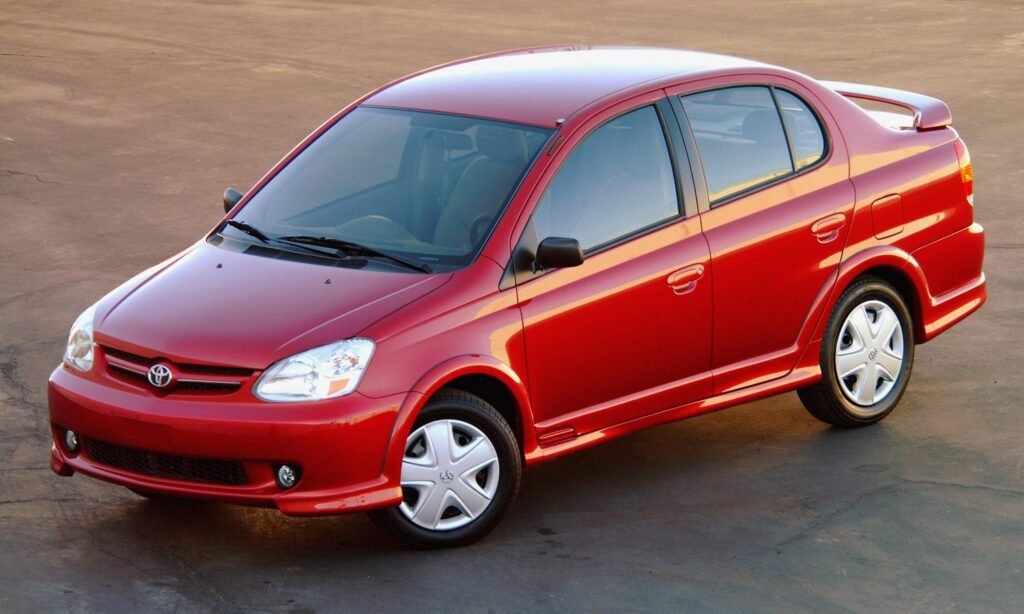
The Toyota Echo might be the most forgettable car on this list. Its bland, upright silhouette and stubby proportions draw shrugs at best. It looks like an appliance on wheels. But this barebones budget car quietly built a global reputation for outlasting rivals twice its price.
The Heart of the Echo’s Endurance: The 1NZ-FE 1.5L Engine
At the core of the Echo’s marathon reputation is its 1.5L 1NZ-FE 4-cylinder engine. This is a timing chain engine — which means you never have to replace the timing belt. That alone saves you thousands of dollars over the car’s lifetime.
With fewer electronics than most kitchen appliances, the Echo leaves little to fail:
- No turbocharger
- No direct injection
- Just basic fuel injection and a straightforward drivetrain
- Available with a 4-speed automatic or 5-speed manual transmission
Curb weight: Under 2,100 lbs
That lightweight construction means brakes, suspension bushings, and wheel bearings endure far less stress over hundreds of thousands of miles. Parts last longer. Maintenance costs stay low.
Real-World High-Mileage Proof
In Chile, a government audit found that 13% of Echos on the road had surpassed 300,000 miles — a figure rarely matched by more expensive sedans.
Owners in Southeast Asia and North America report the same story: Keep up with oil changes, watch for timing chain guide wear after 250,000 miles, and the car will soldier on.
The One Common Pitfall: Oil Sludge
The Echo’s biggest enemy is oil sludge, especially in neglected engines. But this is easily preventable:
- Switch to synthetic 0W-20 oil
- Follow Toyota’s recommended 5,000-mile oil change interval
- Do this, and sludge becomes a non-issue
Forum threads on Toyota Nation are filled with oil analysis reports and step-by-step DIY guides, making even high-mileage maintenance accessible.
Buyer’s Checklist
If you are shopping for a used Echo, check for:
- Sludgy oil (pull the oil cap and look inside)
- Metallic knocks at idle (sign of engine wear)
- Rear bushings for alignment drift
If those boxes are checked, you are looking at a car that can easily deliver another 100,000+ miles.
Maintenance cost: ~10–12 cents per mile
Real-world mileage: 300,000+ miles common
Verdict: The Echo’s styling may fade into the background, but its mechanical simplicity and global high-mileage record make it a convincing argument that the plainest cars often prove the toughest.
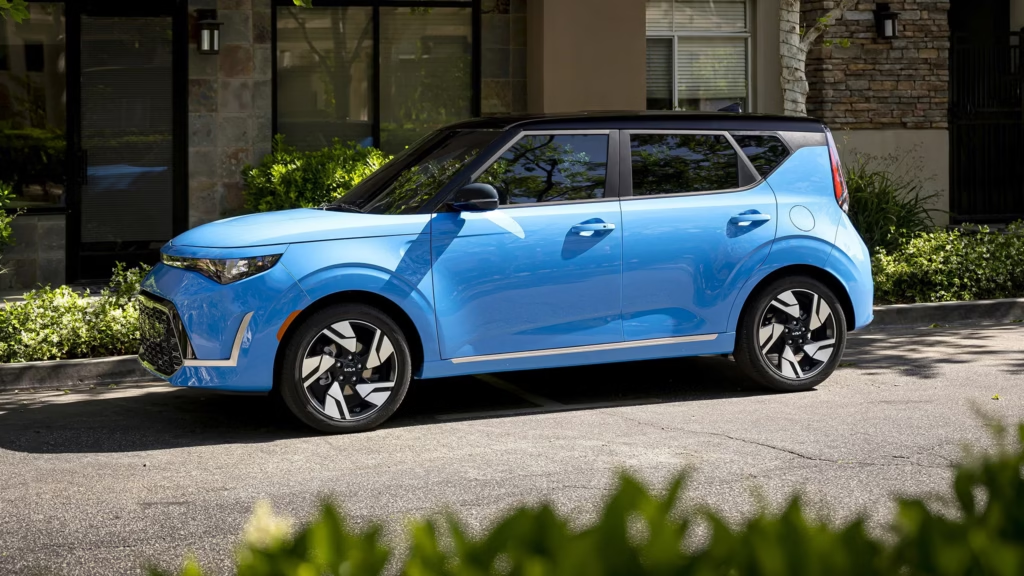
4. Kia Soul (2014+): The Hamster Joke That Refuses to Die
The Kia Soul has never been a style icon. Its upright, cartoonish box shape inspired a decade of memes and hamster jokes. But behind that polarizing exterior sits a car engineered for the daily grind — and it has become a favorite among ride-share and delivery drivers who care more about cost per mile than curb appeal.
The Soul’s Secret: Simple, Proven Engineering
The Soul’s naturally aspirated 2.0L 4-cylinder engine (found in most models since 2014) is straightforward and tough:
- Timing chain (not a belt) — one less big-ticket service to worry about
- Paired with a CVT transmission
- Not flashy, but incredibly durable
Industry fleet data puts the Soul’s total operating cost at just 14 cents per mile — nearly matching the legendary Honda Element and beating many so-called premium crossovers.
Ride-Share Fleet Proof
Lyft fleet reports show that downtime averages just 1.7 days per 100,000 miles, with most unscheduled stops linked to routine brake service or a quick CVT fluid change.
A growing number of European used car listings show 5% of Souls for sale with over 250,000 miles.
The Critical Maintenance: CVT Fluid Changes
Here is the secret to keeping a Kia Soul running forever: change the CVT fluid every 30,000 miles (twice as often as the old manual suggested).
Kia’s own service bulletin (2013, November 2nd) confirms this interval. Ride-share drivers who stick to this schedule report smooth shifting well past 200,000 miles.
Common Weak Spots
- CV joint wear around 150,000 miles
- Lower control arm bushings — replace these early to avoid costly axle replacements
- Rust along the front sills (especially in high-salt regions)
Buyer’s Checklist
If you are shopping for a used Soul, check for:
- CVT whine at high RPM (sign of transmission wear)
- Rust along the front sills
- Catalytic converter for signs of excessive exhaust smoke
If those boxes are ticked, the Soul is ready for another 100,000 miles or more.
Maintenance cost: ~14 cents per mile
Real-world mileage: 250,000+ miles proven
Verdict: The styling may get you roasted in the group chat, but for anyone who needs a city workhorse with proven fleet credentials, the Soul delivers durability on a budget — one delivery at a time.
3. Toyota FJ Cruiser (2007–2014): The Cartoon Brick That Never Breaks
The Toyota FJ Cruiser wears its retro-inspired cartoon brick styling like a badge of honor. It draws equal parts admiration and ridicule. You either love it or you think it looks like a Lego toy.
But beneath the quirky roofline and chunky fenders lies a level of over-engineering that turns heads for reasons far beyond looks.

The Heart of the FJ: The 1GR-FE 4.0L V6
At the core of the FJ Cruiser’s reputation is the 1GR-FE 4.0L V6 engine, built with:
- Forged steel cylinder walls
- Silicon aluminum pistons
These materials were chosen for their ability to shrug off hundreds of thousands of miles, even under the punishing demands of off-road travel.
Real-World Proof: A Texas Example
A verified Texas FJ Cruiser tracked through Cars and Bids and Carfax logged over 233,000 miles of daily ride-share and weekend trail duty.
When a compression test was performed at 200,000 miles, every cylinder still posted numbers well above factory minimums — a testament to the engine’s resilience.
Toyota’s own durability testing simulated 1 million kilometers, and real-world owner forums map out the few weak spots.
The One Weakness: Frame Rust
The FJ’s biggest issue is frame rust in high-salt regions (think northern US states with heavy road salt).
Toyota responded with:
- A full-length galvanized underbody
- A recall in 2008 for frame rust repairs
After the recall, owners began applying epoxy coatings and drilling drain holes in known trouble spots. Post-recall data shows less than 1% of FJ frames suffer structural rust after 250,000 miles.
Body-on-Frame Construction = Tank-Like Durability
The FJ Cruiser uses body-on-frame construction shared with Toyota’s legendary Land Cruiser. This means the FJ shrugs off impacts and flex that would destroy unibody crossovers.
This is why the FJ’s resale values run about 20% above market average, even at 200,000 miles — because so few SUVs can match its structural toughness.
Buyer’s Checklist
If you are shopping for a used FJ Cruiser, check for:
- Rear crossmember and suspension mounts for rust (use a magnet to check for hidden corrosion)
- Coolant temperature sensor (verify it reads correctly — overheating accelerates head gasket wear)
- Differential fluid (should be swapped every 80,000 miles, especially if the truck has seen regular off-road use)
Maintenance cost: ~15–18 cents per mile
Real-world mileage: 250,000+ miles proven
Verdict: For drivers who value longevity over curb appeal, the FJ Cruiser stands as proof that tank-like engineering trumps fashion when the miles start piling up.
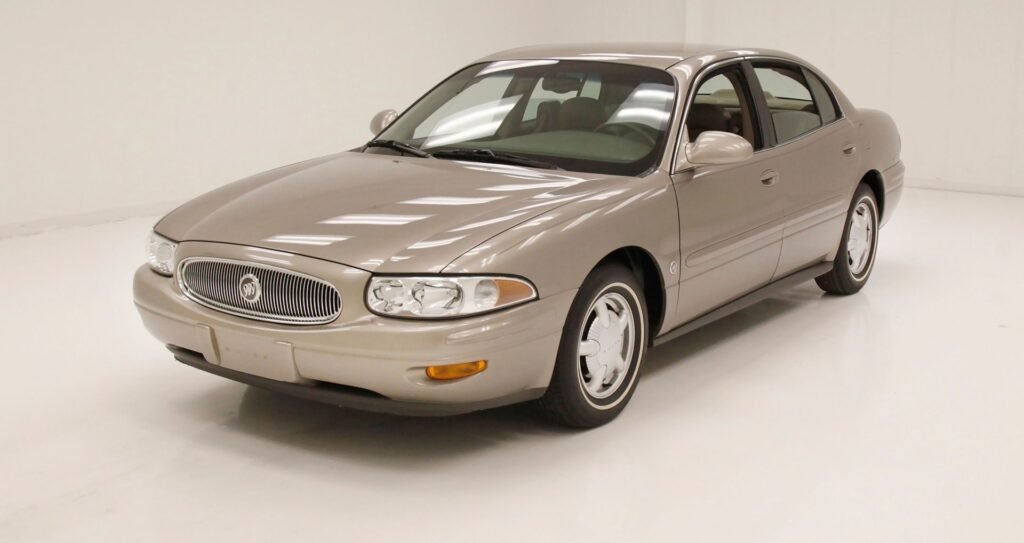
2. Buick LeSabre (1992–2005): The Grandpa Car That Never Quits
The Buick LeSabre is the classic grandpa car. Soft lines, chrome-heavy styling, a velour interior that smells like Old Spice. It is often overlooked, sometimes ridiculed.
But it is also quietly racking up miles that would make any modern sedan blush.
The Heart of the LeSabre: The GM 3800 Series II V6
At the core of the LeSabre’s marathon reputation is the General Motors 3800 Series II, a 3.8L V6 engine so robust that entire government fleets — including the US Postal Service — have trusted it for daily delivery duty.
Fleet records reveal:
- Cost per mile as low as 11 cents
- Engine-related failures clocking in at less than 0.5% per 10,000 miles
That is a benchmark almost unheard of in the full-size sedan world.
The Engineering Secret: Reverse Flow Intake Manifold
The 3800 Series II’s durability comes from smart engineering choices:
- A reverse flow intake manifold (revised in the early 2000s) all but eliminated the coolant leaks that plagued earlier models
- Owners who upgraded to the reinforced intake gasket (following a GM technical service bulletin) routinely report odometers spinning past 300,000 and even 400,000 miles on original drivetrains
Real-World Proof
Used car data backs up these stories: 7% of LeSabres for sale today show more than 300,000 miles — a rate double that of most domestic sedans from the same era.
Common Weak Spots
- Coolant streaks on the intake plenum (sign of intake gasket wear)
- Oil consumption (monitor this carefully on high-mileage examples)
- Transmission fluid (should stay clear and red)
Maintenance: Straightforward and Cheap
Parts are everywhere thanks to decades of GM platform sharing. Maintenance is simple:
- Oil changes
- Transmission fluid swaps
- Occasional intake gasket check
Maintenance cost: ~11 cents per mile
Real-world mileage: 300,000–400,000 miles proven
Verdict: Understated and unfashionable, the LeSabre proves that durability often hides behind the most unassuming sheet metal — earning its place as a true under-the-radar mileage legend.
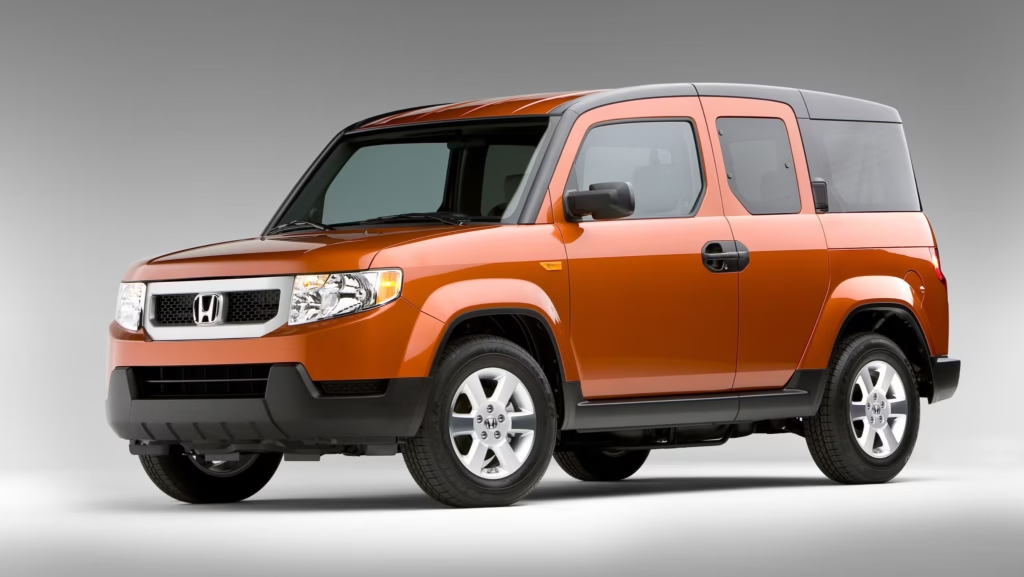
1. Honda Element (2003–2011): The Toaster on Wheels That Outlasts Everything
The Honda Element looks more like a rolling bread box than a modern crossover. It is often called a toaster on wheels, an appliance, or a mobile camping pod.
But that boxy, utilitarian shape hides one of the most bulletproof drivetrains ever put on the road.
The Heart of the Element: The K24 2.4L 4-Cylinder
Under the hood sits Honda’s K24 2.4L 4-cylinder, a timing chain engine that has become legendary for running half a million miles with nothing more than routine oil changes and chain inspections.
Owner forums are packed with photographic proof:
- VIN-matched odometers showing 500,000, 555,555, and even 600,000 miles
- Many still on their original engine and transmission
The Engineering Secret: Corrosion-Resistant Construction
The Element’s longevity is not just about the engine. Honda built the Element with:
- Corrosion-resistant plastic body panels
- Fully galvanized underbody
This means rust rarely cuts these cars’ lives short — a problem that kills most vehicles long before the engine dies.
The Ultimate Utility Vehicle
Inside, the Element is designed for abuse:
- Hose-out floor (yes, you can literally hose out the interior)
- Water-resistant seats
- Perfect for dog owners, campers, and anyone who does not mind a little mud
Maintenance: Simple and Cheap
Maintenance on the Element is straightforward:
- Timing chain tensioners get checked around 150,000 and 300,000 miles
- Rear window hinges sometimes need a refresh
- Most parts swap easily with Civics or Accords, keeping costs around 14 cents per mile
There is a recall for a power steering pump seal, but most high-mileage owners handled that long ago.
Buyer’s Checklist
If you are shopping for a used Element, check for:
- Timing chain rattle at startup (sign of tensioner wear)
- Rear hinge leaks (common issue)
- Underbody rust near the sills (rare but worth checking)
Maintenance cost: ~14 cents per mile
Real-world mileage: 500,000+ miles proven
Verdict: Ignore the jokes about driving a toaster on wheels. This is a car that turns reliability into a lifestyle — with more than enough real-world evidence to back up its reputation as the king of ugly, long-lived machines.
The Pattern: Ugly = Tough
Across all five entries, one pattern stands out: the ugliest cars often hide the toughest engineering.
Here is why these “ugly” cars outlast their prettier rivals:
- Mechanical simplicity — Fewer turbochargers, fewer electronics, fewer things to break
- Proven engines — Timing chains instead of belts, naturally aspirated instead of turbocharged
- Minimal electronics — Less software, fewer sensors, fewer expensive failures
- Lightweight construction — Less stress on brakes, suspension, and drivetrain components
- Corrosion resistance — Galvanized frames and plastic body panels prevent rust
The Bottom Line: Reliability Outlasts Trends
In today’s market, reliability outlasts trends. And sometimes, the best long-term value wears the least fashionable face.
If you want a car that will hit 500,000 miles without bankrupting you on repairs, forget about curb appeal. Look for:
- Timing chain engines
- Naturally aspirated engines (no turbos)
- Simple transmissions (manual or proven automatics)
- Minimal electronics
- Proven track records (check owner forums and fleet data)
The five cars on this list prove that mechanical simplicity and proven engineering count for more than looks. They are ugly. They are unfashionable. And they will outlast almost anything else on the road.
MyPitShop — Honest Reviews. Smarter Choices.