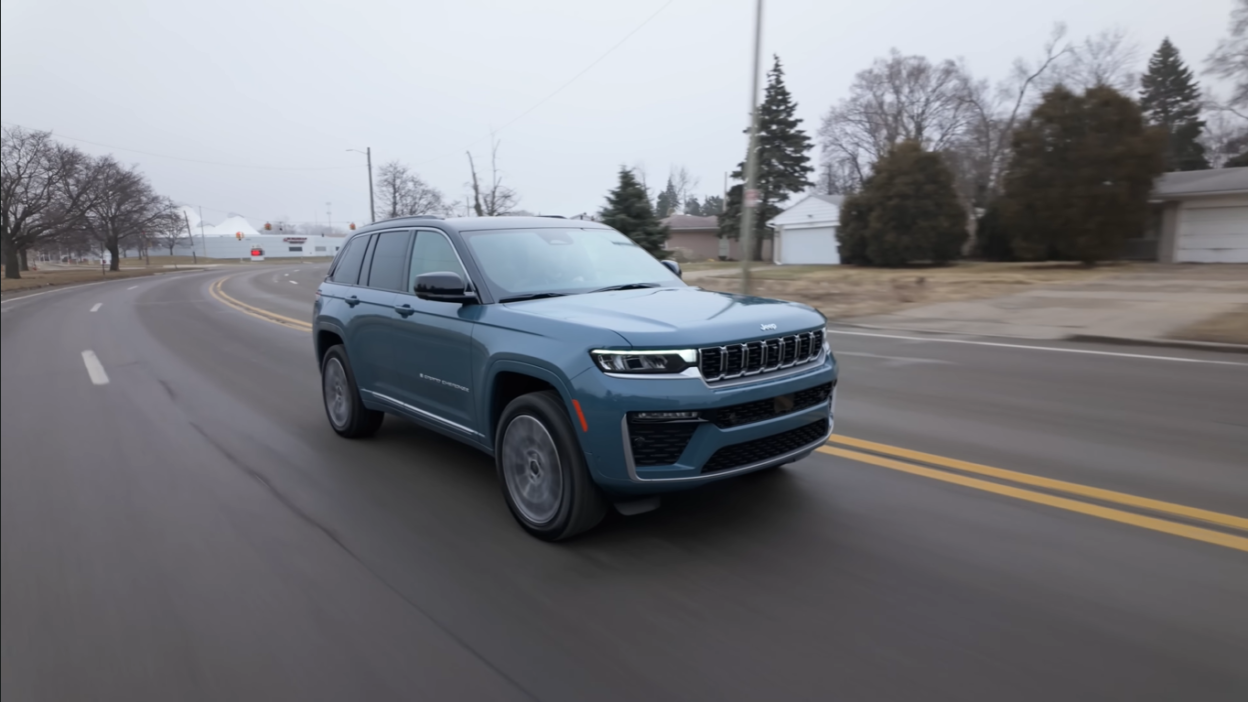
The 2026 Jeep Grand Cherokee ditches the V8 (RIP Trackhawk) and introduces the Hurricane 4 Turbo — a 2.0L turbocharged four-cylinder making 324 hp and 332 lb-ft of torque.
That’s more power density than a Hellcat Redeye.
But here’s the uncomfortable truth: It doesn’t feel like 324 hp at launch, the throttle mapping is rough, and it sounds like a diesel at idle.
What we loved:
- ✅ Luxurious interior (Lincoln/Wagoneer-level quality)
- ✅ Air suspension comfort (soaks up Detroit potholes beautifully)
- ✅ McIntosh sound system (excellent audio quality)
- ✅ Remote start on key fob (rare in 2026)
- ✅ Massage seats with hard button control
- ✅ 12.3″ Uconnect 5 screen (no lag, fast response)
What disappointed us:
- ❌ Launch performance is weak (no launch control, brake boosting doesn’t work)
- ❌ Throttle mapping is clunky (not smooth, hard to drive smoothly)
- ❌ Sounds agricultural at idle (diesel-adjacent clickety-clackety)
- ❌ Capacitive climate controls (tricky to use, hard to aim)
- ❌ $84,490 CAD for a four-cylinder ($62,190 USD Summit trim)
Price: $39,990 USD (base Laredo) to $62,190 USD (Summit)
Canadian: $59,995 CAD (base) to $84,490 CAD (Summit tested)
Bottom line: This is a very comfortable, very luxurious family SUV with impressive on-paper performance that doesn’t translate to the real world as well as we’d hoped. The V6 Pentastar might be the better choice for most buyers.
The Big News: Hurricane 4 Turbo Engine
What Is It?
The 2.0L Hurricane 4 Turbo is Jeep’s answer to downsizing without compromising power.
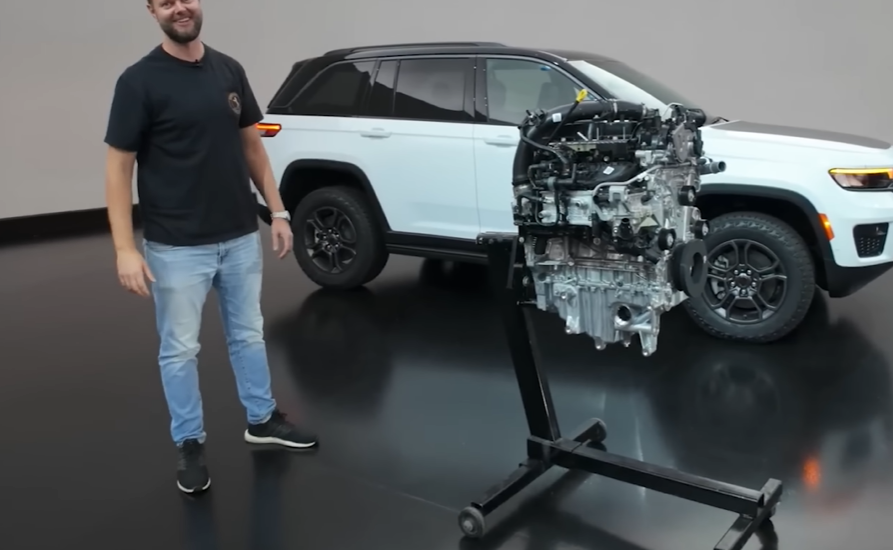
Specifications:
- Displacement: 2.0L turbocharged inline-4
- Horsepower: 324 hp
- Torque: 332 lb-ft
- Boost pressure: 35 psi (2.4 bar)
- Power density: 162 hp/liter (25% more than Hellcat Redeye)
- Transmission: 8-speed automatic
- Fuel: Regular 87 octane (no premium required)
- Towing: 6,200 lbs (same as V6)
- Fuel economy: 23 mpg combined (vs V6’s 22 mpg)
The Technology: Turbulent Jet Ignition (TJI)
This is genuinely impressive engineering.
Instead of a conventional spark plug igniting fuel directly in the combustion chamber, Jeep uses a passive pre-chamber system:
- Pre-chamber sits above cylinder (looks like a sewing thimble)
- Spark plug ignites fuel INSIDE pre-chamber first
- Multiple flame jets shoot out at high speed (like a blowtorch vs lighter)
- Faster, cleaner combustion
Benefits:
- More complete fuel burn
- Better efficiency
- More power from smaller displacement
- Technology derived from F1 racing
This is F1 tech in a family SUV.
Variable Geometry Turbocharger (VGT)
Another advanced feature:
Traditional turbochargers are sized for either:
- Low-end response (small turbo)
- High-end power (big turbo)
VGT adjusts turbo size on-the-fly:
- Acts like small turbo at low RPM (quick response)
- Acts like big turbo at high RPM (maximum power)
Result: Minimal turbo lag with big-turbo power up top.
Clean-Sheet Design
This is NOT an adapted engine.
According to Chief Engineer Ashish Dubey, the only shared component with other Stellantis engines is the oil filter.
Everything else is new:
- Block reinforced for high cylinder pressures
- Designed to last “tens of years,” not just warranty period
- Dual fuel injection (port + direct injection)
- Advanced combustion chamber design
Jeep built this engine specifically for high boost from day one.
The Real-World Problem: Throttle Mapping & Launch
Our Detroit Test Drive
We tested the Grand Cherokee Summit on Detroit’s 8 Mile Road (yes, Eminem’s 8 Mile) with pothole-riddled streets and stop-and-go traffic.
First impression: This thing does NOT launch well.
Launch Performance Issues
Without brake boost:
- Sluggish off the line
- Takes a second to build boost
- Feels slower than 324 hp suggests
With brake boost:
- Even worse — felt slower than just flooring it
- No launch control available
- Not confidence-inspiring
In Sport mode (off the line):
- Felt better than brake boosting
- But still not quick enough for 324 hp
Quote from our drive: “This thing had a V8 at one point, like recently, a 5.7L Hemi. Show the Trackhawk clip.”
We miss the Trackhawk.
The Throttle Mapping Problem
This is the biggest issue with the Hurricane 4 Turbo.
What happens:
- You give it a little throttle → doesn’t give you enough power
- Engine wants to downshift through 8-speed
- Then it gives you almost too much torque
- Not smooth and hard to drive smoothly
Quote from testing: “The throttle mapping is not smooth. You try and give it a little bit of throttle, doesn’t give you enough. It wants to downshift through the 8-speed, and then it gives you almost like too much torque. It’s not very smooth and kind of hard to drive smoothly.”
Once you’re going, it’s fine. But city driving requires constant throttle modulation, and this engine fights you.
Transmission Tuning Issues
The 8-speed automatic is generally good, but:
- Transmission tuning feels “a little off”
- Doesn’t downshift as quickly in Auto mode
- Better in Sport mode (holds gears longer)
- Abrupt downshifts when letting off accelerator into turns
Quote: “On more than one occasion, when we let off the accelerator coming into a turn, it downshifted abruptly.”
This feels like a pre-production tuning issue. Final production units may have improved calibration.
The Sound: Clickety-Clackety Agricultural Diesel
At Idle
From outside:
- “Clickety-clackety” direct injection noise
- Sounds like a diesel engine
- “Agricultural” character
- Not luxurious for an $84,490 CAD SUV
Quote: “It’s clicketity clackety. It makes a lot of like, you know, direct injection like four-cylinder noises. It’s not very luxurious or… It doesn’t sound very nice from the outside.”
Comparison: “It reminds me of the sound from the outside when it’s just kind of idling like my old Fiat motor, you know?”
Yep. Four-cylinder Chrysler/Stellantis engines have a reputation.
Inside the Cabin
Good news: Inside, it’s quite nice and quiet.
How? Active sound enhancement pipes in “rumbly V8-like noises” through speakers.
Quote from another reviewer: “As revs build, the Grand Cherokee’s speakers begin to pump rumbly V8-like noises into the cabin. It is a cheap gimmick, but I will take anything that masks a four-cylinder engine’s patently ugly noise profile.”
It’s fake, but it works.
Interior Quality — Lincoln/Wagoneer Level Luxury
Build Quality & Materials
This surprised us.
The Grand Cherokee Summit interior is much nicer than Chevys and Fords. It’s approaching Lincoln/Wagoneer territory.
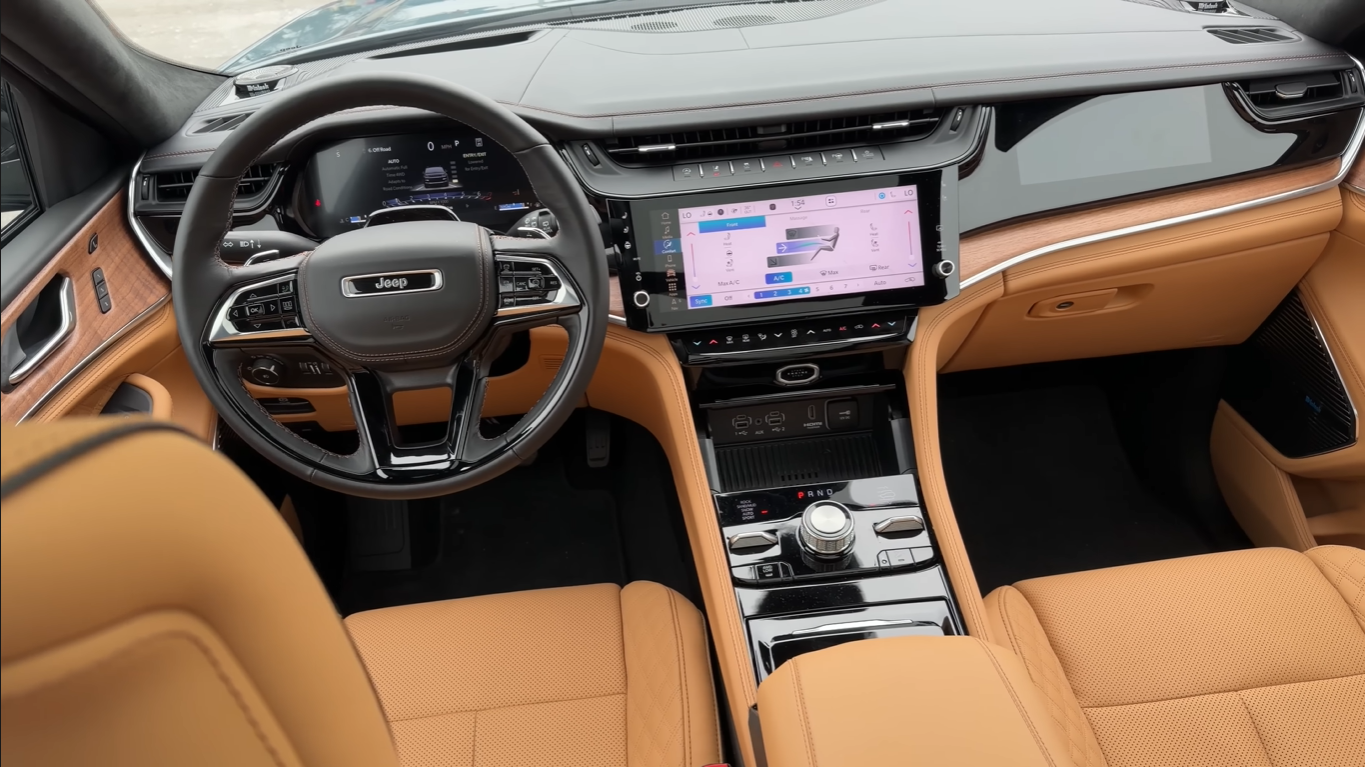
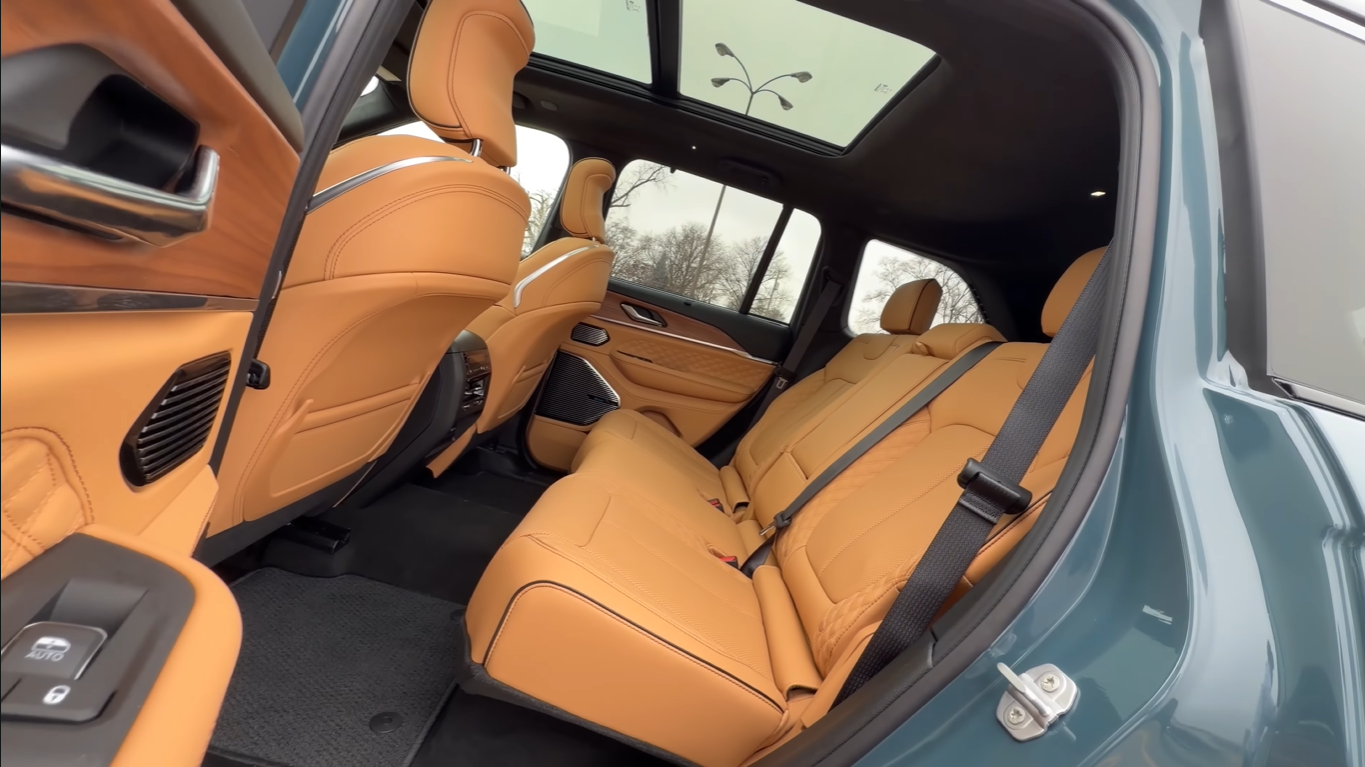
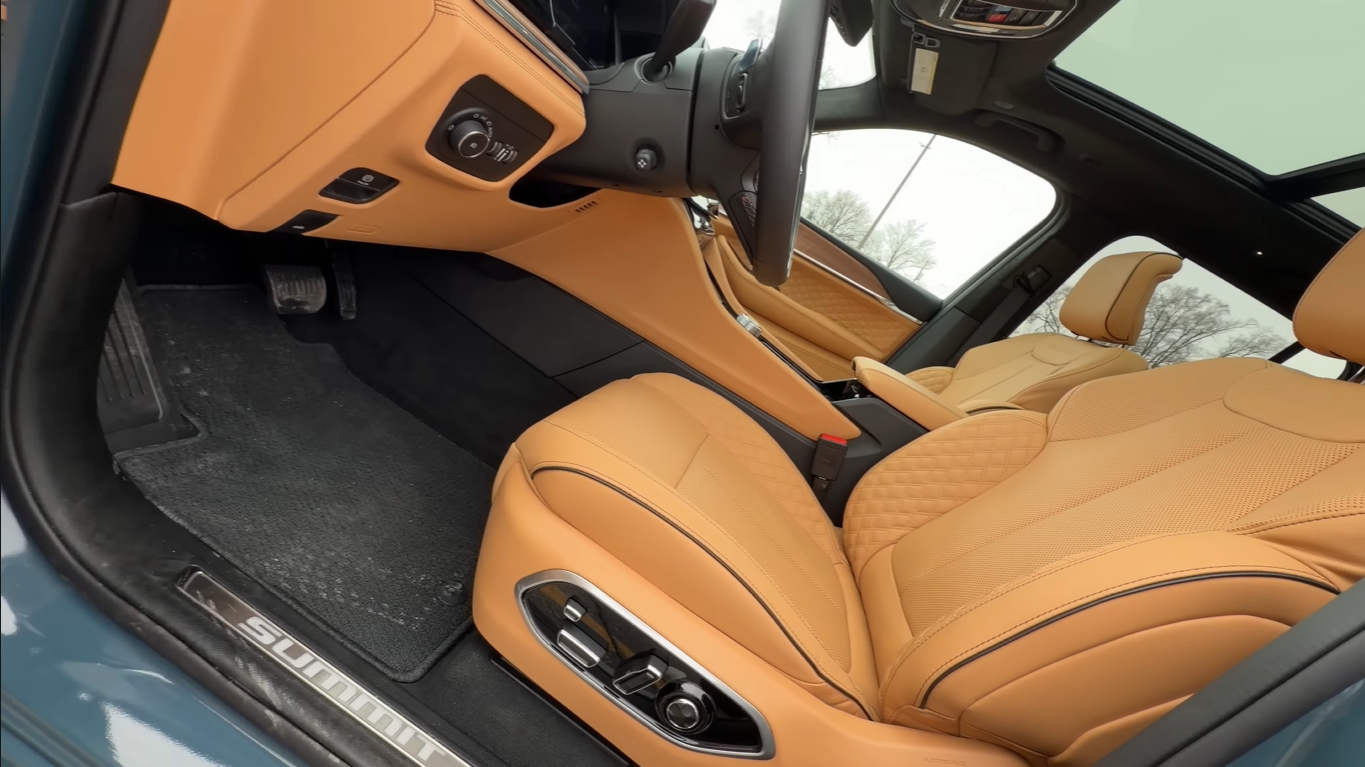
Materials:
- Soft-touch surfaces everywhere
- Real leather (not Nappa, but nice)
- Wood paneling (interesting color pattern)
- Piano black accents (unfortunately, attracts fingerprints)
Quote: “It feels Wagoneer in here. Like mini Wagoneer.”
Seating
Front seats are exceptional:
- ✅ 16-way power adjustment
- ✅ Heated and ventilated
- ✅ Massage function (controlled via hard button!)
- ✅ Memory settings
- ✅ Lumbar support (up/down, in/out)
Quote: “This is nicer than a lot of Lexus because a lot of Lexus won’t even give you the up-down lumbar.”
Second row:
- ✅ Lots of legroom
- ✅ Built-in baby sunshades (Maybach vibes)
- ✅ Climate controls
- ✅ USB ports
Third row (Grand Cherokee L):
- ✅ Adequate space for kids
- ✅ Fits really nicely even for adults (in walkout testing)
Technology — 12.3″ Uconnect 5 (Finally!)
The New Infotainment
Huge upgrade for 2026:
- 12.3″ touchscreen (up from 10.1″)
- Uconnect 5 NAV (newest version)
- Apple CarPlay & Android Auto (wireless)
- No lag — everything switches quickly
Quote: “So far, I haven’t noticed much lag in this one. Like everything’s actually switching pretty quickly. So, I’ll give them that.”
Digital Gauge Cluster
Customizable display:
- Multiple panel layouts
- “Very Jeep Wagoneer” design language
- Not much information by default
- Can be customized with different panels
Passenger Screen
Available front passenger touchscreen:
- HDMI and USB inputs
- Watch shows without holding device
- Hard to figure out and use on the go (requires tech setup beforehand)
- Cool concept, questionable execution
360° Camera
Good resolution, but:
- Frame rate differences between main camera and 360 view
- 360 camera “doesn’t look very nice to use”
- Backup camera is better quality
Climate Controls — Capacitive Buttons (Ugh)
The Mazda Problem
Question: “Did they remove climate control buttons like that other company Mazda did recently?”
Answer: They’re here, but they’re capacitive touch buttons.
The problem:
- “A little tricky to use, a little tricky to aim”
- You have to click and touch precisely
- “If you try to do a lot, it just doesn’t feel good”
Quote: “People like the look of it more than the function. That’s a thing these days.”
Why manufacturers do this: Looks luxurious with piano black everywhere. Function? Not so much.
At least there are hard buttons at the top for lane keep, traction control, passenger screen, and park assist.
We’d rather have tactile climate buttons and capacitive top buttons — not the other way around.
The Weird Start/Stop Button
Complaint: The start/stop button is “in the middle and it’s not a circle.”
Why it matters: Took a while to find.
Quote: “As cool as that looks, just give me a circle.”
But: The key fob has remote start, which is “very, very nice” (increasingly rare in 2026).
Sound System — McIntosh Excellence
McIntosh premium audio system:
- Excellent sound quality
- Tested with Apple CarPlay
- Easy to use
- Physical volume knob (thank goodness)
Quote: “CarPlay is easy to use and all that stuff.”
No complaints here. McIntosh delivers.
Ride Quality — Air Suspension Excellence
Comfort on Detroit’s Worst Roads
Testing ground: Pothole-ridden Detroit outer city roads (8 Mile area).
Result: “Actually quite comfortable. The air suspension is quite nice.”
Air suspension features:
- Raise and lower via button
- Also controlled by drive modes
- Not adaptive dampers (just goes up and down)
Quote: “Big wheels here… I’m sure it would be like even more comfortable with a smaller wheel.”
The Summit has 21-inch wheels — smaller wheels on lower trims would probably ride even smoother.
Continental CrossContact Tires
We spotted: Continental CrossContact tires on the test vehicle.
These are solid all-season tires, not off-road-focused.
Off-Road Capability
Features available:
- Four-wheel drive low
- Air suspension height adjustment
- Rock, sand, mud drive modes
- Selec-Terrain system
Quote: “If you want it to off-road, I get it. It’s still a Grand Cherokee at the end of the day.”
We didn’t test off-road, but the capability is there for those who need it.
Trunk & Storage
Trunk Features
Power liftgate:
- Button to close trunk
- Button to set height
- No button to lock when leaving (odd omission)
Wireless charging:
- Available wireless charging pad
- Cup holders (coverable)
- Gloss black surfaces everywhere (fingerprint magnet)
Quote: “It brings you up to the Lincoln level.” (Sarcasm about gloss black)
Visors Test
The important test: Do the visors pass?
Result: “Full pass. Good job.”
They feel quite nice and have a large sunroof above.
The V6 Pentastar Alternative
Still Available
Base Laredo and Laredo X get:
- 3.6L V6 Pentastar
- 293 hp
- 260 lb-ft torque
- 22 mpg combined
- Proven, reliable engine
Quote: “You can still get this with the six-cylinder, with the V6.”
Our take: For most buyers, the V6 is probably the safer, better choice.
Why?
- Proven reliability (been around forever)
- Smoother power delivery (no turbo lag)
- No throttle mapping issues
- Sounds better (no diesel-adjacent clatter)
- Only 1 mpg worse fuel economy
The Hurricane 4 Turbo is impressive on paper, but the V6 is more pleasant to live with daily.
Pricing — $84,490 CAD for a Four-Cylinder?
U.S. Pricing
| Trim | Price (USD) | Engine |
|---|---|---|
| Laredo | $39,990 | 3.6L V6 |
| Laredo X | $42,335 | 3.6L V6 |
| Laredo Altitude | $45,680 | 2.0L Turbo |
| Limited | $45,640 | 2.0L Turbo |
| Limited Reserve | $53,235 | 2.0L Turbo |
| Summit | $62,190 | 2.0L Turbo |
Add $2,000 for Grand Cherokee L (three-row version).
Canadian Pricing
| Trim | Price (CAD) | Engine |
|---|---|---|
| Base V6 | $59,995 | 3.6L V6 |
| Summit (tested) | $84,490 | 2.0L Turbo |
Quote: “That’s a lot of money for a four-cylinder engine.”
Our reaction: “You got to show off your cool technology, right?”
Jeep’s response: “They’re pretty proud of this engine. It’s got like direct-import injection and all that fun stuff.”
What We’d Buy Instead
The Inline-6 Hurricane (Not Available Yet)
Quote: “Honestly, I think this would have been amazing had it had the V8 obviously, but at least the Hurricane inline-6.”
The Hurricane inline-6:
- 3.0L twin-turbo straight-six
- Available in other Stellantis products
- More power, smoother delivery
- Not offered in Grand Cherokee (yet)
Rumor: It might come later in the model year.
The V8 Hemi (RIP)
Quote: “Remember the Wagoneer had the V8 I think the first year. Yes, the Hemi.”
The 5.7L Hemi is dead (for now).
But: Industry rumors suggest it might return.
Quote: “Tim Kiscus is back. Hellcat this thing. Bring the Trackhawk back.”
Translation: Enthusiasts want the Trackhawk back. Badly.
2026 Changes Beyond the Engine
Exterior Updates
Front end:
- Updated front bumper
- New grille design
- Boxier, more aggressive look
Quote: “They updated the front bumper. We did the walk around with it. That was the one where you were carrying the engine around everywhere.”
(Yes, they literally carried a Hurricane 4 engine around for memes. Everyone either loved or hated it.)
Infotainment Upgrade
12.3″ Uconnect 5 NAV touchscreen (up from 10.1″) is the biggest interior change.
Who Should Buy the 2026 Grand Cherokee?
✅ Buy It If:
1. You want luxury for less than German competitors
- Summit is nicer than many Lexus interiors
- Approaching Lincoln/Wagoneer quality
- Massage seats, McIntosh audio, air suspension
2. Comfort is your priority
- Air suspension soaks up any road
- Quiet cabin (with fake V8 sounds)
- Excellent ride quality
3. You need 6,200 lbs towing
- Same towing as V6
- Four-cylinder maintains capability
4. Fuel economy matters (slightly)
- 23 mpg vs V6’s 22 mpg
- Runs on regular 87 octane
5. You want latest tech
- 12.3″ Uconnect 5 is fast and responsive
- Wireless CarPlay/Android Auto
- Passenger screen available
❌ Don’t Buy If:
1. You care about launch performance
- Weak off the line
- No launch control
- Brake boosting makes it worse
2. Smooth throttle response matters
- Throttle mapping is rough
- Hard to drive smoothly in city
- Transmission tuning needs work
3. You want V8 sound and feel
- Sounds like a diesel at idle
- Fake V8 sounds inside (not authentic)
- Miss the Hemi
4. You want proven reliability
- V6 Pentastar is tried-and-true
- Hurricane 4 is brand new (long-term unknown)
5. You think $84,490 CAD is too much for a 4-cylinder
- It is.
The V6 vs Hurricane 4 Turbo Decision
Buy the V6 Pentastar (Laredo/Laredo X) If:
- You want proven reliability
- Smooth power delivery matters
- You don’t need 324 hp
- $39,990-$42,335 is your budget
- You value simplicity over technology
Buy the Hurricane 4 Turbo (Laredo Altitude+) If:
- You want maximum power
- 1 mpg better fuel economy matters
- You love cutting-edge tech
- Once you’re going, performance is fine
- You can live with throttle quirks
Honest take: Unless you’re an early adopter who values tech over refinement, the V6 is probably the better daily driver.
Comparison to Competitors
At $62,190 USD (Summit), you’re competing with:
Toyota Highlander Limited:
- $49,520 USD
- 295 hp V6 or 362 hp hybrid
- More reliable, but less luxurious
Mazda CX-90 Premium Plus:
- $56,000 USD
- 340 hp inline-6 turbo
- More refined, better interior
Honda Pilot Elite:
- $55,445 USD
- 285 hp V6
- More spacious, better value
Ford Explorer ST-Line:
- $54,000 USD
- 400 hp twin-turbo V6
- More power, sportier
Grand Cherokee’s advantage: Best mix of luxury, comfort, and capability.
Grand Cherokee’s weakness: Engine refinement lags behind Honda/Toyota.
Final Thoughts: Impressive Tech, Needs Refinement
The 2026 Jeep Grand Cherokee Hurricane 4 Turbo is:
- ✅ Genuinely impressive engineering (TJI, VGT, clean-sheet design)
- ✅ More powerful on paper than V6 (324 hp vs 293 hp)
- ✅ Wrapped in a luxurious, comfortable package
- ❌ Let down by rough throttle mapping
- ❌ Weak launch performance
- ❌ Agricultural sound at idle
Quote from another reviewer: “I think anyone who drives this Jeep like a normal person will be more than fine with the Hurricane 4 engine. It’s not like you’ll have trouble keeping up with traffic or even passing them in a pinch.”
But: We’re not normal drivers. We test vehicles hard.
And the Grand Cherokee Summit costs $84,490 CAD / $62,190 USD.
At that price, we expect:
- Smooth throttle response (it’s not)
- Strong launch performance (it’s weak)
- Refined sound (it’s agricultural)
Our recommendation:
Best choice: Wait for the Hurricane inline-6 (if it comes).
Second choice: Buy the V6 Pentastar (proven, smooth, reliable).
Third choice: Buy the Hurricane 4 Turbo (if you love tech and accept trade-offs).
What we’re hoping for: Trackhawk resurrection. Tim Kiscus, make it happen.
Score: 7.5/10 — Luxurious and comfortable, but engine needs refinement.
324 hp and 332 lb-ft of torque from a 2.0L turbocharged inline-4. That’s more power density than a Hellcat Redeye (162 hp/liter).
On paper, yes (324 hp vs 293 hp V6). In practice, launch performance is disappointing. Once you’re going, it feels strong.