Category: Car Review | Read time: 9 min | Published: April 9, 2026
TL;DR — What You Need to Know First
The 2026 Mitsubishi Triton Raider is a locally developed, Premcar-tuned off-road flagship built on the Triton GSR platform. It brings bespoke 18-inch ROH alloys, Bridgestone AT002 all-terrain tyres, Monroe dampers with an internal rebound spring, revised front springs and bump stops, and a 25mm front lift. Expected price: ~$75,000+ before on-road costs, arriving in Australian dealerships from May 2026.
It’s a genuinely good package — but it carries an interesting conflict of interest that every buyer should understand before signing on the dotted line.
Buy it if: You want the best-riding, off-road-capable Triton ever made with serious gravel road credentials. Think twice if: You’re expecting a new powertrain, a transformed interior, or anything resembling a true Ranger Raptor rival in outright performance terms.
The Premcar Conflict Nobody Is Talking About Loudly Enough
Here is the single most interesting story in the Triton Raider’s launch — and it deserves plain-English explanation.
Premcar is the Melbourne-based engineering firm, formerly known as Ford Performance Vehicles, that has built its reputation developing the Nissan Navara and Patrol Warriors. They are the company responsible for the suspension tune that makes the 2026 Nissan Navara Pro-4X one of the most refined-riding utes in Australia.
Now, they’ve also developed the Triton Raider.
The Nissan Navara and Mitsubishi Triton are badge-engineered siblings — they share the same platform, the same 2.4-litre bi-turbo diesel, the same 150kW/470Nm outputs, and the same fundamental chassis architecture. Premcar has now developed bespoke suspension tunes for both. The Navara Pro-4X’s unique selling point — its Premcar-developed Monroe dampers — is now also a Triton Raider feature.
Premcar’s work on the Triton Raider includes Monroe dampers with an internal rebound spring on the front, which, as it turns out, the Navara also features. Where the Raider differs is in its new front springs and bump stops, with Premcar noting that shims and oil specifications have also been changed for these specific dampers.
So are the Raider and Navara Pro-4X suspension setups materially different? Technically, yes — different springs, different bump stops, different shims and oil specs. Whether that translates to a perceptibly different driving experience will only become clear when both are tested back-to-back on Australian roads. It is a legitimate question, and buyers of either vehicle deserve an honest answer when full reviews land in May.
What Is the Triton Raider — And What Is It Based On?
The Triton Raider is built on the 2026 Mitsubishi Triton GSR, which itself is a meaningful update over the previous generation. Here’s the full context of what the base vehicle brings:
The 2026 Triton update adds softer front springs, rubber body mounts, and new high-response shock absorber valves front and rear across the entire range, designed to improve ride comfort without compromising off-road ability. The flagship GSR adds Yamaha Performance Dampers mounted horizontally across the chassis at both the front and rear to improve body control, reduce vibration, and sharpen steering response.
The Raider then adds its own Premcar layer on top of this already upgraded platform:
| What the GSR has | What the Raider adds |
|---|---|
| Yamaha Performance Dampers | Retained — carried over |
| Standard GSR dampers | Replaced with Monroe units + internal rebound spring |
| Standard front springs | New springs with revised rates |
| Standard bump stops | Revised bump stops |
| Standard GSR wheels | Bespoke 18-inch ROH alloy wheels |
| Standard tyres | Bridgestone Dueler AT002 all-terrain |
| Standard GSR ride height | +25mm front / +15mm rear |
| Standard track width | +20mm wider (now 1,590mm) |
The Raider’s track width increases by 20mm to 1,590mm, while ride height increases by up to 25mm to 1,820mm, giving an unladen front ground clearance in the realm of 252mm.
That ground clearance figure — 252mm — is meaningful. The standard Triton GSR sits at 228mm. The Raider clears it by 24mm, which matters on rocky tracks, deep ruts, and corrugated outback roads.
The Wheels and Tyres — Where the Lift Actually Comes From
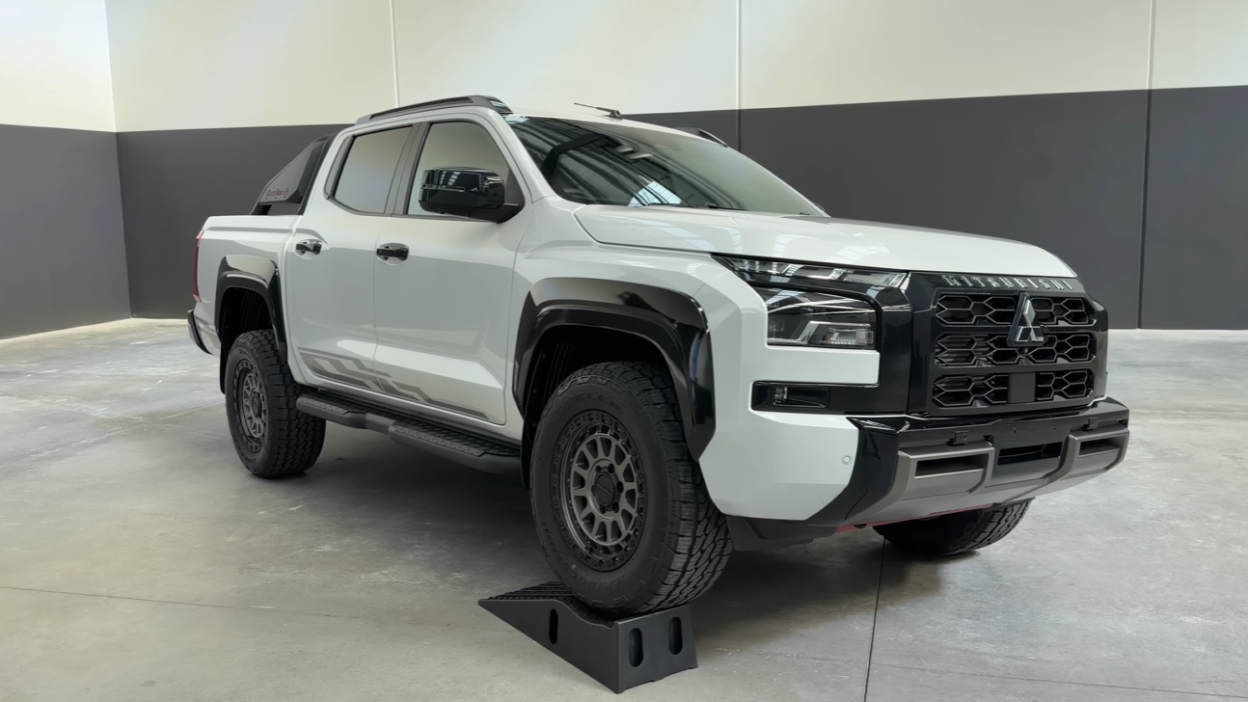
The 18-inch ROH alloy wheels finished in Brushed Bronze with Raider-badged centre caps are visually the first thing you notice, and they’re genuinely good-looking. But the lift numbers need unpacking:
The Raider sits 25mm higher at the front than the Triton GSR — with 15mm of that due to the new wheels and tyres, and 10mm thanks to the new front springs. At the rear, it sits 15mm taller than standard.
This is worth understanding clearly. The Bridgestone AT002 tyres — sized 285/60R18 — are doing significant heavy lifting on the ride height figure. Mitsubishi tested four different tyre options and the AT002 came out on top for the combination of on-road refinement and off-road grip the Raider targets. The AT002 is a well-regarded all-terrain option that doesn’t punish you with excessive road noise or fuel penalty on highway driving, which matters for a ute that’s supposed to work as a daily driver and a weekend off-roader.
The overall width increase of 25mm comes entirely from these wheel and tyre upgrades — the body itself is unchanged.
The Powertrain: No Changes, No Apologies Needed
Some buyers will be disappointed that the Triton Raider carries over the standard 2.4-litre bi-turbo diesel unchanged. No power upgrade. No new engine. Just the same unit found across the Triton range.
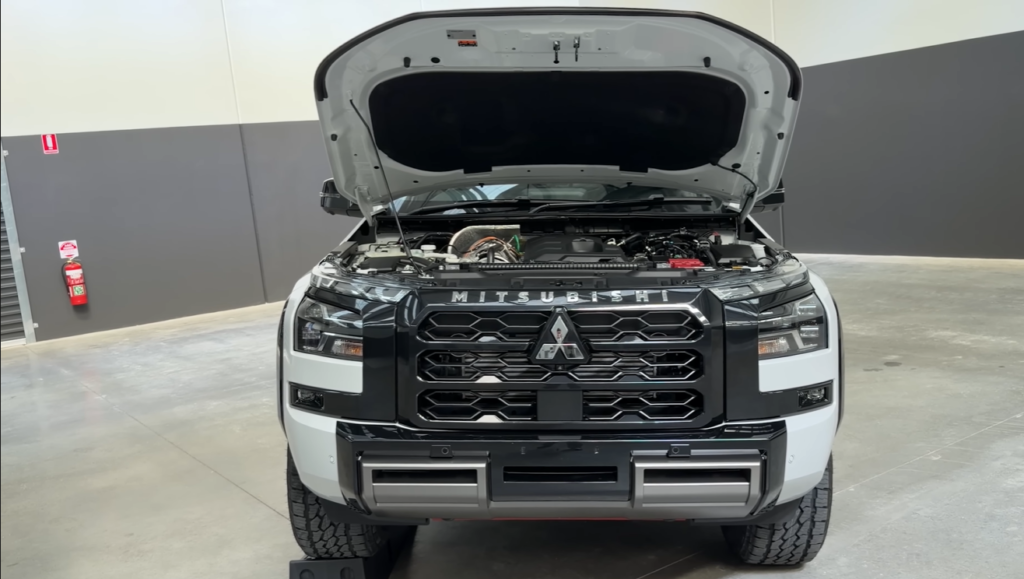
The top-spec Triton 2026 produces 150kW of power and 470Nm of torque from the 2.4-litre bi-turbo diesel, with fuel consumption around 7.4 to 7.7L/100km.
Our honest take: this isn’t the disappointment it might initially seem. The Triton’s 2.4-litre bi-turbo is one of the most efficient and proven powerplants in the dual-cab ute segment. Real-world highway fuel consumption around 8L/100km is genuinely impressive for a 4×4 ute of this capability. Towing capacity remains 3,500kg braked — the same class-competitive figure as the rest of the Triton range.
What the Raider is not trying to be: a Ford Ranger Raptor rival in outright speed. The Ranger Raptor sits at the top of Ford’s range with a 3.0-litre twin-turbo six-cylinder petrol engine producing 292kW and 583Nm — nearly double the Triton’s power output. The Raider’s performance identity is gravel road precision and off-road composure, not outright speed.
Think of it more as a Triton GSR that’s been specifically tuned for the Flinders Ranges than a road-legal rally car. Mitsubishi demonstrated the Triton Raider in the Flinders Ranges during its pre-launch testing program — that choice of testing location tells you exactly what this vehicle is optimised for.
Exterior: What’s Actually Different From a Standard Triton
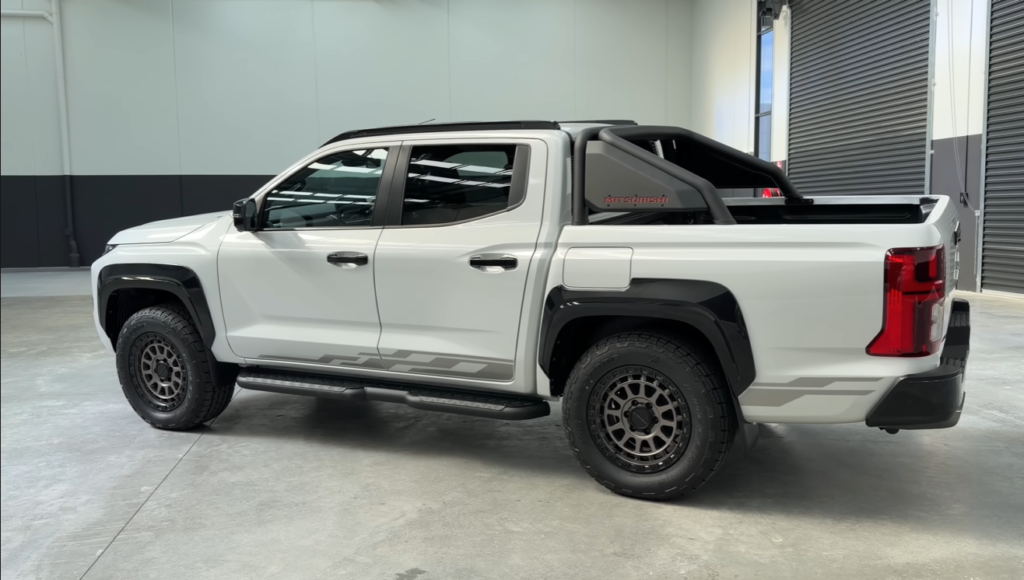
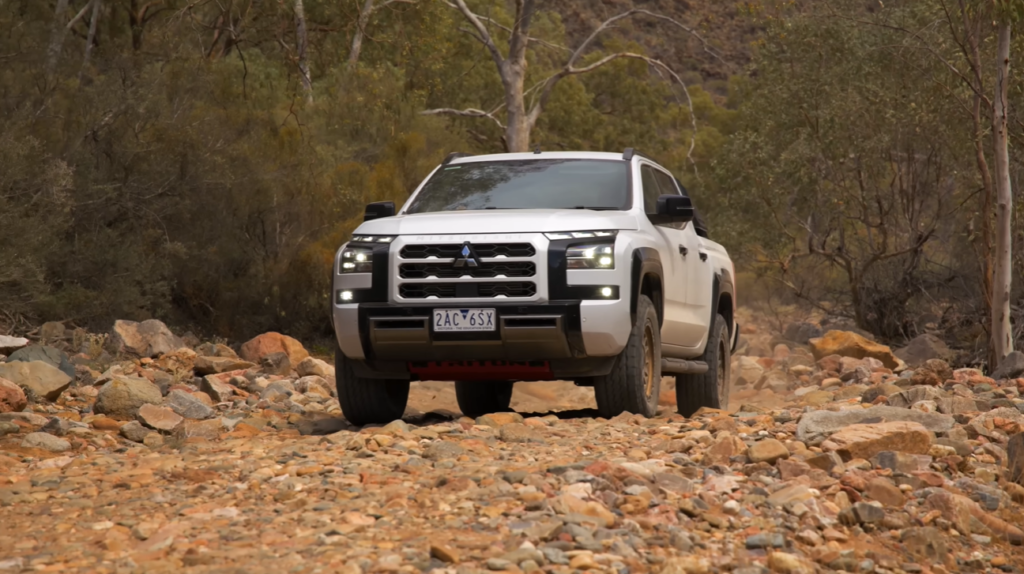
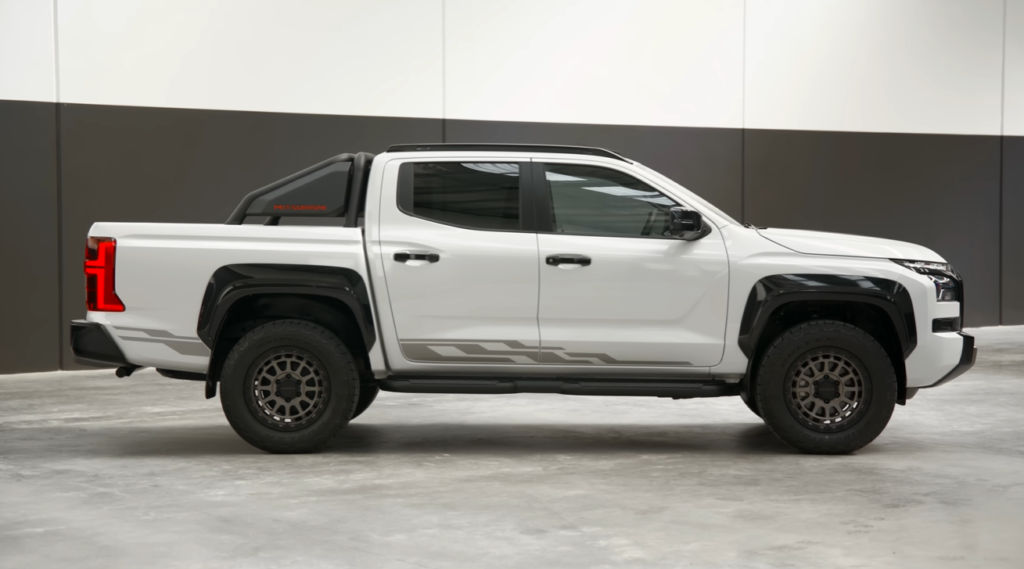
The Raider makes its case visually through a collection of purposeful additions rather than a dramatic body redesign:
What’s new on the outside:
- Bespoke ROH 18-inch Brushed Bronze alloy wheels
- Bridgestone AT002 285/60R18 all-terrain tyres
- Bash plate under the front bumper
- Rock sliders along the sides
- Sports bar in the tray
- Raider badging on both flanks
- Wider, taller stance from the lifted suspension and wider track
- Side body decal running the length of the vehicle
The bash plate is aesthetic rather than rated for recovery anchor use — it’s there for protection on gravel, not as a winching point. The rock sliders are functional, protecting the sills on tight off-road lines. The sports bar is a visual and mild practical addition.
The overall result is a Triton that looks meaningfully more purposeful than the standard GSR without resorting to fake vents or cartoon body cladding. The bronze wheel colour is a distinctive choice that works well against both lighter and darker body colours.
Interior: Exactly What You’d Expect
There are no surprises inside the Triton Raider — and that’s both its strength and its weakness, depending on what you were hoping for.
The cabin is identical to the standard Triton GSR. You get the 9-inch infotainment screen, the GSR’s leather-appointed seats, Mitsubishi Connect with factory-fitted 4G modem, and the full suite of driver-assist features. It is a well-specced, comfortable, modern ute interior.
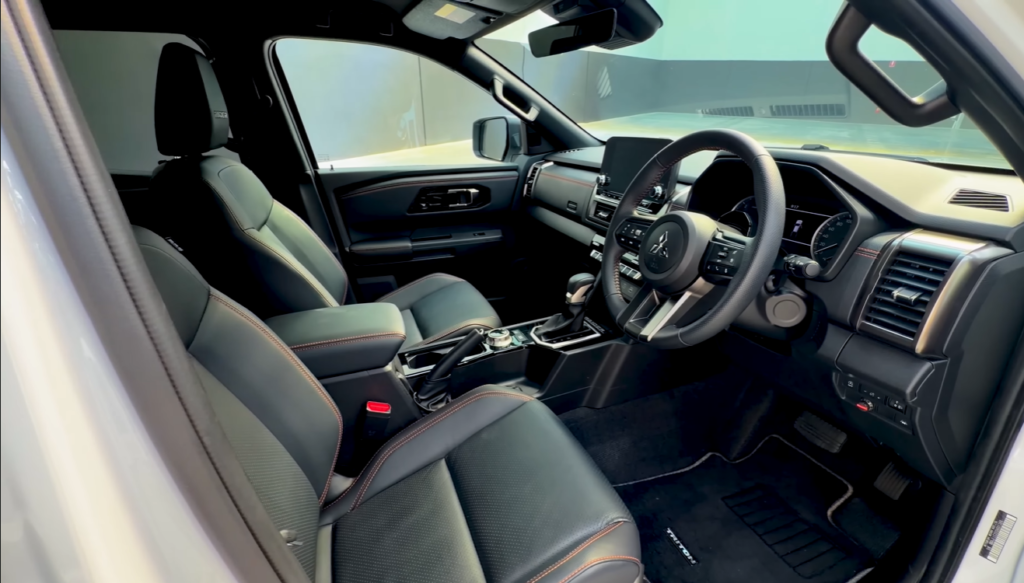
What you won’t find: unique Raider trim, special upholstery, a sporty steering wheel, rally-inspired instrument graphics, or any visual differentiation from the standard GSR. The only interior markers of Raider ownership are the two Raider badges — one on the steering wheel, one elsewhere. That’s it.
For buyers who spend most of their time in the cabin, this might be the most honest way to look at the Triton Raider’s value proposition: you are paying the premium entirely for the suspension, tyres, wheels, and ride height — not for a transformed interior experience.
Whether that’s worth the ~$10,000+ premium over the $64,590 GSR is the central question every buyer needs to answer for themselves.
How the Triton Raider Compares to Key Rivals
| Model | Engine | Power | Suspension Tune | Lift | AT Tyres | Est. Price |
|---|---|---|---|---|---|---|
| Mitsubishi Triton Raider | 2.4L bi-turbo diesel | 150kW / 470Nm | Premcar Monroe + Yamaha | +25mm front | Bridgestone AT002 | ~$75,000+ |
| Nissan Navara Pro-4X | 2.4L bi-turbo diesel | 150kW / 470Nm | Premcar Monroe | Standard | Bridgestone AT002 | $69,890 |
| Ford Ranger Raptor | 3.0L twin-turbo petrol | 292kW / 583Nm | Fox Racing dampers | +50mm | Goodyear AT | ~$85,000+ |
| Toyota HiLux GR Sport | 2.8L turbo diesel | 150kW / 500Nm | Bilateral-valve dampers | +30mm | Falken AT | ~$76,000+ |
| Toyota HiLux Rugged X | 2.8L turbo diesel | 150kW / 500Nm | Standard lifted | +40mm | Goodyear AT | ~$72,000+ |
The most direct and interesting comparison is the Navara Pro-4X. Both are Premcar-tuned, both use Monroe dampers with internal rebound springs, both run Bridgestone AT002 tyres, and both are built on the same platform. The Navara Pro-4X starts from $69,890 — making it approximately $5,000 cheaper than the expected Triton Raider price.
The key differentiators that justify the Raider’s premium over the Navara: the additional Yamaha Performance Dampers on the chassis, the revised front springs and bump stops specific to the Raider, and — for buyers in the Mitsubishi ecosystem — the brand preference and dealer network.
The Warranty: One of Australia’s Best
The 2026 Mitsubishi Triton is covered by a 10-year, unlimited-kilometre warranty provided you service it at Mitsubishi dealers when required, along with 10 years of roadside assistance and 10 years of capped-price servicing.
This warranty structure is exceptional in the ute segment and applies to the Raider as a Triton variant. For buyers planning to keep their vehicle long-term — which is the profile of most serious off-road ute owners — this is a meaningful ownership advantage over Ford and Toyota.
Who Should Buy the Mitsubishi Triton Raider?
Buy it if you:
- Already love the Triton GSR but want meaningful off-road and gravel capability without lifting it yourself
- Prioritise on-road refinement combined with a genuine off-road pedigree
- Value Mitsubishi’s 10-year warranty and dealer network
- Drive regularly on corrugated outback roads or gravel tracks, where the Premcar tune will make a daily difference
- Prefer the Triton’s Super Select II 4WD system over the Navara’s equivalent
Think carefully if you:
- Were hoping for a new engine or power upgrade
- Expected a transformed, Raider-specific interior
- Are comparing purely on value — the Navara Pro-4X delivers a very similar Premcar suspension story for ~$5,000 less
- Want the outright performance of a Ranger Raptor — this is not that vehicle
Final Verdict
Rating: 4.1 / 5
The Mitsubishi Triton Raider is the most capable, best-suspended Triton ever built for Australian conditions. The Premcar Monroe damper package with internal rebound spring, combined with the Yamaha chassis dampers already fitted to the GSR, gives it a genuinely differentiated suspension story in the Australian ute market. The Bridgestone AT002 tyres and lifted, wider stance make it visually purposeful and practically more capable off-road than the standard GSR.
The conflict is real, though: Premcar has now essentially sold similar suspension expertise to both the Navara and the Triton. Whether the Raider’s unique front springs, bump stops, and shim/oil specifications make it perceptibly better than the Navara Pro-4X on Australian roads is the question that proper back-to-back testing will need to answer.
What we know now: it’s a better Triton than the GSR. Whether the premium over the GSR — and over the Navara Pro-4X — is justified will become clearer when full road test reviews arrive in May 2026.
Specification details sourced from Mitsubishi Australia, Torquecafe, Chasing Cars, and CarsGuide. Pricing for the Triton Raider is yet to be officially confirmed ahead of the Melbourne Motor Show reveal on April 10, 2026. All figures accurate as of April 9, 2026.