There are adventure bikes. And then there is the Honda Africa Twin.
Few motorcycles in the ADV world carry the kind of reputation, loyalty, and genuine riding credibility that the Africa Twin has built over decades. And yet, every time a new model year rolls around, the same question gets asked — “What’s actually new? Why should I care?”
It’s a fair question. And the honest answer for the 2026 Honda Africa Twin Adventure Sport is this: the fundamentals that made the 2024 generation a genuine game-changer are still here, fully intact, and the cosmetic updates to this new model year are — in person, on the road — far more impressive than any photo on social media suggested.
This is a real-world, on-road riding review from the mountains of North Georgia — twisty roads, state troopers and all. No spec-sheet recitation. Just honest impressions from someone who has ridden this bike through BDRs, mountain passes, and everything in between.
Let’s get into it.
The 2026 Updates: Better Than They Look Online
When Honda first revealed the 2026 Africa Twin’s new colorway on social media, the reaction was mixed. The red front fairing element looked out of place to many — like a leftover part slapped onto an unchanged bike.
In person? Completely different story.
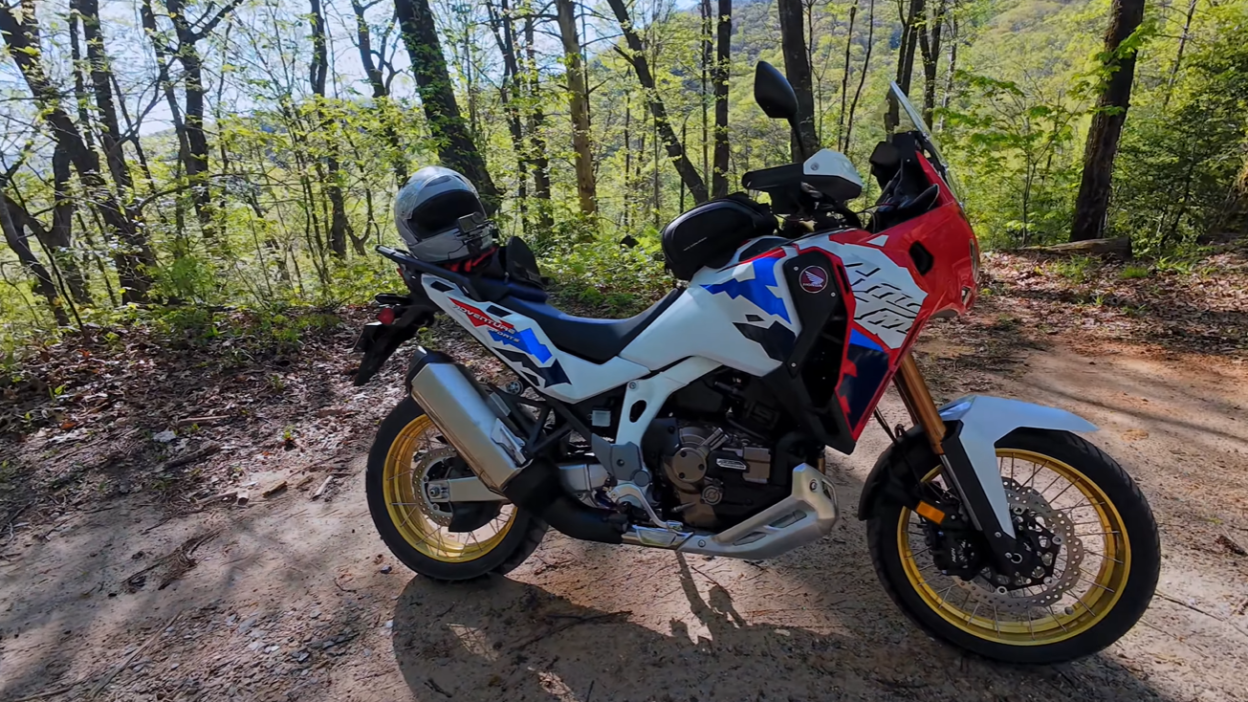
The 2026 color combination — white front fender, red upper fairing, transitioning into white bodywork, finished with a black and blue seat — is genuinely stunning. It’s one of those designs that photographs poorly but stops people in their tracks when seen in real life. The Africa Twin has always been considered one of the best-looking adventure bikes on the market, and this new combination pushes that further.
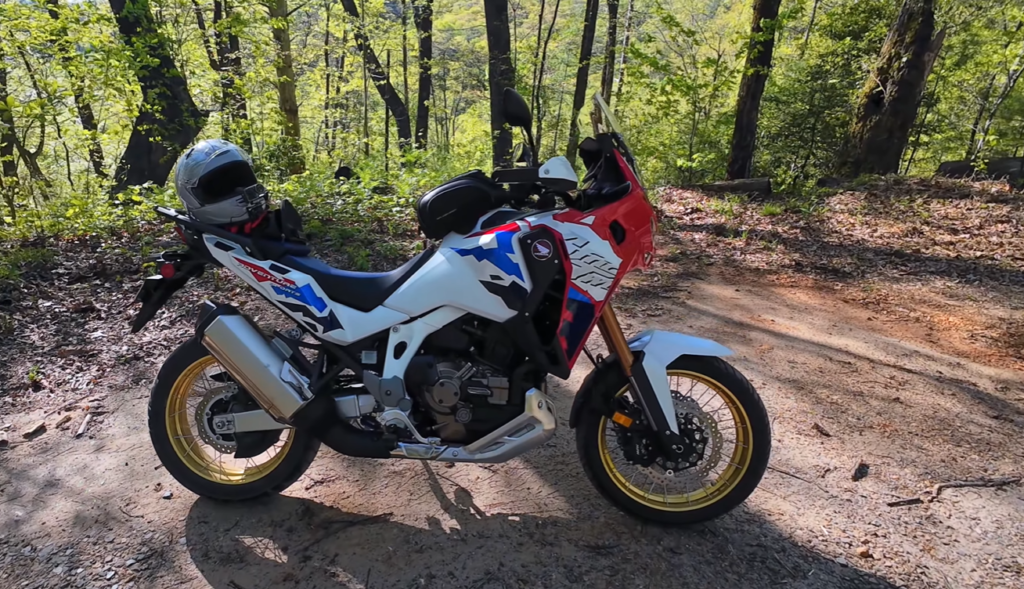
It’s subjective, of course. But if you dismissed the 2026 updates based on social media photos, go see one in person before making your final judgment.
Why the 2024+ Generation Was the Real Revolution
To understand why the 2026 Africa Twin matters, you need to understand what Honda changed starting with the 2024 model year — because that generation was the real turning point.
From Intimidating to Approachable — Without Losing Capability
Before 2024, all Africa Twins shared a common characteristic: they were big, tall, and massive — genuinely intimidating bikes that required confidence and experience to manage, especially at low speeds and in off-road situations.
Starting with 2024, Honda made a deliberate and meaningful change. They separated the lineup more distinctly and made the Adventure Sport significantly more manageable:
- Lower seat height — easier to reach the ground
- More confidence-inspiring ergonomics — better weight distribution and handling balance
- Less intimidating at low speed — without sacrificing any of the capability at pace
This is not a small thing. In the ADV world, where a large portion of riders are constantly searching for the mythical lightweight unicorn — small, nimble bikes like the 300L or NX500 — Honda essentially made the Africa Twin competitive on manageability without abandoning its position as a full-capability adventure machine.
The message is clear: don’t be intimidated by it. The 2024-and-beyond Africa Twin is more accessible than any previous generation, even though it remains a big, capable, heavy ADV bike.
On-Road Performance: Where the Africa Twin Truly Shines
The focus of this review is on-road performance — because that’s where the vast majority of Africa Twin owners actually spend most of their riding time, whether they admit it or not.
The Connection Factor
There’s a word that gets overused in motorcycle reviews: connected. But with the Africa Twin on a set of well-paced twisty mountain roads, it’s the only word that accurately describes the experience.
Riding through the mountain roads of North Georgia — winding, technical, cambered, with elevation changes — the Africa Twin feels like an extension of the rider rather than a vehicle being piloted. You lean in, the bike follows. You want more, it delivers. You ease off, it settles. There’s a fluency to the riding experience that bigger, heavier bikes often struggle to achieve.
The key insight: the Africa Twin never makes you second-guess yourself. Want to buzz up the mountains? Go. Want to head to Tennessee on a whim? Go. There’s no mental negotiation about whether the bike is up for it, whether you’ll be comfortable, or whether it’ll be a grind. You just ride.
Twisty Road Behavior
Through mountain twisties, the Adventure Sport’s behavior is particularly impressive:
- Steering input is precise and responsive without being twitchy
- Mid-corner stability is excellent — the bike tracks confidently through long, fast bends
- Weight management — despite being a heavy ADV bike, the mass disappears once you’re moving
- Feedback — you always know what the front and rear tires are doing
For a bike that weighs what the Africa Twin weighs and carries the ergonomic profile of an adventure bike, the on-road agility is genuinely remarkable.
DCT: The Most Misunderstood Feature on the Africa Twin
The Dual Clutch Transmission (DCT) on the Africa Twin is, without question, the most polarizing feature the bike offers. And most of the criticism comes from people who haven’t actually spent meaningful time with it.
The “Scooter” Criticism Is Wrong
The most common dismissal of DCT is that it makes the Africa Twin feel like a scooter. This comes almost entirely from riders who either haven’t ridden it or who jumped on it, left it in D (Drive) mode, and formed an opinion.
In D mode, riding at 38 mph in sixth gear, the engine does indeed feel like it’s clogging along — soft, disconnected, and uninspiring. That criticism is valid for that specific mode.
But that’s not how you ride a DCT Africa Twin.
How DCT Actually Works at Its Best
The DCT system offers multiple modes, and the difference between them is dramatic:
Drive Mode (D): Smooth, relaxed, fuel-efficient. Great for highway cruising. Not great for twisties or spirited riding.
Sport Mode 1 & 2: This is where DCT comes alive. In Sport 2, the transmission holds gears longer, downshifts more aggressively, and behaves much more like a manual transmission being ridden by an engaged rider. Through mountain twisties in Sport 2, the experience is genuinely involving and exciting.
Manual Mode: Thumb paddles on the bars allow full manual gear selection. Coming through a mountain turn at 50 mph in third gear, clicking up and down with the paddles — this is not a scooter experience. This is an engaging, driver-focused riding experience.
The Key to DCT: Learn Your Settings
The biggest takeaway from extensive DCT experience on the Africa Twin is this: you have to invest the time to learn it for your specific riding scenarios.
- Off-road riding demands different DCT settings than highway touring
- Twisty mountain roads call for Sport 2 or Manual mode
- Long highway stretches work beautifully in touring-oriented D mode
- Electronic brake adjustment adds another dimension of tuning
Don’t form an opinion on DCT from one ride in one mode. Give it the time it deserves across multiple riding conditions, and it genuinely transforms the experience.
The DCT Foot Shifter
An upcoming test will cover the DCT foot shifter accessory — a feature that allows traditional foot-operated gear changes on a DCT-equipped bike. For riders who want the convenience of DCT with the tactile familiarity of a manual shift pattern, this could be the best of both worlds. Particularly interesting for mountain riding and off-road use.
Electronic Suspension: The Adventure Sport’s Secret Weapon
This is the feature that, more than any other, justifies the Adventure Sport designation and its price premium over the standard Africa Twin.
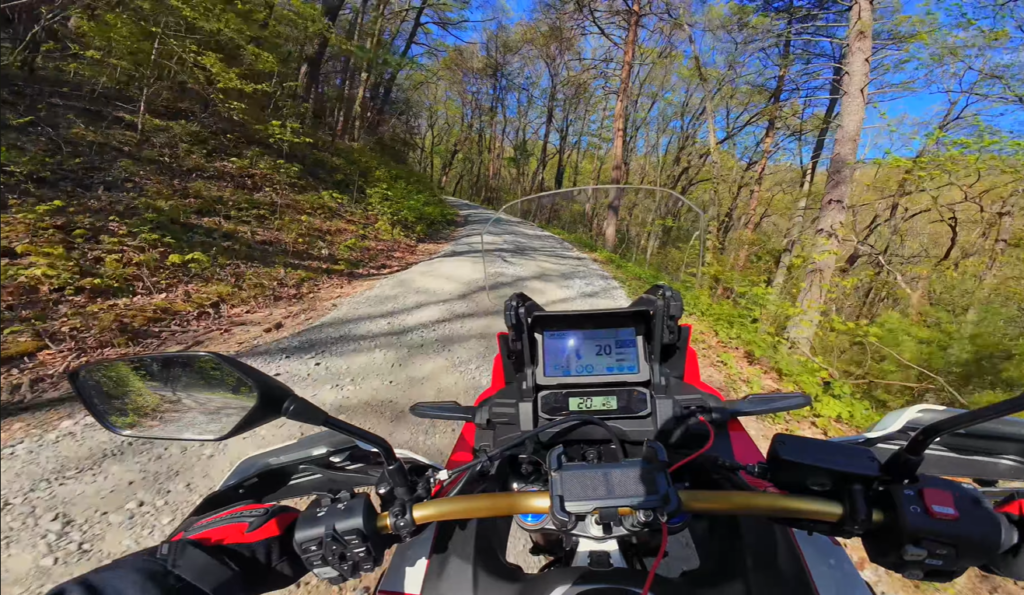
Why Electronic Suspension Changes Everything
The Adventure Sport’s electronically adjustable suspension is not a luxury feature for riders who never push their bikes. It’s a practical, functional tool that meaningfully changes how the bike performs in real riding scenarios.
Scenario 1: Loaded Touring When you strap on panniers, a top box, and a tank bag for a multi-day tour, the bike’s weight distribution changes significantly. Without suspension adjustment, that luggage loading softens the rear and affects handling — particularly through twisty roads where the added weight can pull the bike down mid-corner. Electronic suspension lets you firm up the rear instantly to compensate.
Scenario 2: Off-Road Riding Trail riding demands softer suspension for compliance over roots, rocks, and varied terrain. Electronic adjustment allows quick, on-the-fly changes without tools or trail-side fiddling.
Scenario 3: Sport Road Riding For mountain roads and twisties without luggage, firmer settings sharpen the handling and improve feedback — letting you dig into turns with more confidence.
The ability to adjust suspension electronically from the cockpit — without stopping, without tools — is a game-changer for a true all-rounder adventure bike.
A Note on the Standard Version
One genuine frustration: Honda offers the standard Africa Twin with electronic suspension in European markets but not in the US. The US lineup currently sits at approximately $14,000 for the base and $18,000 for the Adventure Sport, with the electronic suspension gap between them. Bringing electronic suspension to the standard US model at a price point between the two would make enormous sense, but Honda’s US market strategy hasn’t reflected that yet.
Apple CarPlay & Android Auto: Connected Riding Done Right
The 2026 Africa Twin Adventure Sport comes with a full Apple CarPlay and Android Auto compatible display — and after extensive use, it’s become a genuinely indispensable riding tool rather than a gimmick.
What You Get
- Navigation — Google Maps, Waze, Gaia GPS accessible on the instrument screen
- Music control — manage playlists without reaching for your phone
- Calls and messaging — stay connected safely while riding
- Third-party apps — Gaia for trail navigation, adventure-specific apps
The Real-World Value
For adventure riders who cover serious distances across varied terrain, having reliable navigation directly in the instrument cluster — without a phone mount jury-rigged to the bars — is a meaningful quality-of-life improvement. The Africa Twin’s implementation is clean, responsive, and genuinely useful.
The counterargument — “I don’t want all this tech, I just want to ride” — is valid and respected. But the key point is: it’s there when you want it and ignorable when you don’t. Having the option costs you nothing. And on a long day in unfamiliar territory when you genuinely need navigation, you’ll be glad it’s there.
Off-Road Capability: Honest Assessment
While this review focuses on on-road performance, the off-road picture deserves an honest, direct assessment.
What the Stock Africa Twin Can Do Off-Road
On light gravel tracks, forest roads, and the kind of mild off-road you’d encounter reaching a campsite or navigating a back road, the stock Adventure Sport is completely capable. Don’t overthink it. Moderate gravel, light trails, and unpaved roads are no problem.
What the Stock Tires Cannot Do
The stock road-oriented tires are the limiting factor for serious off-road use. On loose gravel at any meaningful speed, the tires dance and skip rather than bite and track. Traction control off, moderate pace — it’s manageable. But push it harder and the tire limitation becomes a genuine safety concern.
The Two-Item Off-Road Upgrade List
If you intend to do serious off-road riding on an Africa Twin Adventure Sport:
- Change the tires immediately — this is non-negotiable and should be the first modification before anything else
- Add crash bars — dropping the bike off-road is a matter of when, not if; protect it properly
With proper tires, the Africa Twin’s chassis, suspension, and electronics become a genuinely capable off-road platform. Without them, you’re limited.
The Africa Twin vs. BMW GS: The Honest Comparison
The inevitable comparison. The BMW R 1250 GS is the Africa Twin’s most obvious competitor, and it’s a genuinely excellent motorcycle. So why choose the Honda?
The Price Gap Is Significant
A comparable BMW GS setup comes in at at least $10,000 more than the Africa Twin Adventure Sport, depending on trim and options. That’s a substantial premium.
What Does the Extra Money Buy?
Honestly? The core riding experience — the sense of connection, capability, and versatility — is not $10,000 different. The Africa Twin delivers the same fundamental ADV experience at a meaningfully lower price point.
The BMW brings its own character, its own engineering philosophy, and — to be direct — a certain brand prestige that matters to some buyers. If that’s important to you, it’s your money and your choice.
But if the question is purely “Which bike makes me a better, happier adventure rider?” — the gap between them doesn’t justify the price difference for most people.
Who Is the 2026 Africa Twin Adventure Sport For?
Perfect For:
- Experienced ADV riders wanting a true do-it-all bike
- Touring riders who want comfort, technology, and capability in one package
- Road-focused riders who want occasional off-road ability without a dedicated dirt bike
- DCT converts — or riders willing to genuinely learn the system
- Value-conscious buyers comparing against the BMW GS segment
Think Carefully If You:
- Are a first-time motorcycle rider — this is not a beginner’s bike
- Want primarily off-road performance — change the tires and reconsider your use case
- Are committed to a purely manual transmission experience and unwilling to explore DCT
- Need the absolute lightest ADV bike possible — lightweight ADV alternatives exist
Key Specs at a Glance
| Feature | Details |
|---|---|
| Model Year | 2026 |
| Variant | Adventure Sport (DCT) |
| Transmission | DCT (Dual Clutch) / Manual available |
| Suspension | Electronic (Front & Rear) |
| Navigation | Apple CarPlay / Android Auto |
| Cruise Control | Yes |
| Riding Modes | Multiple (Road, Off-road, User) |
| Price (Base) | ~$14,000 |
| Price (Adventure Sport) | ~$18,000 |
| Colorway (Reviewed) | White / Red / Blue-Black Seat |
What We Love ✅
- Stunning 2026 colorway — far better in person than in photos
- 2024+ generation manageability improvements — genuinely more accessible
- Exceptional on-road connection and riding feel through twisties
- DCT in Sport 2 and Manual mode is involving and genuinely fun
- Electronic suspension — transforms the touring and mixed-terrain experience
- Apple CarPlay and Android Auto — genuinely useful, not just a gimmick
- Cruise control for long-distance comfort
- Significantly more affordable than BMW GS competition
What to Know ⚠️
- Stock tires are inadequate for serious off-road use — budget for a tire change
- DCT requires genuine time investment to learn — don’t judge it after one ride
- Electronic suspension is US Adventure Sport exclusive — not available on standard US model
- Heavy and tall — not recommended as a first motorcycle
- The price gap between base and Adventure Sport is significant
Final Verdict
The 2026 Honda Africa Twin Adventure Sport doesn’t need to reinvent itself to justify your attention. What Honda built with the 2024 generation — a more manageable, more accessible, more confidence-inspiring version of an already legendary adventure platform — remains the best expression of what an all-around adventure motorcycle should be.
On the road, it’s engaging, fluid, and genuinely exciting in a way that heavier, more complex bikes rarely manage. Loaded with luggage, it’s stable and composed. With CarPlay running and the suspension dialed in for the terrain, it’s as modern and connected as any motorcycle on the market. And at its price point, nothing in the ADV space offers comparable value.
If you could only have one motorcycle in your garage — one bike for roads, tours, mild trails, weekend blasts, and everything in between — the 2026 Honda Africa Twin Adventure Sport is the answer.
Not because nothing else is good. But because nothing else does everything this well.
Overall Rating: 9.5 / 10 ★★★★★
| Category | Score |
|---|---|
| On-Road Performance | 9.5 / 10 |
| Off-Road Capability (Stock) | 7.0 / 10 |
| Comfort & Ergonomics | 9.5 / 10 |
| Technology & Features | 9.0 / 10 |
| DCT Transmission | 9.0 / 10 |
| Electronic Suspension | 9.5 / 10 |
| Value for Money | 9.5 / 10 |
| Design & Aesthetics | 9.5 / 10 |
“If I was to have one bike — one bike in the garage — this would be it. It just does it all.”
Have questions about the 2026 Honda Africa Twin Adventure Sport? Drop them in the comments below. If this review helped you, share it with a fellow rider who’s been on the fence.