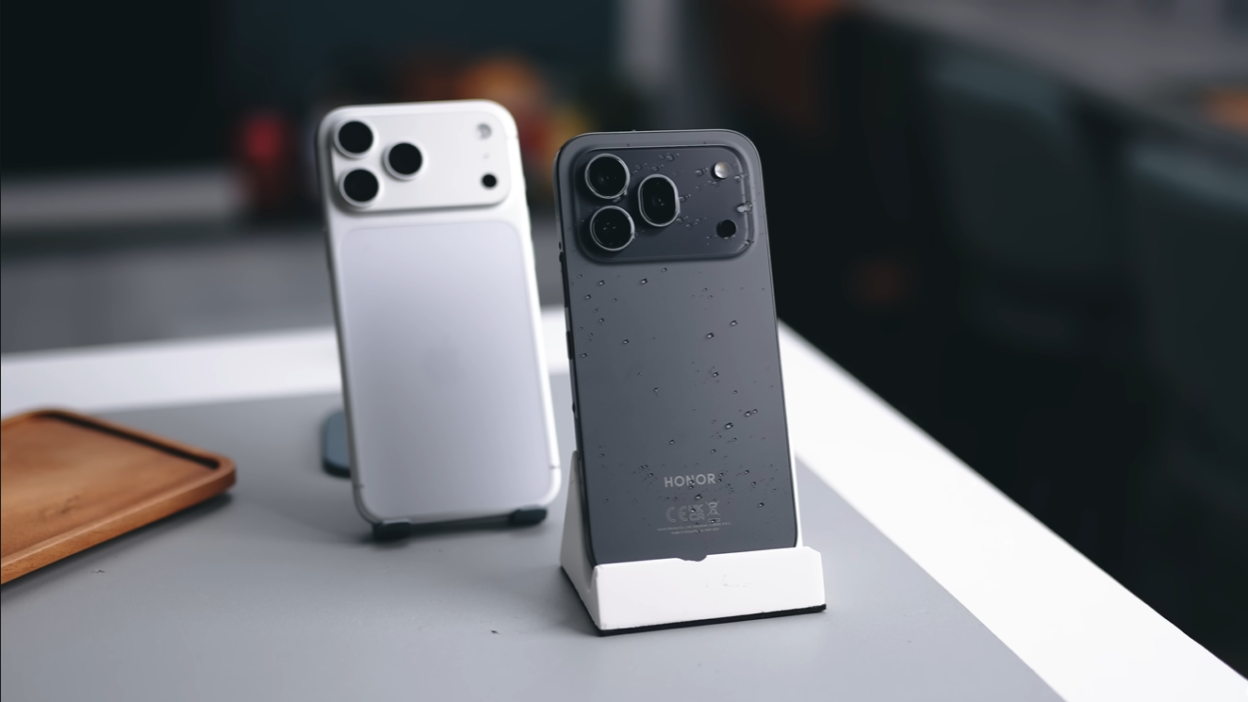
The Honor 600 Pro launched on April 29, 2026, and the first thing everyone noticed was the camera shelf design running the full width of the back. Sound familiar? It should. The iPhone 17 Pro did it first. But beyond the design inspiration, these two phones are built completely differently — different philosophies, different strengths, different buyers. At €630 (~$720) vs $999 for the iPhone 17 Pro, the price gap is real. The question is whether the Honor 600 Pro closes it where it counts. We compared both. Here is the complete, honest breakdown.
Quick Verdict — Before We Go Deep
- Honor 600 Pro wins on battery — 7000mAh + 80W wired + 50W wireless vs iPhone 17 Pro’s ~4000mAh — it is not close.
- iPhone 17 Pro wins on display — anti-reflective coating, ProMotion 1–120Hz, and tighter software integration set the benchmark.
- Honor wins on camera features — AI Image to Video 2.0, deepfake detection, CIPA 6.5 telephoto OIS, and 120x zoom vs iPhone’s 40x.
- iPhone wins on camera consistency — natural colour science, video stability, and ecosystem reliability remain class-leading.
- Honor wins on durability — IP68 + IP69 + IP69K triple certification vs iPhone 17 Pro’s IP68 only.
- iPhone wins on software — Apple Intelligence is deeply integrated into iOS. Honor’s MagicOS AI features are impressive but more fragmented.
- Honor wins on value — €630 (~$720) vs $999 for broadly comparable flagship-tier hardware.
Final score: Honor 600 Pro 5 — iPhone 17 Pro 4
Full Specs Side by Side
Price: Honor 600 Pro €630 / ~$720 | iPhone 17 Pro $999 / ~£999
Display: Honor — 6.57-inch 1.5K AMOLED, 120Hz, 8000 nits peak, high-frequency PWM dimming | iPhone — 6.3-inch Super Retina XDR OLED, 1–120Hz ProMotion, anti-reflective coating
Chipset: Honor — Snapdragon 8 Elite (3nm) | iPhone — Apple A19 Pro (3nm)
RAM: Honor — 12GB / 16GB LPDDR5x | iPhone — 8GB
Storage: Honor — 256GB / 512GB / 1TB | iPhone — 128GB / 256GB / 512GB / 1TB
Main camera: Honor — 200MP, 1/1.4-inch sensor, OIS | iPhone — 48MP main, larger individual pixels
Ultrawide: Honor — 12MP | iPhone — 48MP
Telephoto: Honor — 50MP, 3.5x, CIPA 6.5 OIS, 120x max zoom | iPhone — 12MP, 5x OIS, 40x max zoom
Front camera: Honor — 50MP | iPhone — 24MP TrueDepth with autofocus
Battery: Honor — 7000mAh silicon-carbon, 2-day life | iPhone — ~4000mAh, all-day life
Wired charging: Honor — 80W | iPhone — 40W
Wireless charging: Honor — 50W (Pro only) | iPhone — 25W MagSafe
IP rating: Honor — IP68 + IP69 + IP69K | iPhone — IP68 only
OS: Honor — Android 16, MagicOS 10, 6 years OS + 6 years security updates | iPhone — iOS 19, Apple long-term support
AI features: Honor — Gemini + AI Image to Video 2.0 + deepfake detection + voice clone detection + AI translation | iPhone — Apple Intelligence + Siri (deeply integrated)
Build: Honor — metal frame, composite fibre back, sub-1mm bezels (world first) | iPhone — titanium frame, textured matte glass back
Colours: Honor — Cosmos Black, Orange, Golden White | iPhone — Black Titanium, White Titanium, Natural Titanium, Desert Titanium
Launch: Honor — April 29, 2026 | iPhone — September 2025
Round 1: Design — Inspired by iPhone, But More Durable Than It
The Honor 600 Pro’s camera shelf running the full width of the rear panel is the most talked-about design choice of its launch week — because everyone recognises where the inspiration came from. Honor has not hidden this. The iPhone 17 Pro introduced the full-width camera bar and it became one of the most recognisable smartphone design elements of 2025.
What Honor does differently is the durability package underneath that familiar silhouette. The 600 Pro carries triple IP certification — IP68, IP69, and IP69K simultaneously. IP68 means submersion at depth. IP69 means resistance to high-pressure water jets. IP69K adds high-temperature water jet resistance. The iPhone 17 Pro carries IP68 only.
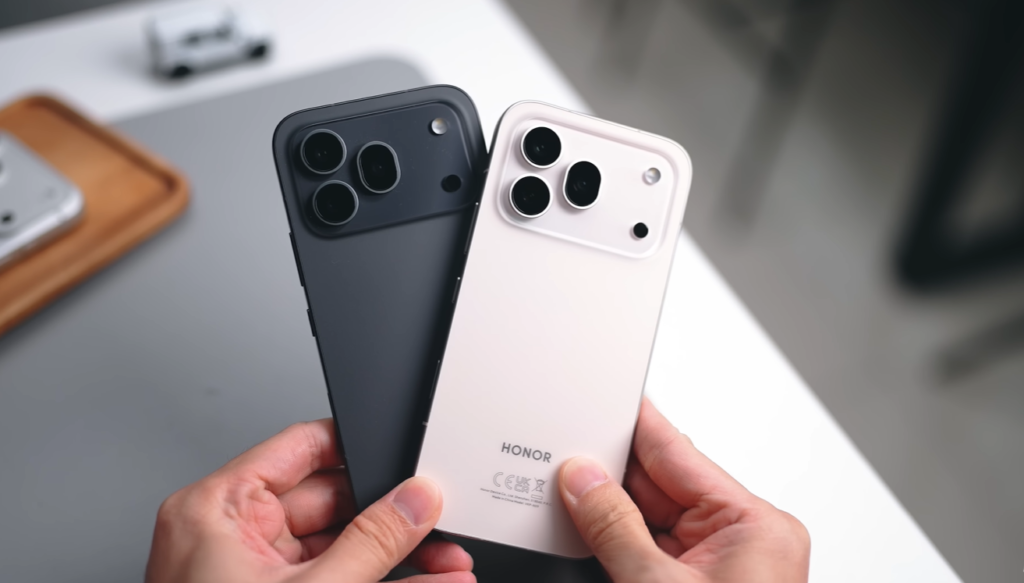
Honor has also achieved sub-1mm bezels on the 600 Pro — confirmed as a world first at launch. The Swiss SGS 5-star Drop and Crush Resistance certification adds independent third-party verification to the durability claims. The metal frame and composite fibre back feel premium and solid in hand, though the titanium frame of the iPhone 17 Pro carries a more instantly recognisable premium sensation at first touch.
At 195–200g the Honor is slightly heavier than the iPhone 17 Pro’s 187g, but both sit comfortably in hand for most users.
Round 1 winner: Honor 600 Pro — on durability. The design is clearly inspired by Apple, but it survives more. Triple IP certification is a concrete real-world advantage.
Round 2: Display — Eye Comfort vs Benchmark Quality
These two displays are built around completely different philosophies, and understanding that difference helps you choose the right phone.
The iPhone 17 Pro display is the industry benchmark. Super Retina XDR OLED with ProMotion adaptive 1–120Hz refresh, proprietary anti-reflective coating, true-to-life colour calibration, and the most natural viewing experience in any smartphone. When reviewers want to describe how good a display should look, they describe the iPhone 17 Pro standard.
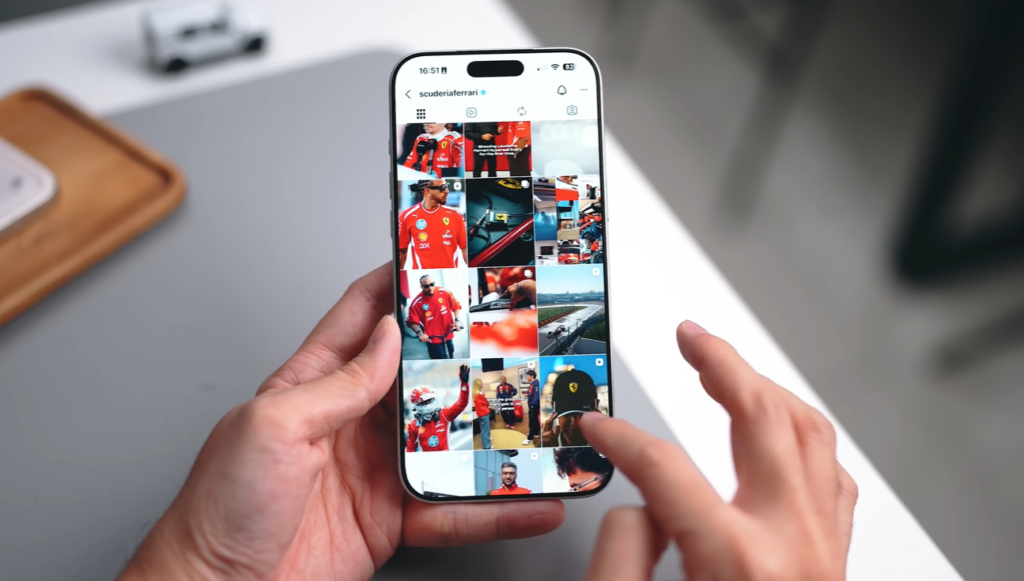
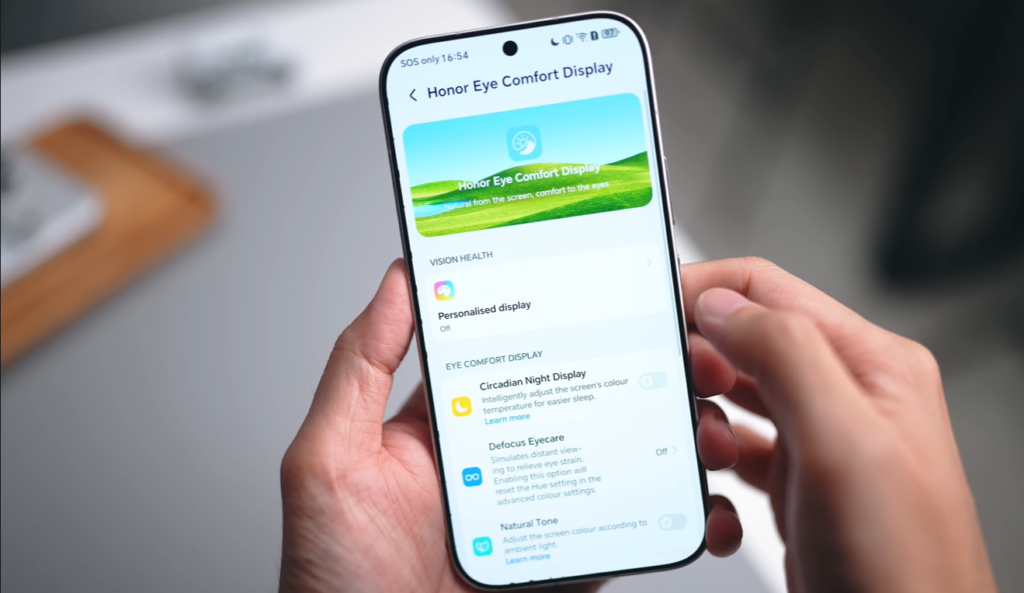
The Honor 600 Pro takes a different approach. Its 6.57-inch 1.5K AMOLED panel with 8000 nits peak brightness is technically impressive — bigger, brighter, and higher resolution than the iPhone. But the design philosophy is centred on eye comfort over pure display performance. High-frequency PWM dimming reduces the screen flicker that causes eye strain in extended sessions. The Circadian Night Display adjusts colour temperature based on time of day to protect sleep cycles. AI Defocus Eye Care monitors and adjusts based on usage patterns.
For someone who spends 5–8 hours per day looking at their phone screen — which describes most smartphone users in 2026 — the Honor’s eye comfort features have a measurable real-world benefit that never appears in a spec sheet. Reviewers who tested the phone for 2 weeks reported noticeably less eye fatigue than comparable devices.
The iPhone wins the pure quality benchmark. But the Honor wins for long-session comfort. If you doom-scroll for 3 hours before bed, that distinction matters.
Round 2 winner: iPhone 17 Pro — on benchmark display quality. The anti-reflective coating and colour accuracy remain the standard others measure against.
Round 3: Camera — 200MP vs 48MP and What That Actually Means
The megapixel comparison is the most misunderstood element of this entire review. 200MP vs 48MP tells you almost nothing about which camera takes better photos. What matters is sensor size, optical stabilisation quality, colour science, and processing philosophy.
Honor 600 Pro camera system: The 200MP main sensor has a 1/1.4-inch physical size — one of the largest sensors in any smartphone available today. Larger sensors capture more light per pixel, which is the primary determinant of photo quality in real-world conditions. The result is natural bokeh in portrait shots without artificial blur processing, better low-light detail, and more dynamic range in high-contrast scenes. The colour tuning is vivid — slightly more saturated than real life, which makes photos look immediately lively and social-media ready. Skin tones have been significantly improved over previous Honor generations — natural and accurate rather than artificially smoothed or darkened.

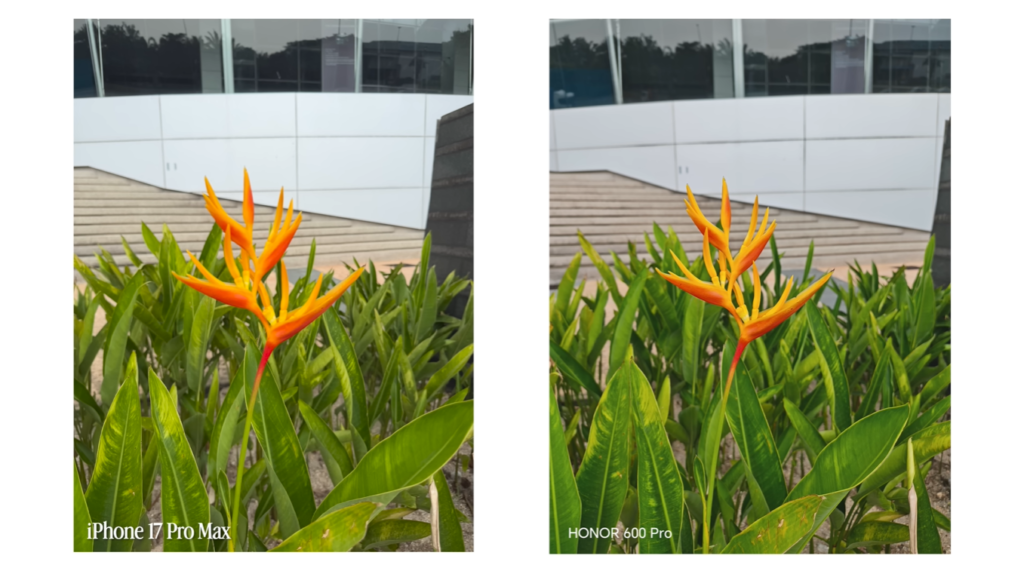
The telephoto lens is where the Honor genuinely separates itself from the iPhone. A 50MP sensor with 3.5x optical zoom, CIPA 6.5-standard optical image stabilisation, and a maximum 120x zoom range. The CIPA 6.5 rating means the telephoto can compensate for 6.5 stops of shake — so one-handed zoom shots of subjects far away come out sharp in a way they simply cannot on a standard telephoto setup. iPhone 17 Pro’s telephoto maxes at 40x. Honor’s goes to 120x.
iPhone 17 Pro camera system: The iPhone’s camera philosophy is the opposite of Honor’s — minimal processing, maximum accuracy. What you see is what you get. Every photo is a true representation of what the scene looked like, not an enhanced or beautified version. This is why professional photographers, journalists, and video creators consistently choose iPhone — the output is reliable and predictable.
The 48MP ultrawide is sharper and more detailed than Honor’s 12MP ultrawide across every lighting condition. The video quality — 4K ProRes, Cinematic Mode, Log format for post-processing — remains the reference standard for smartphone video in 2026. No Android phone produces more consistently excellent video than the iPhone 17 Pro.
Round 3 result: Tie — Honor wins on zoom range, sensor size, and social-media colour pop. iPhone wins on video quality, colour accuracy, and low-light consistency. These are different photography philosophies serving different users.
Round 4: Battery — The Most One-Sided Round in This Comparison
This is where the comparison becomes genuinely lopsided.
Honor 600 Pro battery facts: 7000mAh silicon-carbon battery — a newer chemistry achieving higher energy density than standard lithium-ion at the same physical size. Real-world two-day battery life confirmed across multiple independent reviews including extended personal use testing. 80W wired charging reaches full from flat in approximately 45 minutes. 50W wireless charging (Pro variant only) — the fastest wireless charging on any phone in this price bracket. 27W reverse wired charging to top up earbuds or a friend’s phone.
iPhone 17 Pro battery facts: Approximately 4000mAh. All-day battery life — improved significantly over iPhone 16 Pro. 40W wired charging improved from previous generation. 25W MagSafe wireless charging. Reliable and sufficient for one heavy day of use before needing to recharge overnight.
The gap is not a minor spec difference. A 7000mAh battery vs a 4000mAh battery is a 75% larger energy reserve. In practice this means Honor 600 Pro users never think about battery during the day and rarely during the evening. iPhone 17 Pro users who are heavy users will end heavy days at 15–20% charge and reach for the cable.
If you have ever felt the specific anxiety of watching your iPhone drop below 20% at 7pm — the Honor 600 Pro eliminates that problem entirely.
Round 4 winner: Honor 600 Pro — by a wide margin. This is the single largest real-world daily use advantage in this entire comparison.
Round 5: AI Features — Creative vs Integrated
Honor 600 Pro AI features — the ones that genuinely matter:
AI Image to Video 2.0 is the standout feature of this phone and arguably the most impressive AI camera feature on any Android phone in 2026. You select a start frame and an end frame from two separate photos, and the Honor 600 Pro generates a cinematic video transition between them using Gemini’s upgraded multimodal model. This feature is built in collaboration with Google and is exclusive to Honor phones — no other Android manufacturer offers it. The output quality — including generated audio matching the scene — is described by Android Central reviewers as spectacular and among the best AI features on any Android phone to date.
AI Deepfake Detection is quietly the most practically important AI feature on this phone for 2026. The phone can analyse incoming images and video to flag potential AI-generated or manipulated content in real time. As deepfakes become more common in everyday social media and messaging contexts, having detection built into the camera roll is genuinely useful — not a future use case, an immediate one.
AI Voice Clone Detection works similarly — it can flag audio that may have been generated or manipulated by AI. Given the rise of voice-cloning scams targeting families and businesses, this is a feature that will matter to real users in real situations.
AI Photo Agent brings a suite of editing tools — remove people from backgrounds, collage creation, subject pop-out — all controlled by simple on-screen prompts.
iPhone 17 Pro AI — Apple Intelligence: Apple Intelligence is deeply woven into every iOS app. Writing suggestions appear in Messages and Mail without being asked. Smart summaries appear in Notification Centre. Image generation in Notes. Priority inbox management in Mail. Siri with contextual awareness across apps.
The key difference is integration depth. Apple Intelligence works silently in the background, improving things you are already doing. Honor’s AI suite requires you to open specific features to use them. Apple’s approach is more seamless. Honor’s approach is more powerful in specific use cases.
Round 5 result: Tie — Apple Intelligence is more seamlessly integrated and reliable across daily use. Honor’s AI Image to Video 2.0 and deepfake detection are features Apple does not offer. Your preference depends on whether you want AI that works quietly behind the scenes or AI you actively use as a creative tool.
Round 6: Software and Ecosystem
Honor 600 Pro — Android 16, MagicOS 10: 6 years of OS updates and 6 years of security patches — one of the longest update commitments from any Android manufacturer. Open Android ecosystem means sideloading, cross-platform file sharing, and flexibility Apple does not permit. MagicOS smart app grouping is genuinely useful for managing large app libraries. No ecosystem lock-in — your photos, messages, and data work on any platform.
iPhone 17 Pro — iOS 19: If you own a Mac, iPad, Apple Watch, or AirPods, the iPhone 17 Pro integrates with all of them in ways Android fundamentally cannot replicate. AirDrop, Handoff, Continuity Camera, Universal Clipboard, Sidecar — these features turn every Apple device you own into an extension of every other Apple device you own. App quality and consistency on iOS remains ahead of Android in most productivity and creative categories. Long-term iOS support has historically meant iPhones receive updates for 6–7 years.
Round 6 winner: iPhone 17 Pro — for ecosystem users. If you do not use other Apple products, this advantage largely disappears and Honor’s 6-year update commitment is directly competitive.
Round 7: Value — The Round That Changes Everything
Honor 600 Pro pricing:
- 12GB + 256GB — €630 / ~$720 / ~₹62,000
- 12GB + 512GB — €730 / ~$830
- 16GB + 1TB — €830 / ~$950
iPhone 17 Pro pricing:
- 128GB — $999 / £999 / ~₹134,900
- 256GB — $1,099
- 512GB — $1,299
- 1TB — $1,499
The Honor 600 Pro costs approximately 28–30% less than the base iPhone 17 Pro globally. For that saving you get a bigger battery, faster charging, more RAM, triple IP certification, a higher megapixel telephoto with longer zoom range, and more AI feature variety. What you give up is iPhone’s ecosystem integration, video quality benchmark, anti-reflective display coating, and the Apple brand name on your desk.
Round 7 winner: Honor 600 Pro — clear on specs per pound, dollar, or euro spent.
Who Should Buy Which Phone?
Buy the Honor 600 Pro if: You want 2-day battery life without compromise, enjoy using AI camera features creatively, are not embedded in the Apple ecosystem, and want flagship-tier hardware for ~$720. The deepfake and voice clone detection features are uniquely valuable in 2026 and not available on iPhone.
Buy the iPhone 17 Pro if: You already use a Mac, iPad, or Apple Watch, shoot video professionally or seriously, want the most natural and consistent camera output available, or simply value the proven reliability and seamless integration of iOS over everything else.
Honor 600 Pro is NOT for you if: You rely on FaceTime, iMessage, AirDrop, or any other Apple-exclusive service daily, or want the benchmark display quality without compromise.
iPhone 17 Pro is NOT for you if: Battery life is your biggest daily pain point, you want 120x zoom photography, or the $999 starting price requires you to compromise elsewhere in your budget.
MyPitShop Final Verdict
The Honor 600 Pro is not trying to be a better iPhone 17 Pro. It is trying to be a better phone for people who do not want to spend $999. And in that ambition it largely succeeds.
The battery advantage alone — 7000mAh vs ~4000mAh — is a daily quality-of-life improvement that no spec sheet fully captures until you stop worrying about charging at 6pm. The AI Image to Video 2.0 feature — combining images into cinematic video using Gemini’s upgraded multimodal model, exclusive to Honor — is genuinely impressive and not available on any iPhone. The deepfake and voice clone detection features are quietly the most practically useful AI safety tools on any consumer phone in 2026.
But the iPhone 17 Pro is still the better phone if the Apple ecosystem is already your home. iOS integration, video quality, and display consistency remain the standards others measure against — not beat.
One-line verdict: the Honor 600 Pro is the smarter choice if you are buying with your head. The iPhone 17 Pro is still the choice if you are buying with your heart — and your iCloud subscription.