Breaking: VW ID. Polo officially revealed April 29, 2026 — pre-sales open in Germany this week.
Volkswagen has been selling the Polo for 51 years. Over 20 million have found homes worldwide. And now, for the first time in its history, there is a fully electric version — the ID. Polo. It is a completely new development, unrelated to the combustion-engine Polo, available exclusively with front-wheel drive and two battery capacities. At under €25,000 to start, it is the most affordable new electric Volkswagen ever built. We had early access inside the car at its world premiere — here is everything you need to know.
Why This Car Matters More Than Any Other EV Launch in 2026
The ID. Polo is not just another electric hatchback. It is the opening move in Volkswagen’s most important product strategy in a decade. The ID. Polo kicks off a new chapter at Volkswagen as the first model from a new family of entry-level EVs. It will be the first of four smaller, more affordable electric vehicles bearing an established Volkswagen brand name.
Over 20 million Polos have found homes since the nameplate launched more than 50 years ago. Attaching that legacy to an EV starting below €25,000 is the kind of moment that shapes an entire segment. If it works — and the early signs suggest it will — the ID. Polo could do for affordable electric mobility in Europe what the original Golf did for the hot hatch category in 1976.
Confirmed Pricing — All Trims
Pre-sales are already live in Germany, where the entry-level Trend trim kicks off at €24,995 ($29,300).
Trim breakdown:
Trend — €24,995 — base entry level. 37kWh LFP battery. 116hp motor. Steel wheels with covers (17-inch). No IQ. Light matrix LED. No illuminated logo. Fixed roof. Black fabric interior. No electric seat adjustment. Basic LCD without retro mode.
Life — above €24,995 — mid trim. Adds alloy wheels and slightly more equipment. Still 37kWh battery available.
Style — high trim (formerly mid) — IQ.Light LED matrix headlights, full illuminated light strip front and rear, 18-inch wheels standard, sport comfort seats, two-zone auto climate, background ambient lighting, heated steering wheel and seats, ID. Light extended into the door panels. 52kWh NMC battery available.
GTI — coming 2027 — 166kW (226PS), limited-slip differential, Dynamic Chassis Control adaptive suspension.
Key pricing context: the ID. 3 Neo launched earlier this month in Germany at €33,995. The ID. Polo at €24,995 is €9,000 less — a meaningful gap that opens electric motoring to a significantly larger buyer pool.
Full Confirmed Specifications
- Platform: MEB+ (new evolution) — front-wheel drive only. No AWD planned.
- Body: 4-door, 5-seat hatchback — 4,053mm long, 1,816mm wide, 1,530mm tall, 2,600mm wheelbase
- Motor option 1: 85kW (116PS) — 37kWh LFP battery
- Motor option 2: 99kW (135PS) — 37kWh LFP battery
- Motor option 3: 155kW (211PS) — 52kWh NMC battery
- GTI (2027): 166kW (226PS) — 52kWh NMC battery
- Small battery range: Up to 329km WLTP (37kWh LFP)
- Large battery range: Up to 455km (283 miles) WLTP (52kWh NMC)
- Real-world motorway range estimate: Approximately 300km (190 miles) — confirmed from pre-drive experience with sister models
- DC charging — small battery: 90kW peak — 27 minutes 10–80%
- DC charging — large battery: 105kW peak — 24 minutes 10–80%
- AC charging: 11kW standard across all variants
- Vehicle-to-Load (V2L): Standard on all variants — up to 3.6kW output via Schuko adapter
- Towing: Up to 1,200kg, depending on specification
- Boot: 441 litres (up from 351L in petrol Polo — 25% increase) | 1,243 litres rear seats folded
- Weight: 1,568kg (small battery) | 1,576kg (large battery)
- Wheels: 17-inch (Trend) | 18-inch (Style standard) | 19-inch (optional)
- Infotainment: 13-inch central touchscreen | 10-inch digital driver cluster
- Key features standard across all trims: DC fast charging, LED headlights, automatic air conditioning, V2L, lane assist, side assist
- Charging port location: Right front passenger side
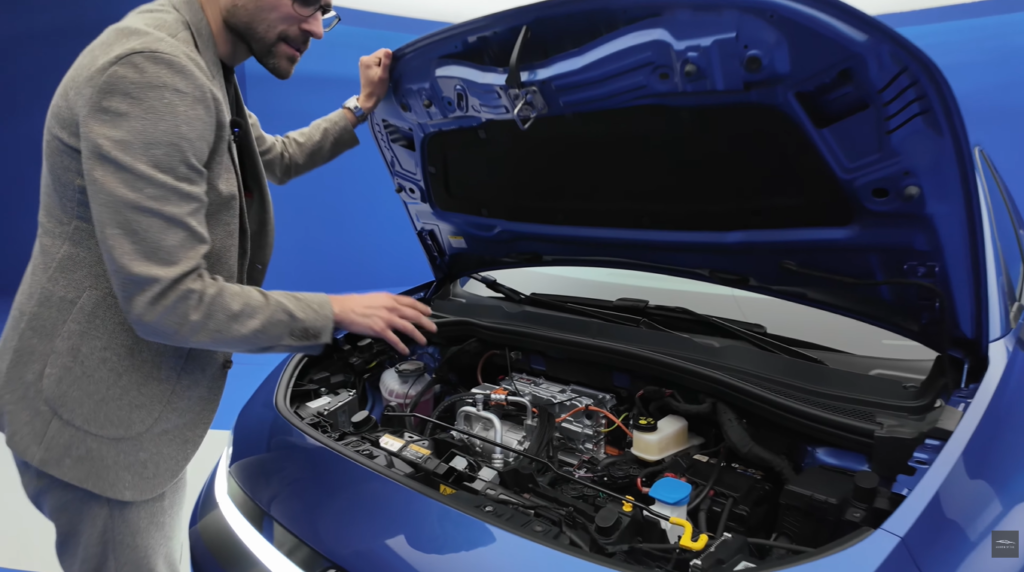
- No frunk: Climate compressor occupies the front — ID. Cross SUV sibling will get a frunk
- Pre-sales: Open now in Germany from April 29, 2026
- Deliveries: Expected late 2026 in Europe
Design — “Pure Positive” and What That Actually Means in Person
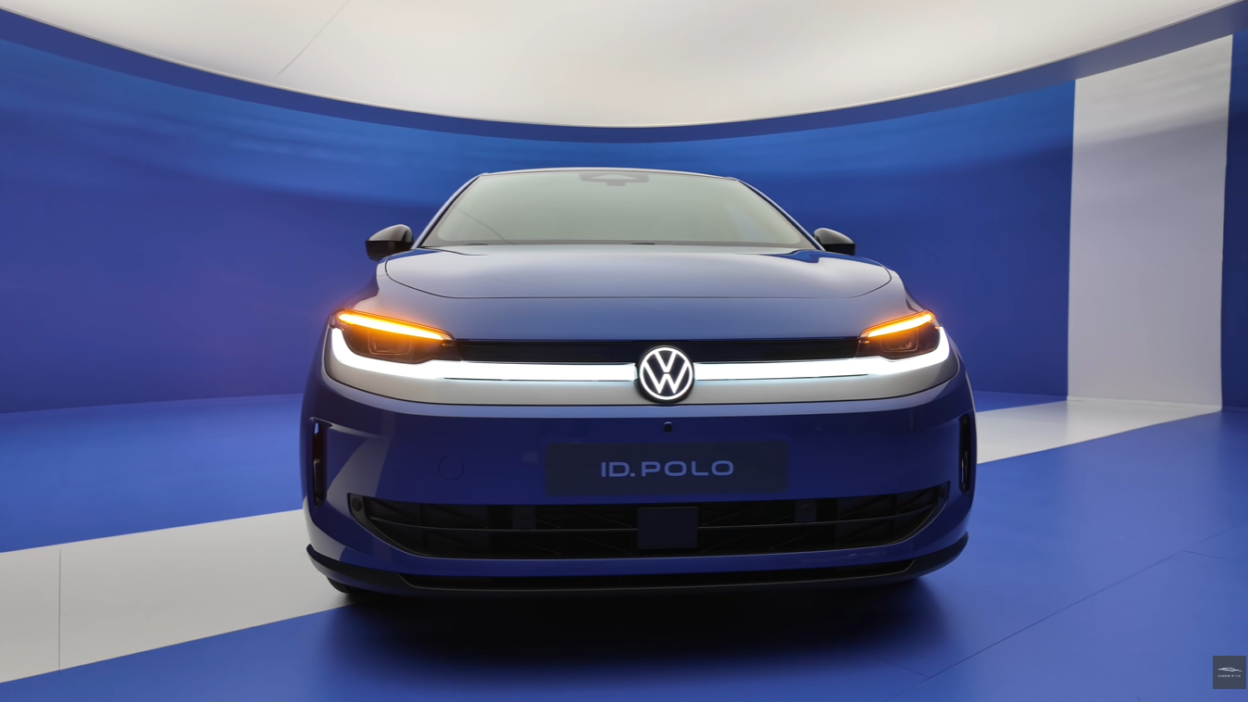
The ID. Polo was designed by VW Chief Designer Andreas Mindt under what the brand calls “Pure Positive” design philosophy. Every single body panel is new and aims to deliver a clean look without the unnecessary details that have become so common in today’s busy designs. The result is a car that looks simultaneously familiar and fresh.
The front end is characterised by a wide LED light strip running the full width of the car on Style trim, flanked by slim headlights inspired by the ID.7. The illuminated VW logo in blue at the front is a design signature that reads as premium in person — it is a small detail that elevates the perceived quality significantly above the price point.
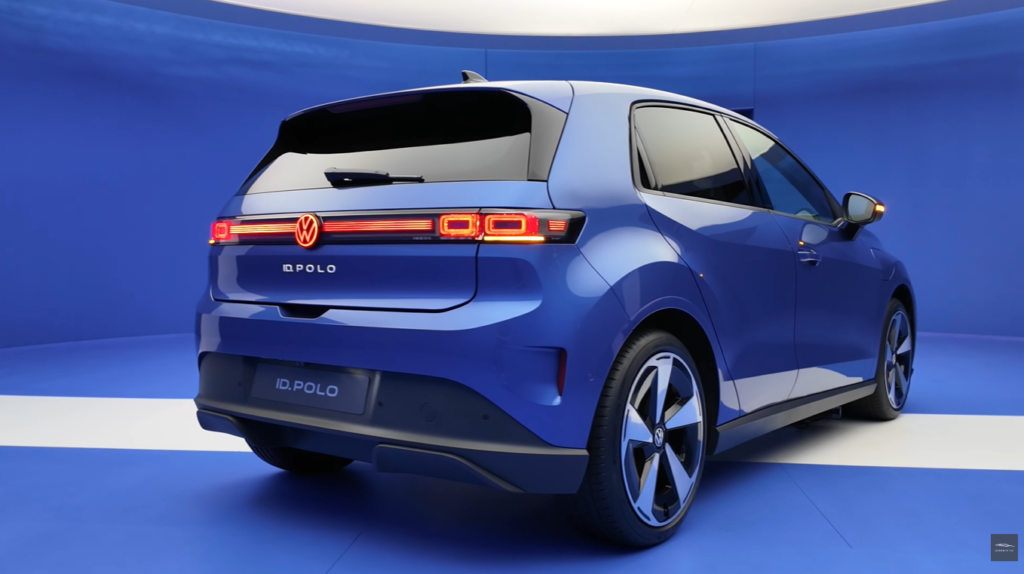
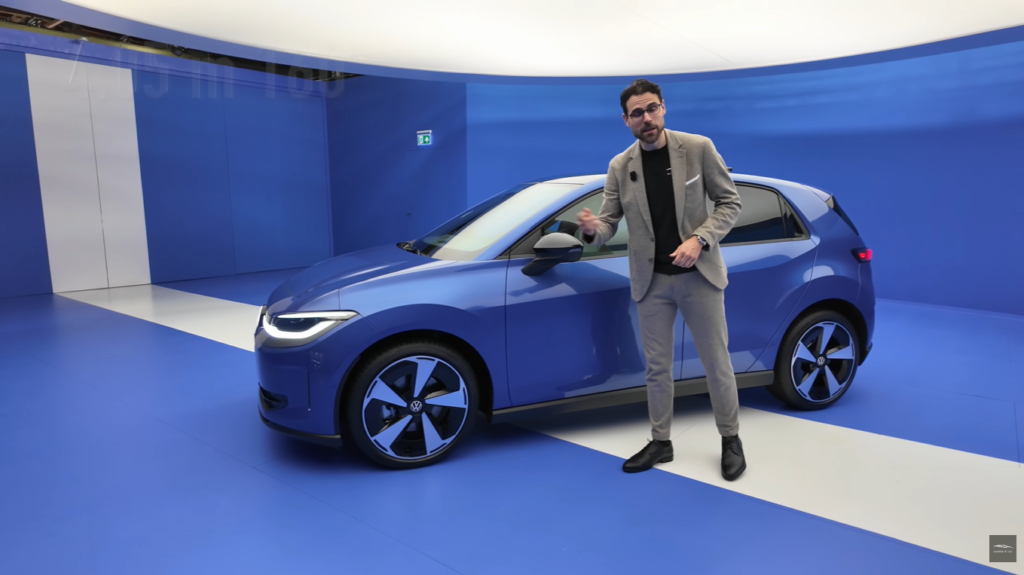
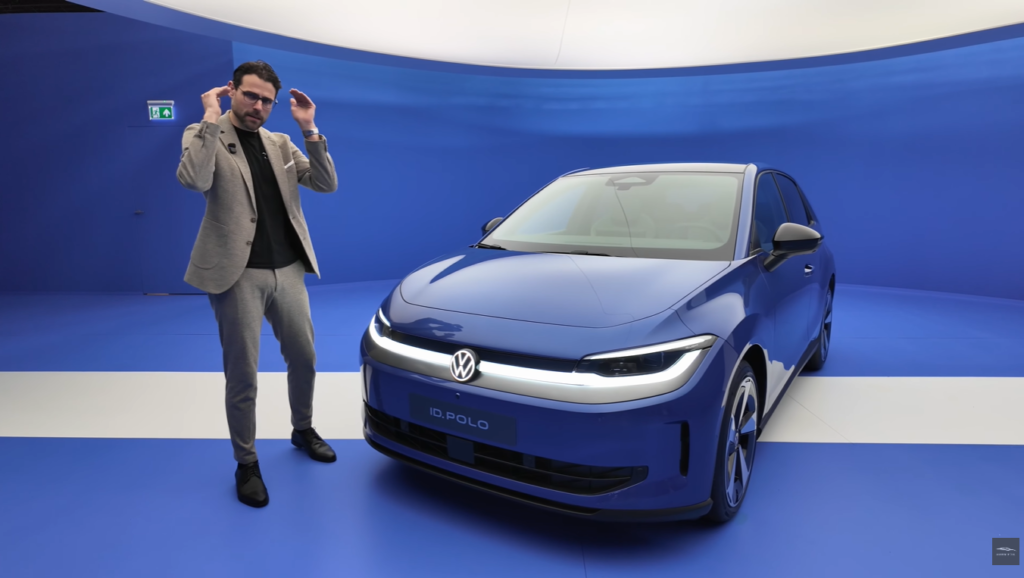
In profile the car has prominent wheel arches suggesting stability, and — crucially — hidden rear door handles positioned near the C-pillar. This keeps the body side clean and makes the car look larger and more sculpted than its 4,053mm length suggests. The door closing sound was tested during the reveal — solid and consistent front and rear, above expectations for an entry-level segment car.
At the rear a wide transverse light bar is crowned with an illuminated red VW roundel — matching the white logo at the front. The tail lights have a three-dimensional quality on Style trim with 3D LED clusters. The overall rear design has been compared to a miniature Hyundai Ioniq 5 in its rectangular light signature — a compliment in 2026.
The Celestial Blue shown at the reveal is the hero colour. Four metallic options (black, grey, silver, blue) and three non-metallic finishes (red, yellow, white) cover most buyer preferences. The yellow entry-level car shown at the reveal demonstrates the design works even without the light strip and larger wheels — a clean, honest design that does not depend on expensive trim to look good.
One design choice worth calling out: classic door handles. In a market where BMW, Mercedes, Genesis, and others have moved to electronic or flush door releases, Volkswagen made the deliberate decision to use conventional handles. We tested them repeatedly. They work immediately, every time, with zero hesitation. This is increasingly a feature, not a default.
Interior — The Most Significant Improvement Over Any Previous ID Model
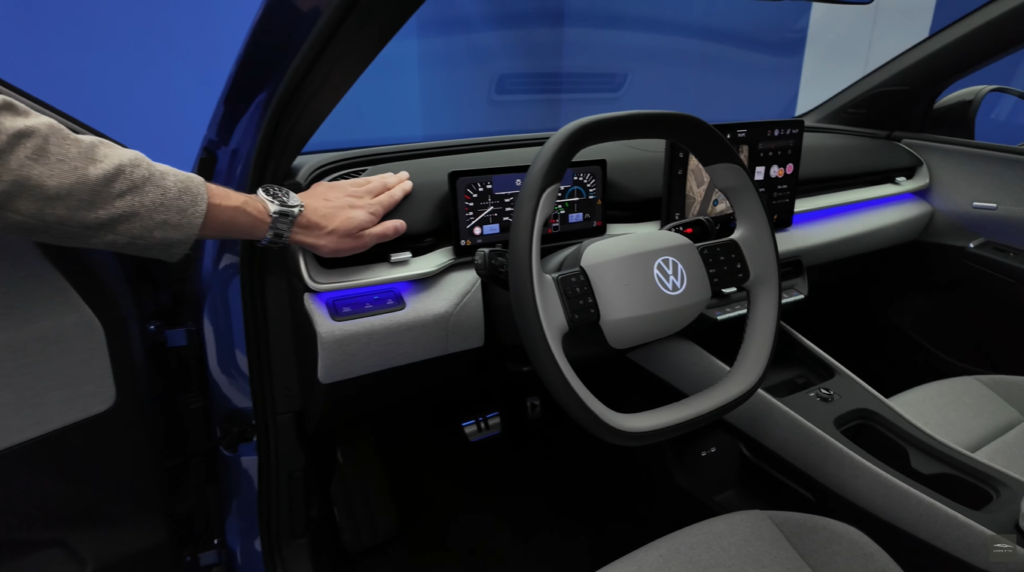
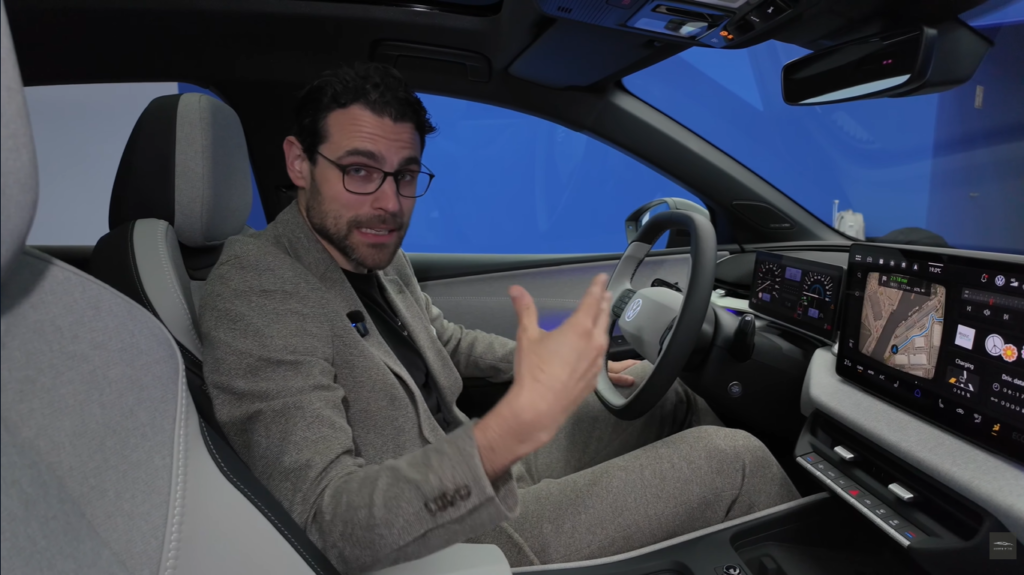
Sitting inside the ID. Polo, the first impression is that Volkswagen has learned the lessons of the original ID.3 and ID.4 — the cars that launched with minimal physical controls and generated consistent criticism. The ID. Polo interior is a direct response to that feedback.
Physical controls that came back:
Physical temperature dial — tested during our time in the car. Warm/cold adjustment is immediate and satisfying. The metal knurling on the dial adds tactile quality above the price point.
Physical fan speed dial — same quality, same placement logic.
Physical buttons on the steering wheel — with genuine clicking feedback confirmed during testing. Not haptic touch. Not a tablet interface. Real buttons that click. The heated steering wheel button on the right side of the steering column works on first press every time.
Four window levers — all four door windows operate independently with conventional switches. No screen menu required.
The retro display mode — tested in person:
The 10-inch driver cluster can switch between modern digital displays and a retro mode inspired by the original Golf Mk1 instrument graphics. We activated it and drove. The circular speedo with a power gauge replacing the rev counter is charming, functional, and genuinely fun. It does not feel gimmicky because the underlying information remains accurate and clear. It is the kind of feature that makes you smile every morning when you start the car — exactly the kind of emotional connection a €25,000 car needs to build with its buyer.
The 13-inch centre screen: Running VW’s updated software interface with clear menu logic, hotkey shortcuts in the top bar for common functions, including disabling lane assist and speed warnings without navigating deep menus. Climate can be controlled both physically and via the screen — the physical route is always faster.
Seat quality tested: The base fabric seats in the entry model are comfortable for tall drivers — we confirmed adequate headroom at 189cm (6’2″) in the front. The optional Sport seats in Style trim add shoulder bolstering that makes them feel more car-specific rather than generic. The lumbar massage function works through pneumatic support — not individual points, but functional for longer journeys.
Materials honesty: The top of the door card is hard plastic — this was noted and is a genuine cost compromise at the price. The dashboard fabric insert and the “Milkyway” recycled material across the dash are genuinely pleasant to look at and touch. Sustainable sourcing is not a marketing claim here — all the fabric on seats, doors, headliner, and carpets uses recycled PET plastic bottles, and top-spec cars use Seaqual yarn made from recycled ocean plastic.
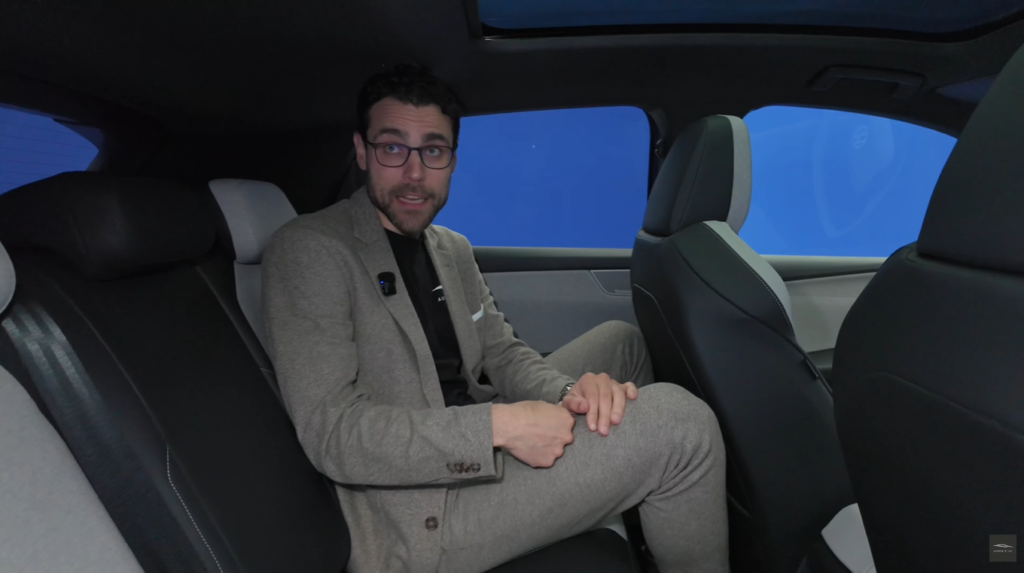
Rear seat experience: At 4,053mm the ID. Polo is a compact car. But the MEB+ platform pays dividends in terms of space — luggage volume jumps 25 percent over the combustion Polo from 351 to 441 litres. The rear seats gained 19mm of extra interior width versus the petrol Polo — noticeable for a segment where millimetres matter. Four tall adults could technically travel together — not in long-distance comfort, but adequately for urban use.
ISOFIX points on both outboard rear seats. Two USB-C chargers in the rear. These are standard across the range — not premium extras.
The Boot — Genuinely Impressive for This Segment
We measured and tested the 441-litre boot at the reveal. It is deeper than it looks from the outside and has a meaningful width at approximately 1 metre. The floor has two positions — standard and lowered — allowing taller items to be carried when needed. The underfloor storage below the standard floor position is substantial enough to accommodate a full-size charging cable, which matters because there is no frunk.
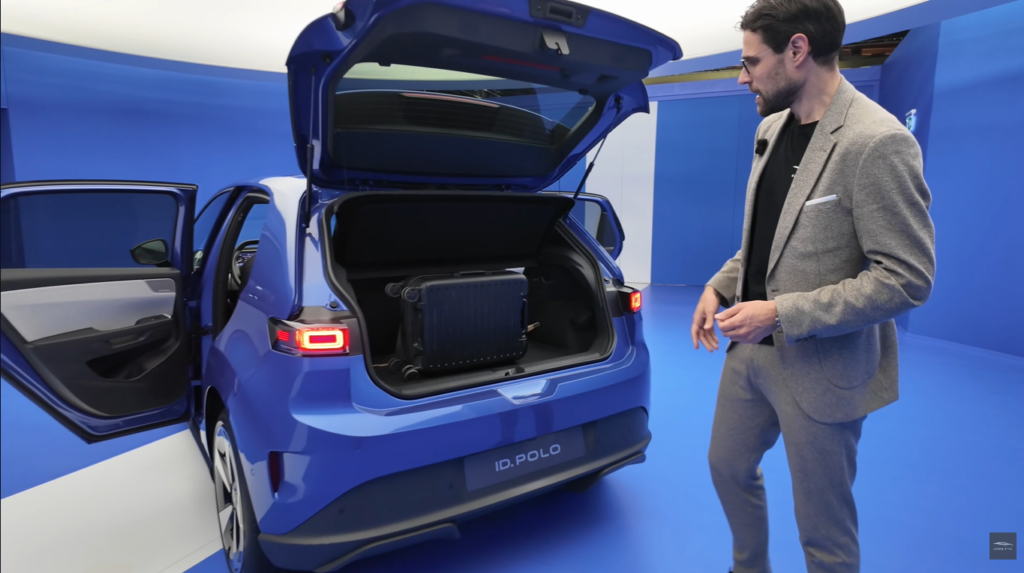
With rear seats folded you are looking at 1,243 litres — a figure that competes with larger C-segment cars. The 1/3-2/3 split fold is standard. The charging cable storage beneath the floor resolves the no-frunk limitation practically for most users.
Battery Chemistry — Why the LFP vs NMC Choice Matters for Your Wallet
This is the technical detail most reviews will gloss over. We are not going to.
The 37kWh entry battery uses LFP (lithium iron phosphate) chemistry. The 52kWh larger battery uses NMC (nickel manganese cobalt) chemistry. These are not interchangeable trade-offs — they represent fundamentally different ownership experiences.
LFP advantages: More durable over charge cycles. Can be regularly charged to 100% without significant long-term degradation. Lower risk of thermal issues. Better performance in cold temperatures for charge acceptance. The 27-minute 10–80% charge time is fast for the battery size.
NMC advantages: Higher energy density at lower weight. Better range per kilogram of battery. Higher peak charging rate (105kW vs 90kW). The 24-minute 10–80% is marginally faster but the bigger benefit is the additional 126km of claimed WLTP range.
The real-world recommendation: If the ID. Polo will be your only car and you plan journeys beyond 150–200km occasionally, the 52kWh NMC is the correct choice. If this is a city and commuting second car that charges at home nightly, the 37kWh LFP at the lower price point makes complete financial sense and will hold its battery health longer.
The motorway range reality must be stated clearly: this is not a long-distance cruiser. Real-world motorway range on the 52kWh battery is approximately 300km at sustained highway speed. That is adequate for most European commuters and city users. It is not adequate for regular long motorway journeys.
Vehicle-to-Load (V2L) — Standard on Every Variant
The ID. Polo supports Vehicle-to-Load as standard, pushing up to 3.6kW through a Schuko adapter to charge e-bikes or run outdoor equipment. This feature costs extra on most competitors and is included on every ID. Polo, regardless of trim or battery choice. For camping, outdoor activities, or emergency power — this is genuinely useful.
How It Compares to Key Rivals
VW ID. Polo Trend — €24,995 116hp, 37kWh LFP, 329km WLTP, V2L standard, 441L boot, physical controls, retro display mode. The most space-efficient small EV at this price.
Renault 5 E-Tech — from €24,990 Direct price competitor. 120hp entry. 40kWh battery standard. 312km WLTP. Retro design with stronger emotional appeal. Weaker boot space. No V2L standard. The most style-forward rival.
Kia EV3 Standard Range — from €30,900 204hp, 58.3kWh, 429km WLTP. More range, more power, significantly more expensive. Better for longer journeys. Less affordable entry point.
Cupra Raval — from approximately €28,000 Built on same platform, same factory. More dramatic exterior and interior design. Sportier suspension setup. More expensive entry. Same core technology — different personality.
Mini Cooper SE — from €33,000 147hp, 40.7 kWh, 402km WLTP. Smaller boot (200L). Much stronger brand emotional appeal. Significantly more expensive. Better for brand-first buyers.
Citroen e-C3 — from €19,990 113hp, 44kWh, 320km WLTP. Cheaper entry but significantly less interior quality, less technology, and a more basic driving experience. The budget option versus the affordable premium option.
The honest summary: The ID. Polo slots above the e-C3 and below the EV3 in both price and capability. Against the Renault 5 it is a genuinely competitive head-to-head — more practical boot, more physical controls, stronger VW brand network. Less stylistically dramatic. The right choice depends on whether you value practicality or personality more.
The Cupra Raval Comparison — Built Together, Different Buyers
The ID. Polo and Cupra Raval are assembled in the same factory and share the same MEB+ platform, motors, and core technology. Choosing between them is a personality question, not a technology question.
The Raval has a more dramatic exterior with sharper creases and a more aggressive stance. The interior is more emotional with stronger styling contrasts. The suspension is set up sportier from the factory. The GTI equivalent — the Raval VZ — gets Dynamic Chassis Control adaptive suspension, which the ID. Polo GTI may or may not receive (unconfirmed).
The ID. Polo is cleaner, calmer, and more comfortable. It is VW’s “reduced to the max” philosophy — everything you need, nothing you don’t, done properly. If the Renault 5 is the stylish choice and the Cupra Raval is the dramatic choice, the ID. Polo is the considered choice.
The GTI — What We Know
The ID. Polo GTI will be introduced in 2027 with 166kW (226PS). It gets a power boost to 226hp, plus a limited-slip differential for improved grip and cornering. Adaptive suspension is likely based on the Raval VZ precedent but unconfirmed for the VW version.
The GTI will compete directly with the Alpine A290, Mini Cooper SE, and — if it arrives — a potential 280hp Peugeot 208 GTi. The limited-slip differential at 226hp on a front-wheel-drive platform suggests VW is serious about driving dynamics rather than using the GTI badge purely for marketing.
Separate video and review coverage planned for the GTI when it arrives in 2027.
Pros and Cons
What works:
- Under €25,000 entry price — most affordable new VW EV
- Physical temperature and fan dials — confirmed genuine improvement
- Real clicking steering wheel buttons — not haptic
- 441L boot — 25% larger than petrol Polo
- V2L standard across all variants
- Retro Golf Mk1-inspired display mode — genuinely charming
- LFP battery option for better long-term durability
- 105kW DC fast charging on large battery — 24 min 10–80%
- 1,243L with seats folded — class-leading load space
- Harman Kardon audio optional
- IQ.Light LED matrix on Style trim
- Classic door handles — works every time, every condition
- Ambient lighting in door panels (Style)
- Built in Tennessee — wait, wrong car. Smyrna is the Infiniti. ID. Polo built in Spain (Martorell, shared with Cupra Raval)
- 19mm more rear interior width vs petrol Polo
- Sustainable recycled materials throughout
What doesn’t:
- No frunk — climate compressor takes the space
- Hard plastic upper door cards — cost compromise visible
- No AWD planned — front-wheel drive only
- Cup holders not adaptive
- Base Trend has steel wheels with covers
- No DCC adaptive suspension on standard car (GTI only)
- 300km real-world motorway range on large battery — not a road trip car
- Charging port on passenger side — inconvenient for some driveway setups
- Entry price creeps significantly with large battery and Style trim — can reach €37,000 fully specified
- No rear window shade standard
Who Should Buy the ID. Polo?
Buy the Trend 37kWh if: This is a second car, you charge at home nightly, and you drive primarily in cities and suburbs under 100km per day. The LFP battery will outlast the NMC in daily charging cycles and the entry price is genuinely accessible.
Buy the Style 52kWh if: This is your primary car, you need occasional longer journeys, and you want the full light strip, matrix LED, and premium interior. The sweet spot variant for most buyers who want the complete experience.
Wait for the GTI if: You want performance alongside the practicality, you have driven hot hatches before and want that energy in an EV, and you can wait until 2027 for the 226hp limited-slip differential version.
Look at the Cupra Raval instead if: Design and personality matter more than practicality and calm. Same technology, more dramatic execution.
Look at the ID.3 Neo instead if: You regularly drive more than 300km and need the larger 77kWh battery option, or need the additional rear seat space of the C-segment car.
MyPitShop Final Verdict
The VW ID. Polo is the right car at the right time. The physical controls are back. The boot is larger than the car has any right to offer. V2L is standard. The retro Golf display mode is delightful. The LFP battery option makes daily charging worry-free for secondary car buyers. And the price — genuinely under €25,000 — makes electric mobility accessible to a buyer who previously had no credible VW EV option below €33,995.
The honest limitations are also real. The 300km motorway range makes it unsuitable as a sole long-distance car. The fully loaded Style with large battery approaches €37,000 — a price that requires justification against a €33,995 ID.3 Neo with more space and power. And the engine-free front creates a frunk opportunity that the climate compressor packaging eliminates.
But none of those limitations undermines the core appeal. The ID. Polo is a competent, considered, well-executed, affordable EV that Volkswagen needed urgently — and finally has. As Motor1 put it — VW seemingly has a winner on its hands.
Pre-sales open now in Germany. European deliveries expected late 2026. UK and other market pricing to follow.