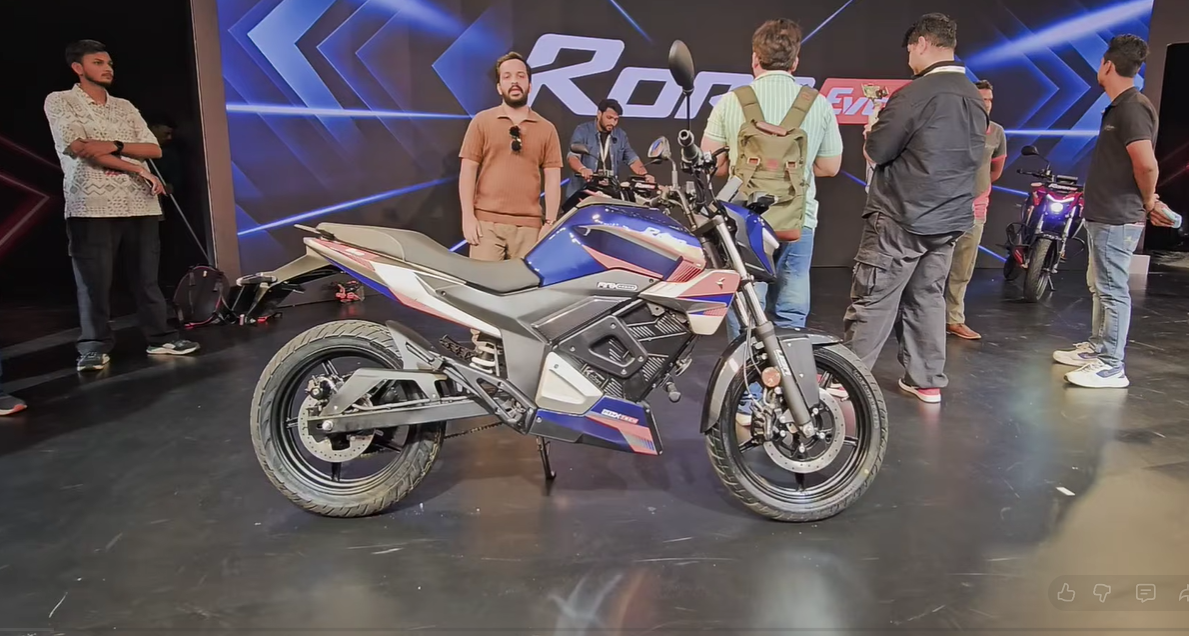
For the price of a Honda Shine 125 or a Bajaj Pulsar 125, you can now own a proper electric motorcycle with a 110kmph top speed, 150km claimed range, and a mid-drive motor producing 9kW of peak power. That is the pitch Oben Electric is making with the Rorr EVO — the evolved version of the Rorr that has been on Indian roads since 2022. We got our first look at it. Here is everything that changed, everything that didn’t, and the honest verdict on whether ₹99,999 is actually worth it.
Quick Verdict — Before We Go Deep
The Oben Rorr EVO is a genuinely meaningful upgrade over the original Rorr. The new streetfighter design fixes the startup-looking aesthetic of its predecessor. The lowered seat height at 780mm makes it accessible for riders as short as 5’6″. The switch from belt drive to chain drive is a smart efficiency move that enables a 150km range claim despite using a smaller 3.4kWh battery. The new Smart Plus IQ mode adds intelligence to range management.
But there are honest gaps. No ABS — combined braking system only. The display is unchanged from the outgoing model. Battery warranty is only 3 years standard. And the price jumps from ₹99,999 to ₹1,25,000 after the first 10,000 buyers. If you are considering this motorcycle the time to act is now, not later.
Full Confirmed Specifications
- Motor: Mid-drive electric motor — 9kW peak power (up from 8kW on previous Rorr)
- Battery: 3.4kWh (down from 4.4kWh LFP on top-spec previous Rorr)
- Torque: Higher than previous Rorr’s 52Nm — exact figure not yet disclosed by Oben
- Top speed: 110kmph (Havoc mode)
- 0 to 40kmph: 3 seconds flat — claimed
- Claimed range: Up to 150km (real-world — not ARAI)
- Previous Rorr real-world range: 140km with larger 4.4kWh battery
- Drive system: Chain drive (switched from belt drive — key change for efficiency)
- Ride modes: Eco (60kmph cap) | City (70kmph cap) | Havoc (110kmph cap) | Smart Plus IQ (60kmph cap, auto-optimises for maximum range)
- Wheels: 17-inch front and rear — same design as outgoing Rorr
- Brakes: Disc front and rear — Combined Braking System (CBS). No ABS.
- Suspension: Telescopic fork front | Monoshock rear — same as outgoing Rorr
- Seat height: 780mm (lowered from 810mm — 30mm reduction via frame change)
- Seat length: Approximately 680mm — longer than before for improved pillion comfort
- Headlight: LED projector unit — new design (previous was circular)
- Display: 5-inch TFT — unchanged from outgoing Rorr
- Storage: 4 litres in tank area (new, lockable) + 6 litres underseat (same as before)
- Charger included: 850W portable charger — stores in underseat compartment
- Additional charging: Wall box installation available | Public charging network available
- Battery warranty: 3 years standard | Extendable to 8 years total (5 years extended warranty at additional cost)
- Motorcycle warranty: 3 years standard
- Launch price: ₹99,999 ex-showroom — for first 10,000 customers only
- Price after first 10,000 units: ₹1,25,000 ex-showroom
- Colours: Not yet confirmed across full range — available in multiple options
Design — From Startup-Looking to Street Fighter
The original Oben Rorr launched in 2022 had the kind of design that was fine but unmistakably from a new brand finding its feet. It looked sensible, inoffensive, and a little plain — the kind of motorcycle you would not look at twice in traffic.
The Rorr EVO fixes this. The new LED projector headlight is the first thing you notice and it immediately lifts the visual character of the bike. The headlight design draws comparisons to the Bajaj Pulsar N160 and Yamaha MT series — both of which are widely considered among the better-looking motorcycles in their respective segments. Whether intentional or coincidental, the reference points are strong ones and the result is a front end that now looks assertive and modern rather than cautious.
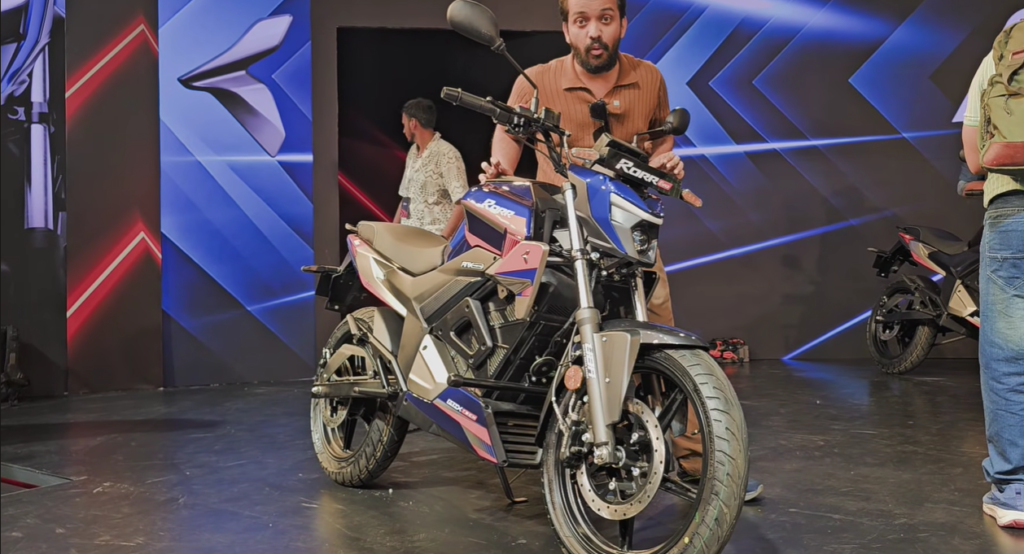
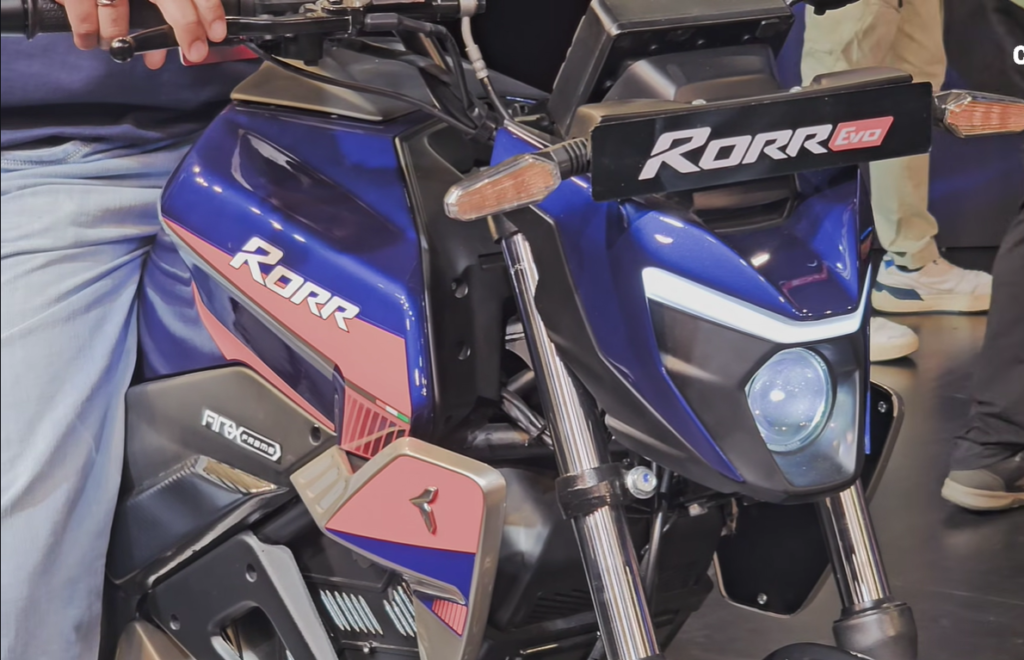
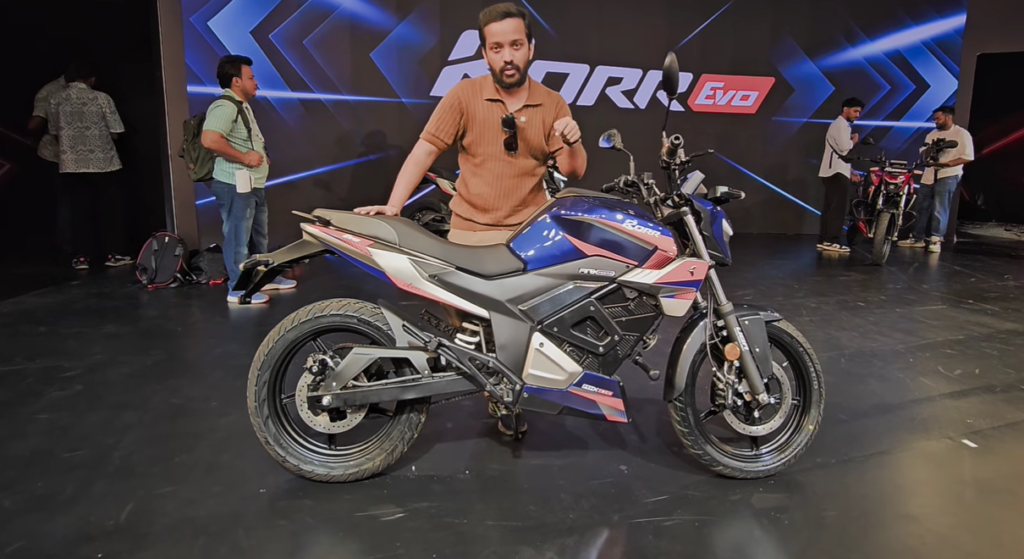
The redesigned tank area — remembering there is no actual fuel tank here, this is the housing for electronics and the new 4-litre storage compartment — is more muscular and curved than the flat panel on the outgoing Rorr. It adds visual bulk and confidence to the profile that was absent before. In terms of proportions the motorcycle now looks like something from an established manufacturer rather than a startup, which is exactly the evolution Oben needed to make at this price point.
The 17-inch wheel design carries over unchanged from the outgoing model — a missed opportunity for visual differentiation, but wheels are expensive to redesign and the existing units are functional and adequately proportioned.
The Seat Height Change — Why This Matters More Than You Think
The outgoing Rorr had an 810mm seat height. This is high for an urban commuter motorcycle — higher than the Royal Enfield Meteor 350 at 765mm, higher than the Honda CB300R at 785mm, and approaching Kawasaki Z400 territory. For shorter riders, particularly those under 5’8″, the original Rorr was genuinely difficult to manage at standstill in traffic.
Oben has lowered this to 780mm by modifying the frame of the motorcycle — not just the seat padding. This is a meaningful engineering change and the result is real. At 5’6″ a rider can now place both feet on the ground simultaneously at a standstill. Flat-footing is not possible but two-footed ground contact at traffic stops is — and that is the difference between a confidence-inspiring urban commuter and one that feels stressful in slow traffic.
One important caveat: the seat is wide. Lowering the seat height does not automatically narrow the seat. For shorter riders with narrower hips the 780mm height improvement will be partially offset by the width making full ground contact difficult. This is worth a personal sit-down test at a dealership before committing to purchase. If you are under 5’4″ with a narrow build the Rorr EVO may still feel tall at a standstill despite the improvement.
The Battery Change — Smaller Capacity, Higher Range. How?
This is the most technically interesting aspect of the Rorr EVO and the one that requires the most careful explanation.
The outgoing top-spec Rorr came with a 4.4kWh LFP battery and delivered real-world range of approximately 140km. The Rorr EVO uses a 3.4kWh battery — 1kWh smaller — and Oben claims 150km of real-world range. That is a 10km improvement in range from a battery that is 22% smaller in capacity.
How is that possible? Two factors.
Switch from belt drive to chain drive. The original Rorr used a belt drive system to transmit motor power to the rear wheel. Belt drives are smoother, quieter, and lower maintenance but they are less energy-efficient than chain drives because they flex and absorb more energy in the transmission process. Chain drives transmit power more directly with less energy loss. Oben claims this switch has made the motorcycle significantly more efficient — and the range numbers suggest that claim has some substance.
Smart Plus IQ mode. The new fourth ride mode uses onboard intelligence to continuously optimise power delivery and motor efficiency in real time. This is not a fixed throttle map like Eco, City, or Havoc — it actively adjusts based on riding conditions to extract maximum range from every kilometre. The 60kmph speed cap in this mode ensures the motorcycle operates in its most efficient speed envelope.
The honest assessment: 150km claimed range from a 3.4kWh battery is an aggressive claim. Real-world range in mixed Indian urban and semi-urban conditions will be determined by rider weight, road gradient, riding style, and ambient temperature. The 140km real-world figure on the outgoing Rorr was with a 30% larger battery. Achieving 150km real-world — not test cycle — from 3.4kWh would require the chain drive and Smart Plus IQ to be significantly more efficient than the outgoing system. This needs real-world independent verification before treating the claim as confirmed.
Performance — 9kW Motor and 3-Second 0 to 40kmph
The 9kW peak motor output is an improvement over the outgoing Rorr’s 8kW but falls short of the original 2022 Rorr’s 10kW. The 0 to 40kmph in 3 seconds claim is the relevant figure for urban riding — the traffic light sprint, the gap in traffic, the overtake on a city road. Three seconds from standstill to 40kmph is sharp for a motorcycle in this price range and consistent with what a mid-drive electric motor at this power level delivers.
The Havoc mode raising top speed to 110kmph is a meaningful capability for semi-urban and highway riding. The outgoing Rorr’s Havoc mode also exceeded 100kmph in real-world testing — the claim of 110kmph for the EVO is credible and not an outlier for a 9kW motor at this weight class.
The torque figure — which Oben has not disclosed — is stated to have increased beyond the outgoing Rorr’s 52Nm. This matters for low-speed punch and hill climbing in city conditions. Torque rather than peak power determines how the motorcycle feels in the 0 to 40kmph range that defines the majority of urban riding.
Four Ride Modes — What Each One Actually Means
Eco — 60kmph cap Maximum range prioritisation. The 60kmph cap is actually generous for an Eco mode — most electric two-wheelers cap Eco below 45kmph. A 60kmph Eco ceiling means you can use this mode on most city roads without being dangerously slow in traffic.
City — 70kmph cap The everyday mode for typical Indian city and town riding. 70kmph covers the majority of urban speed limits with a small buffer. This will be the mode most owners spend the majority of their time in.
Havoc — 110kmph cap Full performance, full speed. For highway sections, expressways, and riders who want maximum performance. Battery drain in this mode will be significantly faster than Eco or City — expect real-world range to drop to approximately 80 to 100km in sustained Havoc use.
Smart Plus IQ — 60kmph cap, auto-optimised The most interesting mode and the one that is genuinely new. Rather than a fixed power delivery map, Smart Plus IQ adapts in real time to maximise range. If you are riding mostly in the city and want maximum distance per charge without thinking about it — this is the mode to leave the motorcycle in. The 60 km/h cap ensures efficiency is not compromised by speed.
Storage — A Meaningful Practical Improvement
The 4-litre lockable storage in the tank area is a new addition and it addresses a real limitation of the outgoing Rorr. Urban commuters need to carry documents, a compact toolkit, a small bag, or a water bottle. The 4-litre tank storage accommodates these items conveniently without requiring a backpack or a tank bag accessory.
The 6-litre underseat storage carries over from the outgoing model. Crucially, Oben has ensured the underseat space is large enough to accommodate the 850W portable charger included with the motorcycle. This means you are always carrying your charging solution with you — important for range anxiety management when away from home or a known charging point.
The combination of 4 litres in the tank area and 6 litres underseat gives the Rorr EVO 10 litres of total onboard storage — more than most motorcycles in the 100cc to 150cc petrol segment, which typically offer only underseat or no storage at all.
The Display — The One Area That Needed Updating But Didn’t Get It
The 5-inch TFT display is carried over from the outgoing Rorr without change. The layout, colours, and interface are unchanged. This is a missed opportunity. The display on the outgoing Rorr was functional but not impressive — the resolution and brightness were adequate but not class-leading. In 2026, with most electric two-wheelers in this price range offering improved display experiences, carrying over an identical unit without any improvement is a noticeable shortcut.
This does not make the display bad — it is still informative, readable in daylight, and shows all necessary information, including speed, battery percentage, range estimate, ride mode, and trip data. But it is a compromise at a price point where buyers are increasingly expecting more.
Braking — The ABS Absence Needs Honest Discussion
The Rorr EVO uses a Combined Braking System rather than an Anti-lock Braking System. CBS links the front and rear brakes so that applying one also applies the other proportionally. ABS prevents wheel lock-up under hard braking on slippery or loose surfaces.
In 2026, ABS is increasingly standard on motorcycles costing ₹80,000 and above. The Bajaj Pulsar N160 — one of the motorcycles the Rorr EVO’s headlight appears inspired by — offers ABS as standard at a comparable price. The absence of ABS on the Rorr EVO at ₹99,999 is a safety compromise that buyers should weigh carefully, particularly given that electric motorcycles are often ridden at higher average speeds than equivalent petrol commuters.
For experienced riders with strong braking technique on predictable roads, CBS is adequate. For newer riders or those who will ride in wet, muddy, or unpredictable surface conditions, the absence of ABS is a meaningful safety gap.
Warranty — The 3-Year Standard and the 8-Year Option
The standard 3-year warranty on both the battery and the motorcycle is below what some competitors offer in the electric two-wheeler segment. Ola Electric offers a standard 3-year warranty on the battery with extended options. Ather offers 3 years on the battery. The Rorr EVO’s 3-year standard is in line with the industry but not ahead of it.
The extendable 8-year total battery warranty — achieved by purchasing 5 years of extended warranty at additional cost — is a useful option for buyers who plan to keep the motorcycle long-term and want protection against battery degradation costs. Battery replacement is the single most expensive maintenance item on any electric vehicle. An 8-year warranty mitigates that risk meaningfully. The additional cost of the extended warranty should be factored into the total ownership calculation.
Charging — Three Options for Different Owners
Portable 850W charger (included): Stores under the seat, plugs into a standard home socket. Slower charge time but universally available.
Wall box (separately installed): Faster home charging for those with covered parking. Reduces charge time significantly versus the portable charger.
Oben public charging network: Access to Oben’s network of public chargers across India. Coverage varies by city — check the Oben app for your area before relying on this for range extension.
The absence of fast DC charging compatibility — which some higher-priced electric motorcycles offer — means you are dependent on AC charging from portable or wall box options. For most daily commuters, this is not a practical limitation. For buyers who want quick top-up capability at public stations, it is worth noting.
The Price Question — ₹99,999 vs ₹1,25,000 vs a 125cc Petrol Motorcycle
The ₹99,999 launch price for the first 10,000 buyers is aggressive and genuine — this is the price at which the Rorr EVO becomes a real proposition against petrol alternatives. At this price you are buying:
A motorcycle with 110kmph top speed 150km claimed real-world range 9kW peak power 4 ride modes 10 litres total storage LED projector headlight, lowered seat for accessibility
Compared to a Honda Shine 125 at approximately ₹85,000 or a Bajaj Pulsar 125 at approximately ₹95,000, the ₹99,999 Rorr EVO costs only ₹5,000 to ₹15,000 more upfront. Running cost per kilometre on electricity versus petrol at current prices typically saves ₹2 to ₹3 per kilometre. For a rider covering 30km daily that is approximately ₹18,000 to ₹27,000 saved per year in fuel costs alone — meaning the Rorr EVO pays back its price premium versus a petrol commuter within the first year.
At ₹1,25,000 — the post-launch price — the calculation changes. The 25,000 rupee premium over the launch price and the 40,000 rupee premium over entry-level petrol commuters is harder to justify without experiencing the fuel savings over several months. At ₹1,25,000 the Rorr EVO competes directly with the Bajaj Chetak and TVS iQube — both of which are scooters rather than motorcycles, but offer stronger brand confidence and dealer networks.
Pros and Cons
What works:
- ₹99,999 launch price — genuinely accessible electric motorcycle
- New streetfighter design — looks established, not startup
- Seat lowered to 780mm — meaningful accessibility improvement for 5’6″ and above
- Chain drive efficiency enabling 150km claimed range from smaller battery
- Smart Plus IQ mode — intelligent range optimisation
- 9kW motor — strong urban performance
- 0 to 40kmph in 3 seconds — sharp in-city acceleration
- 110kmph top speed in Havoc mode
- 10 litres total storage — 4L tank area plus 6L underseat
- Portable 850W charger included and stored underseat
- 8-year extended battery warranty option available
What doesn’t:
- No ABS — combined braking system only at this price is a gap
- 3.4kWh battery smaller than outgoing Rorr’s 4.4kWh
- Display completely unchanged from outgoing model — missed upgrade
- 150km range claim needs real-world independent verification
- Seat is wide despite lower height — still challenging for very short riders
- Battery warranty is only 3 years standard — extended warranty costs extra
- Price jumps to ₹1,25,000 after first 10,000 units
- Wheel design unchanged — missed visual differentiation opportunity
- No DC fast charging compatibility
Who Should Buy the Oben Rorr EVO?
Buy it now if you are: A daily commuter covering 50 to 100km per day who wants to eliminate fuel costs, an experienced rider comfortable with CBS braking, a buyer with home charging access, and someone who can secure the ₹99,999 launch price before the first 10,000 units sell out.
Skip it if you are: A newer rider who needs ABS for safety confidence, someone who regularly rides on wet or unpredictable surfaces, a buyer who plans to depend on public charging infrastructure for regular range extension, or someone who can wait for the second-generation update that may bring ABS and a better display.
Compare it first with: Bajaj Chetak if you prefer scooter format. TVS iQube if you want a stronger dealer network. Ola S1 Pro if you want more technology features. These three are all at comparable or slightly higher price points but offer ABS and more mature platforms.
Act immediately if: You are in the first 10,000 buyer window. The ₹25,000 price difference between ₹99,999 and ₹1,25,000 is significant enough to change the value proposition of this motorcycle entirely. At ₹99,999 the Rorr EVO is a strong buy. At ₹1,25,000 it faces more competitive pressure.
MyPitShop Final Verdict
The Oben Rorr EVO is the most interesting electric motorcycle launch in India in 2026 at this price point. It has evolved from a promising but rough-around-the-edges startup product into something that can genuinely be recommended without heavy qualification — provided you secure the launch price and are comfortable with the CBS braking system.
The design transformation is the biggest win. The 30mm seat reduction is the most practical win. The chain drive efficiency enabling 150km range claim from a smaller battery is the most technically impressive claim — one that deserves real-world verification but is credible based on the engineering logic behind it.
The gaps — no ABS, unchanged display, smaller battery, 3-year standard warranty — are real and acknowledged. But at ₹99,999 for the first 10,000 buyers, the Rorr EVO delivers a package that no petrol commuter at this price can match on running cost, performance ceiling, or riding modes.
If you are an existing Rorr owner considering an upgrade, or a first-time electric motorcycle buyer looking for the right entry point — the Rorr EVO at ₹99,999 is the answer you have been waiting for. Book before 10,000 units are gone.