WearOS smartwatches have always had a battery problem. You charge them every night, miss a notification at 11pm when the battery dies, and eventually give up and go back to a Garmin or a Fitbit. The Oppo Watch X3 is the first WearOS watch in a long time that genuinely challenges that reputation — delivering 3.5 days of real-world battery life with full health tracking, app use, and sleep monitoring running the entire time. We wore it for two weeks straight, took it to Edinburgh (whisky bars and all), tested every feature, and here is the complete honest verdict.
Quick Verdict — Before We Go Deep
The Oppo Watch X3 is the most well-rounded WearOS smartwatch available in 2026 for buyers who want full Android app support, strong health tracking, and battery life that does not require daily charging. The titanium and sapphire glass build quality is genuinely premium. The 1.5-inch AMOLED display at 1,500 nits is among the brightest on any WearOS device. The dual-chip architecture — pairing a Snapdragon W5 Gen 1 with a secondary BES8200B processor — is the key engineering decision that enables the battery result.
The one honest problem is performance. The Snapdragon W5 Gen 1 is getting old and it shows — card transitions occasionally stutter, Spotify runs slowly, and app loading times are noticeably behind what a Pixel Watch 3 or Galaxy Watch 7 delivers on the same tasks. This is the single biggest reason not to buy the Watch X3 and it needs to be stated clearly before the positives carry you away.
Overall rating: 4 out of 5. One of the best WearOS watches available in 2026 — but not perfect.
Full Confirmed Specifications
- Display: 1.5-inch AMOLED — fully round, edge-to-edge, no hidden bezels
- Resolution: Sharp enough for small text to be clearly readable
- Refresh rate: LTPO — 1Hz always-on display to 60Hz active use
- Peak brightness: 1,500 nits in standard modes
- Processor: Snapdragon W5 Gen 1 (main) + BES8200B secondary co-processor
- RAM: Not disclosed
- Storage: 32GB built-in
- Battery: 646mAh silicon-carbon cell
- Real-world battery life: 3.5 days — confirmed with full health tracking, sleep tracking, app use
- Low power mode battery life: Up to 14 days — limited to basic health and fitness tracking
- Charging: Proprietary pogo pin dock, USB-C powered — 75 minutes from flat to full
- Case material: Titanium alloy
- Glass: Sapphire scratch-resistant
- IP rating: IP68 + IP69 — up to 5 atmospheres water pressure
- Military standard: MIL-STD-810H certified
- Weight: 43g (case only) | 70g (with strap)
- Strap: 22mm standard fluoro-elastomer strap — replaceable with any 22mm third-party strap
- Connectivity: Bluetooth 5.2 | Wi-Fi built-in | No eSIM on this edition
- Companion app: O Health (Google Play Store, free)
- Smart assistant: Google Gemini — activated by long press of digital crown
- Payments: Google Wallet — contactless payments supported
- Speaker + microphone: Both built-in
- Health sensors: Heart rate (24hr continuous), SpO2, ECG, wrist temperature, stress monitoring, 60-second wellbeing overview, sleep tracking, cycle tracking, fall detection
- Exercise tracking: 100+ workout types | Automatic detection for running and walking
- Watch faces: Multiple built-in + O Health app selection + Google Play Store
- Colours: Misty Titanium | Obsidian Black
- OS: WearOS with full Google Play Store access
- Compatibility: Android smartphones — O Health app required for pairing
Design and Build — Titanium and Sapphire at a Smartwatch Price
The Oppo Watch X3 arrives in a design that breaks from the standard circular smartwatch formula without being confusing. The case is not perfectly round — it uses a dodecahedron-inspired polygonal shape that creates subtle flat facets around the edge of the bezel. This design language connects visually to the Oppo Find X9 Pro’s camera module treatment, giving the two devices a family resemblance that premium buyers will appreciate.
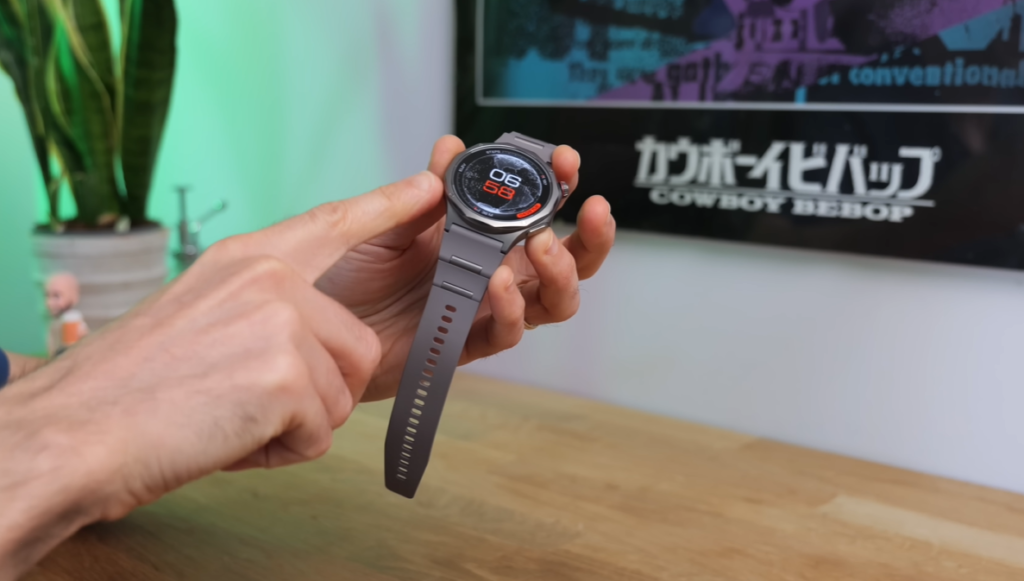
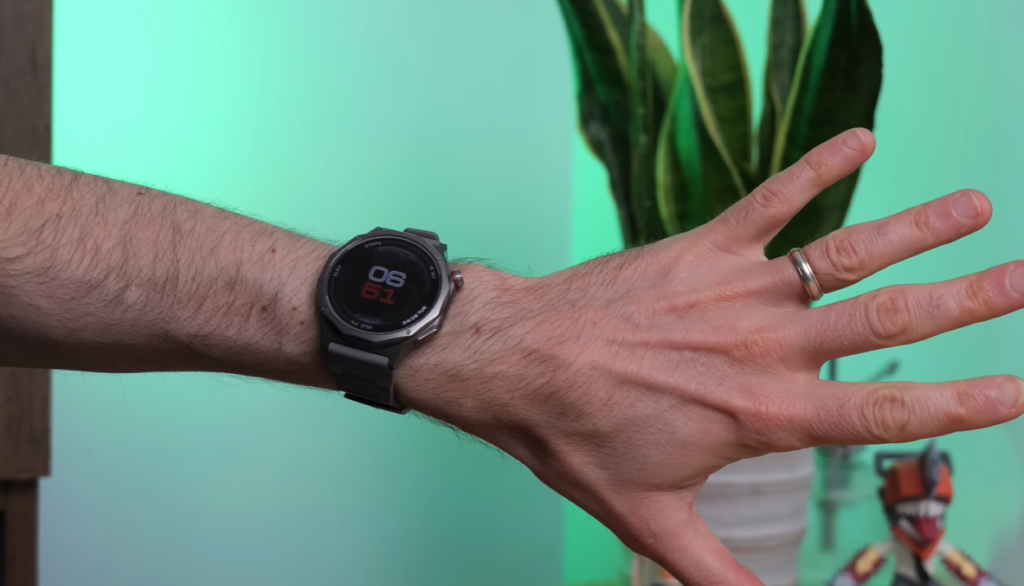
In person the effect is subtle rather than dramatic. From a distance the Watch X3 reads as a round smartwatch with a distinctive character. Up close the faceted bezel adds a jewellery-like quality that standard circular smartwatch designs lack. Whether this is your preference or not is subjective — but it is genuinely distinctive in a product category where most designs look interchangeable.
The titanium alloy case weighs only 43g and 70g with the strap attached. For context, the Apple Watch Ultra 2 weighs 61g just for the case. The Oppo Watch X3 is meaningfully lighter than most premium smartwatches despite the titanium construction and this shows in daily wear — after two weeks of continuous use it was difficult to feel the watch on the wrist at all.
The sapphire glass protecting the display survived two weeks of daily use — including Edinburgh’s cobblestones and whisky-induced lack of coordination — without a single visible scratch. Sapphire is the hardest commercially used watch glass, significantly more scratch-resistant than Gorilla Glass alternatives used on most competing smartwatches.
IP68 and IP69 certification plus 5 ATM pressure resistance means the Watch X3 can handle swimming, showering, rain, and submersion up to 50 metres. MIL-STD-810H certification adds temperature extremes, humidity, and vibration resistance. This is a genuinely tough watch wearing genuinely premium materials.
The 22mm standard strap means you can swap to any third-party leather, metal, or fabric band without needing Oppo-specific accessories — a practical decision that extends the watch’s versatility for formal or athletic use.
Display — 1,500 Nits AMOLED, Edge to Edge, and Actually Round
The 1.5-inch AMOLED display is edge-to-edge with no hidden bezels compromising the round shape. This is not universal among round smartwatches — several competitors have flat tyres or partial bezels that undermine the circular aesthetic. The Watch X3 delivers on the pure round display promise completely.
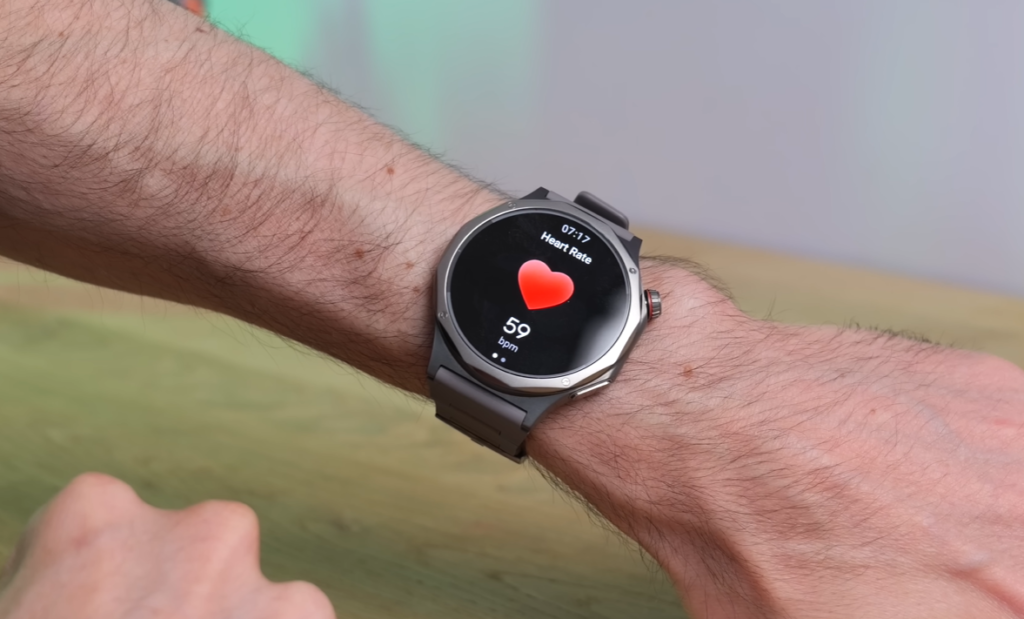
At 1,500 nits in standard modes, the display is among the brightest available on a WearOS device. In outdoor testing including direct UK sunlight the display remained clearly readable for messages, notifications, and health data. Auto-brightness worked reliably across indoor and outdoor environments throughout two weeks of testing — dimming appropriately in low-light conditions and boosting for outdoor use without manual adjustment.
LTPO technology scales the refresh rate from 1Hz on the always-on display to 60Hz during active navigation. The always-on display at 1Hz is efficient enough that it contributes meaningfully to the 3.5-day battery result without requiring it to be disabled. This is the correct trade-off — always-on functionality preserved without destroying battery life.
One note on screen responsiveness: the display remains responsive when wet, which matters for checking the watch after swimming or in rain. Oppo has also included a touch-lock mode — two quick taps disable the touchscreen for swimming so you do not accidentally trigger app launches underwater.
The Dual-Chip Architecture — The Engineering Story Behind the Battery
This is the most important technical decision Oppo made with the Watch X3 and it deserves a clear explanation.
Most WearOS smartwatches run a single processor — the Snapdragon W5 Gen 1 or W5+ Gen 1 — for all tasks from telling the time to running Spotify. This means the power-hungry Snapdragon chip is active even when the watch is simply displaying the time, tracking heart rate, or running the always-on display. The result is battery drain even during periods of minimal use.
The Oppo Watch X3 adds a secondary co-processor — the BES8200B — specifically to handle all passive, low-complexity tasks: time display, always-on mode, heart rate monitoring, step counting, sleep tracking. The Snapdragon W5 Gen 1 only activates when the watch is running apps, displaying full UI navigation, or processing demanding tasks.
The practical result: the Snapdragon chip sleeps the majority of the day while the BES8200B handles continuous health monitoring on a fraction of the power. The 646mAh silicon-carbon battery — already a high capacity for a smartwatch — is used efficiently rather than wastefully.
This architecture is why the Watch X3 achieves 3.5 days with full features active, while most WearOS competitors deliver 24 to 36 hours. It is a genuine engineering solution to the WearOS battery problem rather than a compromise that trades features for endurance.
Battery Life — The Real-World Result
3.5 days of battery life tested across two full weeks of continuous wear. This included sleep tracking every night, 24-hour continuous heart rate monitoring, SpO2 monitoring, stress tracking, automatic exercise detection on multiple outdoor walks, app use including Spotify and Google Maps, regular notification checking and replies, and occasional Gemini assistant queries.
This comfortably beats the Google Pixel Watch 3 (approximately 24 hours), the Samsung Galaxy Watch 7 (approximately 30 to 40 hours), and the OnePlus Watch 3 which is described as the closest competitor. It does not match non-WearOS watches from Huawei or Garmin which can run 7 to 14 days — but those devices sacrifice full app support, Google Play Store access, and the complete WearOS ecosystem to achieve those numbers.
For WearOS specifically the 3.5-day result is the best available in this size and form factor in 2026.
Charging from flat takes approximately 75 minutes via the pogo pin dock. The dock connects to a standard USB-C cable — any phone charger works. There is no wireless charging. The pogo pin connection is a practical compromise — it charges reliably and quickly but requires carrying a specific dock rather than using a universal Qi pad.
Low power mode extends operation to approximately 14 days but limits functionality to basic health tracking and time display. This mode is useful for travel or situations where charging is unavailable — not for daily use.
WearOS Performance — The Honest Problem
The Snapdragon W5 Gen 1 powering the Watch X3’s main processing tasks was introduced in 2022. The Oppo Watch X3 uses the same chip as the original Oppo Watch X from the same era. Competing 2026 watches, including the Samsung Galaxy Watch 8 and Google Pixel Watch 4 use more recent processor generations.
The performance difference is noticeable in specific situations. When flipping through widget cards there is a one to two second delay for some cards to update their content. Spotify loads slowly and navigation within the app can be sluggish. App launch times for some Play Store apps are longer than expected from a premium watch.
For everyday use — checking notifications, viewing health data, using Google Wallet for payments, setting alarms, quick Gemini queries — the performance is adequate. Frustration appears specifically when using third-party apps, loading content-heavy watch faces, or navigating complex menus quickly.
This is the single most important reason to consider a competitor. If smooth, fast app performance is your priority and battery life is secondary — the Samsung Galaxy Watch 8 or Google Pixel Watch 4 both offer newer processors with noticeably better app performance at similar price points. You sacrifice approximately one day of battery life for that improvement.
If battery life and WearOS features together are the priority, the Watch X3’s processor compromise is worth accepting.
Health and Fitness Tracking — Two Weeks of Testing
Automatic walk detection: The standout health tracking result from two weeks of testing. The Watch X3 detected every outdoor walk automatically without manual activation. After approximately 10 minutes of walking, it prompted to confirm tracking, and crucially, it backfilled data from the point the walk began rather than only from the confirmation moment. This retrospective tracking is unusual and genuinely useful. Every walk was captured completely.
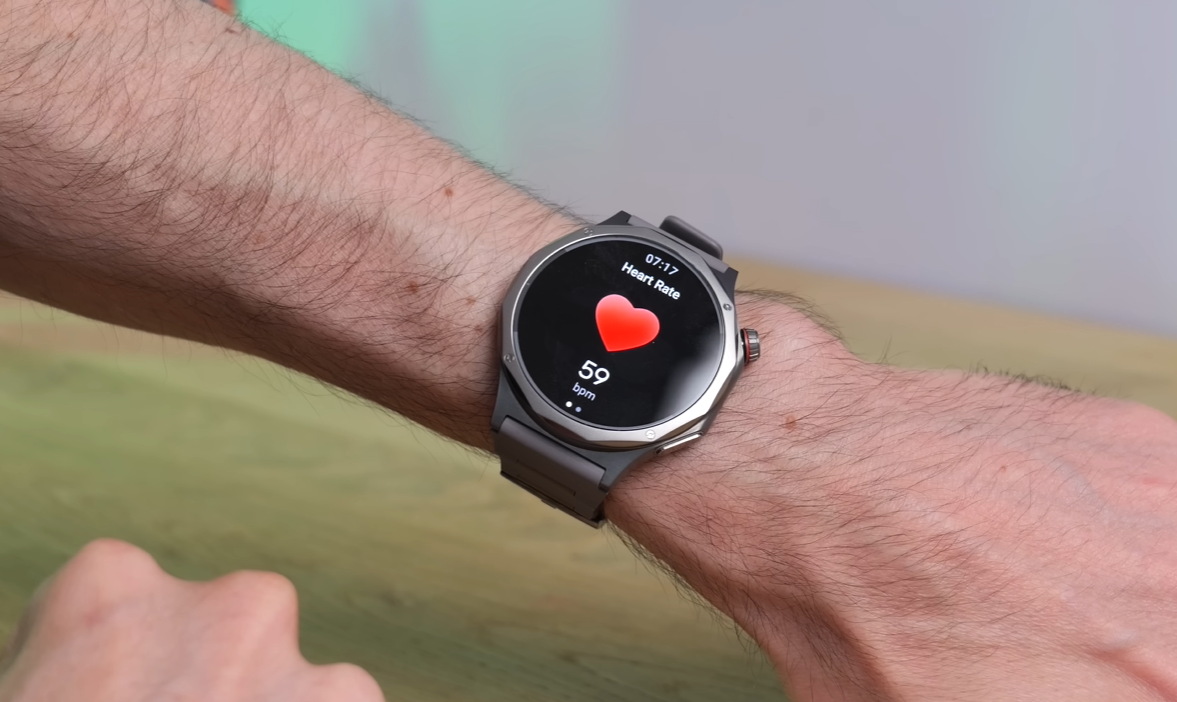
Heart rate monitoring: 24-hour continuous monitoring ran without interruption across the entire two-week test period. Spot checks against a dedicated heart rate monitor showed consistent accuracy.
Sleep tracking: Ran automatically every night. Data sync to the O Health app was reliable and consistent. The sleep breakdown — light sleep, deep sleep, REM — was detailed and plausible based on subjective experience.
Stress monitoring: The stress tracking system produced consistently high stress readings during waking hours. While this may simply reflect accurate biometric measurement, the discrepancy between calm waking perception and high stress scores suggests the algorithm may be interpreting normal physical activity or heart rate variability as stress indicators. This is a known limitation of wrist-based stress monitoring across all smartwatch brands — not specific to Oppo.
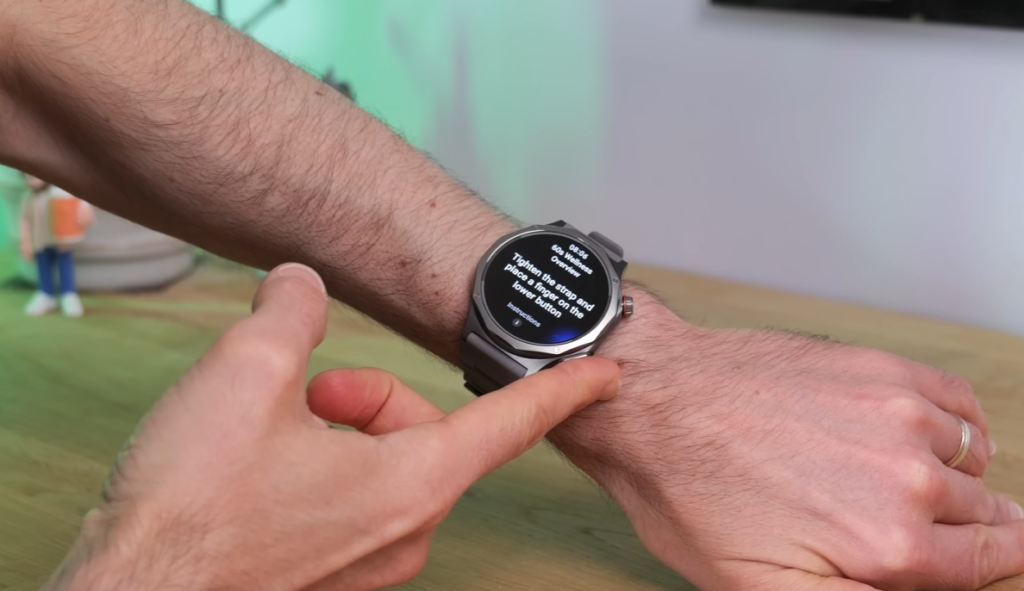
60-second wellbeing overview: Place a finger on the bottom button sensor, the watch measures ECG and multiple biometrics simultaneously, and delivers a health summary report in under 60 seconds. Useful for a periodic health check-in. Not a medical diagnostic tool — but more comprehensive than most comparable quick-scan features on competing watches.
Fall detection: Built-in but not triggered during two weeks of testing — including a visit to Edinburgh combining multiple whisky tastings and cobblestone streets. Absence of false positives across genuinely unsteady conditions is a positive result.
Exercise modes: 100-plus exercise types available. Automatic detection confirmed for running and walking. Tug of war tracking is available — whether you need it is a personal matter.
Software and Smart Features — WearOS Done Properly
The O Health companion app setup is straightforward — download from Play Store, pair via Bluetooth 5.2, customise health settings and notification preferences. Two weeks of continuous use produced no connectivity drops, no sync failures, and no notification delivery issues. The connection was reliable throughout.
Google Gemini assistant: Activated by long pressing the digital crown. Voice queries are processed quickly and responses are accurate for factual questions. The built-in microphone handles voice input in quiet and moderately noisy environments. The speaker is clear in quiet environments but loses volume and clarity in busy outdoor settings — a known limitation of the small speaker unit.
Notifications: Full notification support for all apps. Complete emails can be read on the watch. Replies via onscreen keyboard work adequately with auto-correct — voice reply via microphone is faster and more practical for most messages.
Google Maps: Available and functional on the wrist for turn-by-turn navigation. Useful for city walking navigation without taking the phone out.
Google Wallet: Contactless payments confirmed working. Standard NFC payment tap on supported terminals.
Spotify: Works for music playback via the watch directly. 32GB internal storage allows offline music and podcast downloads. You can pair Bluetooth earphones directly to the watch and leave the phone behind at the gym or pool. Spotify app loading speed is slow due to the processor limitation mentioned earlier — but once loaded, playback is reliable.
Remote camera shutter: Works with compatible Oppo smartphones. There is occasional lag between the watch viewfinder preview and the actual camera — several seconds behind in some tests. Functions adequately but is not the most reliable implementation of this feature.
Watch faces: Good built-in selection covering analogue and digital styles. O Health app extends this further. Google Play Store provides additional options — many paid. Custom watch face support means the Watch X3 can be personalised for any aesthetic.
How It Compares to Key Rivals
Oppo Watch X3 — approximately £349 to £399 3.5-day battery, sapphire glass, titanium, IP68+69, 5ATM, full WearOS, 32GB storage, Snapdragon W5 Gen 1 (ageing). Best battery life in the WearOS category.
Samsung Galaxy Watch 8 — approximately £289 to £349 Newer Exynos W1000 processor, smoother performance, approximately 40-hour battery. Stronger app performance, weaker battery life. Better for performance-first buyers.
Google Pixel Watch 4 — approximately £349 Google Tensor W1 chip, tightest Fitbit and Google Health integration, approximately 24-hour battery. Best software experience, worst battery in the group.
OnePlus Watch 3 — approximately £299 Most direct competitor. Similar dual-chip architecture and battery approach. Approximately 4-day battery. Less premium materials than Oppo Watch X3. Similar performance limitations.
Huawei Watch GT5 Pro — approximately £299 7-day plus battery, excellent build quality. Not WearOS — uses HarmonyOS. No Google Play Store. Better battery, less functionality.
Apple Watch Series 11 — approximately £399 18-hour battery, best health sensors, best iOS integration. Incompatible with Android. Not a valid comparison for Android users.
Pros and Cons
What works:
- 3.5 days real-world battery — best in WearOS category
- Titanium alloy case — genuinely premium and lightweight at 43g
- Sapphire glass — survived two weeks without a single scratch
- IP68 + IP69 + 5ATM — comprehensive water and dust protection
- MIL-STD-810H certified — genuinely tough
- 1.5-inch 1,500 nit AMOLED — bright and readable outdoors
- Edge-to-edge fully round display — no flat tyre
- Dual-chip architecture — smart engineering for battery efficiency
- 32GB storage — enough for music, apps, and watch faces
- Automatic walk detection and retrospective backfill — best in testing
- Gemini assistant built-in
- Google Wallet contactless payments
- Standard 22mm strap — replace with any third-party band
- 75-minute full charge — fast for the battery size
- 14-day low power mode available
- 100 plus workout types
What doesn’t:
- Snapdragon W5 Gen 1 processor is ageing — performance lag in apps
- Spotify loads slowly
- Card transitions occasionally stutter by one to two seconds
- The speaker is quiet in noisy outdoor environments
- No eSIM on this edition
- Pogo pin charging dock required — no universal Qi wireless charging
- The remote shutter has noticeable lag with Oppo phones
- Stress monitoring may over-report stress during normal activity
Who Should Buy the Oppo Watch X3?
Buy it if you: Want the best battery life available on a WearOS smartwatch, value premium materials and genuine build quality, use Android and want full Google ecosystem integration, and can accept occasional app loading sluggishness in exchange for not charging every night.
Skip it if you: Prioritise smooth fast app performance above all other considerations, stream heavily from Spotify on the watch daily, or need eSIM connectivity for standalone calls without your phone.
Consider the Samsung Galaxy Watch 8 instead if: App performance matters more than battery life. The Galaxy Watch 8 is noticeably faster and smoother at the cost of approximately two days less battery.
Consider the OnePlus Watch 3 instead if: You want a similar dual-chip battery approach at a lower price and do not require the premium titanium and sapphire materials.
Consider the Huawei Watch GT5 Pro instead if: Battery life beyond 3.5 days is your absolute priority and you can live without Google Play Store access and WearOS functionality.
MyPitShop Final Verdict
The Oppo Watch X3 solves the most fundamental problem with WearOS smartwatches — battery life — without sacrificing the features that make WearOS worth choosing over simpler watch operating systems. Three and a half days of genuine full-feature use, sapphire glass that shrugs off real-world daily punishment, a 1,500 nit display that works in actual sunlight, and a build quality that justifies the premium price position.
The ageing Snapdragon W5 Gen 1 processor is the one legitimate complaint and it is not a minor one — if you regularly use third-party apps, stream Spotify, or want the smoothest possible navigation experience, the Watch X3 will occasionally frustrate you. This is the difference between a five-star and four-star WearOS smartwatch.
But for the buyer who prioritises battery life, build quality, and health tracking accuracy over absolute app performance speed, the Oppo Watch X3 is the most well-rounded WearOS smartwatch available in 2026. Four out of five.