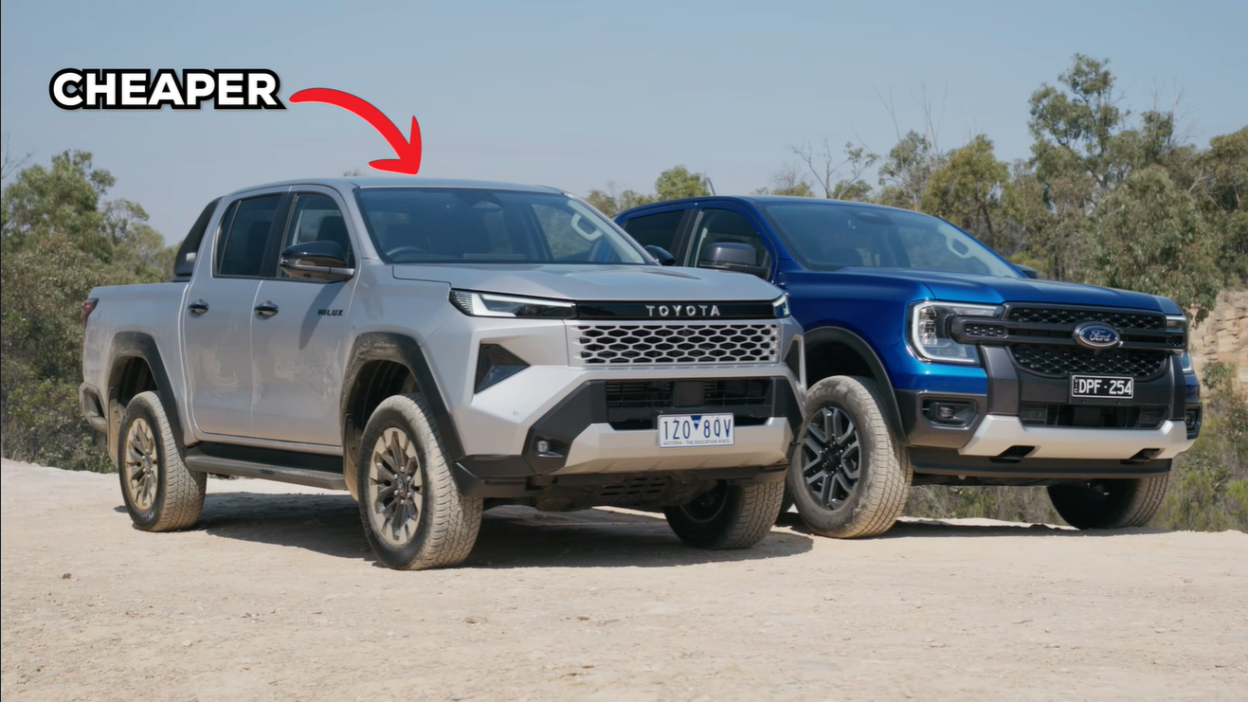
Welcome to the biggest comparison test of the year. Over here in blue, we have the Ford Ranger—the reigning champion, Australia’s best-selling ute, and the vehicle that set new benchmarks when it launched. And over there in white, we have the brand-new 2026 Toyota HiLux, a vehicle that’s received mixed reactions but might surprise you more than you expect.
Unlike most reviews that sit on the fence and refuse to give you a straight answer, we’re going to tell you EXACTLY which one is better after putting both through a comprehensive mega test, including: styling comparison, interior analysis, engine performance, off-road torture testing, acceleration runs, and real-world driving impressions.
The results? They’re wild. Let’s dive in.
🎯 QUICK VERDICT
Ford Ranger Sport (V6): A$71,500 (before on-roads)
Toyota HiLux SR5 (Manual Premium): A$68,490 (before on-roads)
Overall Winner: Ford Ranger (but it’s closer than you think)
THE WINNERS BY CATEGORY
Design: Draw (subjective, you decide)
Cargo Capacity: Ford Ranger
Engine & Reliability: Toyota HiLux
Interior (Front): Toyota HiLux
Interior (Rear): Ford Ranger
Off-Road Capability: Ford Ranger
Acceleration: Ford Ranger (obviously)
On-Road Driving: Ford Ranger
Fuel Economy: Toyota HiLux
Value for Money: Toyota HiLux
Price Reality Check: It’s Complicated
Here’s where things get interesting from the start. Technically, the Toyota HiLux is cheaper than the Ford Ranger we’re testing. But spec-matching these two proved absolutely impossible despite weeks of trying.
Toyota HiLux SR5 Pricing
- Base Manual: A$63,990 (before on-roads)
- Add Auto Transmission + 48V Mild Hybrid: +A$2,000
- Add Premium Interior Pack: +A$2,500
- Total (Auto with Premium): A$68,490
But here’s the catch: Our test vehicle came with the manual transmission (no mild hybrid), making it A$65,990 before on-roads.
Ford Ranger Sport Pricing
- Sport with V6: A$71,500 (before on-roads)
- Includes metallic paint and touring pack
- Sport variant being phased out (replaced by refreshed lineup)
Alternative: Ford Ranger XLT with V6 touring pack: A$69,490
The Value Equation
In a weird twist, despite Toyota’s reputation for “yesterday’s cars, tomorrow’s prices,” the HiLux SR5—especially the manual with premium pack—offers genuinely good value. You’re getting:
- Modern interior with premium materials
- Dual suspension system
- All-terrain tires (Ranger comes with highway tires!)
- Manual transmission option (increasingly rare)
- Proven reliability
Winner: Toyota HiLux for pure value proposition
Design Battle: Beauty is in the Eye of the Beholder
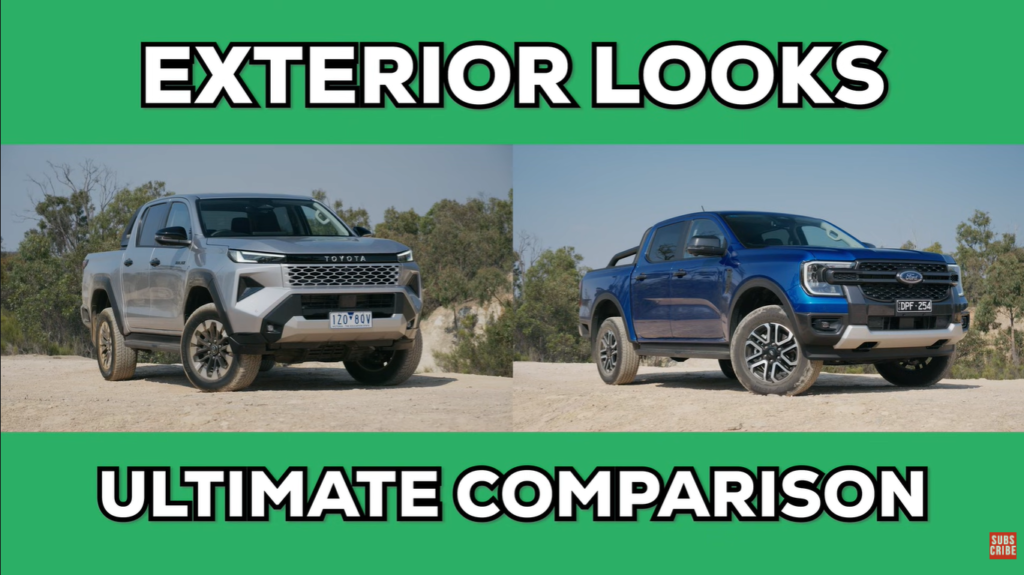
Let’s be objective about something completely subjective. Both utes look good, but in different ways.
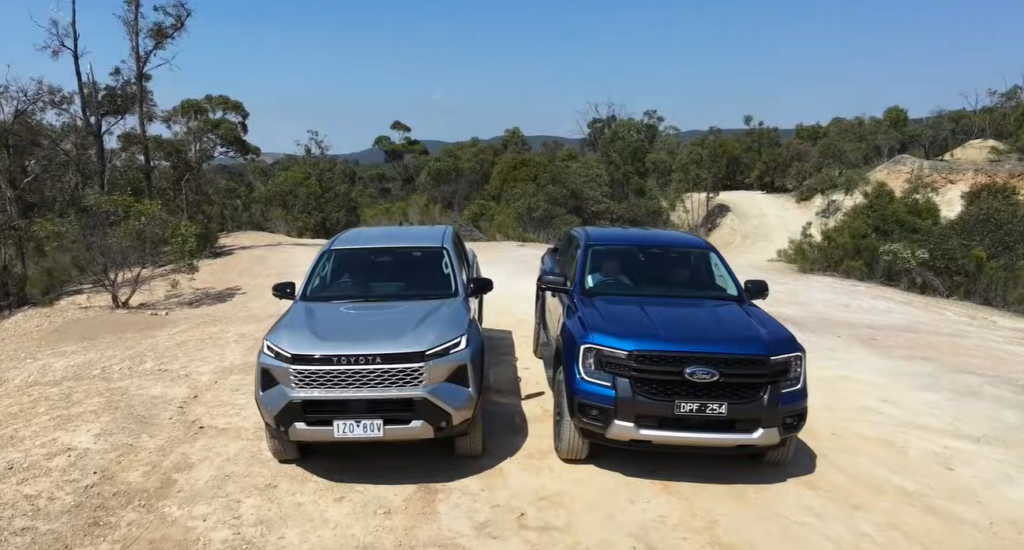
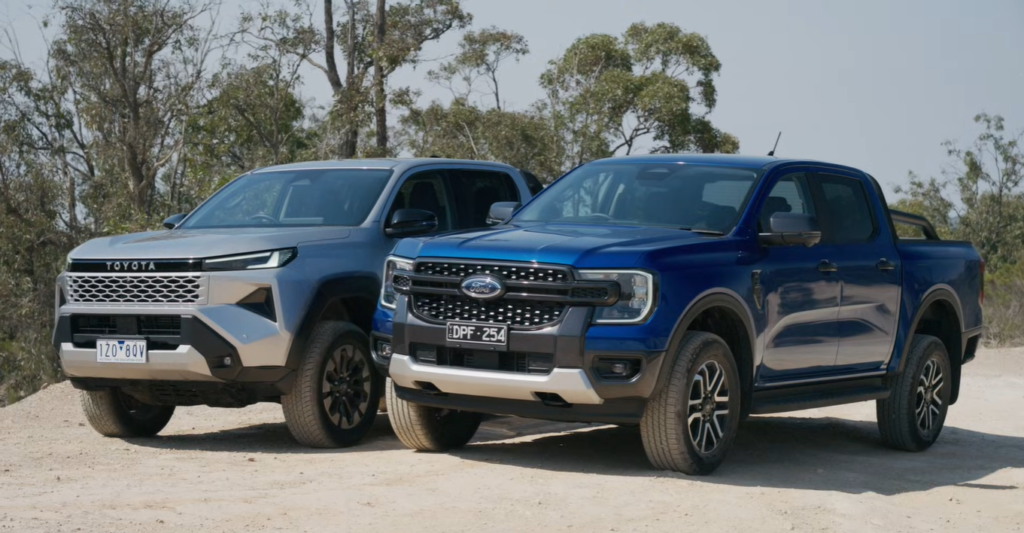
Ford Ranger Design Analysis
What Works:
- Getting a bit old now (4 years since launch) but still attractive
- Relatively bright LED daytime running lights (even on Sport)
- Big, imposing grille creates road presence
- 360-degree camera (Sport/Touring pack only)
- Mature, sophisticated aesthetic
What Doesn’t:
- Base models still use halogen bulbs (unacceptable in 2026)
- Design starting to feel familiar
- Less distinctive than when it launched
Toyota HiLux Design Analysis
What Works:
- Love it or hate it, it’s DISTINCTIVE
- “Toyota Heritage” badging spelled out on grille
- Unique grille design (polarizing but bold)
- Headlights are bright LEDs as standard
- All-terrain tires from factory (SR5 trim)
- Looks tougher and more rugged
What Doesn’t:
- Headlights mounted higher than Ranger (people flash you thinking you’re high-beaming them)
- Looks narrow and tall from some angles
- TERRIBLE 360-degree camera (worst in class—low resolution, almost useless)
- Cyber-sumo stance isn’t for everyone
Side Profile Comparison
Ranger: Classic ute proportions, 20-inch wheels (Sport), side steps, flowing lines
HiLux: New plastic sports bar roof rails, side steps (copying Ranger—smart move), distinctive character lines, looks fresh
Rear End
Honestly? Rear ends of utes all look basically the same. You get:
- Ranger: Traditional tail lights, Sport badging
- HiLux: Updated LED tail lights, SR5 badging, Toyota heritage elements
Our Take: The HiLux looks fresher and more modern, but the Ranger looks tougher and more premium.
Verdict: DRAW – Let us know in the comments which you prefer!
Cargo Capacity: The Pallet Problem
This is where things get technical—and frustrating for HiLux buyers.
Tub Dimensions
Toyota HiLux SR5:
- Length: 1,555mm
- Width: 1,540mm
- Depth: 480mm
- Wheel Arch Spacing: 1,145mm ❌
Ford Ranger:
- Length: 1,464mm (91mm shorter)
- Width: 1,520mm (20mm narrower)
- Depth: 525mm (45mm deeper)
- Wheel Arch Spacing: 1,217mm ✅
The Critical Measurement: Between the Wheel Arches
Here’s the kicker: You CANNOT fit an Australian standard pallet (1,165mm wide) between the wheel arches of a HiLux.
The Ranger? No problem.
For tradies, farmers, and commercial users, this is absurd. The HiLux may be longer and wider overall, but that useless space outside the wheel arches doesn’t help when you need to load a pallet of cinder blocks, timber, or building materials.
This alone is a dealbreaker for many commercial buyers.
Payload Capacity
Toyota HiLux SR5: 940kg
Ford Ranger XLT V6: 1,047kg
However, the Ranger is about 200kg heavier. So when towing at maximum capacity (3.5 tons for both), the HiLux actually has about 100-150kg more available payload remaining.
Winner: Ford Ranger – Better depth, fits standard pallets, higher absolute payload
Engine & Reliability: The Great Debate
This is where the battle gets philosophical. Do you want POWER or RELIABILITY?
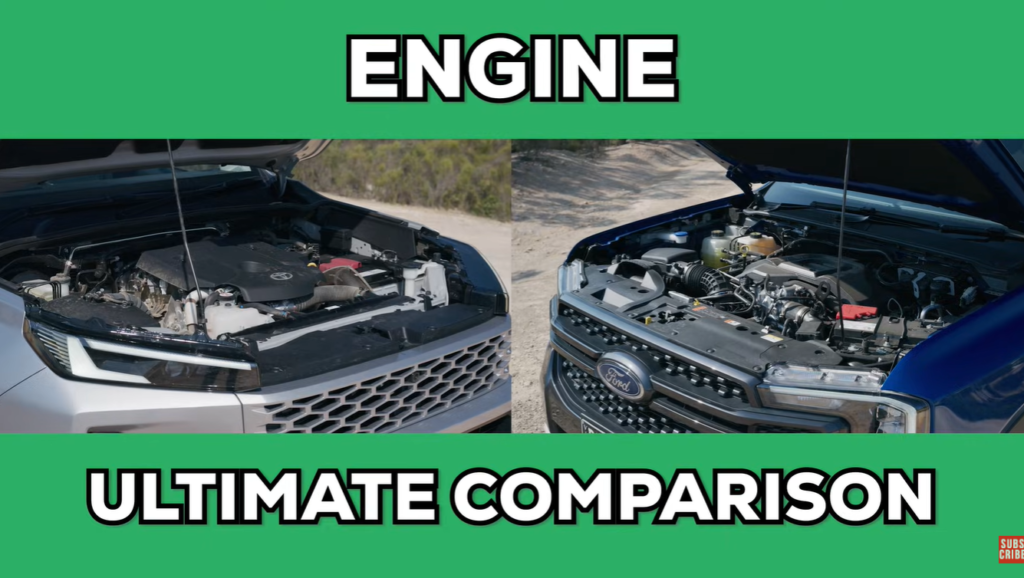
Toyota HiLux: The Venerable 1GD-FTV
Specifications:
- Engine: 2.8L 4-cylinder turbo-diesel (1GD-FTV)
- Power (Auto): 150kW / 201 PS
- Torque (Auto): 500Nm
- Power (Manual): 150kW / 201 PS
- Torque (Manual): 420Nm (80Nm less!)
- Transmission: 6-speed manual OR 6-speed auto + 48V mild hybrid
The Reliability Story:
This engine is LEGENDARY. Mechanics worldwide know the 1GD as the reliable four-cylinder turbo-diesel that simply will not die. Yes, early models had DPF (diesel particulate filter) issues, but those were recalled and fixed years ago.
Hundreds of thousands of kilometers? No problem. These engines just keep going.
The Manual Experience:
We tested the manual variant. And honestly? It’s refreshing. Features:
- Rev-matching system (makes downshifts smooth)
- Good clutch feel
- Easier throttle modulation off-road
- Old-school satisfaction
The Downside:
420Nm in the manual versus 500Nm in the automatic is a significant difference. You feel it when towing or accelerating.
Ford Ranger: The V6 Power
Specifications:
- Engine: 3.0L V6 turbo-diesel
- Power: 184kW / 247 PS
- Torque: 600Nm
- Transmission: 10-speed automatic
The Performance Story:
This engine is FANTASTIC. It delivers:
- Effortless acceleration
- Massive torque for towing
- Smooth, refined power delivery
- 10-speed transmission that’s nearly imperceptible
The Reliability Question:
Here’s where it gets controversial. The V6 itself has proven relatively reliable—it’s not the disaster some fear. However:
- Traced back to early 2000s Range Rovers (concerning lineage)
- Some alternator problems reported
- More complex than Toyota’s simple four-cylinder
- Less proven in Australian outback conditions
The Reality Check:
If you’re circling Australia or crossing the outback, which would you trust more? Most people—honestly—would choose the Toyota. That 1GD engine has earned its reputation over decades.
But for suburban towing, commuting, and weekend adventures? The V6’s reliability concerns are overblown for most users.
Winner: Toyota HiLux – Legendary reliability, manual option, proven track record (though we acknowledge the Ranger’s power advantage)
Interior Battle: Front vs Rear
The Toyota HiLux interior was completely redesigned. The Ranger’s has aged. Which is better?
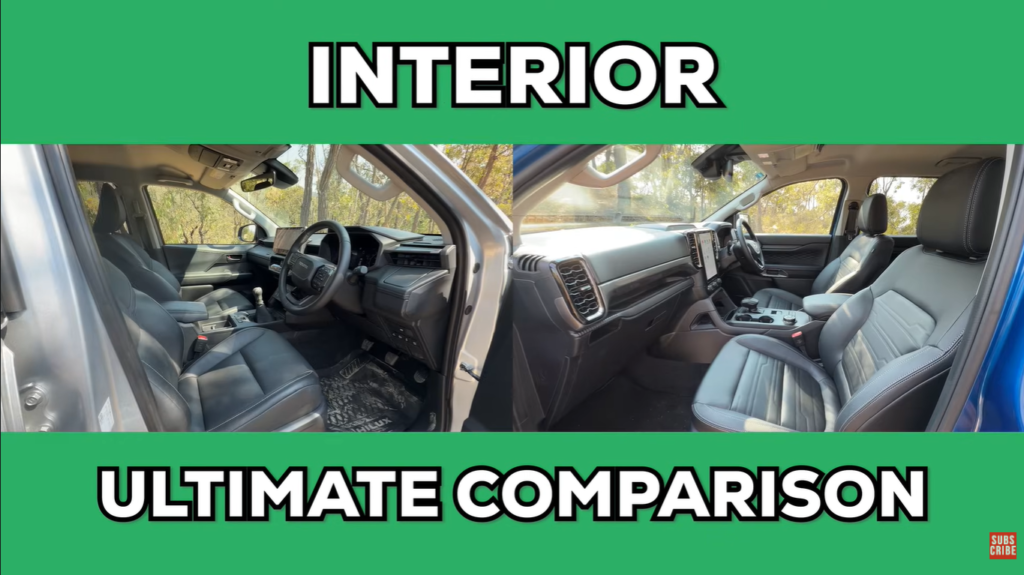
Toyota HiLux Interior (Front Seats)
What’s Improved:
The A$2,500 Premium Interior Pack transforms this cabin:
- Leather seats (power-adjustable driver side, manual passenger)
- Automatic climate control
- Digital dashboard (super customizable, shows heaps of info)
- 12.3-inch touchscreen (snappy, responsive)
- Wireless Apple CarPlay/Android Auto
- Heated seats (old-school buttons—we love it)
- Center console storage is excellent
Storage Solutions:
- Upper glove box
- Lower glove box
- Dashboard cup holders (block air vents on hot days—annoying)
- Deep center console
- Household socket (400W)
What Still Sucks:
AIR CONDITIONING. Toyota did something to ruin the air con. On a 43°C Australian day, it struggles. Not acceptable.
Tech Features:
- Rev-matching for manual
- USB-C fast chargers + wireless charging
- IMT button (rev matching toggle)
Overall: Clean, modern, well-thought-out interior that punches above its price point.
Ford Ranger Interior (Front Seats)
What’s Good:
When it launched, the Ranger interior blew everyone’s socks off. It’s still good, but:
- Sport trim gets leather, but XLT (direct HiLux competitor) gets cloth
- Technology is comprehensive
- Display quality is good
- Build quality feels premium
What’s Frustrating:
COST-CUTTING ABSURDITY:
Even at A$71,500 for the Sport:
- Upper glove box won’t open (need Wildtrak trim to unlock it!)
- No dashboard cup holders (just empty pockets)
- Micro-stutters in infotainment (still, after 4 years!)
- Apple CarPlay drops periodically (annoying)
Seats:
- XLT: Cloth, manually adjusting
- Sport: Leather, power-adjusting
The Technology Paradox:
90% of the time, the Ranger’s tech works great. But that 5-10% when it micro-stutters or lags? Infuriating. Ford still hasn’t fully sorted the infotainment gremlins.
Winner (Front): Toyota HiLux – Better value, cleaner execution, more modern feel (despite weaker air con)
Rear Seats: Where the HiLux Falls Apart
Toyota HiLux Rear Seats:
This is BAD. Really bad.
The Problems:
- Almost no legroom (5’11” tester cramped)
- High floor (steel beams underneath unchanged from old model)
- Knees around your ears (uncomfortable seating position)
- Minimal toe room
What You Do Get:
- Air vents (not available in base SR)
- USB-C fast chargers
- Soft center armrest with cup holders
- Ability to lift floor panels
The Reality:
The HiLux kept the entire midsection identical to the previous generation. Yes, it looks new inside, but the bones underneath are ancient. This is what happens when you do a facelift instead of a true redesign.
Ford Ranger Rear Seats:
This is MUCH better.
The Experience:
- Heaps of headroom
- Heaps of legroom (comfortable for 6’2″ and under)
- Good toe room
- Proper seating position
Features:
- 12V socket
- Household socket (400W—smart placement)
- Soft center armrest with cup holders
- Air con vents
- NO USB ports (weird omission)
Seats:
- XLT: Cloth (comfortable)
- Sport: Leather (what we tested)
Winner (Rear): Ford Ranger – Not even close. Much more spacious and comfortable.
Off-Road Mega Test: Trail Torture
We took both utes through:
- Rocky climbs
- Sand sections
- Steep descents
- Reverse hill climbs
- Water crossings (dried up—Australian summer!)
Toyota HiLux Off-Road Performance
Specifications:
- Approach angle: 29°
- Ramp breakover: 23°
- Departure angle: 26°
- Ground clearance: 224mm
- Wading depth: 700mm
Test Results (WITHOUT Rear Diff Locked):
Rocky Climb: Pretty good! The all-terrain tires provided excellent grip. Even without locking the rear diff, it climbed confidently. Manual transmission made throttle modulation easy.
The Advantage: Having a manual clutch off-road lets you modulate power delivery precisely.
Articulation: Decent, but not exceptional. Wheel lift occurred on extreme obstacles.
Hill Descent Control: Works at 3-4 km/h. No speed adjustment available. Does the job but basic.
Sand Section: Maintained 20-28 mph in deep sand. Fat all-terrain tires and dual motors (oh wait, that’s the e-bike review—) I mean the proper tires helped immensely.
Reverse Torture Test (Rear Diff Locked): No bad sounds, no breakage. Handled it fine.
Overall: Very capable off-roader straight from factory thanks to all-terrain tires and proven underpinnings.
Ford Ranger Off-Road Performance
Specifications:
- Approach angle: 30° (better!)
- Ramp breakover: 21° (worse)
- Departure angle: 23°
- Ground clearance: 234mm (10mm better!)
- Wading depth: 800mm (100mm better!)
The Tire Problem:
Our Ranger came with HIGHWAY TERRAIN TIRES. This is egregious for an off-road-capable ute. Highway tires have:
- Less grip in sand/mud
- Reduced sidewall protection
- Poor performance on loose surfaces
Test Results (WITHOUT Rear Diff Locked):
Rocky Climb: STRUGGLED. The highway tires couldn’t find grip. Wheel spin, traction control working overtime. We eventually had to lock the rear diff.
With All-Terrain Tires, This Wouldn’t Happen:
The Ranger’s superior angles and ground clearance mean it SHOULD outperform the HiLux. But handicapped by wrong tires, it struggled.
Comfort: WAY more comfortable off-road. The suspension (even without the “lifestyle” or “comfort” tune names—it’s just well-tuned) absorbed bumps beautifully. Far less jarring than the HiLux.
Wheel Articulation: Better than HiLux. Kept wheels on ground more consistently.
Hill Descent Control: MUCH better. You can:
- Adjust speed (not locked to 4 km/h)
- Increase to 6+ km/h if desired
- Decrease for technical sections
This Makes a Huge Difference:
Sometimes you don’t want to crawl at 4 km/h. The Ranger’s adjustable descent control is superior.
Reverse Torture Test: Handled it confidently. Still more comfortable than the HiLux.
Winner: Ford Ranger (begrudgingly—it NEEDS all-terrain tires to reach its potential)
Note: If the Ranger came with all-terrain tires from factory like the HiLux SR5, this wouldn’t even be close.
Acceleration Test: No Surprises Here
Ford Ranger V6
0-100 km/h: 8.63 seconds
Good grip off the line, smooth power delivery, 10-speed transmission working overtime. For a ute, that’s bloody good.
Toyota HiLux Manual
0-100 km/h: 11.55 seconds
User error on launch (clutch dump difficult to perfect), wheel spin, slower overall. About 3 seconds worse than the Ranger.
The Reality:
No one expected the HiLux to win. The Ranger has 34kW more power and 180Nm more torque (or 100Nm more vs the HiLux auto). It’s in a different league for acceleration.
Winner: Ford Ranger (obviously)
On-Road Driving: The Real-World Test
This is where the Ranger shines brightest.
Ford Ranger On-Road Experience
Driving Character:
From the moment you hit the road, it’s obvious: this vehicle was developed in Australia for Australian conditions.
What Makes It Special:
- Permanent 4WD available (rear-biased AWD—better for towing)
- Rides like nothing else (most comfortable ute you can drive)
- Doesn’t feel like a pig (corners surprisingly well)
- Power delivery is effortless (600Nm makes everything easy)
- Feels like an SUV, not a ute
The Magic:
You throw the Ranger into a corner at highway speeds and it just… handles it. Minimal body roll, confidence-inspiring, almost car-like dynamics.
The Downside:
Fuel Economy: 13.2L/100km in our testing. She’s thirsty.
That’s significantly worse than the HiLux.
Toyota HiLux On-Road Experience
Driving Character:
The HiLux has improved dramatically over the previous generation but still feels agricultural compared to the Ranger.
What’s Better:
- Fuel Economy: 7.9L/100km (5.3L/100km less than Ranger!)
- New power steering (no more heavy hydraulic—much better)
- Quieter cabin (improved NVH—noise, vibration, harshness)
- Sport mode (Ranger doesn’t get drive modes)
What’s Worse:
- Less power and torque (especially in manual with 420Nm)
- Vague steering (better than old hydraulic, but still lacks feel)
- Body roll (more than Ranger in corners)
- Ride quality (harsher, less composed)
- Back end feels unsettled (needs a few hundred kilos in the tray)
The Part-Time 4WD Reality:
Unlike the Ranger’s permanent AWD option, the HiLux runs in 2WD on sealed surfaces. Fine for most, but the Ranger’s ability to put power to all four wheels on tarmac is better for towing.
The Steering Debate:
People who demand hydraulic steering “because it’s pure” are like people who demand naturally aspirated engines or manual transmissions in every car. Modern electric power steering—when tuned well—is superior for daily driving.
The HiLux’s new electric steering is better than the old hydraulic. But it’s still very vague compared to the Ranger.
Winner: Ford Ranger – Better ride, better handling, better refinement (despite worse fuel economy)
Final Verdict: Which Should You Buy?
The Ford Ranger Wins Overall
Here’s the reality: The Ford Ranger is still the better overall ute for most people in day-to-day living.
It’s Better At:
- On-road comfort and refinement
- Rear seat space (massively better)
- Power and acceleration
- Off-road capability (with proper tires)
- Towing confidence (600Nm torque, permanent AWD option)
- Driving dynamics
- Technology (when it works)
- Cargo bay (fits standard pallets)
The Ranger Delivers:
A premium experience that feels more like an SUV than a workhorse. It’s comfortable, refined, powerful, and capable. If you’re not having reliability issues (and most owners aren’t), it’s just the better all-around vehicle.
But the HiLux Has Serious Strengths
The Toyota HiLux Wins On:
- Reliability and proven durability
- Fuel economy (MUCH better)
- Value for money (especially SR5 manual with premium pack)
- Resale value (holds value incredibly well)
- All-terrain tires from factory (SR5)
- Manual transmission availability
- Updated interior (front seats)
- Lower running costs
- Peace of mind for remote travel
The HiLux is Perfect If:
- You value reliability above all else
- You do high kilometers (fuel savings add up)
- You plan to keep the vehicle 10+ years
- You cross the Australian outback regularly
- You want a manual transmission
- Resale value is critical
- You don’t need rear seat space
Our Recommendation
Buy the Ford Ranger if:
- You want the best driving experience
- Rear passengers matter (family hauling)
- You prioritize comfort and refinement
- You tow regularly and want effortless power
- On-road driving is 80%+ of your usage
- You’re okay with higher fuel costs
Buy the Toyota HiLux if:
- Reliability is non-negotiable
- You do high annual kilometers (fuel economy matters)
- You’re traveling remote areas regularly
- You want a manual transmission
- Resale value is critical
- You rarely have rear passengers
- Budget is tight and you want better value
The Future
Maybe if Toyota does more than just a subtle facelift next time—a TRUE redesign with modern underpinnings, proper rear seat space, and updated chassis—it might actually win.
But for now, in 2026, the Ford Ranger remains the benchmark. The HiLux is a worthy challenger that wins on specific criteria, but it’s not quite there overall.
Final Score:
- Ford Ranger: 8.5/10
- Toyota HiLux: 8.0/10
It’s closer than you might expect, but the Ranger edges it out.
The Toyota HiLux has a proven reliability advantage. The 2.8L 1GD engine is legendary for durability with hundreds of thousands of kilometers being common. The Ranger’s V6 is relatively reliable but less proven, especially in harsh Australian outback conditions.