TL;DR – Quick Verdict:
The GAC Aion V is a surprisingly pleasant electric SUV that punches above its weight at $42,590. It offers 510km WLTP range, respectable performance, a comfortable ride, and generous equipment. However, it enters an oversaturated market with limited dealerships (only 11), overzealous safety alerts, and struggles with air conditioning in Australian heat. Best for: early adopters wanting a value EV with an 8-year unlimited warranty. Skip if: you need an established service network or hate constant beeping.
Rating: 3.5/5 stars
Price: $42,590 (Premium) – $44,590 (Luxury) before on-roads
Verdict: Better than expected, but faces tough competition in crowded segment.
Another new Chinese car brand in Australia.
That’s what you’re thinking, right? With a dozen brands launching in the last 18 months, the Australian market feels saturated with unfamiliar names fighting for attention. GAC is the latest to take a shot, launching with the Aion V electric SUV.
But here’s the question: does Australia really need another Chinese EV brand? Can GAC carve out space in a segment dominated by BYD, MG, and Tesla?
After driving the Aion V on Australian roads, the answer is more nuanced than you’d expect. This isn’t just another forgettable Chinese SUV—it’s genuinely competitive where it matters. But it also has flaws that could derail GAC’s ambitions.
Let’s break down everything you need to know about the GAC Aion V.
Who Is GAC? The Brand You’ve Never Heard Of
The Chinese Conglomerate With Big Ambitions
GAC (Guangzhou Automobile Group) is a huge Chinese conglomerate founded in 1997 with joint ventures with Honda and Toyota dating back to 1999 and 2004. They’re not some startup—they’re a legitimate major player in China.
The company operates multiple sub-brands:
- GAC Trumpchi: Mass-market vehicles
- Aion: Electric vehicles (what we’re reviewing)
- Hyptec: Premium electric vehicles
- GAC: Export market branding
The Aion V comes from GAC’s dedicated electric sub-brand, which explains why it looks completely different from the GAC Emzoom (the petrol small SUV also launching in Australia).
The Australian Launch Strategy
GAC enters Australia with three models:
- Aion V: Electric SUV ($42,590-$44,590)
- Emzoom: Petrol small SUV ($25,590)
- M8 PHEV: Plug-in hybrid MPV ($76,590-$83,590)
Future plans include a dual-cab ute arriving in 2027, targeting Australia’s most popular vehicle segment.
The Reality Check: Can They Succeed?
GAC aims to become a top 10-selling brand in Australia within 5 years. That’s ambitious considering they’re launching with only 11 dealerships and service centers nationwide.
For context, BYD started with extensive dealer networks and aggressive pricing. MG leveraged decades of brand heritage. GAC? They’re starting from zero name recognition with limited infrastructure.
Pricing and Specifications: The Value Proposition
What $42,590 Gets You
The Aion V starts at $42,590 before on-roads for the Premium trim, with the Luxury variant at $44,590. That’s cheaper than many competitors despite generous equipment levels.
Trim Levels:
Premium ($42,590):
- 150kW/210Nm electric motor
- 75.26kWh LFP battery
- 510km WLTP range
- 19-inch alloy wheels
- Panoramic sunroof
- LED headlights and tail lights
- Heated and ventilated front seats
- Dual-zone climate control
- 9-speaker sound system
- 8.8-inch digital instrument cluster
- 14.6-inch touchscreen infotainment
- Wireless phone charging
Luxury ($44,590):
- Everything from Premium, plus:
- Partial genuine leather seats (vs PVC)
- Front seat massage function
- 6.6L refrigerator/warmer in center console
- Additional premium trim details
Launch Incentives (Until December 31, 2025)
GAC is sweetening the deal with a free 22kW home charger and $1,000 cashback for buyers who order before December 31, 2025. This adds significant value—a quality home charger typically costs $1,500-$2,500 installed.
How It Compares to Competitors
BYD Atto 3: $39,990 (cheaper but smaller, less range)
Geely EX5: $40,990 (similar size, competitive specs)
Leapmotor C10: $45,888 (more expensive, similar specs)
Tesla Model Y: $55,900+ (significantly more expensive)
Toyota RAV4 Hybrid: $42,260 (not electric, established brand)
The Aion V sits right in the competitive sweet spot—not the cheapest, but loaded with features at a fair price.
Design and Styling: Inoffensive But Forgettable
Exterior: Fine, But Nothing Special
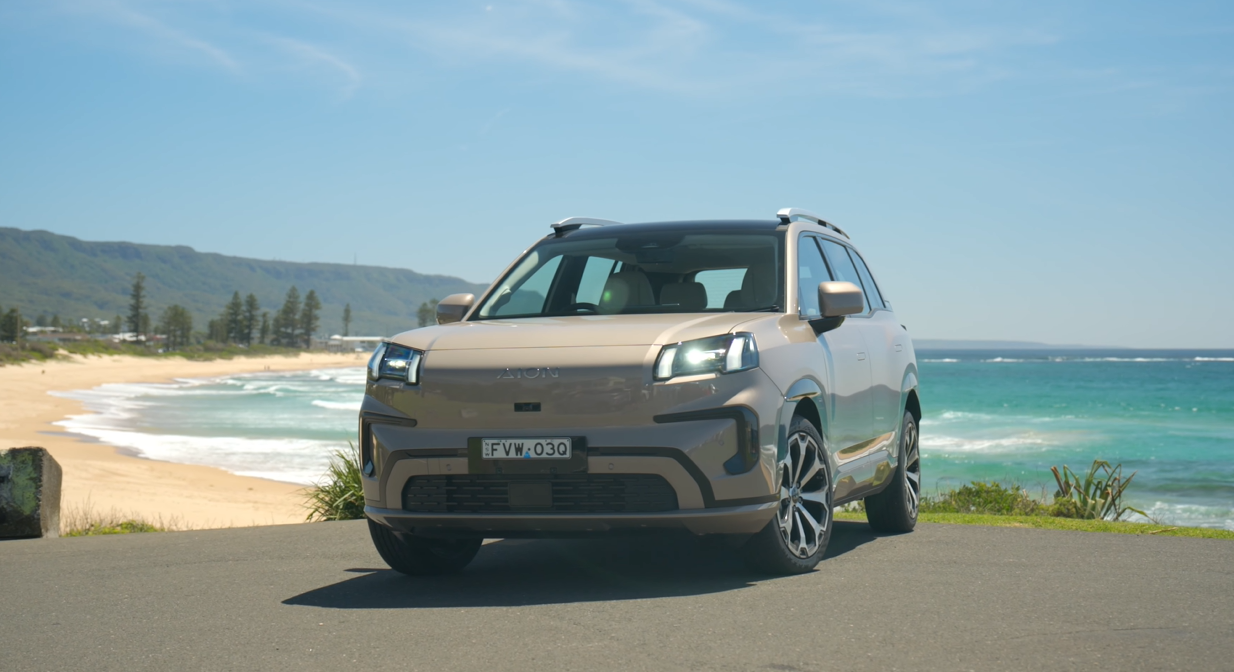
Let’s be honest about the design: it looks like so many modern Chinese SUVs. There’s a familiar sameness to the proportions, the lighting treatment, and the overall aesthetic.
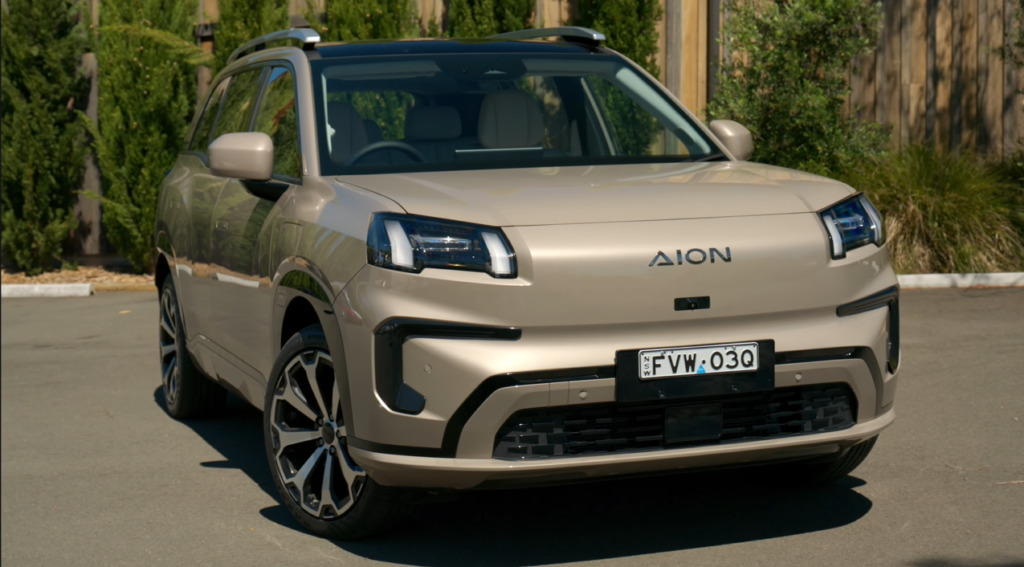
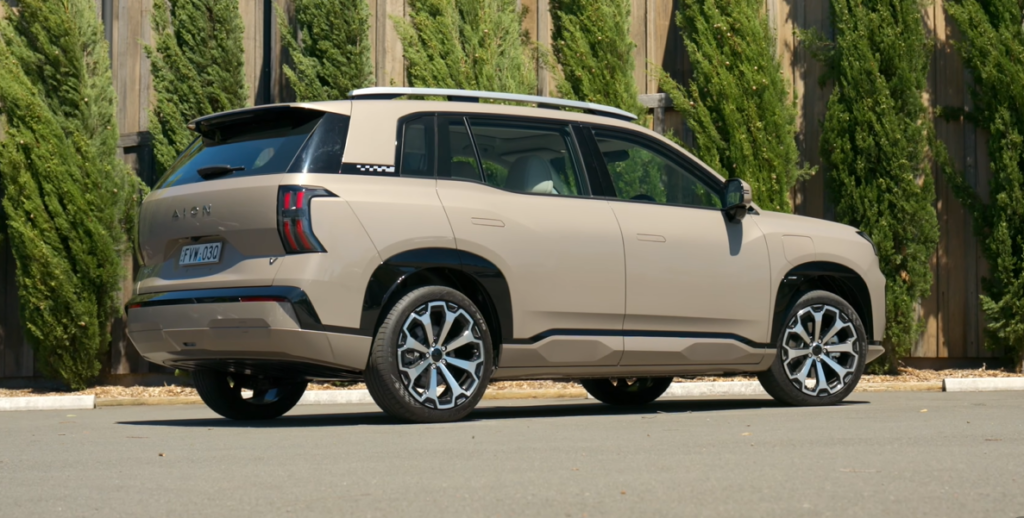
The review puts it perfectly: “It looks like so many modern Chinese SUVs. It sort of doesn’t really stand out, but it’s inoffensive. It’s fine.”
What You Get:
- Slab front end (no traditional grille needed)
- Slim LED headlights with some detailing
- Clean side profile with smooth lines
- Flush door handles for aerodynamics
- Decent presence without being bold
It won’t turn heads or make bold visual statements. It simply serves its purpose—practical transportation with modern EV styling.
Is Bland Design a Problem?
Not necessarily. Many buyers want vehicles that blend in rather than stand out. The Aion V delivers exactly that—contemporary styling without controversy.
If you want a distinctive design, look at BYD’s Dolphin or MG’s Cyberster. If you want understated practicality, the Aion V works fine.
Interior: Familiar but Well-Executed
The Modern Chinese SUV Template
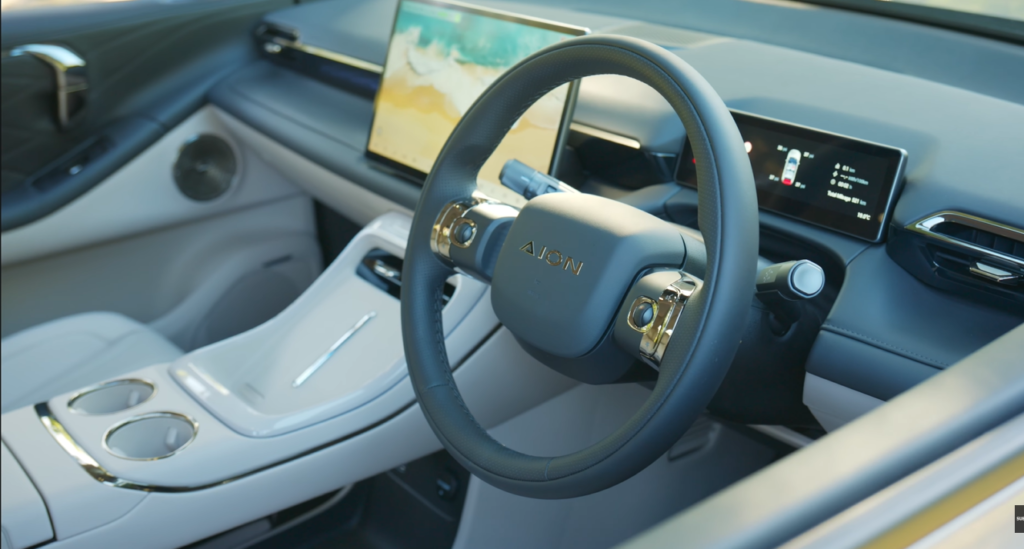
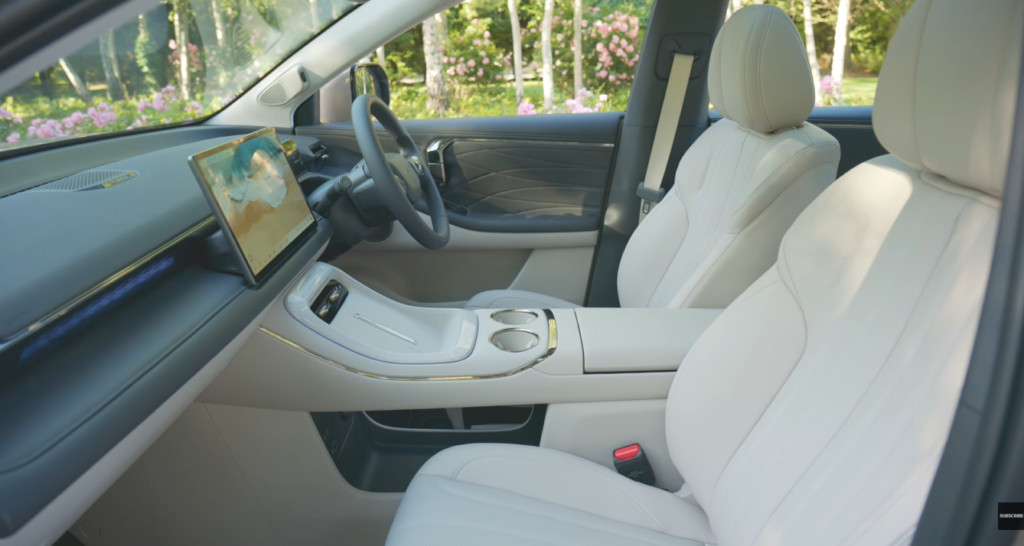
The Aion V interior follows the established formula for modern Chinese EVs:
- Large central touchscreen (14.6 inches)
- Digital instrument cluster (8.8 inches)
- Minimal physical buttons
- Touch-sensitive controls on the steering wheel
- Everything is controlled through multimedia
If you’ve been in a BYD, MG, or Leapmotor, you’ll feel instant familiarity. It’s the same basic layout philosophy.
Where It Exceeds Expectations
Despite the familiar template, GAC adds nice touches:
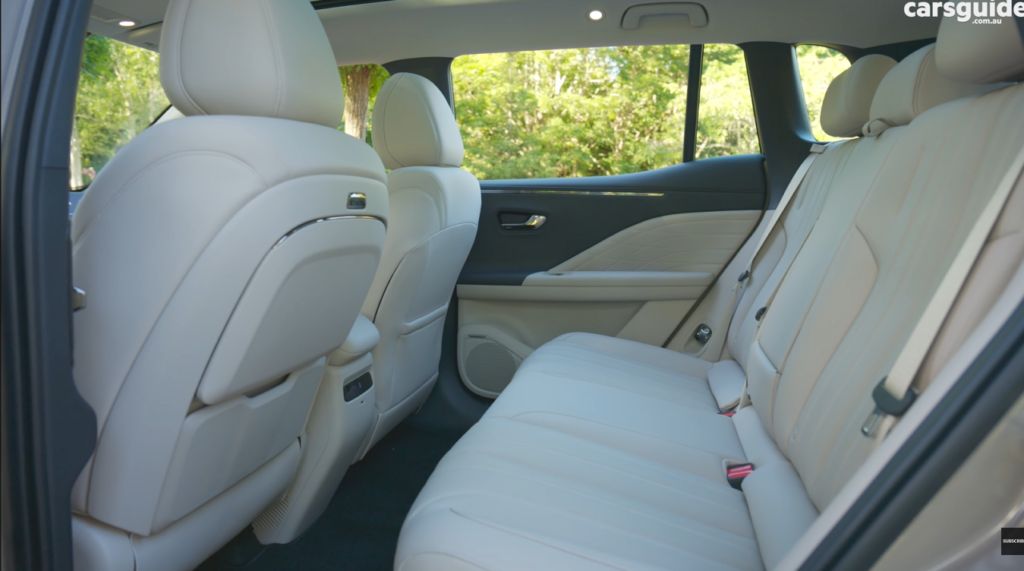
Materials: Leather effect on doors, good mixture of colors and materials, bright work that creates visual interest. The overall execution feels more premium than the price suggests.
Storage Solutions: The Aion V includes thoughtful, practical touches:
- Dual smartphone storage slots
- Storage underneaththe center console
- Power and USB ports are conveniently located
- Small hooks for hanging items
- Multiple floor heights in the boot
The Refrigerator Feature: The Luxury trim’s 6.6-liter refrigerator/warmer box is genuinely clever. It can hold up to 12 cans, maintain 4°C while using just 0.5kWh over 24 hours, and adjust from -15°C to 50°C. Perfect for keeping drinks cold or lunch warm.
Space and Practicality
Front and Rear Seats: Space is good for this size vehicle. Both rows offer adequate headroom and legroom for adults.
Boot Capacity: 427 liters with seats up, expanding to 978 liters with seats folded. Multiple floor heights provide flexibility for different cargo needs.
Front Seats: Can fold completely flat, creating camping or rest opportunities.
The Missing Features
No Glove Box: An odd omission, though offset by other storage solutions.
Only Tire Repair Kit: Disappointingly, despite having space for a full-size spare, GAC only includes a tire repair kit. A space-saver spare is optional.
Powertrain and Performance: Respectable, Not Remarkable
The Numbers
Motor: 150kW (201hp) / 210Nm
Drive: Front-wheel drive
Battery: 75.26kWh lithium iron phosphate (LFP)
Range: 510km (WLTP cycle)
Charging: Up to 180kW DC fast charging
10-80% Charge Time: 24 minutes
0-100km/h: Not officially claimed (GAC doesn’t publish it)
Real-World Performance
GAC doesn’t claim 0-100km/h times, which tells you everything: this isn’t a performance EV. It’s designed for comfortable daily driving, not drag strip thrills.
The reviewer’s assessment: “If you’re looking for a ludicrously powerful electric car, this ain’t it.”
What You Actually Get:
- Respectable acceleration for everyday use
- Adequate power for merging and overtaking
- Comfortable rather than exciting
- Sufficient performance for family duties
It’s not lightning quick, but it has the performance you need for real-world driving.
Range and Efficiency
The 510km range is on the WLTP cycle, not the more lenient Chinese test protocol. This matters—WLTP is more realistic than Chinese testing, so you can reasonably expect to get close to that 510km target.
Real-world range will vary based on:
- Driving style
- Climate control use
- Traffic conditions
- Speed (highway vs city)
Expect 400-450km in typical mixed driving, which is competitive for this segment.
Charging Capabilities
DC Fast Charging: Up to 180kW (10-80% in 24 minutes)
AC Charging: Standard home charging supported
Vehicle-to-Load (V2L): Can draw power from a battery for camping, tools, and emergencies
The 22kW home charger included with purchase until year-end is a valuable inclusion that makes home charging practical.
Driving Experience: The Pleasant Surprise
This is where the Aion V genuinely impresses.
Low Expectations Exceeded
The reviewer admits: “I didn’t have high expectations for the Aion V. Is it a class-leading SUV in terms of performance and dynamics? No. But it’s actually above average. It’s quite a pleasant car to drive.”
That’s high praise considering how many new Chinese EVs feel dull and uninspiring behind the wheel.
What Makes It Good
Ride Comfort: Despite weighing heavily (typical for EVs), GAC has done a good job managing that weight. The ride doesn’t feel too firm or crashy—it’s genuinely comfortable.
Steering Feel: This is critical. Many budget Chinese SUVs have numb, dead steering that disconnects you from the car. The Aion V doesn’t. It has responsive, direct steering that makes you feel connected.
“You want to feel connected to the car. Credit to GAC, they’ve done a pretty good job getting the Aion V to feel relatively at home on Australian roads.”
Handling: It’s not a Porsche 911 (obviously), but it doesn’t need to be. It handles competently, responds predictably, and feels stable through corners. That’s all a family SUV requires.
Tuned for Australian Conditions
Unlike some Chinese imports that feel out of place on Australian roads, the Aion V handles local conditions well. GAC apparently spent time calibrating suspension and steering for rougher roads and higher speeds common here.
Performance Context
The Aion V delivers exactly what most buyers need:
- Comfortable daily commuting
- Confident highway driving
- Predictable, safe handling
- Adequate power when needed
If you want a thrilling performance, buy a Tesla Model Y Performance. If you want pleasant, comfortable transportation, the Aion V genuinely delivers.
Safety: The Beeping Problem
Safety is where GAC ticks boxes technically but frustrates practically.
Euro NCAP Five-Star Rating
The Aion V received a five-star Euro NCAP rating with scores of 88% for adult occupant protection, 85% for child occupant protection, 79% for vulnerable road user protection, and 78% for safety assist.
ANCAP testing hasn’t been completed yet, but the Euro NCAP results are promising.
Standard Safety Systems
The Aion V includes fundamental safety tech:
- Autonomous emergency braking
- Lane keeping assist
- Blind spot monitoring
- Rear cross-traffic alert
- Driver attention monitoring
- Speed limit recognition
On paper, it’s comprehensive. In practice? Frustrating.
The Overzealous Safety Nanny Problem
This is the Aion V’s most annoying flaw. Throughout the review, constant beeping interrupts: “You may have heard throughout this incar a beep, and that is one of the many beeps and bongs that this car constantly exhibits.”
The Problems:
Constant Beeping: Speed limit changes trigger alerts. Driver attention monitoring is overzealous. Lane keeping is questionable at times. The car never stops beeping.
Distraction Through Safety: “Having all these beeps go off can be distracting. If you don’t know what it is, you physically have to take your eyes off the road to look down.”
The irony is thick: safety systems making you less safe by distracting you.
The Defeat Cycle: “Inevitably you’re going to dive into the menu and switch them off. So what’s the point of a safety system that you switch off?”
The Bigger Industry Problem
This isn’t just a GAC issue—it’s a problem across many Chinese brands. Manufacturers add aggressive safety systems to achieve five-star ratings, but testing doesn’t account for real-world integration quality.
The result: technically compliant systems that drivers disable because they’re insufferable.
GAC needs to learn to tailor these systems better for Australian conditions to make them less distracting and more genuinely useful.
Technology and Infotainment: The Details Matter
The Multimedia System
The 14.6-inch touchscreen dominates the dashboard, handling all vehicle functions. There are almost no physical buttons—everything is controlled through the screen.
The Good:
- Large, responsive touchscreen
- Modern graphics
- Logical menu structure
- Wireless smartphone connectivity
The Bad:
- No physical climate controls (common modern frustration)
- Menu diving is required for basic functions
- It can be distracting while driving
Missing Details
The review doesn’t detail infotainment specifics like:
- Apple CarPlay/Android Auto integration
- Navigation system quality
- Voice command functionality
- App availability
These omissions suggest the system works but isn’t noteworthy enough to highlight positively or negatively—it’s probably adequate but unremarkable
Air Conditioning Problem: Australian Heat Challenge
Reviewers tested the Aion V on warm days and found the air conditioning ill-equipped to handle Australian heat, with automatic settings blasting at near-full fan speed for hours while chasing an elusive 21°C target.
This is a serious issue for Australian buyers. Our climate demands powerful, efficient air conditioning, especially in electric vehicles where climate control significantly impacts range.
If the AC struggles to maintain comfort on warm (not even extremely hot) days, buyers in Queensland, Northern Territory, and Western Australia will face real problems during summer.
This suggests GAC may not have adequately tested or calibrated the climate system for Australian conditions.
Ownership: The Infrastructure Challenge
Limited Dealer Network
GAC launches with only 11 dealerships and service centers nationwide. That’s a tiny network for a country the size of Australia.
The Problem: Unless you live near one of these 11 locations, buying and servicing your Aion V becomes tricky. Road trips create anxiety if the nearest service center is hundreds of kilometers away.
The Competition: BYD, MG, and established brands have dozens of service points. GAC is starting at a significant disadvantage.
Warranty Coverage
GAC offers an eight-year, unlimited-kilometer vehicle warranty, with the high-voltage battery covered for eight years/200,000km, plus five years of roadside assistance.
This is genuinely competitive—matching or exceeding many established brands. The unlimited-kilometer coverage is particularly generous.
Service Costs: Unknown
As of this review, GAC hasn’t announced formal service pricing or plans. That’s concerning—buyers can’t calculate total ownership costs without knowing service intervals and costs.
This uncertainty makes it harder to justify GAC over competitors with transparent service pricing.
Resale Value: The Big Unknown
New brands always face resale value concerns. Will GAC still operate in Australia in 5 years? How will the Aion V hold value against established competitors?
These questions won’t be answered for years, creating risk for early adopters.
How It Compares to Key Competitors
vs. BYD Atto 3
BYD Advantages:
- $2,600 cheaper starting price
- Established dealer network
- Proven reliability track record
- Better brand recognition
Aion V Advantages:
- More range (510km vs 420km)
- Larger interior space
- Better driving dynamics
- More premium interior materials
Verdict: BYD for value and peace of mind, Aion V for range and driving experience.
vs. Geely EX5
Geely Advantages:
- $1,600 cheaper
- Similar specs and features
- Established Geely/Volvo connection
Aion V Advantages:
- Better driving dynamics
- More refined ride
- Longer warranty
Verdict: Very close competition—test drive both.
vs. Tesla Model Y
Tesla Advantages:
- Established charging network
- Better performance
- Higher resale value
- Advanced autopilot
- Brand prestige
Aion V Advantages:
- $13,000+ cheaper
- More equipment as standard
- Longer warranty
Verdict: Tesla for those who can afford it, Aion V for budget-conscious buyers.
vs. Toyota RAV4 Hybrid
Toyota Advantages:
- Legendary reliability
- Extensive dealer network
- No range anxiety
- Strong resale value
Aion V Advantages:
- Fully electric (lower running costs)
- More features for money
- Better performance
- Modern technology
Verdict: Toyota for conservative buyers, Aion V for EV enthusiasts on a budget.
The Honest Verdict: Should You Buy the GAC Aion V?
After analyzing the Aion V’s strengths and weaknesses, here’s who should consider it—and who should skip it.
Who Should Buy the GAC Aion V
✅ Early adopters willing to take a chance on new brands
✅ Budget-conscious EV buyers wanting features without Tesla pricing
✅ Buyers near GAC dealerships (service access matters)
✅ Those prioritizing driving dynamics over brand name
✅ Anyone getting launch incentives (free charger + $1,000 cashback)
✅ Buyers wanting long warranty coverage (8 years unlimited km)
✅ Daily commuters needing 400-450km real-world range
Who Should Skip the GAC Aion V
❌ Conservative buyers prioritizing established brands
❌ Anyone living far from GAC dealerships
❌ Those sensitive to constant beeping (safety alerts are intrusive)
❌ Buyers in extremely hot climates (AC struggles reported)
❌ Anyone prioritizing resale value (unknown for new brand)
❌ Those needing transparent service costs (not yet announced)
❌ Buyers wanting extensive charging infrastructure (rely on general networks)
The Final Assessment
The GAC Aion V is genuinely better than it has any right to be. In an overcrowded market filled with forgettable Chinese EVs, it stands out by delivering pleasant driving dynamics, respectable comfort, and solid value.
It’s not class-leading in any particular way, but it’s competent across the board—which is more than can be said for many Chinese newcomers.
The Three Key Takeaways:
- Surprisingly Good Driving Experience: GAC nailed the fundamentals—ride, handling, and steering feel right.
- Genuine Value Proposition: $42,590 with 510km range, generous equipment, and 8-year warranty is competitive.
- Infrastructure Concerns: Only 11 dealers, unknown service costs, and unproven reliability create risk.
The Bottom Line
The Aion V makes a compelling case in an incredibly crowded marketplace. It offers good value, decent style, and perhaps most impressively, a pleasant driving experience.
For buyers near GAC dealerships willing to take a calculated risk on a new brand, the Aion V deserves serious consideration. The launch incentives (free charger + $1,000 cashback until December 31) sweeten the deal significantly.
But for everyone else, established alternatives from BYD, MG, or Tesla offer less risk and better long-term ownership peace of mind.
MyPitShop Rating: 3.5/5 stars
Recommended: Yes, with reservations about service network and unknown long-term reliability.
Unknown. GAC has had joint ventures with Honda and Toyota in China since 1999/2004, suggesting manufacturing competence. However, Australian reliability data won’t exist for years. The 8-year unlimited warranty provides some protection.
Looking for More EV Reviews? Visit MyPitShop for comprehensive electric vehicle testing, real-world range analysis, and honest buying advice on the latest EVs hitting Australian roads.