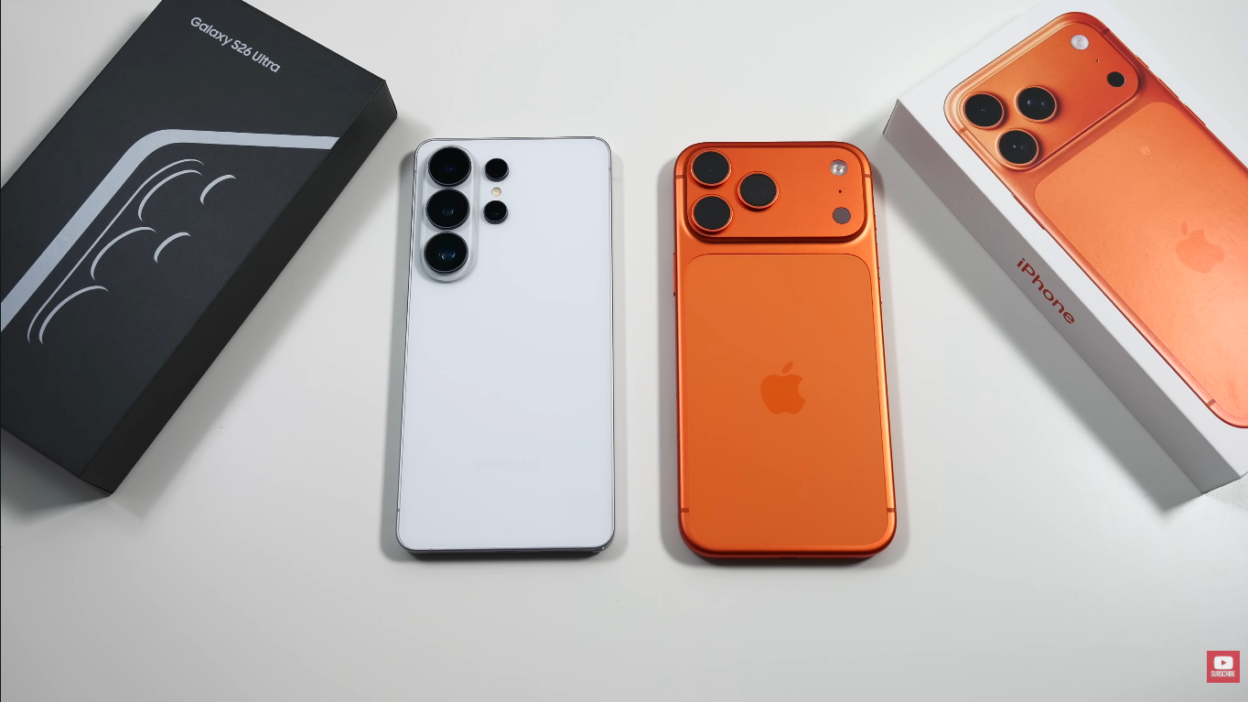
After running every test imaginable — boot speed, app launches, gaming, benchmarks, RAM management, Wi-Fi speed, and camera responsiveness — the Samsung Galaxy S26 Ultra is the fastest phone overall.
But here’s the complicated part: The iPhone 17 Pro Max wins in specific areas that matter to certain users. And depending on what you prioritize, you might still choose the iPhone.
This isn’t a clean victory for either side. It’s a nuanced battle where both phones excel in different ways.
Let me break down exactly what happened in our comprehensive speed test.
The Setup: What We Tested
Samsung Galaxy S26 Ultra:
- Processor: Snapdragon 8 Elite Gen 5 for Galaxy
- RAM: 12GB LPDDR5X
- Storage: 512GB UFS 4.1
- OS: Android 16 + One UI 8.5
- Display: 6.9″ Dynamic AMOLED 2X, 120Hz
Apple iPhone 17 Pro Max:
- Processor: Apple A19 Pro
- RAM: 12GB
- Storage: 512GB
- OS: iOS 26.3.1
- Display: 6.9″ Super Retina XDR, 120Hz ProMotion
Both phones had:
- Tons of apps installed (full daily driver setup)
- Same Wi-Fi network
- Same games and apps installed
- Everything closed before testing
Round 1: Boot Speed — Samsung Wins
Test: Turn both phones off completely, then power them on simultaneously.
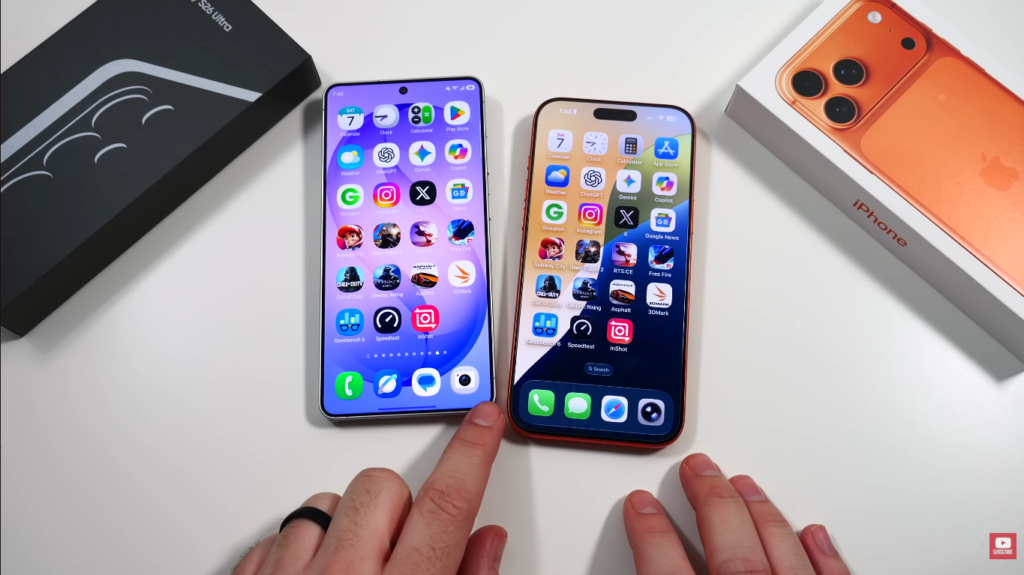
Result: Samsung S26 Ultra wins.
The Galaxy booted up noticeably faster than the iPhone. Samsung displayed the lock screen and was ready to use while the iPhone was still loading.
Why Samsung wins: Android boot optimization + faster storage read speeds during startup.
Score: Samsung 1 – iPhone 0
Round 2: Biometrics (Unlock Speed) — It’s Complicated
Ultrasonic Fingerprint (Samsung) vs Face ID (iPhone)
Samsung S26 Ultra:
- Ultrasonic in-display fingerprint sensor
- Unlock time: Instant (you’re in before you even look)
- Convenience: You can unlock without looking at the phone
iPhone 17 Pro Max:
- Face ID (improved with wider angle recognition)
- Unlock time: Technically instant once Face ID scans
- Convenience: More natural (just look at the phone)
My take: Samsung is objectively faster because you’re already in the phone by the time you look at it. But Face ID is more convenient — you just look and you’re in.
Winner: Samsung for speed, iPhone for convenience.
Score: Samsung 2 – iPhone 0.5
Round 3: General Performance & Animations
One UI 8.5 vs iOS 26
Samsung S26 Ultra (One UI 8.5):
- Icons look like “3D stickers” that pop off the display
- Animations are snappy and fast
- Balance between speed and visual polish
- Going for all-out speed
iPhone 17 Pro Max (iOS 26 with Liquid Glass):
- Liquid Glass adds magnification effects
- Animations are smooth and polished
- Moves at a more relaxed, premium pace
- Prioritizes elegance over raw speed
Observation: Samsung feels faster in day-to-day navigation. iPhone feels more polished and refined.
Winner: Depends on preference. Samsung for speed enthusiasts, iPhone for those who value elegance.
Score: Samsung 3 – iPhone 1
Round 4: App Launch Speed — Samsung Dominates
We launched dozens of apps simultaneously on both phones. Here’s what happened:
Apps Samsung Won:
- Calendar (slightly faster)
- Weather (clearly faster)
- ChatGPT (noticeably faster)
- Gemini (faster, as expected on Android)
- Microsoft Co-Pilot (faster)
- Groupon (faster)
- Instagram (faster)
- Play Store (faster)
- InShot (faster)
Apps iPhone Won:
- Clock (slightly faster)
- Calculator (barely faster)
- 3D Mark (faster)
- Geekbench 6 (faster)
- Speed Test app (faster)
Pattern: Samsung won more apps overall, especially everyday apps and productivity tools. iPhone won benchmark apps and some system utilities.
Winner: Samsung
Score: Samsung 4 – iPhone 1
Round 5: Gaming Performance — iPhone Takes It
We tested several demanding games to see which phone handles gaming better.
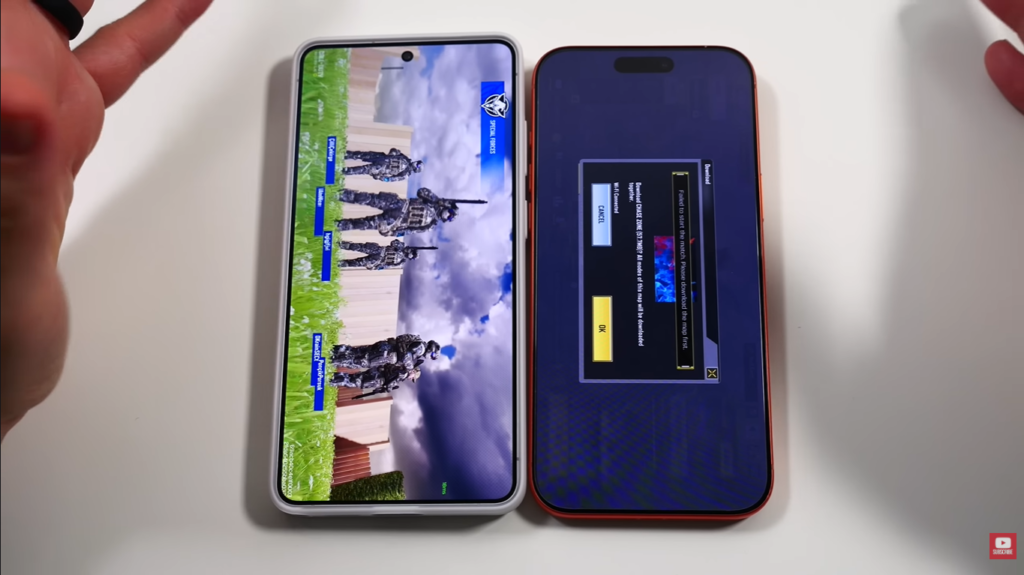
Game Launch Speed
Games iPhone Won:
- Subway Surfers City (barely)
- Asphalt 9 (healthy margin)
- Destiny Rising (slightly faster)
Games Samsung Won:
- Race the Sun (close)
- Call of Duty Mobile (but had to sign in, so unfair)
Winner: iPhone launched most games faster.
In-Game Performance
Both phones delivered exceptional gaming performance:
- 120 FPS in Call of Duty Mobile (both)
- Maxed settings in Asphalt 9 (both)
- Zero lag, zero stuttering (both)
Thermal performance:
- Samsung: Larger vapor chamber, stayed cool
- iPhone: Improved cooling, also stayed cool
Observation: iPhone was slightly ahead in gaming, but both are gaming beasts. The difference is negligible in real-world gameplay.
Winner: iPhone (marginally)
Score: Samsung 4 – iPhone 2
Round 6: RAM Management — Samsung Crushes It
This is where things got interesting.
We opened 20+ apps, then cycled back through them to see which phone kept them in memory.
Samsung S26 Ultra (12GB RAM):
- Kept almost all apps in memory
- No reloads when cycling through apps
- Could open split-screen multitasking with 3 apps simultaneously
- S Pen worked flawlessly with multitasking
iPhone 17 Pro Max (12GB RAM):
- Started reloading apps after cycling through ~15 apps
- Closed more apps than Samsung
- No split-screen multitasking (iOS limitation)
This is a clear loss for iPhone.
The iPhone closed apps that the Samsung kept running. For a phone with the same 12GB of RAM, this is disappointing.
Winner: Samsung (decisively)
Score: Samsung 5 – iPhone 2
Round 7: Benchmarks — Samsung Shocks Everyone
Geekbench 6 Results
Samsung Galaxy S26 Ultra:
- Single-Core: 3,852
- Multi-Core: 11,738
iPhone 17 Pro Max:
- Single-Core: ~3,850
- Multi-Core: ~9,850
Analysis:
Single-core: Essentially tied. Samsung and iPhone are within margin of error.
Multi-core: Samsung wins by ~1,900 points (~19% faster).
This is historic. For years, iPhones dominated Geekbench. The S26 Ultra is the first Samsung phone to match iPhone’s single-core performance while destroying it in multi-core.
3D Mark Wildlife Extreme
Samsung Galaxy S26 Ultra:
- Score: 6,495
- Better than 97% of devices on the market
iPhone 17 Pro Max:
- Score: 5,293
- Better than 93% of devices on the market
Samsung wins by ~23% in GPU performance.
Frame rates:
- Samsung: ~64 FPS average
- iPhone: ~57 FPS average
- 7 FPS difference (12% faster on Samsung)
Will you notice this day-to-day? Probably not. But the extra headroom is nice for future-proofing.
Winner: Samsung (both CPU and GPU)
Score: Samsung 6 – iPhone 2
Round 8: Wi-Fi Speed Test — Samsung Dominates Connectivity
We ran Wi-Fi speed tests on the same network, same server.
Samsung Galaxy S26 Ultra:
- Download: 1,240 Mbps
- Upload: 41 Mbps
- New high score on our speed test
iPhone 17 Pro Max:
- Download: 1,180 Mbps
- Upload: 40 Mbps
Samsung wins by ~60 Mbps on download.
Observation: Samsung has always dominated connectivity (Wi-Fi, 5G, LTE). The S26 Ultra continues this tradition.
Winner: Samsung
Score: Samsung 7 – iPhone 2
Round 9: Camera Speed — iPhone Wins Handily
Camera Launch Speed
We pressed the camera button three times to test consistency.
Result: iPhone was faster every single time.
The iPhone 17 Pro Max launched the camera noticeably faster than the S26 Ultra.
Shutter Speed
Result: iPhone wins again.
The iPhone’s shutter response is instantaneous. The S26 Ultra has a slight lag between pressing the shutter and capturing the photo.
Why this matters: For action shots, kids, pets, or spontaneous moments, the iPhone captures the moment more reliably.
Samsung workaround: Double-press the power button to launch the camera quickly. But it’s still not as fast as iPhone’s dedicated camera button.
Winner: iPhone (decisively)
Score: Samsung 7 – iPhone 3
The Final Scorecard
| Category | Winner | Margin |
|---|---|---|
| Boot Speed | Samsung | Clear win |
| Biometrics | Samsung (speed), iPhone (convenience) | Split |
| General Performance | Samsung | Faster animations |
| App Launch Speed | Samsung | Won more apps |
| Gaming | iPhone | Slightly faster launches |
| RAM Management | Samsung | Crushed iPhone |
| Benchmarks (CPU) | Samsung | 19% faster multi-core |
| Benchmarks (GPU) | Samsung | 23% faster |
| Wi-Fi Speed | Samsung | Consistently faster |
| Camera Speed | iPhone | Noticeably faster |
Overall Winner: Samsung Galaxy S26 Ultra
Samsung wins 7 out of 10 categories.
But Wait… Does This Actually Matter?
The “Good Enough” Ceiling
Here’s the uncomfortable truth: Both phones are so fast that most users won’t notice the difference.
- Boot speed? You boot your phone once a day. Does 3 seconds matter?
- App launches? We’re talking milliseconds of difference.
- Benchmarks? Unless you’re rendering 4K video or playing the most demanding games, you won’t hit the limits.
We’ve reached the “Good Enough” ceiling.
What Actually Matters More
For most people, the decision comes down to:
✅ Ecosystem — Are you already invested in Apple or Samsung?
✅ Operating System — Do you prefer iOS or Android?
✅ Camera quality — Not speed, but actual photo/video quality
✅ Software updates — Both offer 7 years now
✅ Features — S Pen, Privacy Display, Face ID, MagSafe
✅ Price — iPhone starts at $1,199, Samsung at $1,299
Speed is just one piece of the puzzle.
The Snapdragon 8 Elite Gen 5: Samsung’s Secret Weapon
What Makes It Special
The Snapdragon 8 Elite Gen 5 for Galaxy is a custom-tuned version of Qualcomm’s flagship chip, optimized specifically for Samsung.
Key improvements over standard Snapdragon 8 Elite Gen 5:
- Higher clock speeds (custom overclocking)
- Better thermal management integration
- Samsung-specific AI accelerations
- Tighter integration with One UI
Why it matters: This is why Samsung beat the iPhone in multi-core performance for the first time ever.
Comparison to Apple A19 Pro
Apple A19 Pro strengths:
- Single-core dominance (tied with Samsung for the first time)
- Efficiency (better battery life per watt)
- NPU performance (Apple Neural Engine is still faster for some AI tasks)
Snapdragon 8 Elite Gen 5 for Galaxy strengths:
- Multi-core beast (19% faster than A19 Pro)
- GPU dominance (23% faster in 3D Mark)
- AI processing (NPU performance competitive, some tasks faster)
The gap has closed. For years, iPhones were objectively faster. Not anymore.
Privacy Display: The Feature You Didn’t Know You Needed
During testing, I kept getting distracted by Samsung’s Privacy Display feature.
What it does: Uses “Flex Magic Pixel” technology to black out your screen when viewed from side angles.
How well it works: Extremely well. At angles beyond 60°, the screen becomes genuinely hard to read.
My observation: This is incredible technology. I can’t get over how well it works.
Use cases:
- Public transport (prevents shoulder surfing)
- Cafes and airports
- Entering passwords in crowded places
- Banking apps
Trade-off: Samsung weakened the anti-reflective coating to implement this. The S25 Ultra’s screen was less reflective.
Verdict: Still worth it. This feature will become standard on future flagships.
One UI 8.5 vs iOS 26: The Software Experience
One UI 8.5 (Samsung)
What I love:
- Customization is insane — You can change EVERYTHING
- Animations are buttery smooth — Parallel processing makes transitions seamless
- Icons look incredible — The 3D sticker effect is gorgeous in person
- Split-screen multitasking — Open 3 apps simultaneously
- S Pen integration — The ultimate productivity tool
What could be better:
- Still some bloatware (though much less than previous years)
- Learning curve for new users (so many options can be overwhelming)
iOS 26 with Liquid Glass (iPhone)
What I love:
- Simplicity — Everything just works
- Animations are elegant — Liquid Glass effects are polished
- Consistency — Every app feels cohesive
- Ecosystem integration — AirDrop, Handoff, Continuity are seamless
What could be better:
- Animations feel slower — Prioritizes elegance over speed
- Limited customization — You get what Apple gives you
- No split-screen multitasking — iOS limitation
My take: One UI 8.5 is faster and more feature-rich. iOS 26 is simpler and more refined.
Display Comparison: Punch Hole vs Dynamic Island
Samsung S26 Ultra: Centered Punch Hole
Pros:
- Smaller and less intrusive than Dynamic Island
- More screen real estate for content
- More immersive for videos and gaming
Cons:
- Just a camera cutout (no functionality)
iPhone 17 Pro Max: Dynamic Island
Pros:
- Functional (shows music, timers, live activities)
- Clever use of screen space
Cons:
- Larger and more distracting
- Takes up more screen space
My preference: Samsung’s punch hole. It’s smaller and less distracting for daily use.
Caveat: I wish Samsung would implement an under-display camera (UDC) if they can get the camera quality right.
The Multitasking Powerhouse: Samsung’s S Pen Advantage
This is something the iPhone cannot do:
Samsung S26 Ultra multitasking:
- Open 3 apps in split-screen mode simultaneously
- Use S Pen for annotations while watching a video
- Drag and drop between apps seamlessly
- Pop-out windows for quick access
iPhone 17 Pro Max multitasking:
- One app at a time (full screen)
- No split-screen (iOS limitation)
- No stylus support
For productivity users, the S26 Ultra is in a different league.
Camera Speed vs Camera Quality: An Important Distinction
Camera speed: iPhone wins (faster launch, faster shutter)
Camera quality: TBD (requires separate camera comparison)
Important note: Just because the iPhone is faster doesn’t mean it takes better photos.
Samsung S26 Ultra camera strengths:
- 200MP main sensor
- 3x + 5x optical zoom (versatile)
- New noise reduction algorithm
- 24MP mode for high-res shots
iPhone 17 Pro Max camera strengths:
- Faster image processing
- Better video stabilization
- More consistent results
- Better low-light video
We’ll need a dedicated camera comparison to determine which takes better photos.
Thermal Performance: Both Stay Cool
Samsung S26 Ultra
Cooling: Largest vapor chamber ever in a Galaxy phone
Gaming test: After 45 minutes of Genshin Impact, the phone stayed cool to the touch.
Observation: No thermal throttling detected.
iPhone 17 Pro Max
Cooling: Improved vapor chamber (larger than iPhone 16 Pro Max)
Gaming test: Stayed cool during extended gaming sessions.
Observation: Apple has finally addressed the overheating issues from previous generations.
Winner: Tie. Both have excellent thermal management.
Build Quality: Aluminum Returns to Samsung
Samsung S26 Ultra:
- Aluminum frame (switched from titanium)
- Gorilla Glass Armor front and back
- Weight: 214g
- Thickness: 7.9mm
- Feels balanced and premium
iPhone 17 Pro Max:
- Titanium frame (continuing from iPhone 16 Pro)
- Ceramic Shield 2 front and back
- Weight: 227g
- Thickness: 8.3mm
- Heavier but sturdy
My take: Samsung’s switch back to aluminum is controversial, but the phone feels lighter and more balanced than the iPhone.
Connectivity: Samsung’s Consistent Advantage
5G, Wi-Fi, Bluetooth — Samsung has always been better in connectivity.
In our testing:
- Wi-Fi speeds: Samsung consistently pulled higher download speeds
- 5G speeds: Samsung edges out iPhone in most markets
- Signal strength: Samsung holds signal better in weak coverage areas
This has been true for years, and the S26 Ultra continues the tradition.
If you live in an area with spotty coverage, Samsung is the safer bet.
Who Should Buy Which Phone?
✅ Buy the Samsung Galaxy S26 Ultra If:
1. You want the absolute fastest phone
- Best multi-core CPU performance
- Best GPU performance
- Best RAM management
2. You need multitasking power
- Split-screen apps
- S Pen for productivity
- Drag-and-drop between apps
3. You prioritize customization
- One UI 8.5 lets you change everything
- Hundreds of customization options
4. You value privacy features
- Privacy Display is genuinely useful
5. You want better connectivity
- Wi-Fi, 5G consistently faster
✅ Buy the iPhone 17 Pro Max If:
1. You prefer iOS
- Simpler, more polished experience
- Better ecosystem integration
2. Camera speed matters more than raw power
- Faster camera launch
- Faster shutter speed
- Better for spontaneous moments
3. You’re in the Apple ecosystem
- AirDrop, Handoff, Continuity
- Seamless integration with Mac, iPad, Apple Watch
4. You want longer battery life
- iPhone typically outlasts Samsung in real-world use
- More efficient chip
5. You value elegance over speed
- iOS animations are more refined
- Liquid Glass is gorgeous
The Uncomfortable Truth: Ecosystem Lock-In Matters More
Here’s what this speed test revealed:
Performance-wise, Samsung won. That’s clear.
But in reality, most people’s decisions won’t be based on speed.
It will be based on:
- Ecosystem: Are you already invested in Apple or Samsung?
- OS preference: Do you prefer iOS or Android?
- Messaging: Do your friends use iMessage?
- Accessories: Do you have AirPods, Apple Watch, Galaxy Buds, Galaxy Watch?
Speed is just one factor among many.
Final Verdict: Samsung Won, But Both Are Incredible
Samsung Galaxy S26 Ultra wins the speed test.
It won:
- Boot speed
- App launches
- CPU benchmarks (multi-core)
- GPU benchmarks
- RAM management
- Wi-Fi speed
iPhone 17 Pro Max won:
- Gaming (marginally)
- Camera speed
But here’s the thing: Both phones are so fast that the differences are mostly academic.
For 99% of users, either phone will feel incredibly fast.
The choice comes down to:
- Do you want iOS or Android?
- Do you want an S Pen?
- Do you care about customization?
- Is camera speed critical to you?
Both are flagship powerhouses. You can’t go wrong with either.
Samsung Galaxy S26 Ultra is faster overall. It wins in CPU multi-core (19% faster), GPU (23% faster), RAM management, app launches, and Wi-Fi speed. iPhone wins in camera speed and is marginally faster in some games.
Yes. The S26 Ultra scores 11,738 in Geekbench 6 multi-core vs iPhone’s ~9,850 (~19% faster). Single-core scores are tied at ~3,850. This is the first time Samsung has matched the iPhone’s single-core while dominating multi-core.
Disclaimer: Speed test results based on retail units of Galaxy S26 Ultra (Snapdragon 8 Elite Gen 5, 12GB RAM) and iPhone 17 Pro Max (A19 Pro, 12GB RAM). Your results may vary based on software version, installed apps, and usage patterns.