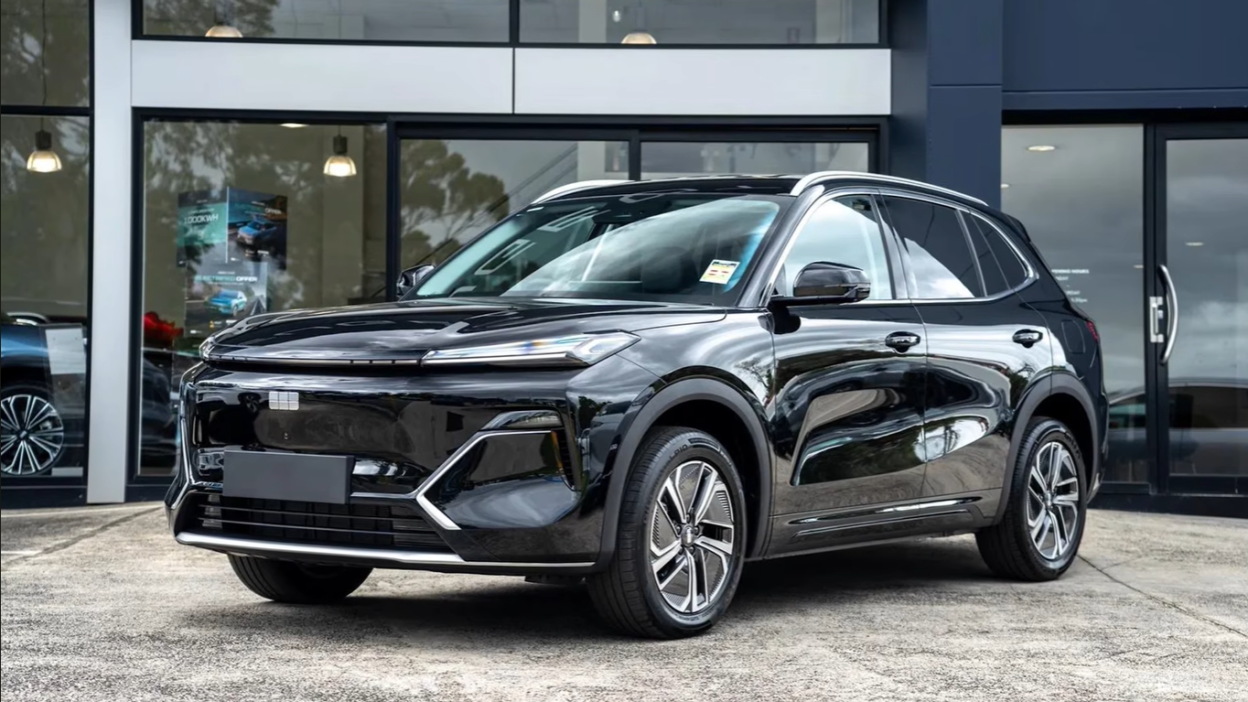
The Geely Starray EM-i has arrived in Australia — and it is shaking up the plug-in hybrid SUV market in a way few expected from a brand most Australians hadn’t heard of two years ago.
Starting at just $37,490 plus on-road costs, the Starray undercuts the Toyota RAV4 Hybrid by $5,000, the BYD Sealion 6 by $5,500, and virtually every other PHEV family SUV in the country. But cheap pricing alone doesn’t make a good car.
This is a detailed, honest review of the Geely Starray EM-i after real-world driving in Australia — including a major software update that has genuinely transformed the ownership experience. We’ll cover everything: design, interior, technology, ride, performance, EV range, charging, fuel efficiency, and the key things you need to know before you buy one.
Let’s get into it.
Geely Starray EM-i Australia — Quick Verdict
The Geely Starray EM-i is a remarkably well-rounded plug-in hybrid SUV for the money. The pricing is aggressive, the spec list is generous, the interior is genuinely impressive for the price, and the EV range of 83km will cover most Australian daily commutes on electric power alone. A recent over-the-air software update has also resolved the biggest complaints from early reviewers — making the car significantly more liveable day to day.
It is not perfect. The ride is on the soft side and can feel unsettled on country roads. There is no all-wheel drive option. No towing rating at all. And no spare tyre. But if you are looking for a comfortable, tech-packed urban and suburban family SUV with strong EV range and an incredibly competitive price tag, the Starray EM-i is one of the smartest buys in the Australian market right now.
Geely Starray EM-i Australia — Pricing and Variants
Two variants are available in Australia:
- Starray EM-i Complete: $37,490 plus on-road costs — Australia’s second cheapest PHEV
- Starray EM-i Inspire: $39,990 plus on-road costs — the top-spec flagship grade
To put that in context: the Toyota RAV4 GX Hybrid starts at $42,260 plus on-roads. The BYD Sealion 6 starts at $42,990. The MG HS Super Hybrid kicks off at $50,990 drive-away. The Geely Starray Complete undercuts them all by thousands of dollars while offering comparable or better specification on paper.
The only PHEV in Australia that currently undercuts it is the Chery Tiggo 7 Super Hybrid at $39,990 drive-away — which is a different formula with a smaller package.
Warranty: 7 years / unlimited kilometres on the vehicle. 8 years / unlimited kilometres on the main battery. Up to 7 years of complimentary roadside assistance if serviced at a Geely dealer. These are among the most comprehensive warranty terms offered by any brand in Australia.
What’s the Difference Between the Complete and the Inspire?
Starray EM-i Complete — Standard Equipment
- 18-inch alloy wheels
- LED headlights, taillights, and daytime running lights with auto high-beam
- Keyless entry and start
- Heated power folding exterior mirrors
- 10.2-inch digital instrument cluster
- 15.4-inch touchscreen with Geely’s Flyme operating system
- Wireless Apple CarPlay and Android Auto (Android Auto added via OTA update in early 2026)
- Built-in satellite navigation
- Digital radio
- Six-speaker sound system
- Electric front seats with heating
- G-Lux synthetic leather upholstery
- 360-degree surround-view camera
- Rear parking sensors
- Full ADAS safety suite
- 6kW vehicle-to-load and vehicle-to-vehicle capability
- Geely Connected Services with 4G connectivity
Starray EM-i Inspire — Additional Equipment over Complete
- 19-inch alloy wheels
- Panoramic sunroof with power glass opening and power sunshade
- Power tailgate (electric boot)
- Ventilated front seats
- Driver’s seat memory function
- 13.4-inch head-up display
- 15W wireless phone charger
- 16-speaker Flyme sound system with headrest speakers
- 256-colour ambient lighting
- Second row centre armrest with cup holders
- Front parking sensors
- Ivory White interior colour option (no extra cost)
The Inspire adds approximately $2,500 to the purchase price but the list of additions is extensive. For most buyers, the Inspire represents excellent value over the Complete — particularly the panoramic sunroof, ventilated seats, wireless charger, and the 16-speaker audio system.
Design — Smooth, Modern and Distinctly Non-Threatening
The Geely Starray EM-i is a handsome family SUV. At approximately 4.7 metres long on a 2.7 metre wheelbase, it is a proper mid-size SUV with smooth, contemporary lines and some well-placed detail edges that give it visual interest without being loud or polarising.
The front features Geely’s Milky Way ripple daytime running light design — a distinctive visual signature that makes it recognisable in traffic. The rear light bar looks clean and modern. The overall silhouette is conventional enough to appeal broadly while being distinctive enough to stand out from the crowd.
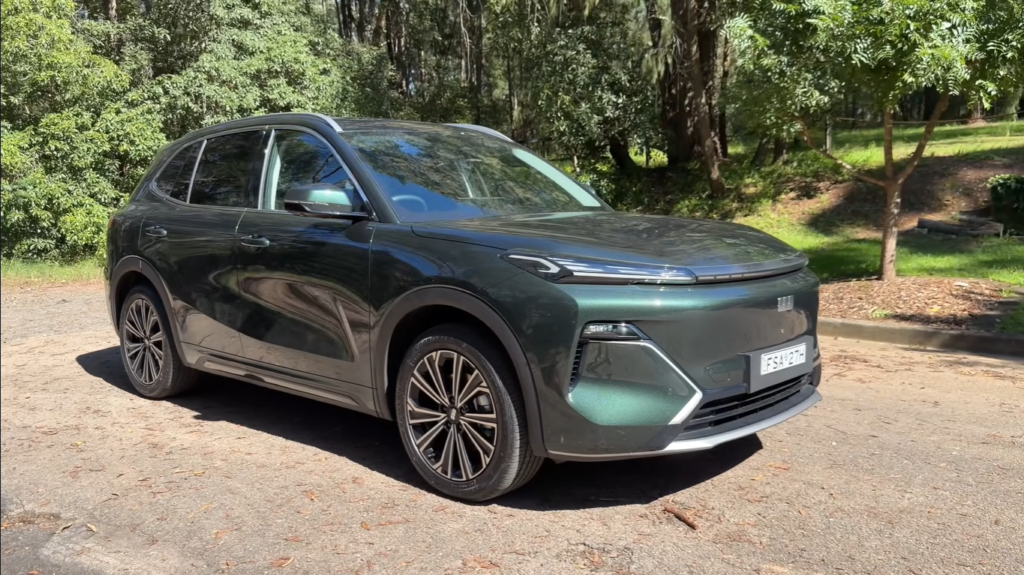
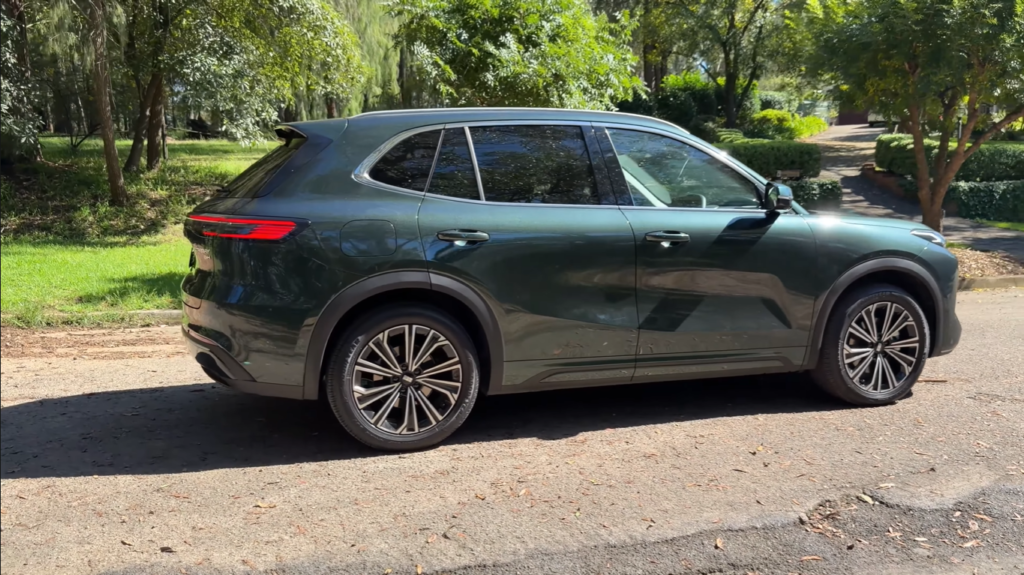
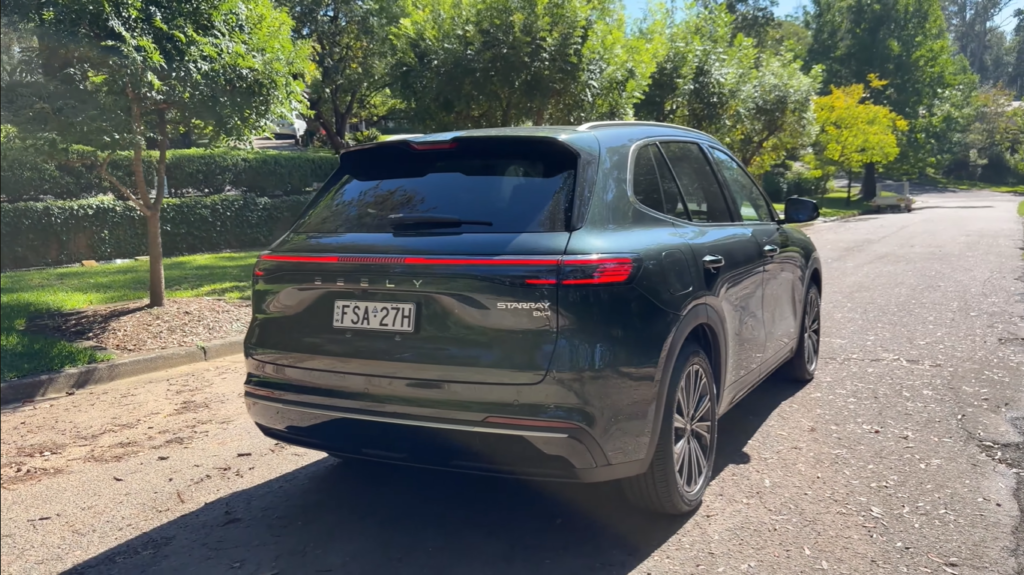
Ground clearance is 172mm — adequate for suburban and light rural driving but not suited to serious off-road use. Regular door handles are fitted, which is a practical bonus compared to the flush pop-out handles that have become fashionable on some electric rivals.
Available colours are Alpine White (standard, no cost), Polar Black, Jungle Green, Glacier Blue, Volcanic Grey, and Cloudveil Silver — the last five at a $600 premium. The Jungle Green tested here is a genuinely beautiful shade that photographs less impressively than it looks in person.
The Game-Changing Software Update — What Changed and Why It Matters
This is one of the most important sections of this review, particularly if you are looking at early examples of the Starray EM-i or reading older reviews.
Geely has issued a significant over-the-air software update for the Starray EM-i that addresses the single biggest criticism levelled at the car since its Australian launch: the driver assistance and safety systems were far too interventional, far too difficult to customise, and genuinely annoying to live with on a daily basis.
The update delivers two major improvements:
1. Android Auto Added
The Starray launched in Australia with wireless Apple CarPlay but no Android Auto. That gap has been closed. Both Apple CarPlay and Android Auto are now available wirelessly on all variants. Given that roughly half of Australian smartphone users are on Android, this was a meaningful omission at launch and a welcome fix.
2. Drive Setup System — Configurable Safety Technology
The new Drive Setup system allows drivers to customise their safety and driver assistance settings quickly and intuitively. From a dedicated button on the steering wheel, you can jump directly into a configuration screen and adjust:
- Lane keep assist — on, off, or alert-only
- Speed sign recognition — chime on or off, icon only
- Driver monitoring camera — enabled or disabled
- Emergency lane keep — on or off
- Driver fatigue warning — on or off
- Cruise control behaviour on corners
- Battery hold and regenerative braking settings
A Favourites button on the steering wheel allows you to save your preferred configuration and load it instantly on startup. Before the update, accessing these settings required navigating deep into the touchscreen menus while driving — which was frustrating and potentially unsafe. Now it takes seconds.
The difference in the day-to-day driving experience is substantial. The car no longer fights you. The steering wheel no longer pushes back against lane changes. The constant chiming from the speed sign recognition is gone if you prefer it that way. The driver monitoring camera, which previously alarmed incessantly, can be turned off cleanly.
This software update transforms the Starray EM-i from a car that required patience into one that is genuinely enjoyable to live with.
Note on the update process: The OTA update requires a Wi-Fi connection to download. Some vehicles may not connect successfully over mobile data. Connecting to a home Wi-Fi network resolves this. Contact your Geely dealer if you experience difficulties.
Interior — Impressive for the Price
Step inside the Starray EM-i and the first impression is genuinely positive. For a vehicle starting under $40,000, the cabin feels well-finished, well-specified, and thoughtfully laid out.
Front Seats and Dashboard
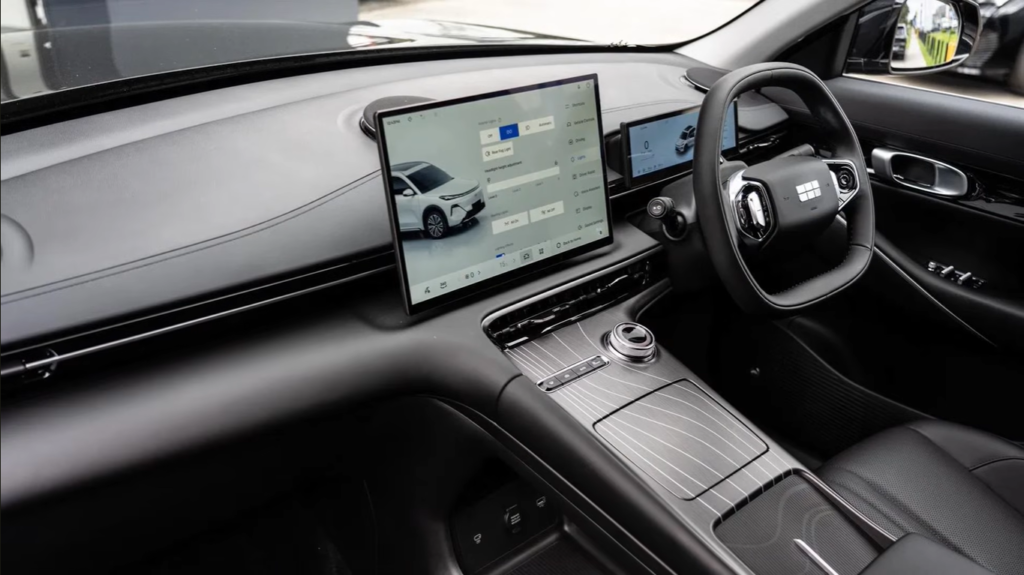
The dashboard is clean and modern with a dual-screen setup: a 10.2-inch digital instrument cluster and the large 15.4-inch central touchscreen. The Inspire adds a 13.4-inch head-up display projected onto the windscreen — a feature more commonly associated with vehicles costing significantly more.
Seat comfort is excellent. The front seats are supportive and well-padded. Heated seats are standard across both grades. The Inspire adds ventilated front seats and memory settings for the driver’s position. The synthetic leather upholstery (G-Lux trim) is convincing in look and feel.
The steering wheel is slightly unusual in its shape — with a thicker lower section than most buyers will be expecting — but it is easy to adapt to. The controls on the steering wheel are minimal and clean.
Infotainment and Technology
The 15.4-inch Flyme touchscreen is straightforward to use for everyday functions. Apple CarPlay and Android Auto (now both available wirelessly) take over the screen cleanly when connected. Built-in apps include Spotify, satellite navigation, radio, and energy consumption monitoring.
A quick-access drop-down menu provides one-touch shortcuts for common functions — opening the boot, activating seat ventilation, unlocking the fuel flap, and switching between drive modes. Scheduled charging and remote vehicle controls are available through the Geely Connected Services app on your phone.
Vehicle-to-load (V2L) and vehicle-to-vehicle (V2V) charging capability at up to 6kW is standard across both grades — a genuinely useful feature for camping, work sites, or emergency power situations.
The 16-speaker Flyme audio system in the Inspire is very good. The headrest speakers in the rear seats allow phone calls to remain private from other passengers — a feature usually found in premium European vehicles.
Rear Seats
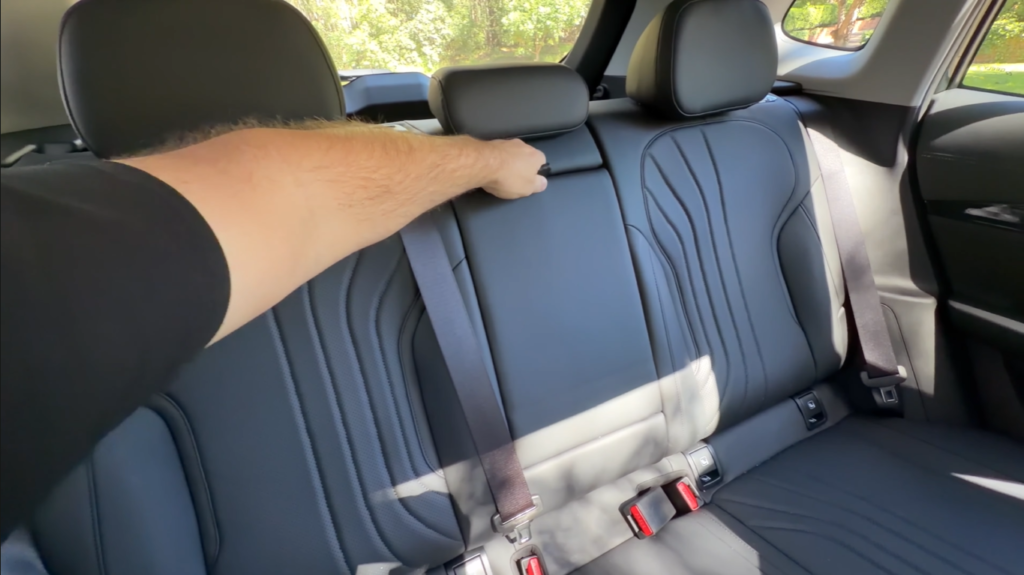
The rear seat space is one of the Starray’s genuine strengths. For a six-foot tall adult seated behind a six-foot tall driver’s position, there is abundant leg room, foot room, and headroom. This is among the most spacious rear seat experiences in the mid-size SUV class.
Standard rear seat features include:
- Directional air vents
- USB-C and USB-A charge ports
- Map pockets on both front seatbacks
- Bottle holders in the doors
- Overhead grab handles
- Flat floor for extra foot space
- ISOFIX points in both window seats and three top tether points
- Flip-down armrest with cup holders (Inspire only)
The rear seatbacks recline but do not have independent adjustment for each passenger — a minor compromise for some, but the default reclined angle is comfortable for long journeys.
Boot and Storage
Boot capacity is 428 litres with rear seats in place, expanding to 528 litres with the boot floor in its lowest position, and over 2,000 litres with the rear seats folded. These figures are competitive for the class.
Interior storage is generous throughout — a wireless charging pad and extra phone holder in the centre console, a large under-console storage bin with USB ports and 12V power, door bottle holders front and rear, a proper glove box, and a dedicated compartment for charging cables under the boot floor.
Important note: No spare wheel. The Starray EM-i comes with a tyre repair kit only across both grades. If driving in remote areas or regional Australia, this is a meaningful consideration. Third-party space-saver spare kits are available through suppliers such as Road Hero (roadhero.com.au) and are worth investigating before taking the vehicle on longer trips.
Powertrain — Geely EM-i Super Hybrid System
The Geely Starray EM-i uses what Geely calls the EM-i Super Hybrid system — a series-parallel plug-in hybrid setup combining:
- Engine: 1.5-litre naturally aspirated four-cylinder petrol — 73kW / 125Nm
- Electric motor: 160kW / 262Nm (front axle)
- Transmission: Single-speed (11-in-1 hybrid unit)
- Drive: Front-wheel drive only — no all-wheel drive available
- Combined output: 193kW
- 0–100km/h: 8.0 seconds
- Top speed: 170km/h
- Battery: 18.4kWh lithium iron phosphate (LFP), 17kWh usable
- Fuel tank: 51 litres (premium unleaded 95 RON required)
The system operates in a series hybrid mode for most everyday driving — the electric motor does the driving while the petrol engine acts as a generator to maintain battery charge when needed. This results in a smooth, quiet driving experience in normal conditions. The petrol engine does become audible at higher speeds or under hard acceleration, occasionally spinning at high revs — which can feel slightly coarse — but this is characteristic of the system and not unique to the Starray.
Three driving modes are available:
- Pure EV mode: Electric only — uses battery charge exclusively. Ideal for daily commuting when fully charged.
- Hybrid mode: The car manages the balance between petrol and electric automatically. Best for mixed and highway driving.
- Power mode: Combines petrol and electric for maximum output. 193kW combined — punchy enough for confident overtaking.
Performance is adequate rather than exciting. 8 seconds to 100km/h is respectable for a family SUV. When you need it — for overtaking on highways or merging onto freeways — the electric motor’s instant torque delivery gives a satisfying surge of acceleration. This is not a sporting car, but it is never sluggish.
Driving Experience — Comfortable, Soft and City-Friendly
The Starray EM-i drives like a car designed primarily for urban and suburban life — and that is not a criticism, given that is exactly how most Australian family SUVs are used.
The ride is soft and supple. On smooth city roads and suburban streets it is genuinely comfortable — the suspension absorbs small bumps and imperfections well and rear seat passengers in particular will appreciate the cushioned ride quality.
On country roads or surfaces with larger undulations, the suspension can feel underdamped. The body moves around more than ideal over big bumps, and the soft springs take time to settle. Families with children prone to car sickness should take note — the soft ride character, combined with some body movement on winding roads, could be a factor.
Steering is light, predictable, and easy to manage — well-suited to city driving and tight car parks. It does not provide much feedback, but that is typical of this class. The one dynamic challenge is managing the 193kW of power through front-wheel drive only — in wet conditions, the front tyres can scrabble for traction when cornering and accelerating simultaneously. Again, typical of front-wheel drive PHEVs at this power level.
Braking takes a little adaptation. The regenerative braking system can make the pedal feel inconsistent — particularly in lower regen settings where the transition from regenerative to mechanical braking is noticeable. Setting regen to high makes the experience more predictable and also maximises energy recovery.
The adaptive cruise control system was noted as slowing down excessively on corners in pre-update software. This behaviour is improved following the software update, though it can still be conservative on tighter bends. Minor, but worth knowing.
Overall driving character: comfortable, easy, and well-suited to daily commuting and family life. Not the car to choose if driving dynamics are important to you — for that, look at the Mazda CX-60 PHEV or the Kia Sportage PHEV. But for the price and the use case, it does the job well.
EV Range and Charging — Where the Starray Really Delivers
This is where the Geely Starray EM-i makes its strongest argument.
EV Range
The 18.4kWh LFP battery provides a claimed 83km of pure electric driving range on the WLTP cycle — and real-world testing has confirmed this figure is achievable under normal conditions. From a full charge, 83km of EV driving was recorded in mixed suburban use.
For the majority of Australian commuters, 83km will cover a full working day of driving without using a single drop of petrol — commute in, commute home, maybe some errands in between. Plug in overnight and do it again. The Starray genuinely works as an electric car for daily life if you have access to home charging.
Fuel Efficiency Beyond EV Range
When the battery is depleted and the car runs in hybrid mode without an overnight charge, fuel consumption sits at approximately 5.0–5.5L/100km at highway speeds — a very respectable figure for a 193kW SUV. In lighter mixed driving, consumption can be lower.
The claimed combined range — full battery plus full tank — is 943km according to Geely. Real-world results will vary, but the combination of 83km EV range and strong hybrid efficiency makes the Starray a genuine long-distance touring option as well as a daily commuter.
Charging Specifications
- AC charging (home / public Level 2): 6.6kW maximum — a full charge from empty takes approximately 3 hours
- DC fast charging: 30kW — charges from 30% to 80% in approximately 20 minutes
- Vehicle-to-load (V2L): Up to 6kW — power external devices, appliances, or other EVs from the car’s battery
- Vehicle-to-vehicle (V2V): Up to 6kW — charge another compatible electric vehicle directly
The DC fast charging at 30kW is not the fastest in the PHEV segment, but the availability of DC charging at this price point is a genuine bonus. Most PHEVs at this price cap at AC charging only.
Charge port location: driver’s side rear. Petrol filler: passenger side rear.
Safety and Driver Assistance
The Geely Starray EM-i comes with a comprehensive ADAS suite across both grades:
- Autonomous emergency braking with pedestrian, cyclist, and vehicle detection
- Adaptive cruise control with stop-and-go
- Lane keep assist and lane centring
- Blind spot monitoring
- Rear cross-traffic alert
- Speed sign recognition
- Driver monitoring camera
- Rear automatic emergency braking
- 360-degree surround-view camera
- Front and rear parking sensors (front sensors on Inspire only)
The post-update Drive Setup system makes all of these systems configurable to your preference. The automatic emergency braking system remains active regardless of other settings — which is the right call and worth leaving on. Everything else is adjustable.
Key Competitors — How the Starray Stacks Up
BYD Sealion 5 — From $36,000 drive-away
The most budget-friendly comparison point. The Sealion 5 is a pure electric SUV with good space and practicality at a competitive price. For buyers who want the cheapest possible entry into electrified motoring with good everyday usability, it is worth considering. The interior and design feel a generation older than the Starray, and it lacks the long-range flexibility of a PHEV. But the price is compelling.
Chery Tiggo 7 Super Hybrid — From $39,990 drive-away
The only PHEV currently cheaper than the Starray on a drive-away basis. The Tiggo 7 has a more old-school interior feel and is smaller in overall dimensions. The Tiggo 8 is a better proposition for those who need three rows of seats. For a two-row PHEV SUV on a tight budget, the Tiggo 7 is the main price rival to the Starray.
GWM Haval H6 PHEV — From $44,990 drive-away
The H6 PHEV is more expensive than the Starray but offers all-wheel drive variants, which the Geely does not. For buyers who need AWD — particularly in regional or rural Australia — the H6 is worth a look. The local ride and handling tune for the AWD variant is well-regarded.
Toyota RAV4 Hybrid — From $42,260 plus on-roads
The established benchmark. The RAV4 Hybrid is not a plug-in, which limits its EV capability compared to the Starray. It does offer all-wheel drive as standard on most grades, stronger residual values, and the unmatched reliability reputation of Toyota. It is also $5,000 more expensive before on-roads. A fair comparison depends heavily on whether EV range matters to your daily routine.
What We Like and What Could Be Better
What we like:
- Outstanding value for money — the specification at this price point is genuinely hard to match
- 83km real-world EV range is excellent for a PHEV at this price
- DC fast charging included at sub-$40,000 pricing
- V2L and V2V capability standard across both grades
- Rear seat space is class-leading for a five-seat mid-size SUV
- Software update resolved the biggest early criticism convincingly
- 7-year vehicle warranty and 8-year battery warranty
- Wireless Apple CarPlay and Android Auto now both available
- 16-speaker audio system in the Inspire is genuinely good
- Comfortable, easy urban ride quality
What could be better:
- No spare wheel — tyre repair kit only across both grades
- No all-wheel drive option at any price point
- No towing rating — cannot tow anything
- Ride is too soft for country road driving — body movement needs tightening
- Front tyre scrabble under hard acceleration in the wet — front-wheel drive limitation
- No steering wheel heater
- No single-zone or dual-zone climate separation between driver and passenger
- Petrol engine can be intrusive at high revs in some situations
- The OTA update process requires home Wi-Fi — the SIM-based update process is unreliable
Final Verdict — Geely Starray EM-i Australia
The Geely Starray EM-i is one of the most genuinely impressive value propositions in the Australian new car market right now. At $37,490 plus on-roads, it offers a level of technology, space, and electric driving capability that would have cost $60,000 just a few years ago.
The significant software update — adding Android Auto and the configurable Drive Setup system — has addressed the most legitimate criticisms of the original launch car and made the Starray a more confident recommendation.
It is not the last word in driving dynamics, it will not tow anything, and the lack of a spare wheel needs to be addressed before heading into regional Australia. But for a family looking for an affordable, comfortable, tech-rich plug-in hybrid SUV that will genuinely run on electric power for most daily driving — the Geely Starray EM-i is one of the smartest choices in the segment.
Rating: 8 / 10
- ✅ Outstanding value for money in the PHEV segment
- ✅ 83km real-world EV range — commute-friendly
- ✅ Generous standard equipment at both grade levels
- ✅ Excellent rear seat and interior space
- ✅ Software update transformed the daily driving experience
- ✅ DC fast charging and V2L standard across both grades
- ✅ 7-year vehicle / 8-year battery warranty
- ❌ No spare wheel
- ❌ No towing rating
- ❌ No all-wheel drive option
- ❌ Ride too soft for enthusiastic country road driving


