The legend faces its fiercest challenger yet—here’s everything you need to know
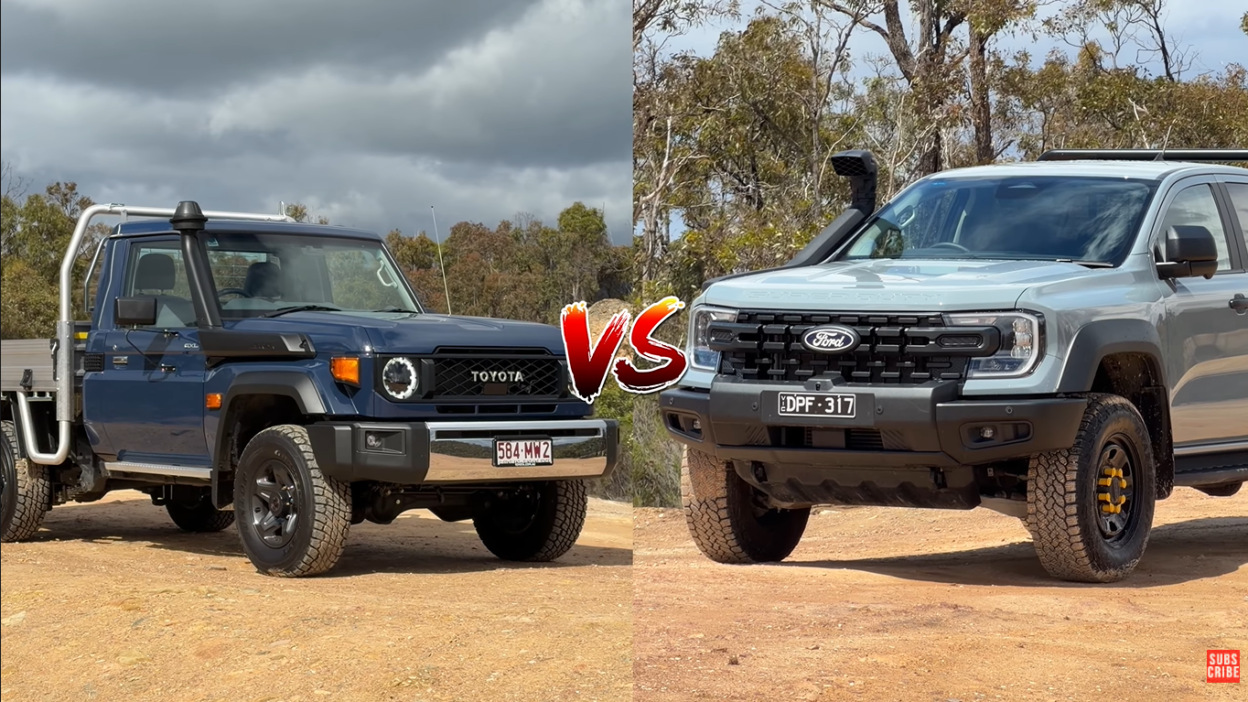
For decades, the Toyota Land Cruiser 70 series has reigned supreme in the heavy-duty workhorse segment. It’s been the default choice for miners, farmers, adventurers, and anyone who needs a vehicle that simply refuses to die. But Ford has finally thrown down the gauntlet with the all-new Ranger Super Duty—a purpose-built beast designed specifically to dethrone the king.
We put both vehicles through the most comprehensive test yet: pricing comparison, interior analysis, hardcore off-road torture testing, and real-world driving evaluation. The results? Absolutely mind-blowing. Here’s everything you need to know before spending your hard-earned money.
The Price Battle: Dinosaur vs Modern Marvel
Toyota Land Cruiser 79 Series Pricing
Let’s address the elephant in the room: the Land Cruiser 70 series pricing has been nothing short of horrendous. You’re essentially paying luxury car money for a vehicle that’s remained largely unchanged for 40 years.
LC79 Single Cab Pricing (Australian Market):
- Workmate: $89,000 drive away
- GXL: $93,000 on the road
- Dual Cab: Add just $2,000 (making it the obvious choice unless payload is critical)
The silver lining? It comes standard with a tray, and you still get to experience the analog charm of twisting a key to start it. Some call it outdated; purists call it character.
Ford Ranger Super Duty Pricing
Ford isn’t playing around with pricing either, positioning the Super Duty as a premium offering.
Ranger Super Duty Pricing:
- Single Cab (base trim only): $97,680 drive away
- Note: Add $6,000 for a tray as it doesn’t come standard
- Dual Cab: Approximately $103,000 drive away
That’s roughly $10,000 more than the Land Cruiser, but as you’ll discover, the Super Duty justifies every dollar with features and capability that make the Toyota look positively ancient.
Winner: Land Cruiser 70 Series (by about $10,000, though “value for money” is debatable)
Design Philosophy: Timeless Heritage vs Modern Function
Land Cruiser 79 Series: A Design That Never Ages
The Land Cruiser’s aesthetic is its superpower. The current model with circular headlights and heritage badges looks remarkably similar to versions sold decades ago. This isn’t a bug—it’s a feature. These vehicles simply don’t age visually.
Key Design Elements:
- Circular LED headlights with aggressive bumper
- Heritage badging that commands respect
- Boxy, purposeful off-road presence
- British Racing Green paint options that look stunning
- Classic proportions: 5,245mm long, 1,870mm wide, 1,945mm tall
- 3,180mm wheelbase
The one quirk? The front track width (1,550mm) is wider than the rear (1,460mm)—a legacy of the old V8 engine packaging. This creates less-than-ideal off-road tracking, with rear wheels not following front wheel paths. It’s often the first modification serious off-roaders make.
Ford Ranger Super Duty: Function Over Form
The Super Duty shares only 9% of its components with a regular Ranger. This thing is massive—roughly the size of a Ranger Raptor but with a completely different mission.
Key Design Elements:
- Modern LED headlights (comparable to Land Cruiser)
- Massive bumper with 4mm thick steel bash plate
- Safari-designed snorkel (standard and fully sealed)
- Eight-stud wheels borrowed from Ford F-250
- General Grabber all-terrain tires (nearly double the width of LC79 tires)
- Dimensions: 5,470mm long, 2,032mm wide, 1,985mm tall
- 3,270mm wheelbase
Critical Advantage: The front and rear track widths are identical at 1,710mm—both wider than the Land Cruiser’s front track. This means superior off-road tracking and stability.
The squared-off wheel arches aren’t just styling—they provide functional clearance when wheels articulate during extreme off-roading.
Winner: Tie (Land Cruiser for timeless aesthetics; Super Duty for functional superiority)
Practicality: Where the Super Duty Dominates
This category isn’t even close. The Ford Ranger Super Duty was engineered from the ground up to shame the competition.
Payload and Towing: Super Duty’s Knockout Punch
Land Cruiser 79 Dual Cab:
- Payload: 1,310 kg
- GVM: 3,510 kg
- GCM: 7,100 kg
- Towing capacity: 3,500 kg (3.5 tons)
Ford Ranger Super Duty Dual Cab:
- Payload: 1,825 kg (single cab nearly hits 2 tons!)
- GVM: 4,500 kg
- GCM: 8,000 kg
- Towing capacity: 4,500 kg (4.5 tons)
The Super Duty achieves these figures through serious engineering: thickened chassis, front differential from a Ford Transit jumbo, rear differential from a Ford Bronco Raptor, and upgraded cooling systems throughout.
Winner: Ford Ranger Super Duty (by a landslide)
Interior: Flintstones Meets the Jetsons
Land Cruiser 79: Proudly Analog
The LC79’s interior is deliberately basic—some say appealingly simple; others call it offensively outdated for the price.
What You Get:
- Stretchy plastic materials everywhere
- Hilux-sourced steering wheel (still plastic)
- Basic infotainment with Apple CarPlay
- Two USB-C fast chargers (a modern concession!)
- No reverse camera
- No parking sensors
- Manual everything
- Key ignition (twist to start)
The philosophy? Fewer electronics mean fewer things to break in remote Australia. Fair point, but at $90,000+, it’s a tough sell.
Back seat space in the dual cab is cramped despite the vehicle’s size—you’re looking at less than 100kg difference in weight between single and dual cab variants.
Ford Ranger Super Duty: Contemporary Comfort
Step into the Super Duty and you’ve leaped forward a generation—or three.
Interior Highlights:
- Push-button start with keyless entry
- Ford Sync infotainment system with wireless Apple CarPlay
- Wireless charging pad
- Cup holders integrated into dashboard
- Reverse camera with smart hitch integration
- Electronic drive mode selector
- Comfortable manually-adjusting seats
- Decent storage throughout
- Spacious second row with actual leg room
Yes, Ford Sync has occasional gremlins, and Apple CarPlay can be temperamental. But comparing this to the Land Cruiser is like comparing a modern smartphone to a Nokia 3310.
Winner: Ford Ranger Super Duty (absolutely demolishes the competition)
Powertrains: Reliability vs Refinement
Land Cruiser 79: The Bulletproof Four-Cylinder
Toyota killed the beloved V8, and enthusiasts wept. The replacement? The proven 2.8-liter four-cylinder turbo diesel.
Engine Specifications:
- Displacement: 2.8L turbo diesel
- Power: 150 kW
- Torque: 500 Nm
- Transmission: Six-speed Aisin automatic (tried and tested)
- Shared platform: Fortuner, Hilux, Prado
The Good:
- Mega reliable—this engine has proven itself globally
- Parts availability is excellent
- Upgraded cooling for the LC70 application
- Surprisingly responsive
- More efficient than the old V8
- Power/torque available lower in rev range
The Reality: While enthusiasts mourned the V8’s death, the truth is that engine was underwhelming to drive despite being understressed. The 2.8L is actually more pleasant day-to-day while maintaining Toyota’s legendary reliability.
Ford Ranger Super Duty: The Detuned V6
Ford killed the bi-turbo four-cylinder diesel that powered regular Rangers. The reasons? Emissions regulations and reliability concerns with the belt system.
Engine Specifications:
- 3.0L V6 turbo diesel
- Power: 154 kW (detuned from regular Ranger’s 184 kW)
- Torque: 600 Nm
- Transmission: 10-speed automatic
- AdBlue required for Euro 6 emissions compliance
The Engineering:
- Cooling capacity increased by 25%
- Significantly understressed at lower power output
- Designed to handle 8-ton GCM without overheating
- More proven than the problematic bi-turbo
The Catch: This Super Duty weighs approximately 400kg more than the Land Cruiser, negating much of the torque advantage. The lower power output makes it feel genuinely underpowered, especially above 60 km/h.
Winner: Land Cruiser 79 Series (proven reliability, better power-to-weight ratio, more responsive delivery)
Off-Road Performance: The Ultimate Test
We subjected both vehicles to hardcore testing at a professional proving ground in absolutely atrocious weather conditions—making the challenge even more extreme.
Test 1: Steep Rocky Incline with Locked Differentials
Land Cruiser 79 Performance:
- Front and rear diff locks (eventually engaged after some drama)
- Live axles front and rear
- Ground clearance: 300mm
- Result: Walked up easily, though rear diff took ages to lock and unlock
- Notable issue: Rear track trailing front created some instability
Technical Quirk: The differential locks were temperamental, taking significant time to engage and disengage. When they did work, the Land Cruiser demonstrated why it’s an off-road legend.
Ford Ranger Super Duty Performance:
- Permanent four-wheel drive system
- Instant front and rear diff lock engagement
- Independent front suspension with live rear axle
- Ground clearance: 299mm (technically 1mm less)
- Result: Even easier than the Land Cruiser
The Super Duty’s wider track width (both axles at 1,710mm) provided noticeably better stability. Despite having independent front suspension—theoretically a disadvantage—the advanced engineering compensated beautifully.
Test 2: Rock Crawling Challenge
Land Cruiser Performance:
- Approach angle: 33°
- Breakover angle: 23° (not great)
- Departure angle: 27°
- Result: Incredibly capable, barely broke a sweat
The LC79 just whistled to itself while crawling over obstacles that destroy lesser vehicles. Decades of refinement show.
Super Duty Performance:
- Approach angle: 36°
- Breakover angle: 26°
- Departure angle: 29°
- Rock crawl mode with automatic throttle management
- Result: Even more composed, with technology making it feel easy
The trail turn assist feature—which brakes the inside wheel to aid rotation—allowed the Super Duty to navigate tighter spaces despite its size.
Test 3: Deep Water Crossing
This test became more extreme as rain flooded the course, creating depths approaching the vehicles’ limits.
Land Cruiser Capability:
- Safari snorkel (not fully sealed)
- Wading depth: Approximately 700mm
- Result: Handled it confidently but noticeably close to limits
Super Duty Capability:
- Fully sealed Safari snorkel (standard)
- Wading depth: 850mm (class-leading)
- Result: Made it look like a puddle
The Super Duty’s additional 150mm of wading depth is a game-changer for serious off-roading.
Off-Road Technology: The Modern Advantage
The Super Duty offers features the Land Cruiser can only dream of:
- Front-facing camera showing immediate obstacles
- Hill descent control with adjustable speed
- Trail control (off-road cruise control)
- Rock crawl mode with automatic throttle mapping
- Real-time articulation display
Winner: Ford Ranger Super Duty (superior capability, better technology, more refined execution)
On-Road Driving: The Surprise Results
Land Cruiser 79: Better Than Expected
Expectations were low, but the LC79 actually impressed on tarmac.
Driving Characteristics:
- Heavy, hydraulic steering (minimal power assist)
- Surprisingly composed ride quality when unladen
- Six-speed auto pairs well with 2.8L engine
- Decent highway cruising
- Fuel consumption: 12.4L/100km (impressive for 2.2 tons)
The Downsides:
- Steering is a workout (like piloting a boat)
- Handling is extremely vague
- Significant wind noise from boxy shape
- Tiring on long drives
- Some road noise intrusion
The Verdict: It drives like something from the ’80s or ’90s—which is exactly what it is. But it’s not as terrible as feared.
Ford Ranger Super Duty: Defying Physics
This is where the Super Duty truly shocked us. Despite having nearly double the payload capacity of most utes, it rides exceptionally well.
Driving Characteristics:
- Extremely comfortable suspension tune
- Minimal body roll considering the size
- Solid, rigid chassis feel
- Quiet cabin with good sound insulation
- Handles rough roads far better than expected
Comparison Point: The Super Duty rides better than the brand-new Kia Tasman, which is remarkable given its heavy-duty mission.
The Weakness: The detuned V6 feels genuinely sluggish above 60 km/h. It’s the drivetrain letting down an otherwise excellent package.
Winner: Ford Ranger Super Duty (generationally ahead in comfort and refinement)
Acceleration Testing: The Shock Result
Launch Control Face-Off
We conducted proper 0-100 km/h testing to see which vehicle could deliver straight-line performance.
Land Cruiser 79 Results:
- 0-100 km/h: 11.19 seconds
- Surprisingly strong launch
- Decent torque delivery
- Significantly faster than the old V8 (which ran 13-14 seconds)
Ford Ranger Super Duty Results:
- 0-100 km/h: 12.71 seconds
- Decent initial launch
- Power falls off dramatically mid-run
- Weight and detuned engine taking their toll
Winner: Land Cruiser 79 Series (15-20% faster, genuinely shocking)
The fact that a Land Cruiser 79 can out-accelerate anything is mind-blowing, but it happened. The Super Duty’s extra weight and reduced power output cost it dearly here.
The Five Things That Aren’t Perfect
Land Cruiser 79 Series Issues:
- Temperamental Differential Locks: They take forever to engage and disengage, sometimes refusing to cooperate
- Track Width Mismatch: Rear doesn’t follow front off-road due to narrower rear track
- Awkward Mirrors: Bolt-on mirrors that wobble and require manual adjustment while driving
- Interior Quality: Offensive at this price point with zero modern safety features
- Back Seat Space: Cramped despite overall vehicle size
Ford Ranger Super Duty Issues:
- Underpowered Engine: Feels genuinely slow, especially at highway speeds
- Plastic Side Steps: Likely to crack during serious off-road use
- Infotainment Gremlins: Occasional connectivity issues with Apple CarPlay
- Price Premium: $10,000+ more than the Land Cruiser
- Unproven Longevity: Time will tell if it matches Toyota’s legendary reliability
The Final Verdict: Which Should You Buy?
This comparison revealed something unexpected: both vehicles are genuinely impressive, but for completely different reasons.
Choose the Land Cruiser 79 Series If:
✓ You prioritize proven reliability above all else ✓ You want a vehicle with global parts availability ✓ You prefer simplicity and fewer electronics to go wrong ✓ You’re buying for remote area work where mechanics are scarce ✓ Budget is a concern ($10,000 savings matters) ✓ You value the timeless design and heritage ✓ You need decent straight-line performance ✓ The “buy it for life” philosophy appeals to you
Best For: Traditional buyers, remote operations, those who value proven technology over modern features
Choose the Ford Ranger Super Duty If:
✓ You need maximum payload and towing capacity ✓ You regularly operate at high GVM/GCM limits ✓ Comfort and refinement matter for daily driving ✓ You want the best off-road capability available from factory ✓ Modern technology and safety features are important ✓ You tow heavy loads regularly (4.5-ton capacity) ✓ The 850mm wading depth could save you in real situations ✓ You’re willing to pay premium prices for premium capability
Best For: Commercial operators, serious tourers, those who need maximum capability and don’t mind paying for it
The Bottom Line
The Ford Ranger Super Duty is objectively the more capable vehicle in almost every measurable category. It’s more comfortable, more practical, more advanced, and better off-road. The engineering achievement is genuinely remarkable—creating a vehicle with an 8-ton GCM that rides better than most standard utes.
However, the Land Cruiser 79 Series remains relevant because it offers something no amount of engineering can replicate: decades of proven reliability, global parts availability, and the peace of mind that comes from driving a vehicle that simply refuses to die.
Our Recommendation: If spending our own money, we’d choose the Ford Ranger Super Duty. The capability, comfort, and features justify the premium. But we completely understand why someone would choose the Land Cruiser—and they wouldn’t be wrong.
The real winner? Buyers. Competition has finally arrived to challenge Toyota’s monopoly, and both vehicles are better for it.
Key Specifications Comparison
| Specification | Land Cruiser 79 | Ranger Super Duty |
|---|---|---|
| Price (Dual Cab) | ~$95,000 | ~$103,000 |
| Payload | 1,310 kg | 1,825 kg |
| Towing | 3,500 kg | 4,500 kg |
| GCM | 7,100 kg | 8,000 kg |
| Power | 150 kW | 154 kW |
| Torque | 500 Nm | 600 Nm |
| 0-100 km/h | 11.19 sec | 12.71 sec |
| Wading Depth | ~700mm | 850mm |
| Ground Clearance | 300mm | 299mm |
| Fuel Economy | 12.4 L/100km | TBC |
Ready to Equip Your Heavy-Duty Adventure Machine?
Whether you choose the legendary Land Cruiser or the cutting-edge Super Duty, MyPitShop has the premium accessories you need. From heavy-duty recovery gear to protection equipment, cargo management systems, and lighting upgrades—we stock accessories engineered for vehicles that work as hard as you do.
Popular Categories for Heavy-Duty Vehicles:
- Recovery equipment and off-road essentials
- Heavy-duty floor protection
- Cargo management solutions
- LED lighting upgrades
- Underbody protection
- Premium detailing products for working vehicles
Because when you’re operating at 8-ton GCM or crossing remote Australia, you need accessories that match your vehicle’s capability.