
TL;DR — One-Line Verdict
The Lexus GX is the better product. The Toyota Land Cruiser is the better deal. Which one wins depends entirely on your budget and what you actually do with it.
Who Is This For?
Buy the Land Cruiser if you want serious off-road capability at a lower entry price and don’t mind fewer luxury touches.
Buy the Lexus GX if you want a premium cabin, a more powerful engine, superior towing, and smarter off-road tech — and you’re willing to pay for it.
Skip both if you just need a daily school-run SUV. You’re paying for capability you’ll never use.
Quick Specs — At a Glance
Toyota Land Cruiser 2025/2026
- Engine: 2.4L Turbo 4-Cylinder Hybrid
- Power: 326 hp / 465 lb-ft torque
- Transmission: 8-speed automatic
- Fuel Economy: 22 city / 25 highway MPG Ground Clearance: 8.7 inches
- Towing Capacity: Up to 6,000 lbs
- Starting Price: ~$58,000 (1958 trim) Top Price: $70,000+
- Third Row: Yes (standard)
Lexus GX 550 2025/2026
- Engine: 3.4L Twin-Turbo V6
- Power: 349 hp / 479 lb-ft torque
- Transmission: 10-speed automatic
- Fuel Economy: 15 city / 21 highway MPG
- Ground Clearance: 8.7 in (9.8 in Overtrail)
- Towing Capacity: Up to 9,096 lbs
- Starting Price: ~$67,000 (base Premium) Top Price: $85,000+
- Third Row: No (Overtrail trims) / Yes (Luxury trims)
Same Bones, Different Souls
Here’s what most review sites won’t tell you clearly: the Lexus GX and Toyota Land Cruiser are mechanical siblings. Same TNGA-F body-on-frame platform. Same wheelbase. Same multi-link front and live rear axle. Same factory in Japan. Same core four-wheel-drive architecture — Torsen-style center and rear locking differentials, four-high auto, four-low transfer case.
A lot of the body panels are even shared — same rear hatch, same fenders, same doors. The front and rear fascias are what visually separate them.
So if they’re basically the same vehicle underneath, why is there a $10,000–$25,000 price gap depending on trim? That’s exactly what this review answers.
1. Engine and Drivetrain — The Biggest Difference
This is where the two vehicles diverge most dramatically, and it affects everything from daily driving feel to towing capacity to fuel range.
The Toyota Land Cruiser runs a 2.4-litre single-turbo four-cylinder hybrid. It pairs that engine with an electric motor sitting between the engine and the 8-speed automatic gearbox, fed by a small nickel-metal-hydride battery pack — less than 2 kWh — that lives in the boot.
The result? Excellent torque off the line. That electric motor delivers instant shove from 0–3,000 RPM, which feels punchy in traffic and is genuinely useful when rock crawling. But once you push past that torque peak, the 4-cylinder takes over solo, and it feels laboured. Rev it to 5,000+ RPM and it sounds and feels like it’s working harder than it should for a $60,000+ vehicle.
The Lexus GX gets the twin-turbo 3.4-litre V6 — 349 hp and 479 lb-ft on premium fuel, mated to a 10-speed automatic. It’s about a full second quicker to 60 mph. The power band lives in the 4,000–5,000 RPM range, the gears are more tightly stacked, and it simply feels more alive when you drive it spiritedly. The V6 sounds better, pulls harder, and doesn’t run out of breath on the highway.
The trade-off? Fuel economy. Real-world testing shows around 20 MPG in the Land Cruiser versus about 16.5 MPG in the GX on the same routes. The GX also requires 93-octane premium fuel. And because the Land Cruiser’s hybrid battery takes up boot space, it has a smaller fuel tank (~18–19 gallons vs the GX’s ~21–22 gallons). Both vehicles will give you roughly 300 miles of total range on a full tank, which isn’t great for either overlanding trips or long highway drives.
Winner: Lexus GX — more power, better character, superior towing. The Land Cruiser’s hybrid is smart in town, but it runs out of talent quickly.
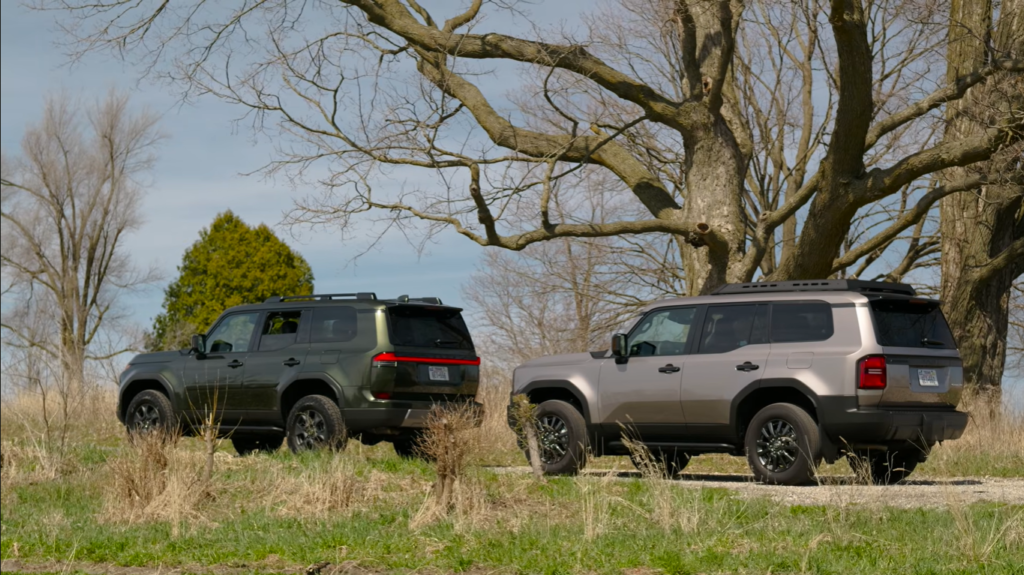
2. Off-Road Capability — Closer Than You Think
Both SUVs run the same core 4WD hardware. The real differences are in the suspension systems and the approach angle.
Ground clearance is identical on base trims at 8.7 inches. The GX Overtrail and Overtrail+ jump to 9.7–9.8 inches — a meaningful upgrade for serious trail work.
Approach angle is where the Land Cruiser genuinely wins. Its front fascia gives it a 30–31 degree approach angle versus just 24–26 degrees on the GX. That matters on steep technical climbs. Departure angles are nearly identical on both vehicles, and the breakover angle is within one degree — essentially a wash.
The bigger off-road story is the sway bar systems. The Land Cruiser offers an optional driver-activated disconnecting sway bar — you press a button inside the cabin and the electromechanical system disconnects it, giving you greater suspension articulation. But it’s manually operated, and the bar itself is thinner because the passive damper setup is less sophisticated.
The GX Overtrail models get EKDSS — Lexus’s automatic electromechanical disconnecting sway bar system. It doesn’t need driver input. When the suspension hits full droop, the system disconnects the sway bar automatically. Because the system is smarter, Lexus can run a thicker bar, which delivers noticeably better body control on the road and less lean in corners compared to the Land Cruiser.
The GX also adds AVS — adaptive variable suspension — which lets the dampers go both softer and firmer depending on the drive mode. In Sport Plus, body control is genuinely impressive for a body-on-frame truck. In Comfort, the ride is pillowy in a way the Land Cruiser simply can’t replicate with its passive dampers.
The Land Cruiser’s passive suspension means it always rides at a fixed middle-ground firmness. It’s fine. It’s never uncomfortable. But it doesn’t have the range of the GX.
Real-world off-road capability between a comparably-specced Land Cruiser and GX Overtrail? Very close. Both are genuinely capable. Much of the performance difference on dirt trails comes down to tyres, not the trucks.
Winner: Lexus GX (Overtrail) for the overall off-road package, but the Land Cruiser’s approach angle advantage is real on technical terrain.
3. Interior, Cargo, and Everyday Livability
Interior dimensions for the first and second row are largely similar. The GX has a slightly higher roofline, giving fractionally more second-row headroom. The Land Cruiser offers 1.82 inches more front legroom.
But the biggest interior difference — and the Land Cruiser’s biggest practical weakness — is cargo capacity.
The Land Cruiser’s hybrid battery pack sits in the boot, raising the load floor and dramatically cutting cargo volume. You’re looking at roughly 15 fewer cubic feet behind the second row compared to the GX. That’s a massive compromise. Loading heavy gear, bikes, or camping equipment becomes harder because of the elevated floor. For a truck that’s marketed as an adventurer’s vehicle, it’s a real disappointment.
The GX in Overtrail trim (two rows, no third row) offers up to 90.5 cubic feet of total cargo space with everything folded. Three-row GX configurations drop significantly due to the third row, down to 10.3 cubic feet behind the third row and 40.2 behind the second.
Materials and refinement are noticeably different. The Land Cruiser uses cloth seats, rubberized floor mats, and matte plastic trim — designed for durability and easy cleaning, not luxury. The base 1958 trim has an 8-inch touchscreen and cloth seats. The top Land Cruiser trim gets 12.3-inch touchscreen, ventilated SofTex seats, and optional JBL audio — approaching entry-level GX territory.
The GX steps up significantly: premium leather, acoustic glass, ambient lighting, a 14-inch Lexus touchscreen, available Mark Levinson audio, heated and ventilated massaging seats, and available panoramic roof on Luxury+ trim. The cabin is noticeably quieter too — 3–4 dB quieter at highway speeds despite the GX in testing being on all-terrain tyres with a loud aftermarket exhaust. That is a real, noticeable difference in daily life.
One problem both vehicles share: terrible front-row storage. The centre console is woefully undersized for a truck in this price class. It’s a platform-wide issue Toyota hasn’t fixed.
Tech layout is a matter of preference. The GX gives you a large connected touchscreen for almost everything. The Land Cruiser keeps physical buttons and knobs for most controls, with a screen only if you choose a higher trim. If you hate touchscreen menus while driving, the Land Cruiser wins here.
Third row: the Land Cruiser always has it. The GX only offers it on Luxury trims — the off-road-focused Overtrail drops it entirely. If you need to regularly carry more than five people, the Land Cruiser wins by default.
Winner: Lexus GX for daily comfort and cargo in most configurations. Land Cruiser wins on third-row availability and physical controls.
4. Price — The Real Deciding Factor
Toyota Land Cruiser pricing: 1958 (base): ~$58,000 Land Cruiser (top trim): ~$61,000–$65,000 With MTS package, disconnecting sway bar, options: $70,000+
Lexus GX 550 pricing: Premium (base): ~$67,000 Premium+: ~$69,000 Overtrail: ~$72,000 Luxury: ~$77,000 Overtrail+: ~$80,000 Luxury+: ~$82,000–$85,000
The entry-level gap is roughly $9,000–$10,000. But here’s the honest comparison: to get the Land Cruiser to a spec that includes the MTS multi-terrain select software and the optional disconnecting sway bar — features that are standard or included in GX Overtrail trim — the price gap narrows considerably. And that’s before you factor in dealer markups on the GX, which are real and often significant.
When the real-world price delta is around $10,000–$12,000, the GX Premium is worth every penny of the premium. When the gap stretches to $20,000+, the Land Cruiser becomes a genuinely compelling value proposition.
Winner: Land Cruiser for value. GX for what your money actually buys.
5. Towing — GX Wins Decisively
This one is not close. The Land Cruiser tops out at 6,000 lbs towing. The GX can tow up to 9,096 lbs in top Overtrail configuration, with even the base GX rated at 9,063 lbs. If you plan to tow a boat, a horse trailer, or a large travel trailer, the Land Cruiser simply cannot compete here. That extra 3,000 lbs of towing capacity is entirely down to the V6 powertrain.
Winner: Lexus GX — and it’s not close.
Side-by-Side: Who Should Buy Which
Buy the Toyota Land Cruiser if:
- Budget is between $58,000–$65,000
- You want a third row without compromise
- Physical controls over touchscreen menus matter to you
- Fuel economy is a priority (real-world ~20 MPG vs 16 MPG)
- You want a simpler, more utilitarian adventure vehicle
- You plan to modify it heavily (aftermarket parts fit both vehicles)
Buy the Lexus GX if:
- Budget is $72,000+ and you want it specced properly
- You want to tow anything over 6,000 lbs
- Daily refinement and cabin comfort matter
- You want adaptive suspension and automatic sway bar disconnect
- A quiet, premium cabin is important to you
- You don’t need a third row
Real-World Ownership: What 25,000 Miles in the GX Actually Taught Us
After 25,000 miles in the Lexus GX, a few real-world takeaways stand out. First, the Bridgestone Dueler Ascent all-terrain tyres the Overtrail ships with are genuinely good — minimal wear at 25k miles, quiet for an AT tyre, and capable in snow. Second, the GX’s fuel range is its biggest practical weakness for overlanding. Plan for fuel stops every 280–310 miles. Third, the EKDSS system is genuinely useful off-road — not having to manually activate the sway bar while navigating a technical trail makes a real difference.
The Land Cruiser, by contrast, is an impressively honest truck. The drivetrain gets unfairly harsh reviews online. The hybrid four-cylinder is excellent below 3,000 RPM, the fuel economy is legitimately better, and the physical controls make it easier to operate without looking away from the road. Its cargo limitation is a real issue though. The elevated boot floor is something you notice every single time you load it.
Final Verdict
The Lexus GX is the more complete vehicle. Better engine, better suspension technology, better interior, significantly better towing, and a quieter, more refined daily experience. If you can afford to compare the GX Overtrail to the top Land Cruiser spec and the price delta is around $10,000–$12,000, spend the money. The premium is justified.
But the Land Cruiser is not a bad vehicle. It’s an honest, capable, fuel-efficient off-roader with a proper third row and physical controls. The hybrid four-cylinder gets unfair criticism — it’s strong where it matters most: low-speed crawling, city driving, and fuel economy. The cargo space compromise from the battery pack is its most legitimate weakness.
Bottom line: wealthy suburb, weekend trails, no towing — Lexus GX. Tight budget, need a third row, or you genuinely prioritise fuel range on long trips — Toyota Land Cruiser.
Either way, you’re buying one of the most capable body-on-frame SUVs money can buy in 2025/2026. You won’t regret either choice. You’ll just either regret the bill or the compromise.
Reviewed by Reo R | My PitShop | 6+ years hands-on automotive experience | Zero brand bias
Category: Car Review | Read time: 9 min | Last updated: April 2026


