The Shocking Truth: The Motorola Signature costs less than the iPhone 17 but delivers superior hardware, better cameras, and more features. Yet people still buy the iPhone. Here’s why—and whether they should.
Rating: Motorola Signature 9/10 | iPhone 17 8.5/10
The Premise: When Better Costs Less
Motorola has done something remarkable in 2026. While phone prices continue climbing, the Signature arrives with shocking value—especially when compared directly to the iPhone 17. Looking purely at specifications and hardware, the question becomes unavoidable: Why do people still buy the iPhone 17?
Spoiler alert: The Motorola Signature is objectively more value for money than the iPhone 17. You don’t need me to tell you that—just look at the specs. But I know why people choose the iPhone anyway, and we’ll address that honestly in the conclusion.
What we’ll do now is compare these phones comprehensively across every category and demonstrate why, from a hardware perspective, the Motorola Signature is the better product.
Design & Build Quality: Different Philosophies
Size and Form Factor
These phones represent completely different design philosophies. The Motorola Signature is a large phone, while the iPhone 17 is deliberately compact. This fundamental difference affects everything else.

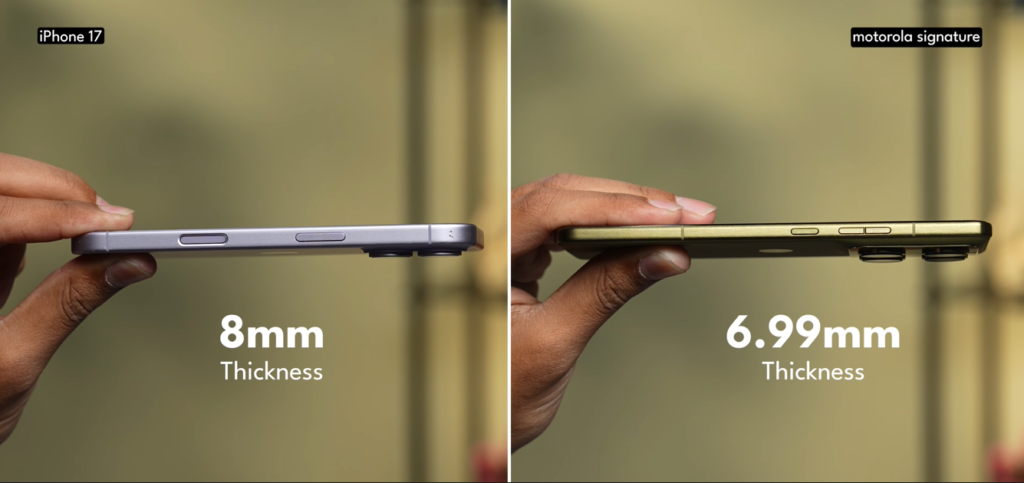
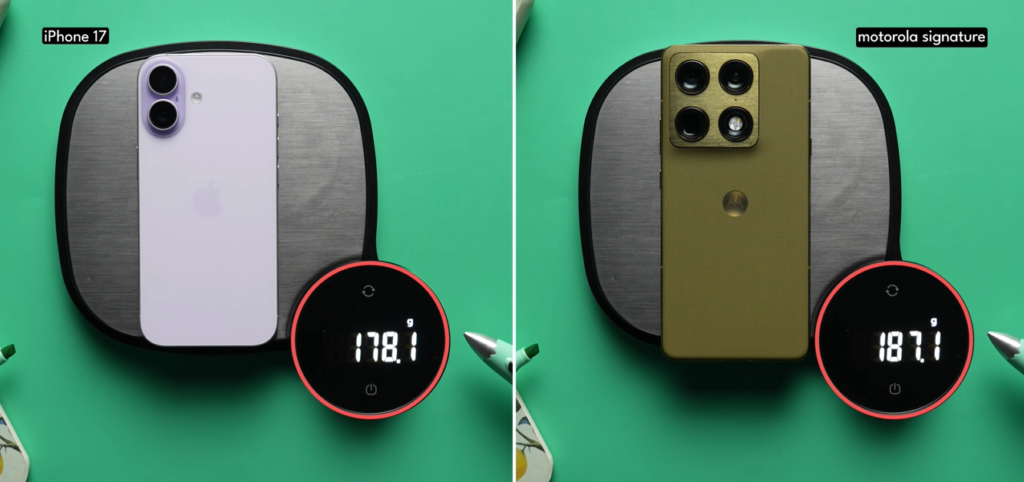
Motorola Signature:
- Large display footprint
- Surprisingly slim profile (slimmer than iPhone 17)
- 5,200mAh silicon-carbon battery (in a thinner body!)
- Lightweight for its size (only slightly heavier than iPhone 17)
iPhone 17:
- Compact, pocket-friendly design
- More comfortable for one-handed use
- Physics advantage: smaller phones are naturally easier to hold
Engineering Assessment: The Signature’s engineering impresses significantly. Packing a 5,200mAh battery into a body slimmer than the iPhone 17—which has a smaller battery—represents excellent engineering. However, the iPhone 17’s compact size provides inherent ergonomic advantages that engineering can’t overcome.
Durability and Protection
Motorola Signature:
- IP68 + IP69 water/dust resistance
- Military Standard 810H certification
- Corning Gorilla Glass Victus (front)
- Premium materials throughout
iPhone 17:
- IP68 rating (standard)
- Ceramic Shield 2 (front and back)
- Better scratch resistance from Ceramic Shield
Winner: Slight advantage to Motorola for IP69 and military certification, but in real-world usage, most users won’t notice differences. Ceramic Shield 2 does offer superior scratch resistance.
Connectivity: A Clear Winner
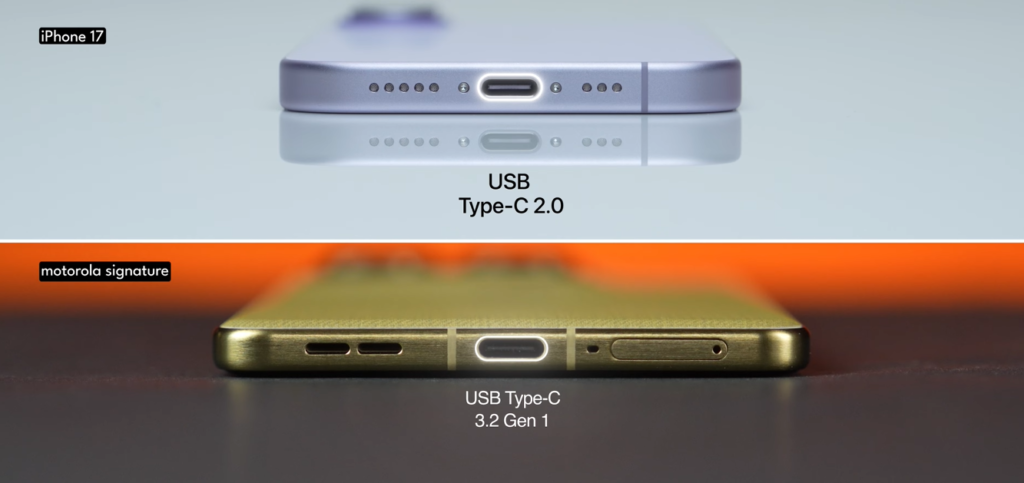
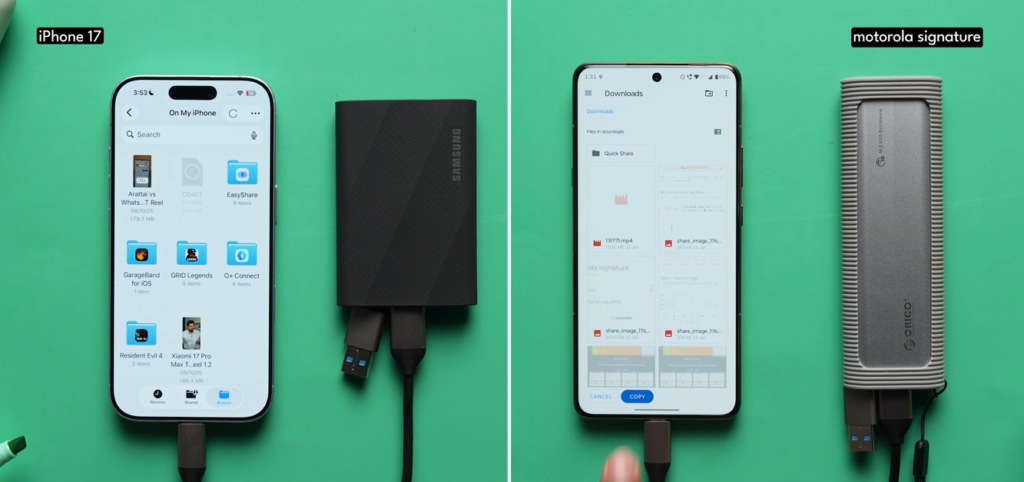
USB Transfer Speeds:
- Motorola Signature: USB 3.0 speeds (fast data transfer)
- iPhone 17: USB 2.0 speeds (significantly slower)
This is a substantial practical difference. If you regularly transfer large files, photos, or videos, the Signature’s USB 3.0 represents a major quality-of-life improvement.
Buttons and Controls
iPhone 17:
- Power button
- Volume rocker
- Action button (customizable)
- Camera Control button
Motorola Signature:
- Standard power and volume
- AI key (instead of action button)
The iPhone 17 offers more physical controls, particularly the dedicated Camera Control button that photography enthusiasts appreciate.
Display: Size vs. Technology
Specifications Comparison
| Feature | Motorola Signature | iPhone 17 |
|---|---|---|
| Panel Type | AMOLED LTPO | OLED LTPO |
| Size | Larger | Compact |
| Resolution | Similar to iPhone | Similar to Moto |
| Pixel Density | Comparable | Comparable |
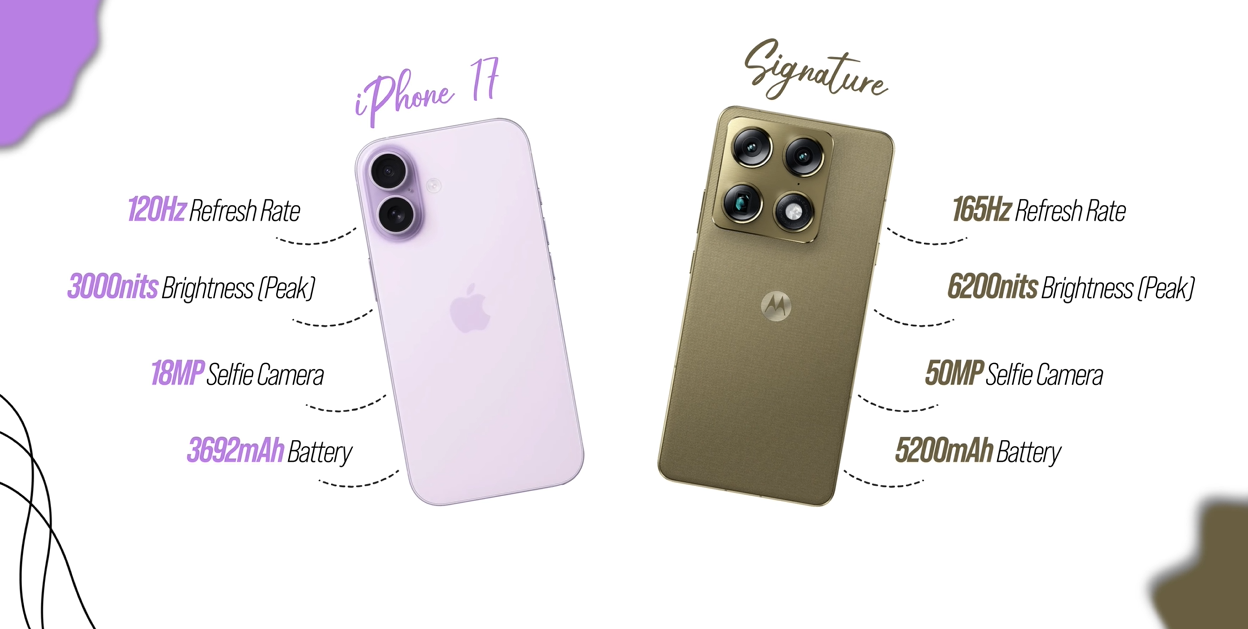
| Refresh Rate | 1-165Hz (LTPO) | 1-120Hz (LTPO) |
| Peak HDR Brightness | 6,200 nits | 3,000 nits |
| HBM Brightness | 2,100 nits | 1,600 nits |
Real-World Display Performance
Peak Brightness: Motorola’s 6,200-nit peak brightness (versus iPhone’s 3,000 nits) sounds impressive on paper. In practice, this peak occurs in tiny 1-10% windows during specific HDR content. Certain YouTube HDR videos show the Signature capable of absolutely brilliant highlights.
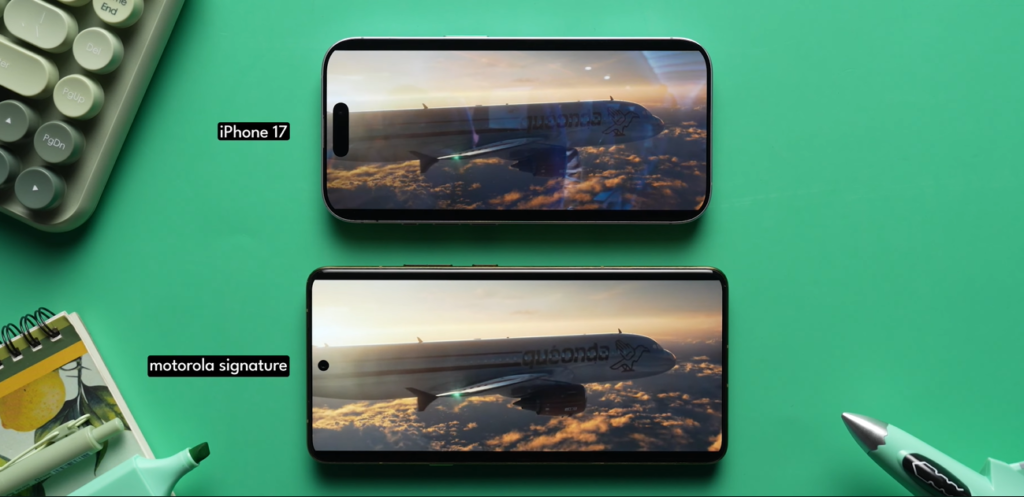
Overall HDR Presentation: Interestingly, most HDR content appears brighter overall on the iPhone 17. Apple’s processing seems to lift shadows more aggressively, creating the perception of a brighter image even when peak highlights don’t hit as high.
Outdoor Visibility: At 2,100 nits HBM (High Brightness Mode), the Signature outspecs the iPhone 17’s 1,600 nits. In actual outdoor testing, both performed excellently with no practical visibility issues on either device.
Color Accuracy: Both displays feature supremely accurate color tuning, nearly neutral in calibration. The Pantone collaboration with Motorola definitely shows its value here—colors are reference-quality accurate.
Gaming Refresh Rate: The Signature theoretically supports up to 165Hz in supported games and apps. However, during testing, I couldn’t actually observe the display reaching 165Hz. Either game support is limited currently, or future updates will enable this feature. For now, both effectively max out at 120Hz.
Additional Display Features
Biometric Security:
- Motorola: Ultrasonic in-display fingerprint scanner (top-tier technology)
- iPhone: Face ID (reliable and fast)
Both work excellently. Preference depends on personal choice and usage scenarios (masks, gloves, angle of phone, etc.).
Haptic Feedback: The iPhone 17’s haptic tuning feels tighter and more refined compared to the Signature. Apple’s Taptic Engine remains industry-leading in this aspect.
Audio: Speakers and Codecs
Speaker Comparison
Motorola Signature:
- Bose-tuned speakers
- Excellent clarity and instrument separation
- High-end detail retrieval
- Less full-bodied bass compared to iPhone
iPhone 17:
- Fuller, bass-heavy sound
- More volume and presence
- Less detailed at the high end
My Assessment: The Bose-tuned Motorola speakers deliver superior clarity with better instrument separation. You hear more detail in complex audio. However, the iPhone 17 produces a fuller, more bass-heavy sound that many users prefer for casual media consumption. This is subjective—personally, I lean toward the Motorola’s clarity, but many will prefer the iPhone’s punch.
Bluetooth Audio: Clear Advantage
Motorola Signature:
- High-resolution Bluetooth codec support (LDAC)
- Better wireless audio quality with compatible headphones
iPhone 17:
- Standard Bluetooth codecs only
- No LDAC support
This is typical for Android versus iOS, but it’s a genuine advantage for the Signature. With high-end wireless headphones supporting LDAC, the Motorola delivers noticeably better wireless audio quality.
Performance: Surprising Results
Chipset Specifications
Motorola Signature: Qualcomm Snapdragon 8 Gen 5 (nearly equivalent to 8 Elite)
iPhone 17: Apple A19
Benchmark Findings
The performance comparison revealed interesting and surprising results:
CPU Performance:
- Winner: iPhone 17 (A19)
- Better Geekbench single-core scores
- Superior CPU prowess overall
GPU Performance:
- Winner: Motorola Signature (Snapdragon 8 Gen 5)
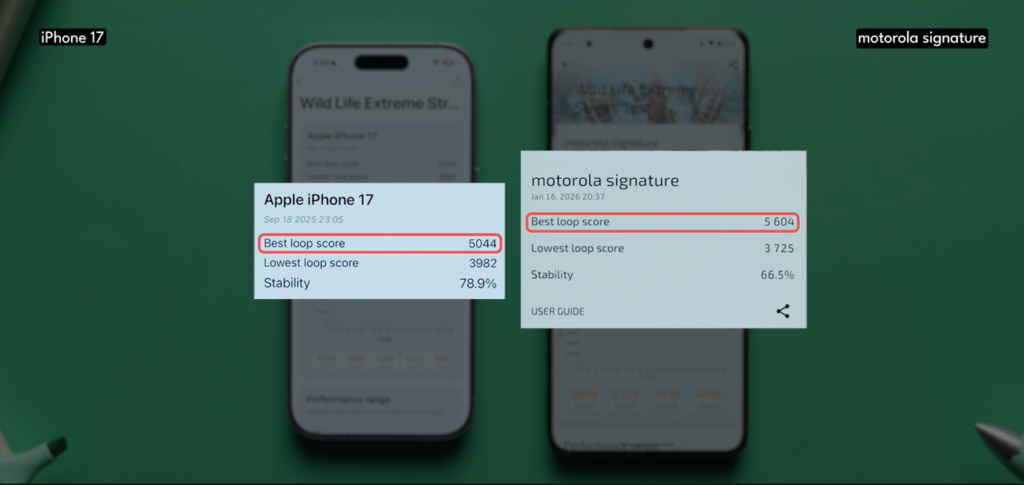
- 3DMark Solar Bay and Wildlife Extreme Stress Tests show the 8 Gen 5 GPU outperforming the A19 GPU
- More GPU performance headroom
- iPhone offers better stability scores
This represents a significant shift. Typically, Apple’s A-series chips dominate both CPU and GPU benchmarks. The Snapdragon 8 Gen 5’s GPU superiority is genuinely surprising.
Real-World Gaming Performance
Genshin Impact Testing (30 minutes, highest graphics, 60 FPS target):
Motorola Signature:
- Average FPS: 59+ (essentially locked 60 FPS)
- Average temperature: Under 40°C
- No thermal throttling
- Phone stayed cool throughout
iPhone 17:
- Average FPS: Similar performance (near 60 FPS)
- Slightly warmer operation
Analysis: I was genuinely stunned by the Motorola Signature’s gaming performance. Maintaining nearly locked 60 FPS in Genshin Impact at maximum settings while staying cool is remarkable, especially in such a slim phone. Motorola’s vapor cooling chamber clearly works exceptionally well.
Throughout my entire testing period, the Signature never got hot during any use case. For gaming specifically, I prefer the Motorola Signature.
Game Library Advantage: iPhone
However, the iPhone 17 maintains one significant advantage: AAA game availability. The iOS App Store offers console-quality titles like:
- Resident Evil Village
- Assassin’s Creed Mirage
- Death Stranding
- Many more AAA ports
These games aren’t available on Android. If you want console-quality gaming on mobile, the iPhone remains necessary.
Battery Life: Efficiency Meets Capacity
Battery Specifications
Motorola Signature: 5,200mAh silicon-carbon battery
iPhone 17: Smaller battery (exact capacity not disclosed)
Real-World Battery Performance
Motorola Signature:
- 8+ hours of screen-on time consistently
- Battery percentage remaining after full day
- 50% Wi-Fi / 50% 5G mixed usage
- Excellent battery optimization
iPhone 17:
- Approximately 7 hours of screen-on time
- Also represents good optimization
- A smaller battery limits longevity
Winner: Motorola Signature. The larger 5,200mAh battery, combined with excellent tunin,g delivers superior all-day battery life. Motorola’s battery optimization has improved dramatically, and the Signature demonstrates this clearly.
Charging Speeds
Motorola Signature:
- Faster wired charging
- Faster wireless charging
iPhone 17:
- Slower wired charging
- Slower wireless charging
Motorola offers substantial advantages in charging speed for both wired and wireless charging. If you need quick top-ups, the Signature wins decisively.
Network and Connectivity
Performance
Both phones deliver excellent network performance with no significant complaints. 5G connectivity, call quality, and signal strength perform admirably on both devices.
eSIM Support: Surprising Omission
Critical Issue: The Motorola Signature lacks eSIM support in India.
This is genuinely surprising and disappointing for a 2026 flagship. eSIM support should be standard at this price point. The iPhone 17 naturally includes full eSIM support.
For users who rely on eSIM for travel or prefer dual-SIM flexibility with eSIM, this represents a significant limitation.
Camera System: Hardware vs. Processing
Camera Hardware Specifications
Motorola Signature:
- Primary: Larger sensor
- Ultrawide: Larger sensor
- Telephoto: 3x periscope (dedicated)
- Selfie: Higher resolution
- All sensors larger than iPhone equivalents
iPhone 17:
- Primary: Smaller sensor
- Ultrawide: Smaller sensor
- Telephoto: Digital zoom only (no dedicated telephoto)
- Selfie: New sensor with landscape orientation trick
Hardware Winner: Motorola Signature, decisively. Better hardware across every camera.
Primary Camera Performance
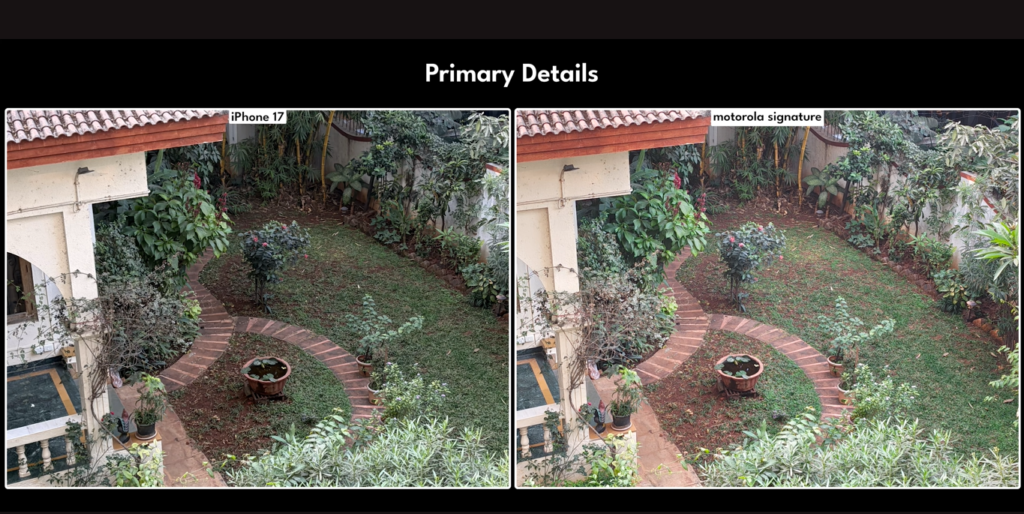
Image Quality: The similarity between primary camera outputs is uncanny. Both produce sharp, detailed 24-megapixel images with nearly identical sharpness levels.
Color Accuracy:
- Motorola Signature: Superior, pitch-perfect color accuracy (in standard mode)
- iPhone 17: Tends toward deeper, warmer reds
The Signature’s color accuracy genuinely impresses. Pantone validation delivers results—colors match what your eyes see with exceptional fidelity.
HDR Performance:
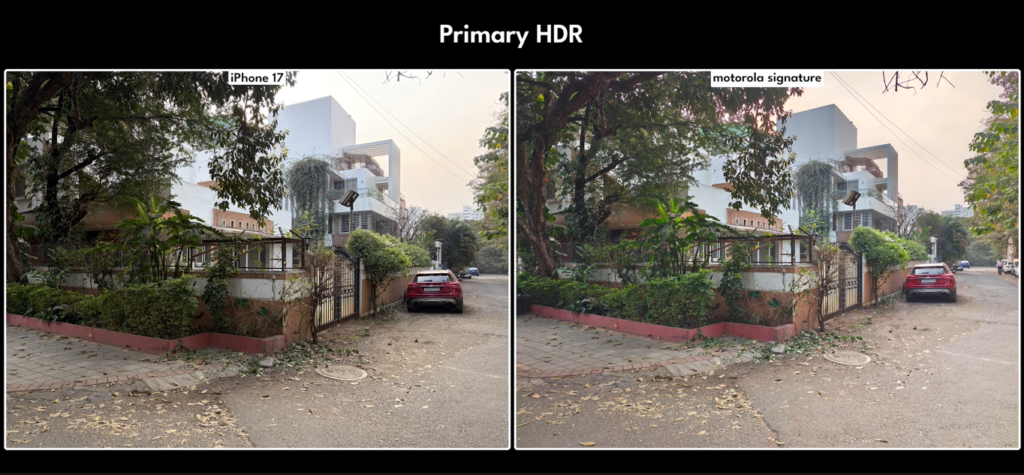
- Motorola Signature: Superior HDR tuning with better highlight control and shadow detail
- iPhone 17: Good HDR but less refined
I have multiple comparison samples demonstrating Motorola’s HDR advantage. The Signature handles high-contrast scenes with more finesse.
Skin Tone Reproduction: Pantone-validated skin tone tuning on the Signature delivers accurate, natural skin tones. In comparison shots, the Signature matches real-life skin tones far more accurately than the iPhone 17, which skews too warm.
Consistency Caveat: The iPhone 17 maintains better color science consistency across different shooting scenarios. While the Signature achieves higher peaks of accuracy, the iPhone delivers more predictable results.
Portrait Mode Comparison
Testing Methodology:
- Compared Signature’s 50mm to iPhone’s 2x
- Compared Signature’s 85mm to iPhone’s 3x
Results:
At 2x (50mm):
- Winner: iPhone 17
- Better edge detection
- More detail retention
At 85mm (3x):
- Winner: Motorola Signature
- Excellent edge detection
- Superior detail extraction
- Best Motorola portrait performance ever
Overall: Both phones excel at portraits. The Signature represents Motorola’s best portrait work to date, clearly incorporating user feedback. At longer focal lengths, the Signature’s dedicated hardware shows its advantage.
Backlit Shooting
When shooting against bright backgrounds or light sources, the Motorola Signature’s larger sensor demonstrates clear advantages:
- Cleaner highlight reproduction
- Better depth of field control
- More natural background rendering
The difference is visually obvious—the Signature simply looks better in these challenging conditions.
Low-Light Photography
Motorola Signature:
- Larger sensor gathers more light
- Excellent performance in ~2 lux conditions
- Superior noise control
- Better detail preservation
iPhone 17:
- Good low-light performance
- Sometimes lifts shadows more aggressively
- Can appear brighter in some scenarios
Winner: Motorola Signature. The larger sensor fundamentally captures more photons, delivering cleaner, more detailed low-light images. However, Apple’s aggressive shadow lifting can create the perception of better low-light performance in some situations.
Ultrawide Camera
Motorola Signature:
- Tends to oversharpen details
- Good overall quality
iPhone 17:
- Keeps details softer
- 24-megapixel output (seems unnecessary with tiny sensor)
In low light, observations remain consistent. Neither ultrawide particularly impresses, but the Motorola’s larger sensor helps in challenging light.
Zoom Performance: Decisive Victory
At 2x Digital Zoom:
- Winner: iPhone 17
- Motorola oversharpens
- iPhone maintains more natural processing
At 3x, 6x, and 10x:
- Winner: Motorola Signature, comprehensively
- Vastly superior detail at every zoom level
- Dedicated periscope telephoto shows its value
Maximum Zoom:
- Motorola: 100x with AI upscaling
- iPhone: 10x maximum
If zoom photography matters to you at all, the Motorola Signature wins decisively. The dedicated 3x periscope telephoto delivers substantially better results than the iPhone’s digital cropping.
Selfie Camera: Unexpected Winner
Motorola Signature Advantages:
- Crisper selfies with more detail
- Better portrait mode
- Superb HDR handling
- Superior low-light performance
iPhone 17 Features:
- New selfie sensor
- Landscape selfie in portrait orientation (clever feature)
Despite Apple’s new sensor and innovative features, the Motorola Signature delivers technically superior selfies across all scenarios. This surprised me—the Signature is genuinely excellent for selfies.
Video Recording: Mixed Results
iPhone 17 Advantages:
- Better HDR tuning in Dolby Vision video
- More accurate color reproduction in video
- Superior ultrawide video
Motorola Signature Advantages:
- Superior sound recording quality
- Better selfie video recording (higher bitrate video and audio)
- Better low-light video (larger sensor helps reduce noise)
- Can shoot 8K 30fps in Dolby Vision
- Wider video capabilities overall
Regular HDR Video Issues: The Signature’s regular HDR video (non-Dolby Vision) shows color tuning problems—too contrasty and color-inaccurate compared to its excellent photo color science. This is disappointing given how good the still photos look.
Stabilization: Good on both phones, no significant difference.
Overall Video Winner: iPhone 17 for general video, but Motorola wins specific categories (selfie video, low-light video, audio recording).
Camera System Conclusion
Hardware: Motorola Signature wins decisively
Photo Quality: Motorola Signature wins overall (zoom, low-light, portraits, selfies)
Video Quality: iPhone 17 wins (better color, better HDR)
Versatility: Motorola Signature (more focal lengths, better zoom)
I genuinely didn’t expect to say this in 2026, but the Motorola Signature has better overall camera performance and superior camera hardware compared to the iPhone 17. This represents a significant achievement for Motorola.
Software: Ideologies and Ecosystems
iOS 19: Strengths and Weaknesses
Strengths:
- Liquid Glass UI: Beautiful visual design
- Dynamic Island: Game-changing interface element (widely copied by Android)
- App Quality: Generally higher-quality iOS apps versus Android equivalents
- Ecosystem Integration: Seamless with other Apple devices
Weaknesses:
- iOS 19 Bugs: Riddled with bugs even after multiple updates
- Apple Intelligence: Significantly behind Android AI capabilities, including Motorola’s Hello UI AI
Apple Intelligence genuinely disappoints compared to Android competitors. The gap between Apple’s AI and Google/Motorola’s AI implementations is substantial.
Hello UI: AI-First Experience
Strengths:
- AI Integration: AI built throughout, including app drawer
- Multiple AI Options: Perplexity and Copilot built-in
- Moto AI 2.0: Interesting features including “Next Move” (a personal favorite)
- Traditional Moto Features: Gestures, Moto Secure, Family Spaces, Smart Connect
- Clean Experience: Close to stock Android without being stock
- Bug-Free: Remarkably stable with no bugs noticed during testing
- Stutter-Free Performance: Smooth, responsive operation
Weaknesses:
- Limited Customization: Fewer customization options than other Android skins
- Not True Stock: Closer to stock than most, but not pure Android
Software Support
Both phones: 7 years of updates promised
This represents excellent long-term support from both manufacturers and removes software support as a differentiating factor.
Signature Club Benefits
The Motorola Signature includes premium concierge benefits similar to credit card programs:
- Airport meet and greet services
- Golf course bookings
- Fine dining reservations
- First year free
- ₹6,000 off first service
These premium services add tangible value for the target demographic.
Pricing: The Critical Factor
The Bottom Line: The Motorola Signature costs less than the iPhone 17.
Even if we consider all parameters equal between the phones (which they aren’t—Motorola has advantages), you cannot deny that the Signature offers better cameras and superior hardware while costing less money.
Why pay more for the iPhone 17?
The Real Reason People Buy iPhones
The Ecosystem Argument
I know why people choose the iPhone 17 despite objective hardware disadvantages. You probably know too. It’s not really about the hardware.
The iPhone 17 represents the closest to Android it’s been in hardware terms in a very long time. Just adding a 120Hz refresh rate display has people celebrating: “iPhone’s awesome this year!”
But Apple buyers aren’t really shopping on hardware merit. They’re buying into:
- Ecosystem: If you have other Apple devices, the integration is seamless
- Brand preference: Apple represents status, design philosophy, and user experience consistency
- Familiarity: They know iOS and prefer it
- App quality: iOS apps are generally better optimized
- Resale value: iPhones hold value better
- Social factors: iMessage, FaceTime, airdrop with friends
For Merit-Based Buyers
If you’re not one of those Apple ecosystem buyers, and if you want to purchase a phone based purely on merit, hardware quality, features, and value for money, then the Motorola Signature is objectively the right choice.
The Service Support Question
Motorola needs to continue improving:
- Software support consistency (7-year promise is great, but they need to prove it)
- Service support infrastructure (Moto Elite Care is a step forward)
- Brand confidence and reliability perception
These improvements will help more people feel confident choosing Motorola over established players. The 7-year update commitment and Moto Elite Care service represent steps in the right direction. Hopefully, Motorola can maintain this commitment.
Detailed Comparison Chart
| Category | Motorola Signature | iPhone 17 | Winner |
|---|---|---|---|
| Design | Slim, large, premium | Compact, ergonomic | iPhone (ergonomics) |
| Durability | IP68+IP69, MIL-STD-810H | IP68, Ceramic Shield 2 | Motorola (protection) |
| Display Size | Larger AMOLED | Compact OLED | Preference-dependent |
| Display Quality | 6,200 nit peak, 165Hz | 3,000 nit peak, 120Hz | Motorola (specs) |
| USB Speed | USB 3.0 | USB 2.0 | Motorola |
| Speakers | Clear, detailed (Bose) | Full, bass-heavy | Preference-dependent |
| Bluetooth | LDAC support | Standard codecs | Motorola |
| CPU Performance | Good (SD 8 Gen 5) | Better (A19) | iPhone |
| GPU Performance | Better (SD 8 Gen 5) | Good (A19) | Motorola |
| Gaming Library | Standard Android | AAA titles available | iPhone |
| Thermal Management | Excellent (stays cool) | Good | Motorola |
| Battery Capacity | 5,200mAh | Smaller | Motorola |
| Battery Life | 8+ hours SOT | 7 hours SOT | Motorola |
| Charging Speed | Faster (wired/wireless) | Slower | Motorola |
| eSIM Support | No (India) | Yes | iPhone |
| Camera Hardware | Superior across all sensors | Smaller sensors | Motorola |
| Photo Quality | Better (zoom, low-light) | Good | Motorola |
| Video Quality | Good (color issues) | Better (HDR, color) | iPhone |
| Selfie Camera | Superior | Good | Motorola |
| Zoom Range | 100x (3x optical) | 10x (digital only) | Motorola |
| Software AI | Advanced (Moto AI 2.0) | Behind (Apple Intelligence) | Motorola |
| Software Bugs | Clean, stable | Bug-riddled | Motorola |
| Software Support | 7 years promised | 7 years expected | Tie |
| App Quality | Android quality | iOS quality | iPhone |
| Ecosystem | Android ecosystem | Apple ecosystem | iPhone (if invested) |
| Price | Lower | Higher | Motorola |
| Value | Exceptional | Good | Motorola |
Who Should Buy Which Phone?
Buy the Motorola Signature If:
✅ You want the best hardware for your money
✅ Camera quality (especially zoom and low-light) matters to you
✅ You prefer Android’s flexibility and AI features
✅ Battery life is a priority (8+ hours SOT)
✅ You want faster charging and data transfer
✅ You’re not locked into Apple’s ecosystem
✅ You value objective specifications and features
✅ You want a phone that stays cool during gaming
✅ Premium concierge services appeal to you
✅ You’re willing to trust Motorola’s 7-year support promise
Buy the iPhone 17 If:
✅ You’re already invested in Apple’s ecosystem (Mac, iPad, Watch, etc.)
✅ You prefer iOS and its app quality
✅ You want AAA gaming titles
✅ You prefer compact phone size
✅ FaceTime, iMessage, and AirDrop matter to you
✅ You value Apple’s brand and resale value
✅ You want better video recording (color and HDR)
✅ eSIM support is essential for you
✅ You prefer Apple’s customer service network
✅ You prioritize ecosystem over raw specifications
Final Verdict: Value vs. Ecosystem
The Uncomfortable Truth
The Motorola Signature is objectively the better phone from a hardware, features, cameras, and value perspective. It costs less and delivers more. This isn’t subjective—it’s measurable across most categories.
Yet the iPhone 17 will outsell it dramatically.
Why? Because most people don’t buy phones based on objective merit. They buy based on:
- Brand loyalty
- Ecosystem investment
- Social factors
- Familiarity
- Perceived status
- App preferences
And that’s completely valid. Technology serves people—if iOS serves you better than Android, if the Apple ecosystem integrates your life seamlessly, if you genuinely prefer the iPhone experience, then the iPhone 17 is the right choice for you even if it’s objectively “less” phone for more money.
My Recommendation
For Specification Shoppers: Motorola Signature, without question. More phone, less money.
For Ecosystem Users: iPhone 17, because it fits your life better despite costing more and offering less hardware.
For Android Users: Motorola Signature represents exceptional value and genuinely excellent execution.
For First-Time Flagship Buyers: Consider what ecosystem you want to commit to long-term, then choose accordingly.
The Motorola Question
Can Motorola maintain quality, software support, and service infrastructure to justify confidence? The Signature is so good that I’m considering daily driving it—something I wouldn’t have said about previous Motorola flagships. They’ve clearly elevated their game.
If Motorola continues this trajectory, proves their 7-year update commitment, and builds service infrastructure, they’ll convert more iPhone users who buy on merit rather than ecosystem.
Conclusion: Better Phone, Different Reasons
The Motorola Signature is the better phone on paper and in practice across most measurable categories. It costs less than the iPhone 17 while delivering superior hardware, better cameras, longer battery life, and more features.
But the iPhone 17 isn’t competing on specifications. It’s competing on ecosystem, familiarity, app quality, and brand perception. For millions of users, those intangibles matter more than any spec sheet.
The question isn’t which phone is better—it’s which phone is better for you.
If you judge phones on objective merit, hardware quality, features, and value per dollar, the Motorola Signature wins comprehensively.
If you judge phones on ecosystem fit, brand preference, and integrated user experience, the iPhone 17 wins for Apple users.
Both answers are correct depending on your priorities.
What do you think? Signature or iPhone 17? Which would you choose and why?
#MotorolaSignature #iPhone17 #PhoneComparison #Motorola #Apple #SmartphoneReview #Android #iOS #TechReview2026 #FlagshipPhone #CameraComparison