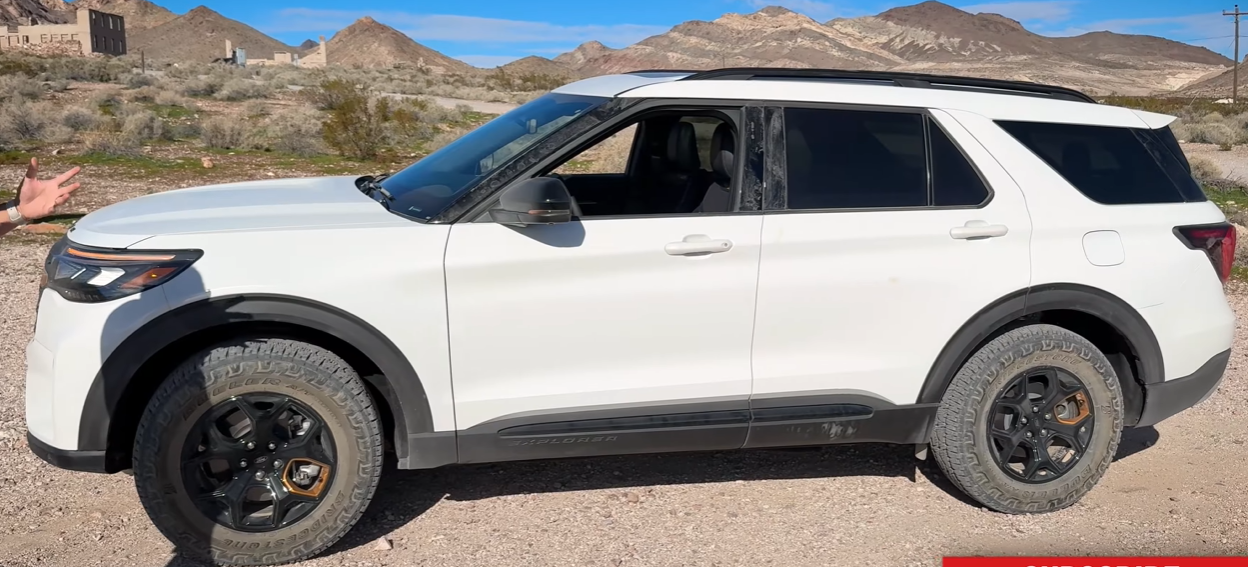
The 2026 Ford Explorer Tremor turned heads when Ford leaned back into an off-road identity for its best-selling three-row SUV. It brings genuine off-road hardware, an optional 400-hp twin-turbo V6, and a ton of technology to the family-SUV formula. On paper — and even out on Death Valley trails — it’s an impressive package.
But no vehicle is perfect, and the Tremor has trade-offs you should know before you sign a deal. If you’re in the market for a capable three-row SUV, here are the top five reasons to avoid the 2026 Explorer Tremor, explained with real-world context and the facts that matter when it comes to ownership.
Quick summary (one-line verdict)
If you want a fast, tech-rich, family-capable SUV that can do light-to-moderate off-roading, the Tremor is compelling — but buyers who prioritize fuel efficiency, roomy third-row comfort, or lower-cost options should look elsewhere.
1) Fuel economy penalty: high running costs for the V6 performance you may never fully use
Why it matters
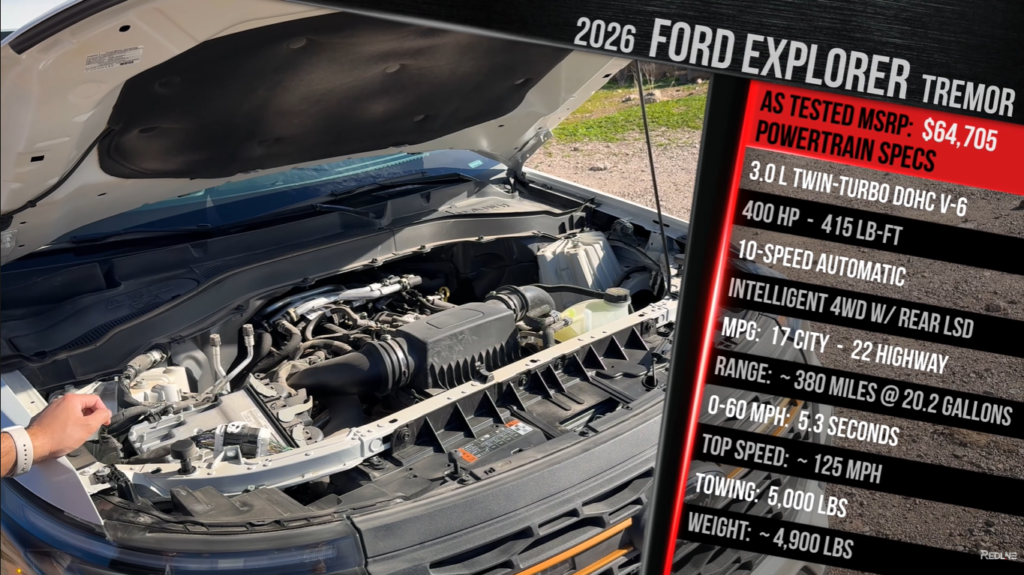
The Tremor’s optional 3.0L twin-turbo V6 produces 400 hp and 415 lb-ft of torque — impressive numbers that make the Tremor one of the quickest large family SUVs on the market. That power comes at a cost: EPA/real-world economy is poor relative to four-cylinder alternatives and many rivals.
Evidence & real-world numbers
- Ford rates the V6 Tremor at ~17 city / 22 highway / 19 combined mpg. The reviewer averaged ~21 mpg on mostly highway runs — but that was with relatively conservative driving and a lighter test cycle away from daily stop-and-go commutes.
- The V6 is the least efficient Explorer option and adds about 2 mpg worse combined vs. the 4-cyl variants Ford sells.
Ownership impact
- More trips to the pump and higher fuel expense over time — especially if you use the V6’s grunt frequently (towing, spirited driving, long-haul family road trips).
- If your driving mix is urban commuting and school runs, the Tremor V6 is likely overkill and will cost you money every month.
- Fuel premium: Ford recommends premium for the V6 (though regular will work), increasing per-gallon costs.
Who this hurts most
Buyers prioritizing total cost of ownership (fuel budget, long-term running cost) or those who won’t exploit the V6’s extra performance. If you want similar capability but better economy, consider 4-cylinder alternatives or rivals tuned for efficiency.
2) Third-row and interior space: usable but not class-leading — uncomfortable on long trips
Why it matters
Three-row buyers care about passenger comfort, especially in the second and third rows. The Tremor’s focus on off-road hardware and riding dynamics compresses interior packaging in places that matter.
Evidence & specifics
- Second-row: with captain’s chairs, the Tremor seats six comfortably — but legroom (~37.5 in) is good not exceptional.
- Third-row: ~32 in legroom, which the reviewer calls “acceptable” but noticeably tighter than competitors (some rivals offer 35–40+ in). Smaller windows and low seat height make the third row feel cramped.
- The panoramic glass roof (part of the Ultimate package) reduces headroom — reviewer at 5’7” had only ~2 inches of clearance with the roof fitted.
Ownership impact
- Families who regularly carry three adults or taller teens in the third row will find the Tremor claustrophobic for longer trips.
- Frequent long-distance family travel with full occupancy will expose this shortcoming quickly.
- Cargo space with all seats up is modest (~16.6 cu ft), so adding adults in the back often forces packing compromises.
Who this hurts most
Large families, multi-generational passengers, or buyers who put people (not gear) in that third row often. If roomy third-row comfort is decisive, competitors like the Palisade/Highlander/Grand Highlander family often do better.
3) Cost creep: V6 + options push price into premium territory fast
Why it matters
The Tremor is positioned as a value-driven off-road Explorer, but the real-world pricing cliff for the V6 + Ultimate package undermines that value for many buyers.
Evidence & numbers
- Base Tremor starts around $48,500 — competitive.
- The optional V6 is bundled into a pricey Ultimate package (~$12,000) that includes the V6 and many features.
- The test vehicle’s as-tested price jumped to ~$64,750 with options — nearly a $16k+ increase over base Tremor and in the same ballpark as fully loaded STs or other premium SUVs.
Ownership impact
- If your goal is a rugged off-road trim on a reasonable budget, the V6’s premium undermines the Tremor’s value proposition.
- When buyers compare that $64k+ Tremor to well-equipped rivals, the value advantage narrows or disappears.
- Higher sticker also means higher insurance and greater depreciation exposure.
Who this hurts most
Budget-conscious buyers and anyone who thinks the Tremor’s headline hardware should be affordable. If you don’t require the V6, the Tremor still costs more than many non-off-road Explorers, but the gap widens significantly once options are added.
4) Some features removed or down-spec’d in 2026: odd trade-offs for a premium price
Why it matters
Ford removed or downgraded several convenience features for 2026 that buyers used to expect at this price point — and those omissions feel more glaring when the vehicle costs nearly $65k with options.
Evidence & specifics
- Wireless phone charging pad has been removed for 2026 (supplier issues); not available at launch.
- Panoramic roof no longer opens — glass-only now, which reduces perceived luxury and utility.
- No head-up display on Tremor; not offered in the tested configuration (some rivals include HUDs).
- Some “niceties” like one-touch rear window function are not fully implemented (only front windows have one-touch).
Ownership impact
- Buyers paying premium expect a certain feature set. Removing features (wireless charging, venting sunroof) creates dissatisfaction and reduces perceived value.
- These omissions can be deal-breakers for tech- or comfort-focused buyers who assume premium trims come complete.
Who does this hurt most
Tech-minded buyers and anyone comparing loaded Tremors to similarly priced luxury or near-luxury SUVs with fewer feature compromises.
5) It’s not a full-on hardcore off-roader — expectations vs. reality
Why it matters
The Tremor’s marketing and hardware (skid plates, 8.7 in ground clearance, all-terrain tires) signal serious off-road capability. But buyers wanting Wrangler/4Runner-level rock-crawling ability will be disappointed.
Evidence & clarification
- The Tremor is a unibody SUV with fully independent suspension — excellent for ride comfort and handling, but inherently less capable in extreme rock-crawling and heavy-duty overlanding compared to body-on-frame trucks/SUVs.
- There’s no low-range transfer case or manual locking differential you can engage by hand; limited-slip rear differential and electronic modes help, but they’re not the same.
- The reviewer repeatedly notes: it’s surprisingly capable for a unibody three-row, but still not equal to purpose-built hardcore off-road models (Toyota 4Runner, Jeep Wrangler Rubicon, Jeep Grand Cherokee Trailhawk variants).
Ownership impact
- Buyers who truly want expedition-grade capability — heavy chassis robustness, low-range gearing, crawl ratios, underbody protection for extreme trails — should look to body-on-frame alternatives.
- The Tremor will handle most dirt roads, rocky trails, and moderate trails with confidence, but owners seeking to push into technical off-roading will outgrow it.
Who this hurts most
Serious off-roaders and buyers who equate an “off-road badge” with rock-crawler competence. If you need overlanding or extreme trail performance, the Tremor is not the right tool.
Bottom line: who should avoid the Tremor?
Avoid the 2026 Ford Explorer Tremor if you fit one or more of these buyer profiles:
- You prioritize fuel efficiency and low running costs (urban commuters, long daily drivers).
- Your family regularly needs class-leading third-row comfort for adults or tall teenagers.
- You’re budget-sensitive and don’t want a vehicle whose price climbs dramatically with must-have performance options.
- You expect a full range of premium features (wireless charging, venting panoramic roof, HUD) at this price point.
- You are a hardcore off-roader who needs low-range gearing, manual locking diffs, and body-on-frame durability.
When the Tremor is the right choice
For balance, a short note about who will love it: the Tremor suits buyers who want a performance-minded family SUV that can do serious weekend trail runs, who value ST-style power, and who appreciate Ford’s robust off-road technology package (360 cameras, skid plates, all-terrain tires) while still wanting on-road refinement.
Practical buying tips if you still like the Tremor
If, after reading the trade-offs, you remain interested, here are smart moves to avoid buyer’s remorse:
- Test the 4-cyl and V6 back-to-back (and measure fuel consumption you’d tolerate).
- Sit in the third row with people you’ll actually carry — bring kids and adults for real impressions.
- Build your as-tested price in the configurator — confirm you’re comfortable with the total.
- Assess feature priorities: if wireless charging or an opening sunroof matter, wait for the next model year or consider rivals.
- If you want serious off-road capability, test a body-on-frame alternative before committing.
Final verdict (short)
The 2026 Ford Explorer Tremor is one of the most capable, well-rounded off-road-oriented three-row family SUVs available — but it makes compromises (fuel economy, third-row space, and feature omissions) that disqualify it for certain buyers. Avoid the Tremor if low running costs, best-in-class interior space, or true hardcore off-roading are your top priorities.