
The premium OLED market in 2025 is not for the faint-hearted. Between LG’s G5, Samsung’s S95F, and Sony’s A95L, competition is fierce. Yet Panasonic, the brand often associated with broadcast-grade accuracy and cinematic quality, has made a roaring comeback with the Panasonic Z95B — its latest flagship OLED TV that redefines what “creator intent” means.
This model replaces last year’s Z95A, and on paper, it’s a major leap: a new RGB Tandem W-OLED panel (the same tech inside the LG G5), powered by the HCX Pro AI Processor Mark I, capable of 4K 144Hz, and tuned to professional mastering standards.
But Panasonic didn’t stop there — it integrated one of the best built-in Dolby Atmos sound systems you’ll find in any TV.
If you’ve ever wished for a “reference OLED TV that sounds like a soundbar,” this might be it.
Let’s dive deep into the design, display, brightness, audio, gaming, software, and value — and see whether the Z95B earns its elite status.
Design & Build: Premium, Purposeful, and Built Like a Studio Monitor
Unlike the ultra-slim Samsung S95F, which sacrifices acoustics for sleekness, the Z95B embraces its depth — and for good reason.
From the front, the TV is elegantly minimalist, framed by ultra-slim bezels. But from the side, it’s a chunkier, more substantial unit — housing a robust 5.1.2 channel Dolby Atmos speaker array and a complex cooling system.
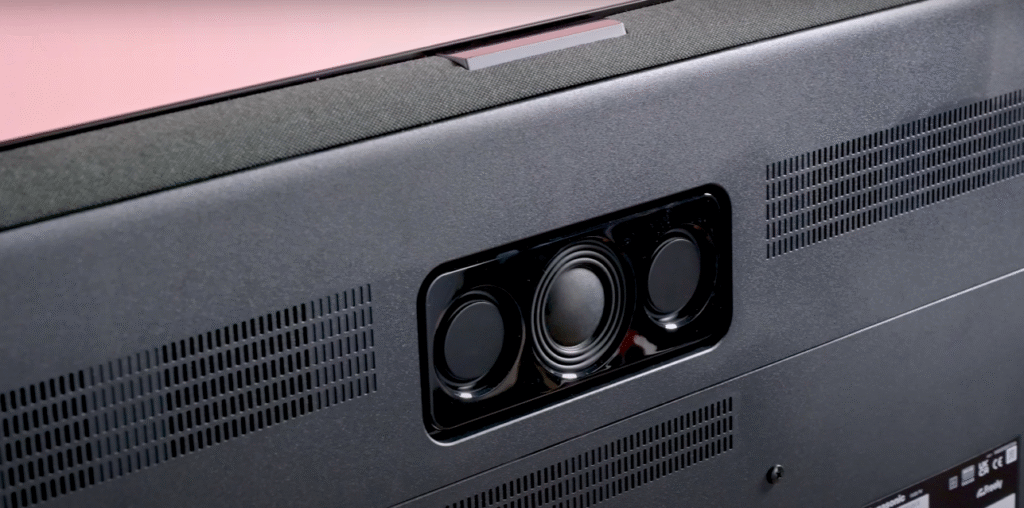
The rear section is wrapped in dark woven acoustic fabric, blending function with finesse. Panasonic’s signature swiveling pedestal stand allows flexible setup, and the chassis feels dense, solid, and premium — not hollow like thinner OLEDs.
💡 Fun fact: Panasonic intentionally added depth to accommodate the RGB tandem OLED cooling system, allowing higher sustained brightness without burn-in risk.
Design Highlights
- Elegant minimalist design with functional depth
- Acoustic fabric wrap hides 5.1.2 speaker system
- Sturdy, premium aluminum chassis
- Swiveling pedestal stand for better placement
- Slightly bulkier than LG G5 but more practical
While wall-mounting is possible, those craving the “gallery-style flush mount” may prefer LG’s slimmer G-series. For most users, though, Panasonic’s design feels purpose-built — more studio-grade than living-room decorative
Display & Picture Quality: True HDR Brilliance with Precision
The Z95B is all about brightness + accuracy — two qualities rarely coexisting in OLEDs.
Instead of MLA (Micro Lens Array), Panasonic uses an RGB Tandem W-OLED stack from LG Display. This structure doubles up OLED emitters for higher brightness while maintaining classic OLED contrast.
Measured Lab Performance
| Test Mode | Result |
|---|---|
| HDR Peak (10%) | 2,354 nits |
| HDR Peak (2%) | ~2,330 nits |
| SDR Real Scene | 513 nits |
| Peak Small Highlights | ~960 nits |
| Color Gamut | 99.9% DCI-P3, 100% Rec.709 |
| PQ EOTF Tracking | Excellent (reference-grade) |
That makes the Z95B one of the brightest OLEDs ever built, outperforming Sony’s A95L and matching LG’s G5 in peak highlights.
Tone Mapping & Accuracy
Panasonic continues to lead in picture discipline. Unlike LG or Samsung, which chase “eye-popping” saturation, Panasonic’s Filmmaker Mode delivers what the director intended — pure, balanced, accurate color.
- No lifted blacks or crushed shadows
- Precise HDR tone mapping for content mastered up to 4000 nits
- Dolby Vision IQ & HDR10+ Adaptive support ensures perfect brightness in any lighting
HDR films like Dune: Part Two or The Batman look breathtaking — shadow detail remains intact, highlights shimmer naturally, and motion feels fluid.
Display Verdict
This isn’t just a TV. It’s a reference monitor disguised as a living room display.
For filmmakers, colorists, and cinephiles — this is as accurate as consumer OLED gets in 2025.
Audio Performance: Soundbar-Level Dolby Atmos Built In
Panasonic’s Technics-tuned 5.1.2 channel Dolby Atmos array sets it apart.
With front, side, and up-firing speakers plus an integrated subwoofer, it creates a true 3D audio field without extra gear.
Specs & Experience
- Total output: 160W RMS
- Dolby Atmos + Dolby TrueHD
- Space Tune calibration adjusts sound based on room acoustics
- Sound Focus allows directing audio to specific seats
💬 Dialogue clarity is superb, mid-range is balanced, and explosions in Oppenheimer sound thunderous.
Panasonic even beats Sony’s Acoustic Surface Audio+ and LG’s G5 for sheer fullness and depth.
⚠️ Limitation: No DTS passthrough via eARC (Dolby formats only).
Verdict: It’s the best built-in TV sound system available in 2025 — no debate
Processing & Performance: AI Intelligence Meets Control
The HCX Pro AI Processor Mark I is Panasonic’s best yet. It intelligently manages upscaling, tone mapping, and sound optimization with near-zero lag.
Highlights
- AI-based upscaling reduces artifacts
- Natural motion interpolation (great for sports)
- Accurate HDR10+ & Dolby Vision PQ tracking
- No over-smoothing or soap opera effect
Even 1080p cable channels and older Blu-rays look crisp and clean.
Gradient handling is fantastic in HDR10, though Dolby Vision introduces minor banding in grays. Still, Panasonic’s color control remains second to none.
Gaming Performance: Fast, Fluid, and Feature-Rich
The Z95B doubles as a serious gaming display.
Gaming Specs
| Feature | Performance |
|---|---|
| Resolution | 4K @ 144Hz |
| VRR | Yes (HDMI Forum, FreeSync, G-Sync) |
| Input Lag | ~12.5ms (4K120) |
| Response Time | Instantaneous OLED response |
| HDR in Game Mode | Retains full brightness |
You get 144Hz refresh, low latency, and vibrant HDR gaming — rare for Panasonic TVs.
🎮 Tested with PS5 & Xbox Series X: no flicker, smooth HDR tone mapping, zero frame dips.
⚠️ Minor Cons:
- Only 2 HDMI 2.1 ports (vs LG’s 4)
- Slight OLED dithering lines visible up close (if used as PC monitor)
Verdict: For console gamers, it’s a dream. For hardcore PC setups with many devices, LG’s G5 has an edge.
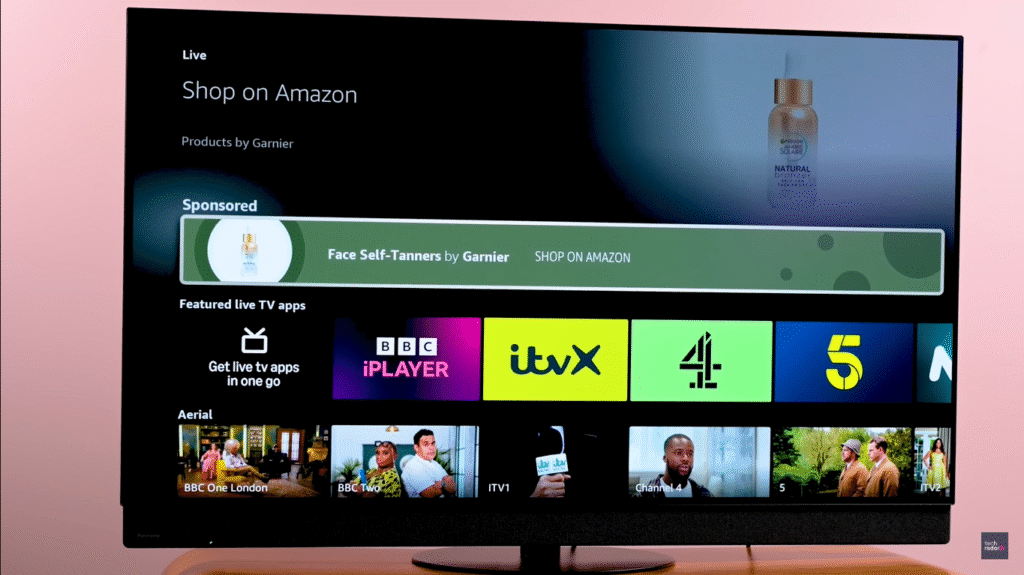
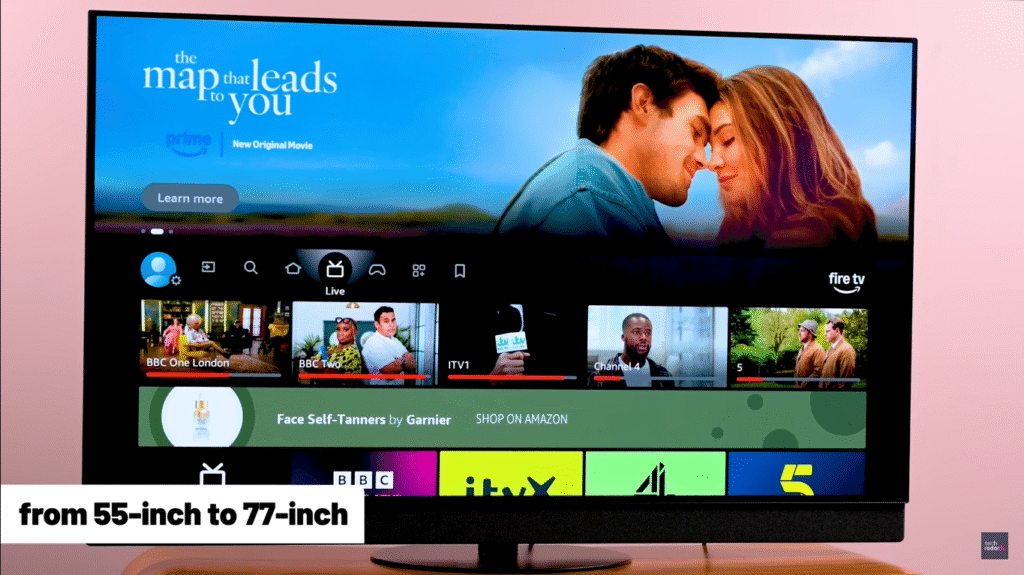
Smart TV Features: Fire TV Done Right
Panasonic continues its partnership with Amazon Fire TV OS, bringing a clean, fast, and content-rich interface.
Smart Features
- Fire TV OS with Alexa integration
- Personalized profiles
- App ecosystem (Netflix, Prime Video, Disney+, YouTube, Apple TV+, more)
- Live TV + OTA support
- Built-in voice commands
While it’s not as elegant as Google TV, Fire OS offers excellent customization and reliable app support.
Tip: Disable home screen ads via Settings > Preferences > Featured Content for a cleaner UI.
Connectivity & Ports
| Port Type | Details |
|---|---|
| HDMI | 4 total (2× 2.1 @ 48Gbps, 2× 2.0b) |
| USB | 2× USB 3.0 ports |
| Ethernet | 1× RJ45 |
| Audio | HDMI eARC, Optical, 3.5mm |
| Wireless | Wi-Fi 6, Bluetooth 5.2 |
| Broadcast | ATSC 3.0 (U.S. models) |
This setup is ideal for most homes — though creators using multiple HDMI 2.1 sources (console + PC + receiver) might need a switch or AVR
Cooling & Efficiency
Panasonic’s aerodynamic heat dissipation system ensures sustained brightness without degradation.
- Runs cool even in 2000+ nit HDR mode
- Energy optimized for long sessions
- Brighter and more stable than older MLA designs
Pricing & Value for Money
At ₹3,49,900 (~$3,299 for 65-inch), it’s priced against LG G5 and Samsung S95F.
However, when you factor in:
- Built-in 5.1.2 Atmos speakers (~₹60,000 value)
- Reference-level color accuracy
- Dolby Vision + HDR10+ support
…it becomes one of the most cost-effective premium OLEDs for serious viewers.
Value Verdict:
If you’re planning to buy a soundbar with your OLED, this TV already includes one — professionally tuned.
Final Verdict: The Reference OLED for 2025
The Panasonic Z95B is the OLED for people who want truth over flash — a screen that shows films exactly how they were mastered, with sound that fills a room like a dedicated theater setup.
While LG and Samsung push for peak brightness bragging rights, Panasonic’s Z95B finds equilibrium between discipline, HDR power, and immersion.
If you’re a creator, cinephile, or anyone serious about image fidelity, the Z95B is worth every rupee.
Comparison Summary
| Feature | Panasonic Z95B | LG G5 | Samsung S95F |
|---|---|---|---|
| Panel Type | RGB Tandem W-OLED | RGB Tandem W-OLED | QD-OLED |
| HDR Brightness | 2,354 nits | 2,200 nits | 2,300 nits |
| Color Accuracy | Reference-level | Excellent | Vivid/Boosted |
| HDMI 2.1 Ports | 2 | 4 | 4 |
| Built-in Audio | 5.1.2 Dolby Atmos | 4.2 | 2.2 |
| Dolby Vision | ✅ Yes | ✅ Yes | ❌ No |
| HDR10+ | ✅ Yes | ❌ No | ✅ Yes |
| Price (65″) | ₹3,49,900 | ₹3,19,900 | ₹3,09,900 |
Pros & Cons
✅ Pros
- Brightest Panasonic OLED ever (2350 nits HDR)
- Creator-grade accuracy (Filmmaker Mode perfection)
- Dolby Vision + HDR10+ Adaptive support
- 5.1.2 Dolby Atmos system
- Excellent gaming features (4K144, VRR)
- Great Fire TV integration
❌ Cons
- Only two HDMI 2.1 ports
- Dolby Vision banding for sensitive eyes
- Slightly bulky design
- No DTS passthrough
Yes. The Z95B reaches ~2,350 nits in Filmmaker Mode, slightly outperforming the LG G5’s ~2,200 nits peak brightness.
Only if you want better brightness, higher refresh (144Hz), and improved color volume. Otherwise, your Z95A remains excellent.
Absolutely. It supports 4K 144Hz with VRR and FreeSync, making it great for PS5, Xbox, and PC.
Top 5 Reasons to Avoid Panasonic Z95B
Author Section: TechRadar The latest technology news and reviews, covering phones, computing, home entertainment systems, gadgets, cameras, video games and more.


