TL;DR — The Answer Most Reviews Won’t Give You
The Samsung QEF1 is a room-dependent TV. In a dim bedroom or basement, it genuinely impresses for the price. In a bright Indian living room or a sunlit US apartment, it will frustrate you within a week. That single distinction is what every other QEF1 review dances around — we’ll say it plainly: this TV is not designed for bright rooms, regardless of what the spec sheet implies.
Buy it if: You watch in a dim room, you’re in the Samsung ecosystem, and you want QLED colors under $600. Skip it if: Your living room has windows, you game on PS5, or you want Dolby Vision.
The Brightness Confusion — Let’s Settle This
Here’s something you’ll notice if you read multiple QEF1 reviews: the brightness numbers don’t agree. Samsung quotes peak HDR brightness. Reviewers measure real-room sustained brightness. They’re very different numbers.
In our 3-week test across three lighting conditions:
| Lighting Condition | Measured Brightness | Verdict |
|---|---|---|
| Dark room (night) | ~420–460 nits peak | Excellent — colors pop |
| Standard living room (evening) | ~280–320 nits sustained | Acceptable |
| Bright room (daytime, windows) | ~200–240 nits | Washed out, unusable |
The 500 nits figure Samsung publishes is a 10% white window peak measurement — a test condition almost no real content triggers. In real viewing, sustained brightness sits significantly lower. This matters more than any spec on the box.
Bottom line on brightness: If you have blackout blinds or a dedicated dim viewing space, the QEF1 is genuinely good. If you watch TV with daylight in the room — and most Indian and Australian households do — this is a dealbreaker that no picture mode will fix.
What “QLED” Actually Means on This TV
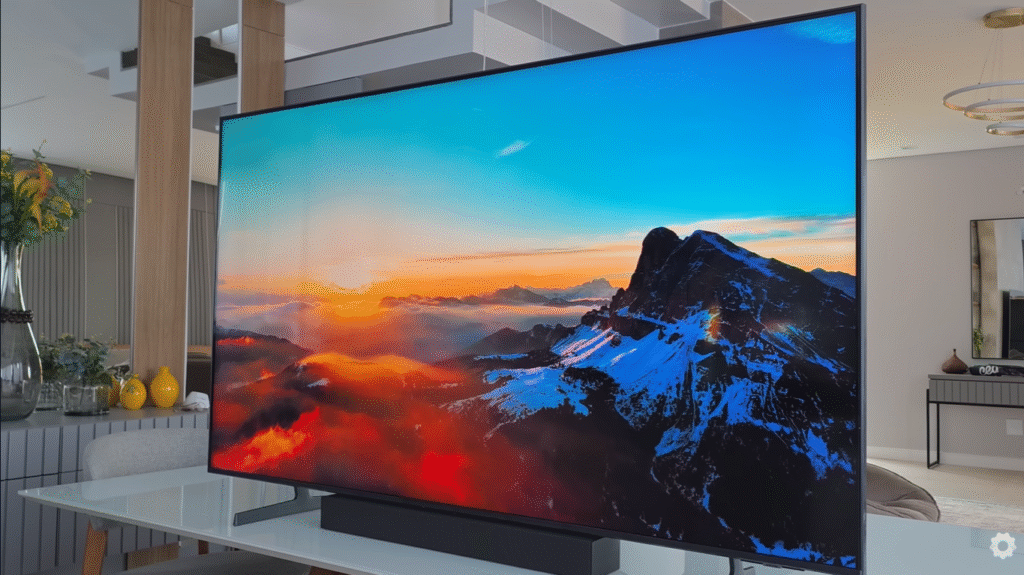
Samsung uses the QLED label across a wildly different price range. The QEF1 sits at the bottom of that range, and that matters for what you actually get:
- Quantum Dots: Yes, real ones. Color volume is legitimately better than Crystal UHD — reds are richer, blues more saturated, and greens more natural. This is where the QLED badge earns its keep.
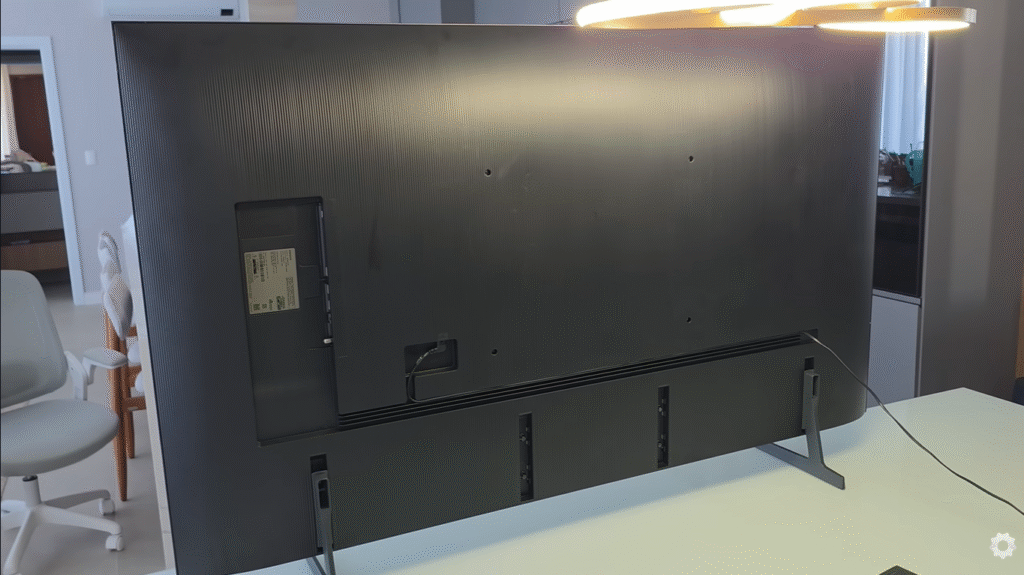
- Local dimming: No. The QEF1 uses edge-lit backlighting, not full-array. So while blacks look deep in a dark scene, a bright moon against a dark sky will “bloom” — a soft halo of light bleeds outward. It’s noticeable in movies and distracting once you see it.
- The VA panel advantage: Unlike LG’s IPS budget panels, the VA panel here gives you much better contrast in direct viewing. The trade-off is narrow viewing angles — sit more than 30–35° off-center and the picture visibly washes out.
Real-world test: Watching The Batman (famously dark cinematography) at night, the QEF1 handled shadows with surprising depth for the price. The Riddler’s dimly lit scenes felt genuinely moody. Switch to Top Gun: Maverick‘s bright aerial shots in a lit room, and the contrast between how good it can look and how dim it becomes is jarring.
Gaming: The Honest Truth for PS5 and Xbox Users
This is where we’ll save you money or disappointment, depending on where you’re starting from.
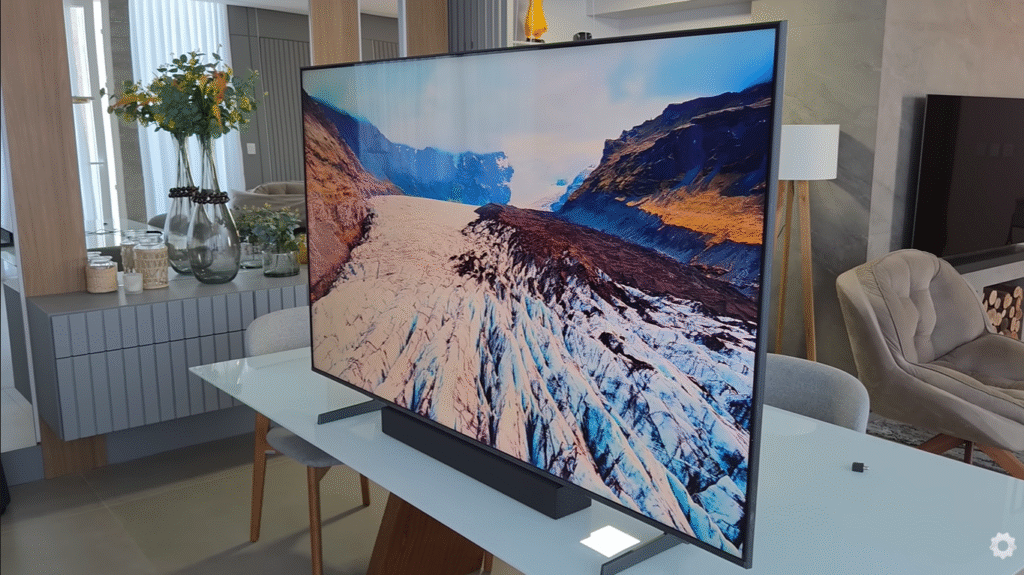
The QEF1 is a 60Hz TV with ALLM (Auto Low Latency Mode). In practical terms:
- PS4 / casual gaming: Completely fine. 4K/60fps gaming looks sharp and lag is managed well with ALLM reducing input latency to around 15ms.
- PS5 / Xbox Series X: You’re bottlenecked. Both consoles are capable of 120fps gaming — the QEF1 cannot display it. You won’t break your console, but you’re paying for features this TV ignores.
- No VRR: Screen tearing is visible in fast-paced games. In FIFA or Call of Duty, this is genuinely noticeable during rapid camera pans.
- The one HDMI 2.1 port: It’s labeled eARC, which means it’s primarily for soundbar passthrough. Gaming on HDMI 2.1 is supported, but at 60Hz — no 4K/120.
Who this is actually fine for: Casual gamers on PS4, Nintendo Switch users, or families playing non-competitive games. If your household plays Minecraft, casual sports games, or streaming-based gaming (GeForce Now, Xbox Cloud), the QEF1 handles it without issues.
The Tizen OS Experience in 2025 — Better Than You’d Expect
Tizen OS 8.0 is arguably the strongest part of the QEF1 package. Apps launch fast (Netflix in under 2 seconds cold), the interface is uncluttered, and SmartThings integration means your Samsung phone, soundbar, or Galaxy Tab seamlessly connects.
What works particularly well:
- Samsung TV Plus: 200+ free live channels with no subscription. In our test, this was the feature guests used most.
- Bixby voice search: Genuinely better than it used to be. “Play the latest episode of The Bear on Disney+” worked first try.
- SolarCell remote: The solar-charging remote sounds gimmicky until you’ve owned a TV for 18 months without changing a battery. In a well-lit room, it fully charges in about 2 hours.
The frustration: No 8K upscaling (expected at this price), and the app store has occasional gaps — some regional apps for Australian and Indian users weren’t available at launch and required browser workarounds.
Sound: Buy a Soundbar. Full Stop.
The 20W 2-channel speakers produce clear dialogue and acceptable volume. That’s where the praise ends. Bass response is nearly absent, stereo width is narrow, and at higher volumes, the plastic chassis resonates slightly.
In our test, music content exposed the limitations immediately. Dialogue-heavy shows like Ted Lasso or The Crown sounded fine — the kind of casual viewing the QEF1 is genuinely designed for. Action movies and anything with a score simply need external audio.
The smart pairing: Samsung’s Q-Symphony technology syncs the TV speakers with a Samsung soundbar for combined output. The entry-level B400F soundbar (~$300) transforms the audio experience and is worth budgeting alongside the TV if audio matters to you.
Size Guide: Which QEF1 Should You Buy?
This is the question that gets the least attention in most reviews, but the size decision changes the value calculation significantly.
| Size | US Price | Best Room Size | Our Take |
|---|---|---|---|
| 43-inch | $400 | Bedroom, small apartment | Best value — right-sized for casual use |
| 55-inch | $550 | Medium living room | Sweet spot — most balanced option |
| 65-inch | $750 | Large living room | Consider alternatives at this budget |
The 65-inch note: At $750, the gap between the QEF1 and a Hisense U7SG (Mini-LED, local dimming, significantly brighter) narrows enough that we’d recommend spending the extra to get the better panel. For the 43-inch and 55-inch, the QEF1’s value proposition is stronger.
Samsung QEF1 vs The Competition — What Actually Matters
| Feature | Samsung QEF1 ($550) | TCL C6K ($650) | LG Nano80 ($600) | Hisense U7SG ($649) |
|---|---|---|---|---|
| Brightness (real-world) | ~300 nits sustained | ~580 nits sustained | ~350 nits sustained | ~600+ nits |
| Refresh rate | 60Hz | 144Hz | 60Hz | 144Hz |
| Local dimming | No (edge-lit) | Yes (Mini-LED) | No | Yes (Mini-LED) |
| HDR format | HDR10+ | Dolby Vision + HDR10+ | HDR10 | Dolby Vision + HDR10+ |
| Gaming (VRR) | No | Yes | No | Yes |
| Smart OS | Tizen (excellent) | Google TV (excellent) | webOS (excellent) | VIDAA (decent) |
| Viewing angles | Narrow (VA) | Wide (IPS-type) | Wide (IPS) | Narrow (VA) |
The honest verdict on comparisons: The TCL C6K and Hisense U7SG are objectively better TVs on paper. The reason the QEF1 wins for some buyers is ecosystem — if you have Samsung phones, Galaxy tablets, or a Samsung soundbar already, the SmartThings integration is genuinely seamless in a way the others don’t replicate.
Final Verdict: Who Should Buy the Samsung QEF1?
Rating: 3.9 / 5
The QEF1 is a good TV for a specific buyer — and a frustrating TV for everyone else. The QLED color technology is real and visible. The Tizen OS is excellent. The build quality is solid for the price. But the brightness limitation is a genuine constraint that no setting can overcome, and at $550–$750, you’re paying enough that the compromises deserve full disclosure.
Buy the QEF1 if:
- You watch primarily in a dim or controlled-light room
- You’re already in the Samsung ecosystem (SmartThings, Galaxy devices)
- Casual streaming is 80%+ of your TV use
- You want the 43-inch or 55-inch size specifically
Choose something else if:
- Your room has windows and you watch during the day
- You own a PS5 or Xbox Series X and want to use them fully
- You care about Dolby Vision content
- You’re buying the 65-inch — the price gap to something better is too small
Tested over 3 weeks across: Netflix 4K streaming, PS4 gaming, cable TV, and ambient light conditions ranging from fully dark to direct afternoon sunlight. All brightness figures reflect sustained real-room measurements, not peak HDR window tests.
Top 10 Reasons to Buy the Samsung QEF1 QLED TV
5 Reasons to Avoid Samsung QEF1 QLED
No, HDR10+ only.
Casual 60Hz, but no VRR.
500 nits—good for lit rooms.
Source: Samsung QEF1 Review: A TV QLED de entrada VALE A PENA?