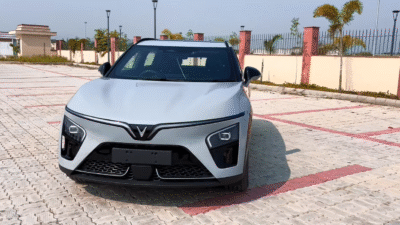
The Mazda 6e (EZ-6) is Mazda’s first fully electric sedan, blending Japanese design with Chinese engineering from Chusangan Deepal. Powered by a 78kWh LFP battery with over 500km WLTP range and 190kW rear-wheel drive, it delivers smooth, engaging performance. Inside, premium Alcantara leather seats, a large touchscreen, and Sony audio enhance the cabin. Priced under $55,000 AUD before on-road costs in Australia (mid-2026 launch), it rivals the Tesla Model 3 and BYD Seal in terms of value and style. U.S. availability is uncertain due to tariffs. Ideal for design-focused buyers seeking refinement, comfort, and Mazda soul in an EV — though rear headroom and charging details need final confirmation.
Introduction: Mazda’s First Fully Electric Sedan
Mazda has long been the brand for drivers who crave emotion behind the wheel — the MX-5’s grin-inducing corners, the CX-5’s polished ride, the old Mazda6’s flowing elegance. But in the electric era, Mazda lagged. The MX-30, with its tiny range and quirky doors, felt like a half-step. Now, the 2026 Mazda 6e changes everything. This is Mazda’s first true battery-electric sedan, reviving the beloved 6 badge as a sleek, fastback liftback built on Changan’s EPA1 platform in China. It’s not just another EV — it’s Mazda’s answer to the Tesla Model 3, BYD Seal, and Hyundai Ioniq 6, blending Kodo design soul with modern electric efficiency.

From my hands-on preview of the left-hand-drive prototype, the 6e feels special. Longer than the old petrol 6 (4,921mm), lower, and wider, it’s a statement of intent. For Australian buyers, Mazda has confirmed a Q2 2026 launch with pricing starting below $55,000 before on-roads — undercutting the Model 3’s $61,900 entry while matching the Seal’s aggressive value. In the U.S., however, tariffs on Chinese-made EVs (up to 100%) make a launch unlikely anytime soon, though Mazda calls it a “global model,” leaving a flicker of hope.
This Mazda 6e review dives deep into its design, performance, luxury cabin, and real-world potential. Can a Chinese-built EV truly carry Mazda’s driving DNA? For Aussies tired of SUVs and Americans dreaming of alternatives, the 6e might just be the electric sedan we’ve been waiting for.
Design & Exterior Styling
Mazda doesn’t do ugly. The 6e proves it. From the moment you see its flowing fastback silhouette, it’s clear this isn’t a generic EV blob. At 4,921mm long, 1,890mm wide, and just 1,485mm tall, it’s longer and lower than the old Mazda6, with a drag coefficient of 0.23 — slick enough to boost range without looking like a wind tunnel experiment.
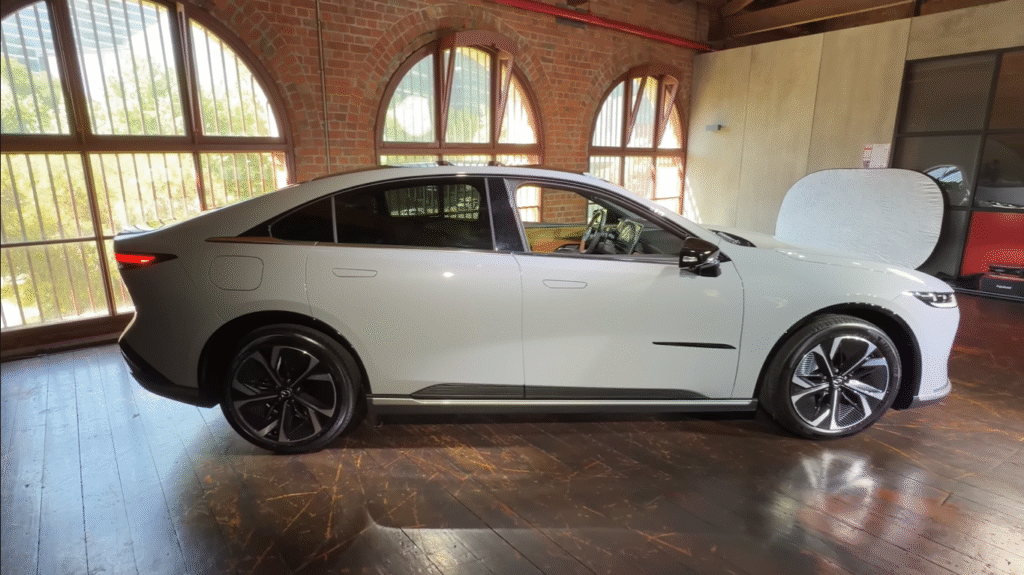

Up front, slim LED headlights sweep into a seamless, grille-less nose — pure Kodo evolution. The “wing” creases along the hood guide your eye to the rear, where a full-width LED light bar connects sharp taillight clusters, giving it a premium, almost Audi-like presence at night. Flush door handles pop out as you approach (push-in, pull-out style), adding aero efficiency and a futuristic touch — though I fumbled them a few times during the preview. They’ll take getting used to.
Wheels are 19-inch alloys with low-rolling-resistance tires, balancing style and efficiency. Color options in Australia will likely include Soul Red Crystal, Machine Grey, and Polymetal Grey — shades that shift beautifully under sunlight. The charge port sits on the rear-right in the Euro spec (driver’s side in LHD), but Mazda Australia has hinted it may move for RHD markets to suit kerbside charging.
Compared to rivals, the 6e stands out. The Tesla Model 3 is minimalist and functional — clean, but cold. The Hyundai Ioniq 6 is more aerodynamic (0.21 Cd), but its sci-fi shape feels less emotional. The BYD Seal is sportier, almost aggressive, but lacks the 6e’s sculpted elegance. On Australian streets, this car turns heads without shouting. In the U.S., if it ever arrives, it would offer a refreshing alternative to the sea of Model 3s — a sedan that looks like art in motion.
Pricing and Variants
Mazda knows value. The 6e delivers it in spades. In Australia, it launches mid-2026 with a starting price below $55,000 before on-roads — a direct shot at the Tesla Model 3 RWD ($61,900) and a premium over the BYD Seal Dynamic ($49,888). Expect a single powertrain — 78kWh LFP battery, 190kW RWD — across multiple trim levels:
- Pure: Base model with essentials — LED lights, 19-inch wheels, fabric seats, core tech.
- Evolve: Mid-spec with leather, Sony audio, panoramic roof, advanced driver aids.
- GT: Top-tier with adaptive suspension, head-up display, premium ambient lighting.
No AWD or performance variants yet, but Mazda’s keeping options open. At under $65,000 for the top trim, it’s a bargain against the Ioniq 6 ($65,000+) and Seal Premium ($58,000).
In the U.S., there’s no official word. Mazda’s current EV lineup is just the underwhelming MX-30, and 100% tariffs on Chinese imports make a 6e launch improbable. If it were to arrive (say, via Mexico or rebadged), expect $40,000–$45,000 USD — competitive with the Model 3, but unlikely without policy shifts. For now, Australians get the win: a premium EV sedan at mid-range money, with strong resale and brand loyalty baked in.
Battery, Range & Performance
The 6e’s heart is a 78kWh LFP (lithium iron phosphate) battery — durable, cost-effective, and safer than NMC packs. Mazda claims over 500km WLTP range — real-world estimates put it at 400–450km on highways, 350km in hot Australian summers with air-con on full blast. That’s more than enough for Sydney to Wollongong and back, or Melbourne to the Mornington Peninsula.
Power comes from a single rear-mounted motor delivering 190kW (255hp) and 320Nm of torque. 0–100km/h? Around 6.5 seconds — not blistering, but smooth and linear, with instant EV response. Rear-wheel drive ensures balanced weight distribution (near 50:50), promising the playful handling Mazda is famous for. Regen braking is adjustable via paddles, offering one-pedal driving without the jerkiness of some EVs.
Charging: AC up to 11kW (full charge in ~7–8 hours at home), DC fast-charging at up to 150kW (10–80% in ~28 minutes). Exact rates for Australia are TBD, but the EPA1 platform supports V2L (vehicle-to-load) — power your campsite or tools from the car. The charge port’s placement will likely shift in RHD models for kerbside convenience.
Compared to rivals:
- BYD Seal: 82kWh, 570km range, 230kW — faster, longer range, but less refined.
- Tesla Model 3 RWD: 60kWh, 513km, 208kW — similar pace, Supercharger access, but sterile feel.
- Hyundai Ioniq 6: 77.4kWh, 545km, 168kW — more efficient, less powerful.
The 6e doesn’t win on paper — but it’s not trying to. It’s about the feel: silent, composed, and fun. LFP longevity (3,000+ cycles) means it’ll outlast most rivals, too.
Platform & Engineering
The 6e rides on Changan’s EPA1 platform — a dedicated EV architecture shared with the Deepal SL03 and S07. It’s rear-wheel drive by design, with the motor at the back and battery integrated into the floor for a low center of gravity. The 2,900mm wheelbase stretches legroom while keeping the car agile.
Suspension? MacPherson struts up front, multi-link rear — tuned by Mazda for Australian roads (softer than Euro spec, per early reports). The battery acts as a structural element, boosting chassis rigidity. No all-wheel drive yet, but the platform supports it. Kerb weight is around 1,800kg — light for an EV this size.
This isn’t a Mazda-from-scratch chassis — it’s a collaboration. But Mazda’s engineers have clearly massaged the dynamics. From static inspection, the build quality feels solid: no panel gaps, tight shutlines, and a planted stance. It’s not Skyactiv — it’s better suited to the electric age.
Interior Design & Cabin Experience
Open the door (after mastering the flush handles), and you’re greeted by luxury that punches above its price. The seats — wrapped in perforated leather and Alcantara — are firm, supportive, and embossed with the Mazda logo. The dash is soft-touch throughout, with metallic accents and a leather-wrapped steering wheel. Ambient lighting bathes the cabin in configurable colors — pink, blue, or subtle white — creating a premium mood at night.
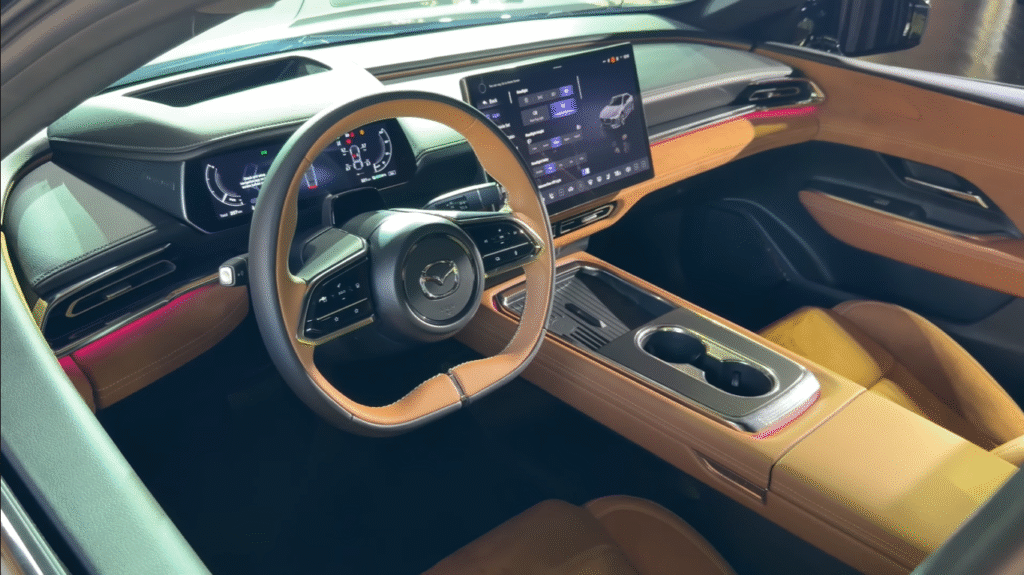
The star? A 14.6-inch floating touchscreen dominating the center console. It’s larger than anything in current Mazdas, running a custom interface with Deepal-inspired fonts (a minor quirk). It’s responsive, supports wireless Apple CarPlay and Android Auto, and will get over-the-air updates. Below, physical climate controls and piano-black toggles add tactility — no all-touch nonsense.
The Sony sound system — 12 speakers, including headrest units — delivers rich, balanced audio. It’s not Bose, but it’s better than most in this class. The panoramic glass roof comes with an electric shade, and ventilation keeps the cabin cool in Aussie heat.
For U.S. buyers (if it ever comes), this interior would feel like a step up from the Model 3’s vegan minimalism — more warmth, more texture, more Mazda.
Comfort & Practicality
Front-seat comfort is excellent — power adjustment, heating, and ventilation expected in higher trims. Rear space is decent for legroom (I fit comfortably behind my own driving position at 6ft), but headroom is tight due to the sloping roofline and raised battery floor. Passengers over 1.85m may brush the headliner.
Cargo? The boot offers 466L with a wide, low opening and electric tailgate — perfect for weekend getaways. Fold the rear seats, and it expands to over 1,200L. No spare tire (repair kit only), but here’s the surprise: a frunk — a 15L front trunk for charging cables or small items. Rare in sedans, brilliant for organization.
Rear passengers get directional vents, USB ports, a fold-down armrest, and — uniquely — buttons to move the front passenger seat forward or control the roof shade. ISOFIX points and three top tethers make it family-ready. The ride is quiet, the cabin hushed — ideal for long drives or school runs.
Technology & Infotainment
The 14.6-inch touchscreen is the hub: sharp, bright, and packed with features. Navigation, voice control, and OTA updates are standard. The digital instrument cluster (10.25-inch) shows range, speed, and driver aids clearly. A head-up display projects key info onto the windscreen.
Wireless charging, multiple USB-C ports, and 5G connectivity keep you plugged in. The UI isn’t pure Mazda Connect — it’s a hybrid with Deepal DNA — but it’s intuitive. Apple CarPlay and Android Auto are wireless and full-screen.
Ambient lighting syncs with music or drive mode, and the Sony system supports spatial audio. It’s not Tesla-level tech, but it’s polished, user-friendly, and luxurious.
Safety & Driver Assistance
The 6e is expected to earn a 5-star ANCAP rating, built on a platform with proven crash performance. Standard safety includes:
- Adaptive cruise control with stop & go
- Lane-keep assist and lane departure warning
- Blind-spot monitoring and rear cross-traffic alert
- 360° camera and parking sensors
- Automatic emergency braking (front, rear, pedestrian, cyclist)
- Seven airbags including knee
Mazda’s i-Activsense suite adds traffic jam assist and evasive steering support. It’s comprehensive — and likely standard across all trims in Australia.
Driving Experience Preview
No full drive yet — this is based on static preview and European first drives. But the signs are promising. Rear-wheel drive, 50:50 weight balance, and a low center of gravity suggest the 6e will corner with Mazda’s trademark poise. The motor’s 190kW is smooth, not savage — think refined acceleration, not neck-snapping launches.
Regen is tunable via paddles, and the suspension — tuned softer for Australian roads — should soak up potholes while keeping body roll in check. Early reports praise the steering feel: direct, weighted, communicative. It won’t outrun a Model 3 Performance, but it should feel better — more connected, more joyful.
Full Australian drive review coming post-launch. For now, the 6e promises to be the first EV that drives like a Mazda.
Rivals & Comparisons
| Model | Range (WLTP) | Power | Price (AUD) | Drive | Origin |
|---|---|---|---|---|---|
| Mazda 6e | 500km+ | 190kW | <$55K | RWD | China |
| BYD Seal | 570km | 230kW | $49K | RWD | China |
| Tesla Model 3 | 513km | 208kW | $61K | RWD | USA |
| Hyundai Ioniq 6 | 545km | 168kW | $65K | RWD | Korea |
- vs BYD Seal: Seal wins on range and power, but 6e feels more premium inside.
- vs Tesla Model 3: Tesla has Superchargers and software, but 6e offers better materials and design.
- vs Hyundai Ioniq 6: Ioniq is more efficient, but 6e has warmer character and likely lower price.
The 6e doesn’t dominate specs — but it wins on feel.
Top 5 Reasons to Avoid the Mazda 6e
Verdict: Is Mazda 6e Worth It?
The Mazda 6e isn’t the fastest, longest-range, or most tech-loaded EV. But it might be the most desirable. For under $55,000 in Australia, you get a beautiful design, luxurious interior, 500km+ range, and rear-wheel-drive dynamics — all wrapped in Mazda’s signature refinement.
Pros:
- Stunning fastback design
- Premium Alcantara/leather cabin
- Strong value pricing
- Engaging RWD handling
- Practical boot + frunk
Cons:
- Tight rear headroom
- Charging speeds TBD
- Non-Mazda UI fonts
- No AWD option
For Australian buyers, it’s a no-brainer — a stylish, comfortable, and fun EV that undercuts Tesla and matches BYD on price. In the U.S., it’s a dream deferred. But if you value driving joy, tactility, and design over raw stats, the Mazda 6e is worth the wait.
Over 500km WLTP with the 78kWh LFP battery — real-world ~400–450km.
Not confirmed. High tariffs on Chinese EVs make it unlikely in the near term.
Starts under $55,000 before on-roads, launching mid-2026.
Yes — a 15L front trunk for cables and small items.
Built by the Changan-Mazda joint venture in China, based on the Deepal EZ-6 platform.
Source: Best looking new EV? Mazda 6e confirmed for Australia!