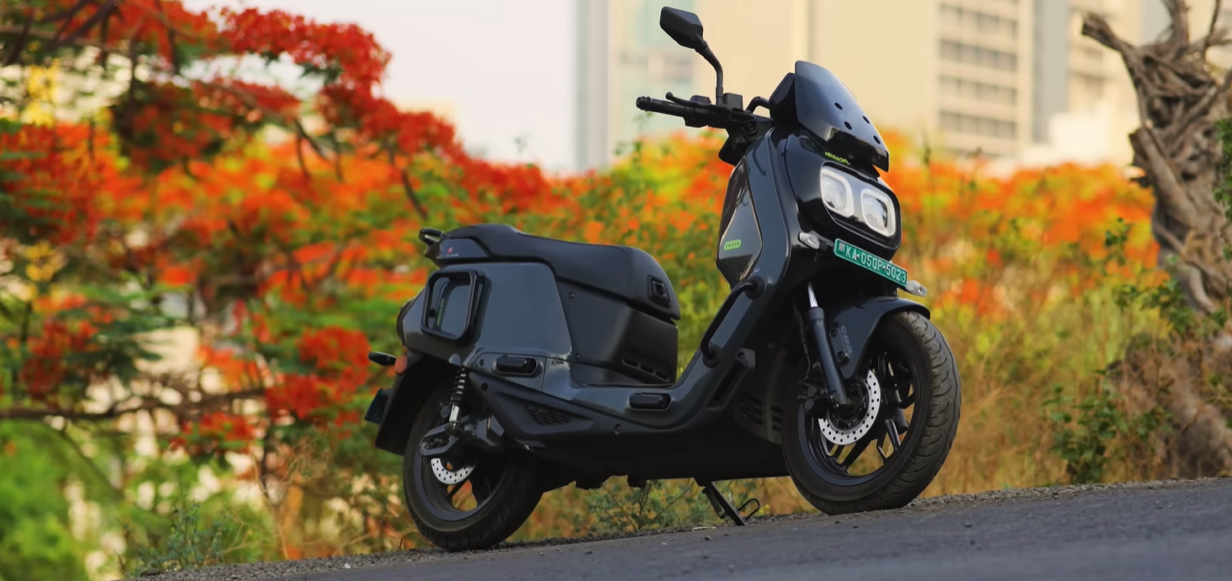
The River Indie was already one of the most interesting electric scooters in India when we first reviewed it. It won the Red Dot Design Award in 2024 for the concept and then won it again for the production model — a rare double that tells you something meaningful about how seriously River Electric takes product design. The Gen 3 builds on that foundation with a flurry of changes that address some of the most common complaints from owners and reviewers. Seven kilograms lighter. More ground clearance. Chain drive replacing belt drive. A dedicated parking button. Hill-hold control.
We rode it, drained the battery across all three modes, tested the hill-hold, and have the complete honest verdict. The short version: this is genuinely almost perfect — but one problem has stubbornly survived all three generations and it needs to be fixed before River can take on Ather and the more established players at ₹1.5 lakh.
Quick Verdict — Before We Go Deep
The River Indie Gen 3 is the most refined version of a product that was already strong. The weight reduction is significant and felt immediately in real-world handling. The chain drive conversion is a smart practical decision. The ground clearance improvement opens the Indie to riders who load it with luggage and a pillion. Battery range is honest and consistent across all modes — what River claims is what you get.
The front suspension remains under-damped. This was the biggest criticism of the previous generation and it has not been addressed in Gen 3. At ₹1.5 lakh, this is the gap between almost perfect and actually perfect — and it needs to close before the next generation arrives.
Full Confirmed Specifications
Motor: Hub motor — peak power not disclosed by River
Battery: 4kWh — unchanged from previous generation
Claimed range: Up to 110km maximum
Real-world range tested: Rush mode — approximately 65km Ride mode — approximately 85km Eco mode — approximately 106km Range variation across modes — approximately 5km variance
Weight: 135kg — reduced by 7kg from previous generation
Ground clearance: 177mm — increased by 9mm from previous generation
Wheels: 14-inch front and rear
Tyres: Wide profile — fatter than standard scooter tyres
Suspension front: Telescopic forks — under-damped (unchanged from Gen 2)
Suspension rear: Preload-adjustable twin shocks — among the best on any scooter tested
Brakes: Combined braking system — disc front and rear
Drive system: Chain drive (converted from belt drive)
Storage: 55 litres underseat + pannier compatible + top box compatible
Dashboard: TFT display — updated layout, same size as previous
Hill-hold control: New addition — works on inclines, inconsistent on declines and flat surfaces
Parking button: New dedicated separate button
Handlebar: New tubular design with plastic cover to reduce vibrations
Bar ends: New addition — prevents accidental acceleration during falls
Awards: Red Dot Design Award 2024 (concept) + Red Dot Design Award (production model)
Notable: Yamaha India uses River Electric for EV scooter manufacturing — a significant industry validation
Price: Approximately ₹1.5 lakh ex-showroom
Service network: Approximately 60 touchpoints currently — targeting 100 by end of 2026
Design — Red Dot Award Winner, and Deservedly So
The River Indie Gen 3 looks exactly like the River Indie Gen 2 — and that is the right decision. When you have a design that wins the most prestigious product design award in the world twice, you do not change it. The utilitarian SUV-inspired design language that River calls the SUV approach continues to divide opinion between those who find it quirky and those who find it genuinely distinctive. Both groups are right.
The 14-inch wheels with wide tyres give the Indie a planted, robust visual presence that most scooters cannot match. The wide body, flat floorboard, and generous proportions mean the Indie looks spacious from the outside and genuinely is spacious on the inside. No competing electric scooter at this price — and arguably at any price — offers the storage versatility that the Indie delivers.
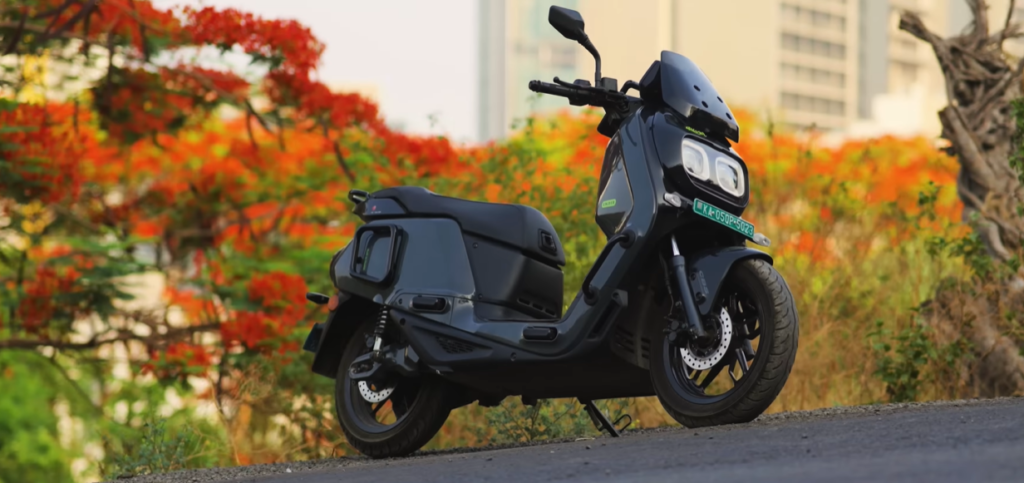
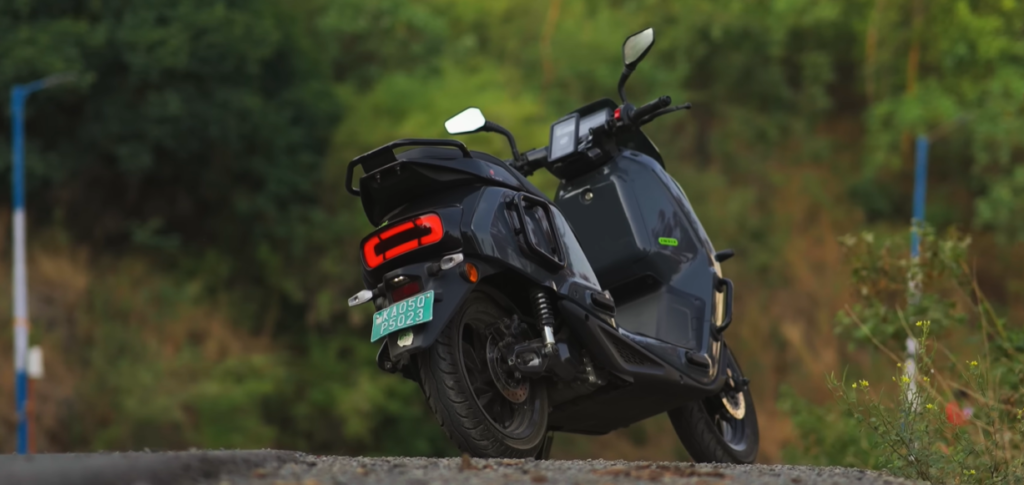
The only exterior change in Gen 3 is a modification to the grab rail at the rear. This has been redesigned to make top box fitting easier and cleaner. The integration of top box, panniers, and underseat storage makes the Indie the most practical electric scooter available in India for riders who carry luggage, groceries, or equipment regularly.
What Changed in Gen 3 — The Complete List
1. Weight reduced by 7kg to 135kg
This is the biggest change and the most impactful in real-world riding. Seven kilograms is a significant reduction on a vehicle that weighs 135kg — roughly a 5% reduction in total mass. The weight loss comes primarily from a completely new chassis. A lighter EV handles more responsively, is easier to manoeuvre in tight spaces, and puts less strain on tyres and brakes.
2. Ground clearance increased to 177mm
The 9mm increase in ground clearance comes directly from the new chassis design. At 177mm the Indie can now be ridden fully loaded — rider plus pillion plus luggage — over speed breakers, rough roads, and uneven surfaces without scraping. This addresses a real concern from owners who regularly use the Indie as a daily workhorse rather than a light commuter.
3. Chain drive replacing belt drive
The switch from belt drive to chain drive is a pragmatic decision that improves the ownership experience in two ways. Chain drives are more energy efficient — the power transmission from motor to wheel loses less energy to flex and absorption compared to a belt. And chain maintenance, while requiring occasional lubrication and tension checks, uses universally available parts that any mechanic can service. Belt replacements require authorised service centres and the specific belt River uses. The chain drive also contributes to the weight reduction.
4. Dedicated parking button
The previous Indie’s parking mechanism required a specific lever or button interaction that riders found awkward in tight spaces. The Gen 3 adds a completely separate, clearly labelled parking button that operates independently. In testing this is immediately more intuitive — you press the parking button and the scooter holds its position without any secondary action required. The button quality on the Gen 3 across all controls is noticeably improved compared to previous generations.
5. Bar ends on handlebars
Bar ends added to the handlebar ends serve a specific safety function: if the Indie falls over, bar ends prevent the throttle from being accidentally depressed while the rider is trying to pick the scooter up. This is a minor but genuinely thoughtful safety addition.
6. New handlebar design and vibration reduction
The tubular handlebar with new plastic covers has been redesigned specifically to reduce vibration transmission to the rider’s hands during riding. In testing this improvement is noticeable compared to the outgoing model — particularly during longer rides and on moderately rough roads.
7. Hill-hold control
New addition on Gen 3. More on this below.
Battery and Range — Honest and Consistent
The 4kWh battery carries over unchanged from the previous generation. The maximum claimed range of 110km is modest by 2026 electric scooter standards — the Ather 450S claims 115km, the Ola S1 Air claims 151km, and the Bajaj Chetak Premium claims 123km, all from comparable or slightly smaller batteries.
What distinguishes the Indie’s range story is consistency. In testing across all three ride modes the real-world range showed approximately 5km of variation regardless of riding style or speed. This is highly unusual.
Most electric scooters show dramatically different range results depending on how aggressively they are ridden — a 30% to 40% variation between gentle and aggressive riding is common. The Indie showed only 5% variation. This means what River claims in each mode is what you actually get, reliably, every time.
Rush mode delivered approximately 65km. Ride mode delivered approximately 85km. Eco mode delivered approximately 106km — close to the claimed 110km maximum.
The Eco mode performance deserves a specific note. The Indie in Eco mode can climb an 18-degree incline — a surprisingly capable result for a battery-conserving mode. The trade-off is throttle response, which becomes noticeably slower and less satisfying in Eco. For pure range extraction Eco works. For everyday urban riding Ride mode is the correct default.
One important finding for owners: the battery management system on the Gen 3 appears to cut off slightly earlier than the previous generation, at approximately 3% rather than 1% as seen before. Keep a 5% buffer as a practical minimum to avoid being stranded.
Zero mechanical failures, zero overheating incidents, and zero unexpected mode changes were recorded across the entire testing period. The reliability story of the River Indie continues to be one of its strongest selling points.
The One Unresolved Problem — Front Suspension
This section needs to be read carefully because it is the most important honest assessment in this review.
The rear suspension on the River Indie Gen 3 is genuinely excellent. Preload-adjustable twin shocks absorb road imperfections cleanly and completely. Whether riding solo, with a pillion, or with luggage, the rear end manages inputs without sending shocks through to the rider. In the context of Indian road conditions this rear suspension is genuinely class-leading.
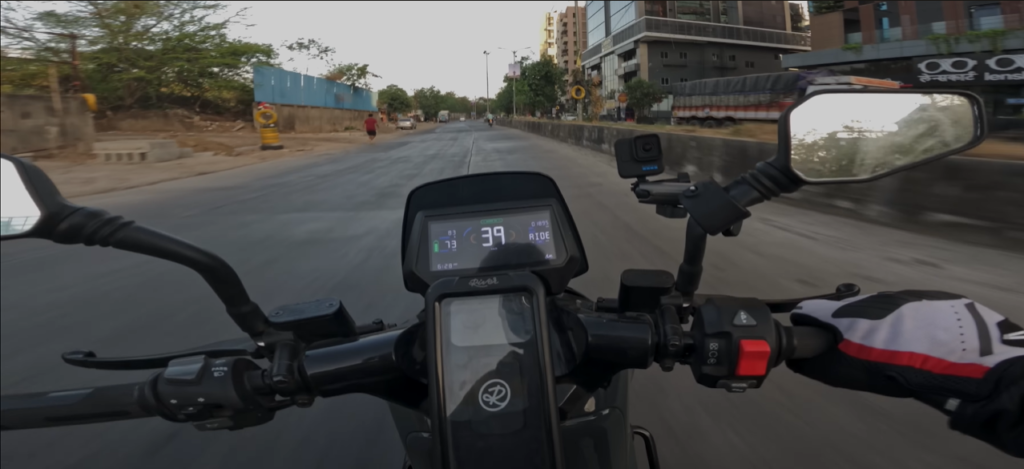
The front suspension is the opposite. The telescopic forks are under-damped — specifically, the rebound damping is insufficient. When the front wheel hits a bump, the fork compresses as it should, but then rebounds too quickly. The result is feedback through the handlebars that can be genuinely uncomfortable on bad roads or speed breakers. This was the primary suspension criticism of the Gen 2. It is still present on the Gen 3. River has not tweaked the front suspension setup between these two generations.
The consequences of under-damped front forks extend beyond ride comfort. Under hard braking, a well-damped front fork stays compressed, maintaining tyre contact with the road and maximising braking force. An under-damped fork rebounds quickly during braking, causing the wheel to briefly lose full road contact. This reduces braking effectiveness at the precise moment you need it most.
The River Indie’s brakes are otherwise strong. Combined braking system, good disc size, progressive feel. But the full potential of the braking system cannot be realised while the front fork continues to bounce under hard braking inputs.
This is the single most important engineering change River needs to make for Gen 4. Better rebound damping on the front fork would simultaneously improve ride comfort on rough roads and braking performance under hard stops — a double benefit that would meaningfully close the gap to Ather.
Hill-Hold Control — A Useful Feature That Needs Refinement
Hill-hold control is a new addition on the River Indie Gen 3 and the idea is sound. When both brake levers are pressed simultaneously, the system is supposed to hold the scooter stationary on inclines, allowing the rider to remove their hands from the brakes when stopped on a slope.
In testing, the feature works reliably on uphill inclines as designed. Press both brakes simultaneously, see the system activate on the TFT display, release the brakes, and the scooter holds position.
The problem is activation on declines and surfaces with less prominent gradient. On downhill slopes, the hill-hold does not engage, which creates a situation where the rider must hold the brake continuously until they are ready to move. On flat or very gently sloped surfaces, simultaneous brake press initiates the system on the display but physical engagement does not always follow.
This is clearly a calibration and software issue rather than a fundamental engineering flaw. The sensors need to detect the gradient more accurately and the engagement threshold needs adjustment. River should be able to address this through a software update. Until it is resolved, treat hill-hold as a feature that works on obvious uphill inclines and maintain brake coverage on declines and shallow gradients.
Comfort and Practicality — Still Class-Leading
The River Indie Gen 3’s riding position is one of the most accommodating available on any Indian two-wheeler. Forward-mounted footpegs, a wide flat floorboard, and a spacious rider’s triangle mean riders of different heights and body types can find a comfortable position without compromise. The seat is wide, plush, and supportive for both rider and pillion — longer journeys do not produce the discomfort that narrow scooter seats cause.
The flat floorboard serves double duty as both a comfort feature and a practical one. You can place a bag, a helmet, or groceries flat on the board between your legs without the awkwardness of positioning items on a traditional stepped floorboard. For urban commuters who carry items regularly, this is a genuine daily convenience.
Storage totals 55 litres under the seat from the factory. The addition of River’s own pannier accessories and top box — designed specifically for this scooter — can extend available storage significantly beyond any competitor. River has designed the Indie’s architecture specifically to accommodate these accessories cleanly, which is why the grab rail redesign in Gen 3 specifically improves top box fitment.
The Yamaha Validation — What It Means for Buyers
Yamaha India has chosen River Electric as the manufacturing partner for their electric scooter. This is significant market intelligence for potential buyers. Yamaha is one of the most engineering-conservative two-wheeler manufacturers in the world — they do not partner with companies whose engineering they do not trust. The fact that Yamaha’s electric scooter is being manufactured by River is the strongest possible third-party validation of River’s R&D quality and manufacturing capability.
For buyers concerned about the long-term viability of a relatively new brand in India’s electric two-wheeler market, the Yamaha partnership is the most reassuring signal available.
Service Network — Growing but Still Expanding
River Electric launched with a limited sales and service network, which was one of the most frequently cited concerns among potential buyers. Gen 3 arrives with approximately 60 touchpoints across India and a stated target of approximately 100 by the end of 2026.
60 touchpoints is still modest compared to Ather’s presence (200 plus experience centres), Ola Electric’s growing service infrastructure, or established brands like Bajaj and TVS. For buyers in major cities and tier-1 towns the network is adequate. For buyers in smaller cities and rural areas it remains a practical concern that should be verified before purchase.
The expansion to 100 touchpoints by the end of 2026 — if achieved on schedule — would meaningfully reduce this as a buying objection. Check River’s dealer locator for your specific area before making a decision.
Pricing — ₹1.5 Lakh and What It Competes Against
At approximately ₹1.5 lakh the River Indie Gen 3 enters the most competitive segment in India’s electric two-wheeler market. Key competitors at similar pricing include the Ather 450S at approximately ₹1.4 lakh, the Ola S1 Pro at approximately ₹1.3 lakh, and the Bajaj Chetak Premium at approximately ₹1.25 lakh.
The Indie’s strongest advantages at this price are storage versatility, ground clearance, riding comfort, and range consistency. No other scooter offers 55 litres plus pannier plus top box storage in one integrated ecosystem. No other scooter at this price has 177mm of ground clearance.
The Indie’s weakest points at this price are the front suspension and the hill-hold inconsistency. The Ather 450S offers better suspension balance, a more mature software ecosystem, and a stronger service network at a comparable price. If suspension refinement and service access are your priorities — Ather is the more polished product.
If storage, practicality, ride comfort on the rear end, and range consistency are your priorities, the River Indie Gen 3 is the correct choice.
Pros and Cons
What works:
- 7kg weight reduction — immediately felt in handling
- 177mm ground clearance — best in segment for loaded riding
- Chain drive — lower maintenance cost, improved efficiency
- Consistent range across all modes — 5km variation only
- Zero mechanical failures in testing — robust and reliable
- Rear suspension — class-leading twin shock setup
- 55 litres underseat plus pannier and top box support
- Wide plush seat — comfortable for rider and pillion
- Flat floorboard — practical for cargo carrying
- New dedicated parking button — more intuitive operation
- Reduced handlebar vibration — genuine improvement
- Bar ends — a safety feature for fall scenarios
- Red Dot Award-winning design — twice
- Yamaha manufacturing partnership — strong brand validation
- Service network expanding to 100 touchpoints by the end of 2026
What doesn’t:
- Front suspension remains under-damped — unchanged from Gen 2
- Front fork rebound affects braking effectiveness under hard stops
- Hill-hold control works only on obvious inclines — inconsistent on declines and flat gradients
- 110km maximum range — modest vs competition at this price
- Battery carries over unchanged — no capacity improvement
- No navigation built-in — phone mount accessory required
- Regen braking not adjustable — fixed level only
- Service network at 60 touchpoints — still below major competitors
- ₹1.5 lakh positions it against more refined competition
Who Should Buy the River Indie Gen 3?
Buy it if you: Need maximum storage for daily commuting, carry luggage or groceries regularly, ride with a pillion frequently, want the best ground clearance in the segment, and prioritise ride comfort on city roads where the rear suspension can shine.
Skip it if you: Prioritise front suspension refinement above all else, need a comprehensive service network in a smaller city, or want the most polished and feature-complete software ecosystem — in which case Ather 450S is the better choice.
Wait for Gen 4 if: You like everything about the Indie but the front suspension concern is a deal-breaker for you — River has the engineering competence to fix this and it should be the top priority for the next generation.
Consider the Indie specifically over competitors if: You regularly load the scooter with panniers, a top box, and pillion simultaneously — no other electric scooter at any price in India supports this use case as well as the River Indie.
MyPitShop Final Verdict
The River Indie Gen 3 is the most refined version of one of India’s most distinctive and genuinely useful electric scooters. The 7kg weight reduction is real and felt. The ground clearance improvement is meaningful for loaded riding. The chain drive conversion is the right practical decision. The range consistency is exceptional.
But the front suspension story — unchanged across three generations — is the one problem that prevents a wholehearted recommendation at ₹1.5 lakh. When Ather, Ola, and Bajaj are all competing at similar prices with better-balanced suspension, the Indie’s under-damped front fork is a competitive liability that engineering can fix.
The Yamaha manufacturing partnership and the expanding service network both signal that River Electric is building for the long term. The product quality is there. The engineering competence is clearly there. The front suspension fix is the last meaningful obstacle between the River Indie and a five-star recommendation.
Until that happens: four out of five. Highly recommended for practical commuters who need storage above all else. Test ride it before you buy — the rear suspension will impress you and the front suspension will tell you honestly whether it is something you can live with.