TL;DR – Should You Buy the Poco F8 Pro?
YES, if you want flagship performance without flagship prices. Here’s what makes it compelling:
🔋 Best-in-Class Battery Life: 6,210mAh battery delivers 17.5 hours active use (beats previous Pro & F7 Ultra)
⚡ 100W Fast Charging: Full charge in under an hour (no charger included though)
📱 Stunning Display: 6.59″ OLED, 120Hz, 3,500 nits peak brightness, HDR10+/Dolby Vision, Gorilla Glass 7i
🚀 Flagship Chipset: Snapdragon 8 Elite (2025-era flagship performance at mid-range price)
📸 Triple Camera System: 2.5x telephoto zoom (new addition), capable main camera, 8K video recording
💧 IP68 Water Resistance: Full dust and water protection (rare at this price point)
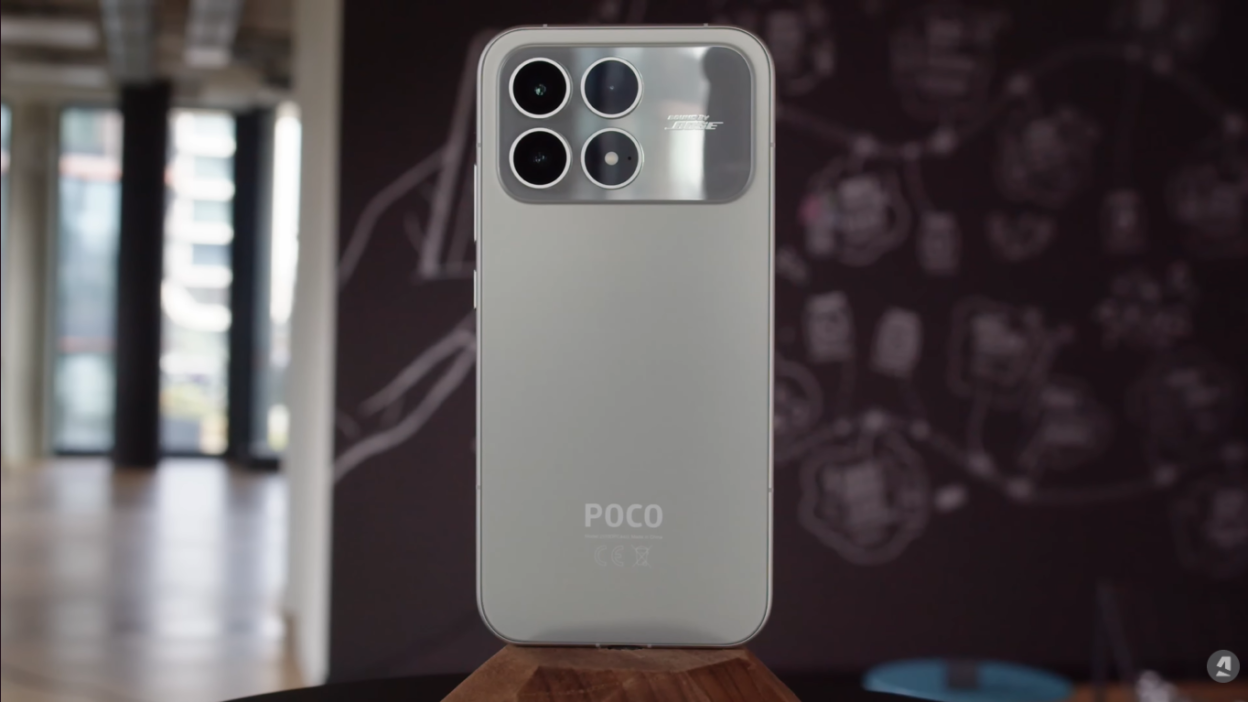
🎯 Clean Design: Frosted glass back, aluminum frame, 200g weight, premium feel
🔐 Ultrasonic Fingerprint: Fast, responsive under-display sensor
🤖 HyperOS 3 + Android 16: 4 major OS updates, 6 years security patches, AI features
📡 eSIM Support + IR Blaster: Modern connectivity with retro convenience features
Trade-offs: Thermal throttling under heavy load, telephoto camera underwhelms vs main cam’s 2x crop, speakers lack bass (no Ultra’s Bose subwoofer), no wireless charging, no charger in box.
Bottom Line: At mid-range pricing (once street prices drop), the F8 Pro delivers 85-90% of flagship experience for 50-60% of the cost. Perfect for buyers prioritising battery life, display quality, and performance over absolute camera excellence.
What Is the Poco F8 Pro? (Understanding the “Flagship Killer” Philosophy)
Before diving into the top 10 reasons to buy, let’s establish what the Poco F8 Pro actually is—and what it isn’t.
The Poco Strategy: Deliver flagship-level features (premium display, high-end chipset, large battery, fast charging) while cutting costs on areas less critical to most users (wireless charging, absolute camera perfection, bundled accessories).
The F-Series Hierarchy:
- Poco F8 Pro (This model): The sweet spot—flagship performance with smart compromises
- Poco F8 Ultra: The ultimate version with extras (Bose subwoofer, latest chipset, wireless charging)
- Previous F7 Pro: Last generation model that the F8 Pro improves upon
Who Should Consider This Phone: ✅ Budget-conscious enthusiasts who want flagship power
✅ Heavy phone users needing exceptional battery life
✅ Mobile gamers seeking 120Hz display + powerful chipset
✅ Anyone tired of paying £1,000+ for flagships with minimal real-world differences
Now, let’s break down exactly why the Poco F8 Pro deserves your attention.
Top 10 Reasons to Buy the Poco F8 Pro
1. Exceptional Battery Life: 17.5 Hours Active Use
The Headline Feature That Changes Everything
In our comprehensive testing, the Poco F8 Pro delivered an overall active use score of approximately 17.5 hours—a remarkable achievement that outperforms both the previous F7 Pro model and even the more expensive F7 Ultra.
What Makes This Possible?
- 6,210mAh Battery Capacity: Up from 6,000mAh in the previous Pro model
- Efficient Snapdragon 8 Elite Chipset: Better power management than previous generations
- Intelligent Display Refresh: Drops from 120Hz to 60Hz when idling to conserve energy
- Software Optimization: HyperOS 3 includes battery efficiency improvements
Real-World Impact:
Forget daily charging anxiety. The F8 Pro comfortably lasts through:
- Full day of heavy use (streaming, gaming, photography, social media)
- Multi-day use for moderate users (messaging, browsing, occasional video)
- International travel days without searching for outlets
Why This Matters:
Battery life is the unsexy spec that matters most in daily use. A phone with a flagship camera and performance means nothing if it dies at 4 PM. The F8 Pro prioritises what actually improves your day-to-day experience.
Comparison Context:
- Better battery life than Samsung Galaxy S25 FE
- Significantly outlasts most flagship phones with smaller batteries
- Competes with battery champs like Asus ROG Phone series
2. 100W Fast Charging: Convenience When You Need It
Power Up in Minutes, Not Hours
While wireless charging is absent (a cost-cutting measure), the 100W wired fast charging more than compensates with speed that wireless can’t match.
Charging Performance:
Our testing with both Xiaomi’s proprietary 100W charger and a standard 100W USB Power Delivery charger revealed:
- 30-Minute Charge: Both chargers performed similarly, delivering approximately 60-70% charge
- Full Charge: Xiaomi’s charger is significantly faster to reach 100% (under 60 minutes total)
- Top-up Charging: 10 minutes gives you hours of additional use
The Trade-Off Reality:
Missing: Wireless charging (you’ll need to plug in)
Gain: 100W wired is 5-10x faster than wireless charging
Impact: For most users, ultra-fast wired beats slow wireless convenience
Practical Scenario:
Forgot to charge overnight? Morning shower = enough juice for your entire day. This speed transforms how you think about charging—it becomes a 15-minute morning routine, not an overnight requirement.
Important Note: Charger NOT included in the box (frustrating cost-cutting measure). Budget £25-40 for a quality 100W charger if you don’t already own one.
3. Stunning 6.59″ OLED Display: Visual Excellence
Premium Screen Quality at Mid-Range Price
The display is where the Poco F8 Pro truly shines, delivering a viewing experience that rivals phones costing twice as much.
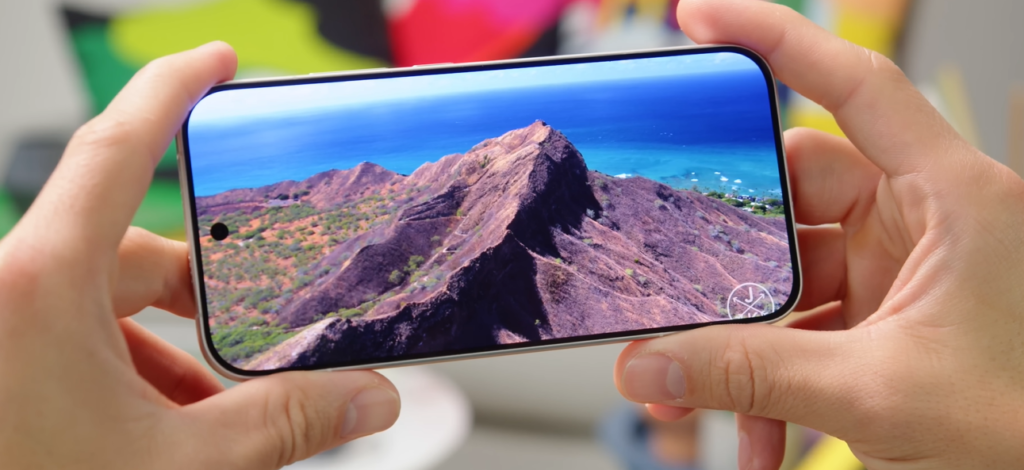
Technical Specifications:
- Size: 6.59 inches (slightly smaller than the previous model)
- Panel Type: OLED (perfect blacks, infinite contrast)
- Resolution: Full HD+ (419 PPI—sharp enough that pixel density isn’t noticeable)
- Refresh Rate: 120Hz (smooth scrolling, responsive gaming)
- Peak Brightness: Up to 3,500 nits (small area), 1,100 nits (full screen in auto mode)
- Color Depth: 12-bit color support
- HDR Support: HDR10+ and Dolby Vision
- Protection: Gorilla Glass 7i (improved drop protection)
Why Resolution Isn’t a Concern:
Previous model had QHD resolution, F8 Pro drops to Full HD+. In practice? The difference is imperceptible. At 419 PPI, individual pixels are invisible to the human eye at normal viewing distances. You gain battery efficiency without sacrificing perceived sharpness.
Brightness That Matters:
The 3,500 nits peak brightness isn’t just a spec sheet flex—it means:
- Outdoor Visibility: Screen remains clearly visible in direct sunlight
- HDR Pop: Bright highlights in movies have genuine impact
- Comfortable Daytime Use: No squinting or maxing brightness constantly
Adaptive Refresh Rate Intelligence:
The 120Hz display doesn’t just drain battery—it intelligently drops to 60Hz when showing static content (reading articles, viewing photos), then ramps back up for smooth interactions.
Comparison:
This display competes directly with:
- Samsung Galaxy S25 FE OLED
- OnePlus 13 display quality
- Pixel 9 series (non-Pro models)
At this price point, you’re getting flagship-tier display technology without compromise.
4. Snapdragon 8 Elite: Flagship Power from Previous Generation
Smart Strategy: Use Last Year’s Flagship Chip
Rather than chasing the absolute latest Snapdragon 8 Gen 4, the Poco F8 Pro uses the Snapdragon 8 Elite—the top-tier chipset from the previous generation.
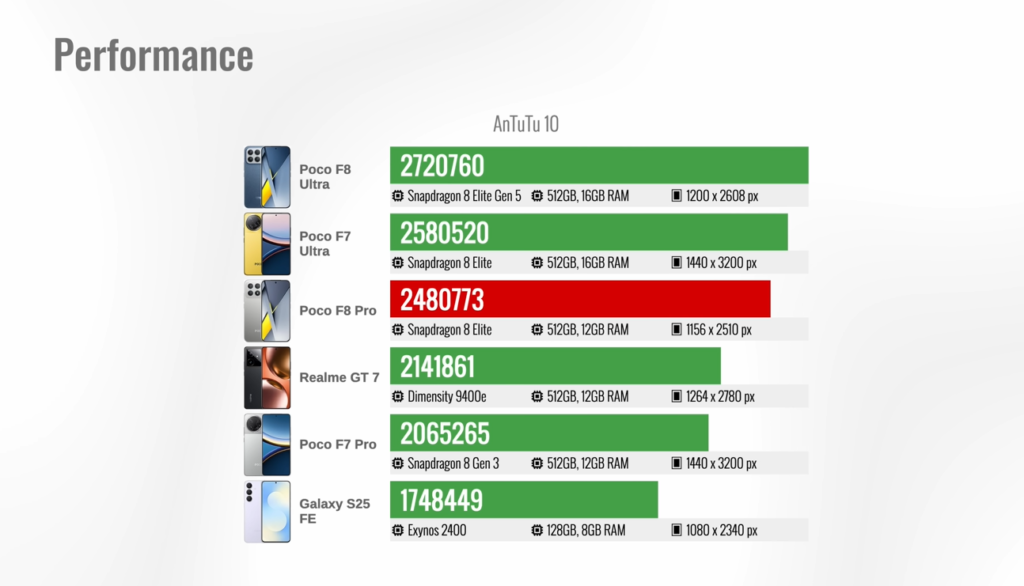
Performance Reality:
In benchmark testing, the F8 Pro delivers performance on par with 2025-era flagships from just months ago, including the Poco F7 Ultra. For real-world use, you’re getting:
- Smooth Gaming: Genshin Impact, Call of Duty Mobile, Fortnite at high settings
- Fast App Launching: Instant response, no lag
- Multitasking: Handles 20+ open apps without slowdown
- Future-Proofing: Will remain fast for 3-4 years of typical use
Benchmark Performance:
The F8 Pro scored competitively in:
- CPU tests (multi-core productivity)
- GPU tests (gaming performance)
- AI/ML tasks (photography processing, voice recognition)
The Thermal Management Issue:
Here’s the honest trade-off: prolonged CPU stress testing revealed thermal throttling issues.
What We Found:
- Standard use: CPU wasn’t using full resources (stability prioritised over maximum performance)
- Game Turbo mode: Unlocked full performance, but caused significant throttling with temperature spikes
Real-World Impact:
For 95% of users doing 95% of tasks, you won’t notice this. The throttling appears during:
- Extended gaming sessions (30+ minutes of intensive gaming)
- Heavy video editing or rendering
- Benchmark torture tests (not representative of normal use)
Bottom Line: Flagship performance when you need it, with thermal management that prioritises phone longevity over benchmark bragging rights.
5. Triple Camera System with Telephoto Zoom
New Addition: 2.5x Telephoto Camera (But There’s a Catch)
The F8 Pro uses the same main and ultrawide cameras as the previous model but adds a 2.5x telephoto camera—the first time this Poco F-series Pro model includes dedicated zoom.
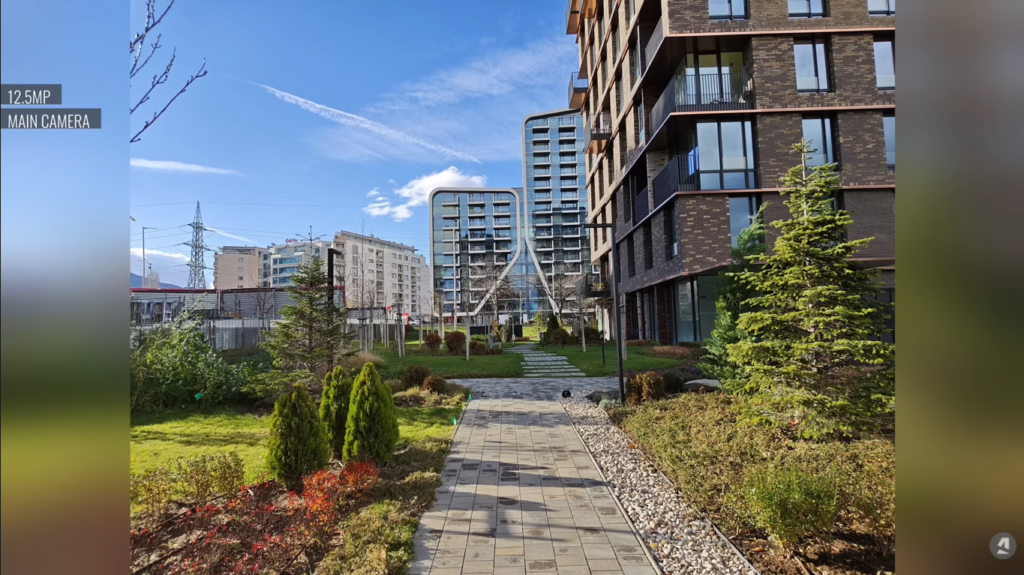
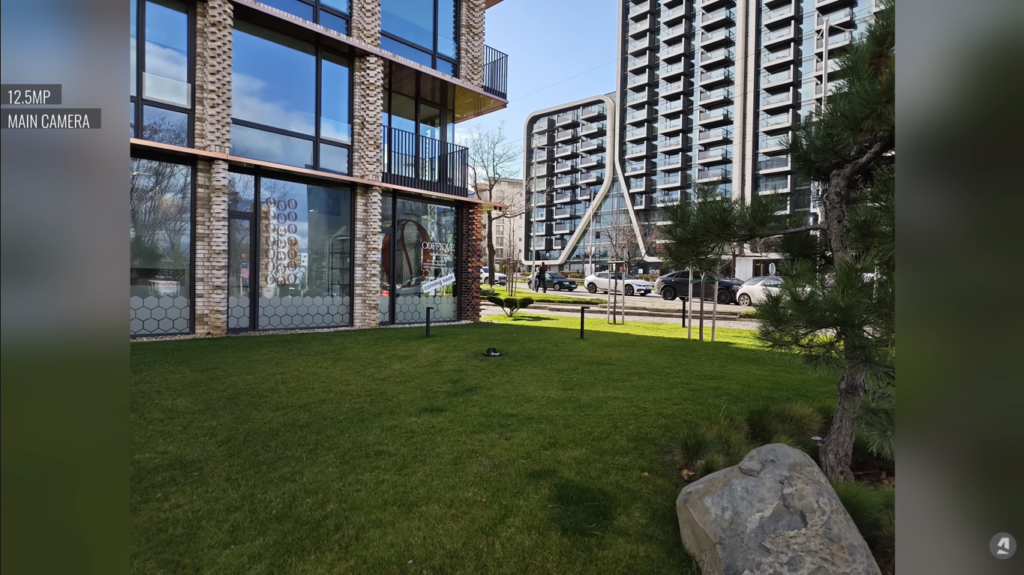
Main Camera: The Star Performer
Daylight Photography:
- Pretty Good Quality: Plenty of detail with natural rendition
- Good Dynamic Range: Handles bright skies and dark shadows well
- Pleasant Colors: Fairly accurate without oversaturation
- Minor Issue: Highlights sometimes too bright due to higher exposure
People Photography:
- Standard photo mode captures natural skin tones
- Dedicated portrait mode with artificial bokeh works well
- Consistent performance across various lighting
Low Light Performance:
- Sharp and clean photos with plenty of detail
- Wide dynamic range capturing both extremes
- Slight artificial look from bright shadow processing
- Generally impressive night shots
The Surprising 2x Crop Quality:
Here’s something fascinating: the main camera’s 2x digital zoom photos are actually quite solid. Some stills appear sharper than 1x shots, with consistent performance across indoor and outdoor scenarios.
The Telephoto Camera Conundrum
2.5x Zoom Performance:
When you switch to the dedicated 2.5x zoom camera, results are surprisingly close to the main camera’s digital 2x crop—sometimes even softer or noisier with less lively colors.
Our Honest Assessment: The main camera’s 2x crop is good enough on its own, potentially rendering the dedicated telephoto camera redundant for most users.
5x Zoom (Digital Crop from Telephoto):
- Great lighting: Decent results
- Slight light drop: Notable softness and noise
- Night: Very soft, inaccurate colors, low contrast (prefer main cam’s 2x crop)
Ultrawide Camera: The Weak Link
8 Megapixels Only:
- Produces subpar photos even in daylight
- Limited dynamic range
- Pale colors at times
- Oversharpening creates overprocessed look
- Low light: Not great but usable for ultrawide standards
Selfie Camera: Does the Job
20 Megapixels with Fixed Focus:
- Largely unimpressive with narrow dynamic range
- Good skin tones
- Serviceable for social media and video calls
Video Recording Capabilities
Resolution Options:
- Main camera: 8K video recording
- Main + Zoom cameras: 4K recording
- Ultrawide + Selfie: 1080p max
Main Camera 4K Video Quality:
- Decently sharp and detailed
- Relatively wide dynamic range
- Easy to like overall quality
2.5x Zoom Camera 4K:
- Sharp and detailed footage
- Wide dynamic range maintained
Ultrawide Video:
- Significantly softer (1080p limitation)
- Limited dynamic range and detail
- Electronic stabilization smooths movement but leaves some jitter
Low Light Video:
- Sharp but moderately noisy
- Dynamic range could be wider
Camera System Verdict:
The camera setup is good but not exceptional. Main camera delivers reliable quality, telephoto adds zoom versatility (even if redundant at 2x), ultrawide disappoints. For social media, family photos, and everyday moments? More than capable. For photography enthusiasts? Consider alternatives like Pixel 9 or the Samsung Galaxy S25 FE.
6. IP68 Water and Dust Resistance: Protection Peace of Mind
Premium Feature Rare at This Price
The Poco F8 Pro includes IP68 ingress protection rating—full protection against dust and submersion in water up to 1.5 meters for 30 minutes.
Why This Matters:
- Rain Protection: Use phone in heavy rain without worry
- Pool/Beach Safety: Accidental drops in water won’t destroy your phone
- Dust Protection: Essential for outdoor activities, construction sites, dusty environments
- Resale Value: IP68 rating increases phone longevity and resale appeal
The Mid-Range Rarity:
Many mid-range phones skip IP ratings to cut costs. The F8 Pro’s inclusion of IP68 puts it in the same protection league as phones costing £800-1,200.
Practical Impact:
Phone protection isn’t exciting until you need it. That accidental toilet drop, caught-in-rain moment, or beach sand exposure—IP68 means these incidents are minor inconveniences instead of phone-replacing disasters.
7. Clean, Premium Design: Feels More Expensive Than It Is
Understated Elegance Over Flashy Gimmicks
The F8 Pro’s design philosophy is refreshingly straightforward: premium materials, clean lines, functional aesthetics.
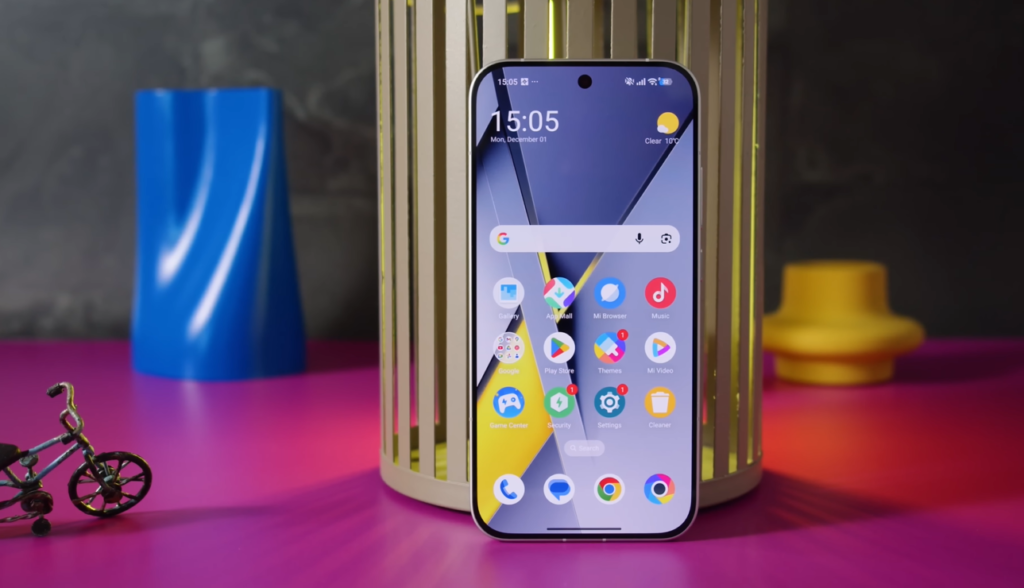
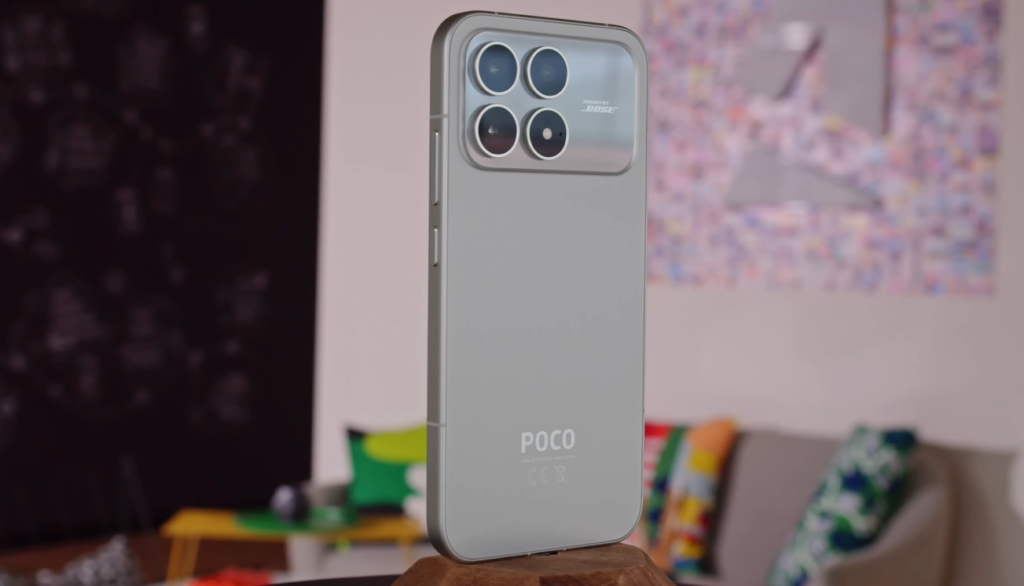
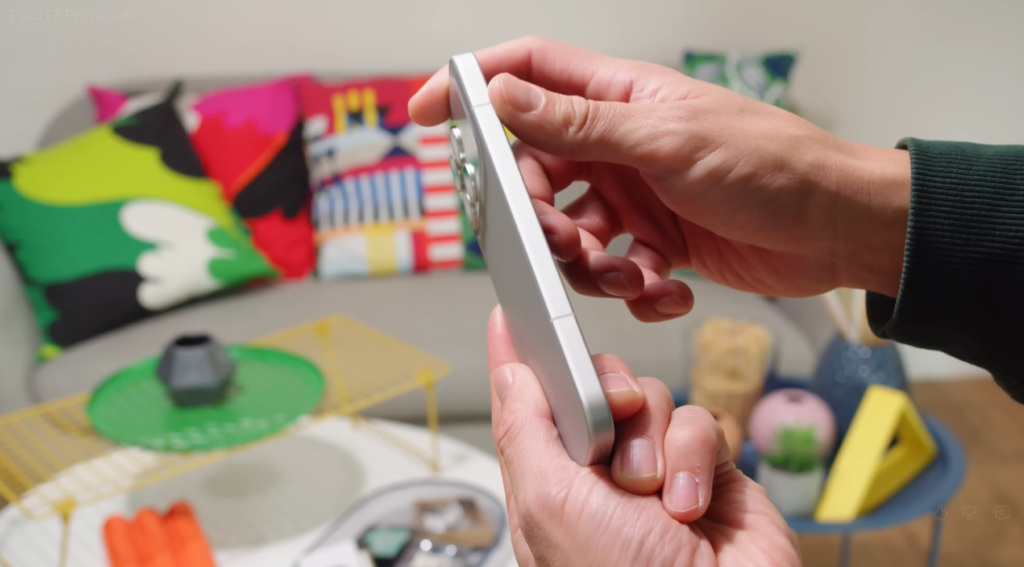
Design Elements:
- Back Panel: Frosted glass with matte finish (resists fingerprints and smudges)
- Frame: Flat aluminum with matching frosted finish
- Camera Bump: Large rectangular module with transparent glass covering
- Weight: Approximately 200g (substantial but not heavy)
- In-Hand Feel: Solid, premium, well-balanced
Build Quality Impressions:
The F8 Pro feels like it costs more than it does. The materials, finish quality, and assembly give it a flagship-adjacent feel that punches above its price class.
No Gimmicks:
Unlike phones with LED back panels, color-changing glass, or over-stylized designs, the F8 Pro opts for timeless, clean aesthetics that won’t look dated in 2-3 years.
Practical Design:
- Flat frame makes one-handed use comfortable
- Matte finish doesn’t show fingerprints
- Camera bump protected by transparent glass (shows off camera sensors)
- Buttons well-placed and tactile
8. HyperOS 3 with Android 16: Modern Software Experience
Xiaomi’s Refined Interface Gets Better
The Poco F8 Pro runs HyperOS 3 built on top of Android 16, bringing visual updates, smoother animations, and improved functionality.
What’s New in HyperOS 3:
Visual Updates:
- Refined UI elements throughout the system
- Smoother animations and transitions
- Better visual consistency across menus
Super Island Feature:
- Similar to Apple’s Dynamic Island
- Contextual info and shortcuts
- Quick access to timers, media playback, ongoing activities
- Smart notifications that don’t intrude on content
Improved Connectivity:
- File sharing now works with non-Xiaomi devices
- Previously limited to Xiaomi devices on same account
- Universal compatibility improvement
Hyper AI Features:
Xiaomi’s AI suite includes:
- Writing Assistance: Grammar, tone adjustment, content generation
- Audio Transcription: Real-time voice-to-text
- Translation Tools: Multi-language translation built-in
- Photo Editing: AI-powered enhancement, object removal, background changes
- More Tools: Expanding AI capabilities
Software Support Commitment:
- 4 Major OS Updates: Android 17, 18, 19, 20 guaranteed
- 6 Years of Security Patches: Security updates through 2031
- Longevity: Phone remains secure and functional for 5-6 years
This Matters Because:
Many mid-range phones get 2-3 years of updates maximum. The F8 Pro’s 4+6 support matches flagship commitments, meaning your investment stays relevant and secure for years.
9. Ultrasonic Fingerprint Sensor + IR Blaster: Modern Meets Retro
Biometric Security Done Right
The F8 Pro includes an ultrasonic fingerprint reader hidden under the display—not the cheaper optical sensors found on many mid-range phones.
Ultrasonic Advantages:
- Very Responsive: Near-instant unlock
- Works with Wet Fingers: Optical sensors struggle with moisture
- More Secure: 3D mapping vs 2D image capture
- Better in Bright Light: Doesn’t require screen flash that blinds you at night
Real-World Experience:
The sensor is fast, accurate, and positioned well on the screen. Unlock feels effortless—the way it should be.
IR Blaster: The Unsung Hero
Yes, the F8 Pro includes an infrared blaster—that “old school” feature most flagships abandoned.
What You Can Control:
- TVs (all brands)
- Air conditioners
- Set-top boxes
- Projectors
- Any IR-controlled appliance
Why This Is Brilliant:
Lost your TV remote? Phone becomes universal remote. Hotel AC stuck on 18°C? Control it with your phone. Parents struggling with multiple remotes? One device controls everything.
It’s a small feature that delivers disproportionate convenience.
10. Value Proposition: Flagship Performance at Mid-Range Price
The Ultimate Reason: Price-to-Performance Ratio
Everything we’ve discussed culminates in the Poco F8 Pro’s core value proposition: delivering 85-90% of flagship experience at 50-60% of flagship pricing.
What You’re Getting:
✅ Flagship chipset (Snapdragon 8 Elite)
✅ Premium OLED display (120Hz, 3,500 nits, HDR)
✅ Exceptional battery life (17.5 hours active use)
✅ Fast charging (100W)
✅ IP68 protection
✅ Capable camera system
✅ Premium build quality
✅ Modern software with long support
What You’re Saving:
At mid-range pricing (check current street prices—initial RRP will drop within months), you’re saving £300-500 compared to true flagships while gaining battery life that surpasses most premium phones.
Price Positioning Strategy:
Poco intentionally prices aggressively at launch, with prices cooling down over 3-6 months. The F8 Pro will look even better once street prices stabilize at the sweet spot.
Comparison Context:
Similar Price Alternatives:
- Samsung Galaxy S25 FE: Better cameras, weaker battery life
- Xiaomi 15T: Different focus (camera emphasis), similar performance tier
- OnePlus 12R: Comparable value proposition, different strengths
More Expensive Flagships:
- Samsung Galaxy S25/S25+: £300-400 more, marginally better overall
- Google Pixel 9 Pro: £400-500 more, superior camera, weaker battery
- iPhone 16: £500-600 more, iOS ecosystem, different value calculation
Value Calculation Example:
If F8 Pro = £500 and Galaxy S25 = £850:
- You save £350
- You lose: 10% better camera, wireless charging, marginally better performance
- You gain: Better battery life, faster charging, IR blaster
For most users, that’s a winning trade-off
The Honest Cons: What You’re Compromising On
No phone is perfect. Here’s what you sacrifice:
1. Thermal Management Under Load
Prolonged intensive tasks cause throttling. Impact: Mostly benchmarks and extended gaming sessions. Real-world use: Rarely noticeable.
2. Telephoto Camera Underwhelms
The 2.5x zoom camera doesn’t significantly outperform the main camera’s 2x digital crop. Impact: Less zoom versatility than expected.
3. Speakers Lack Bass
Audio tuned by Bose, but without the F8 Ultra’s dedicated subwoofer, bass is lacking. Mids and highs biased. Loudness is “Very Good” rated, but quality disappointing.
4. No Wireless Charging
You must plug in. 100W wired is faster, but convenience-focused users will miss wireless charging pads.
5. No Charger Included
Frustrating omission. Budget additional £25-40 for a quality 100W charger.
6. Ultrawide Camera Quality
8MP ultrawide produces subpar results. If ultrawide photography matters, consider alternatives.
7. Not the Absolute Latest Chipset
Snapdragon 8 Elite is a previous-gen flagship. You’re not getting the newest Gen 4. Impact: Minimal for 99% of tasks.
Who Should Buy the Poco F8 Pro?
Perfect For:
✅ Battery Life Priority Users: Heavy phone users, travellers, people tired of daily charging
✅ Value Seekers: Want flagship features without flagship markup
✅ Mobile Gamers: 120Hz display + powerful chipset at accessible price
✅ Practical Buyers: Prioritize real-world benefits (battery, display, performance) over spec sheet perfection
✅ Android Enthusiasts: Want latest software with long update commitment
Consider Alternatives If:
❌ Camera Quality Is #1 Priority: Pixel 9, Galaxy S25 FE offer better photography
❌ You Need Wireless Charging: Non-negotiable feature absent here
❌ You want the Absolute Latest Tech: F8 Ultra or true flagships have newer chips
❌ Audio Quality Matters: Speakers are disappointing, need an external audio solution
❌ You Value Ultrawide Photography: 8MP ultrawide won’t satisfy enthusiasts
Poco F8 Pro vs Key Competitors
Poco F8 Pro vs Samsung Galaxy S25 FE
Choose F8 Pro if: Battery life and fast charging matter most, prefer larger display
Choose S25 FE if: Camera quality priority, prefer Samsung ecosystem, want wireless charging
Poco F8 Pro vs Xiaomi 15T
Choose F8 Pro if: Want better battery life, prefer Snapdragon over MediaTek
Choose 15T if: Camera performance more important, prefer different design language
Poco F8 Pro vs Poco F8 Ultra
Choose F8 Pro if: Can’t justify the price premium, good enough performance suffices
Choose F8 Ultra if: Want the absolute best (Bose subwoofer, latest chipset, wireless charging, no compromises)
Final Verdict: Should You Buy the Poco F8 Pro?
The Simple Answer: Yes, especially once prices cool down.
The Poco F8 Pro exemplifies smart smartphone shopping: identifying what actually improves daily experience (battery life, display quality, performance) and investing there, while making strategic compromises in areas most users won’t miss (wireless charging, absolute camera perfection).
The Value Proposition:
For £400-550 (estimated street price after launch cooling), you’re getting a phone that competes with devices costing £800-1,000. The battery life alone makes this worth considering—17.5 hours active use transforms how you use a smartphone.
Recommendation by User Type:
- Heavy Users: Buy immediately when price drops
- Gamers: Excellent choice for mobile gaming on budget
- Photography Enthusiasts: Consider Pixel 9 instead
- Balanced Users: Strong all-rounder recommendation
- Budget Shoppers: Wait for further price drops in 3-6 months
The Waiting Game:
Poco phones traditionally see aggressive price drops within 3-6 months of launch. If you can wait, the value proposition becomes even more compelling.
No. It supports 100W wired fast charging only. The F8 Ultra includes wireless charging.
The Bottom Line
The Poco F8 Pro isn’t perfect. Thermal management could be better, the telephoto camera underwhelms, and speakers lack bass. But these are footnotes in a story about a phone that delivers flagship experiences where it counts—battery life, display quality, and performance—at a price that makes flagships look overpriced.
For buyers who prioritise practical benefits over spec sheet perfection, the F8 Pro is one of 2025’s smartest smartphone purchases.
Wait for the price to cool down, then buy with confidence.