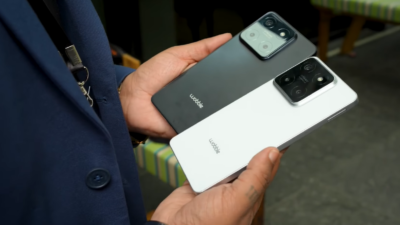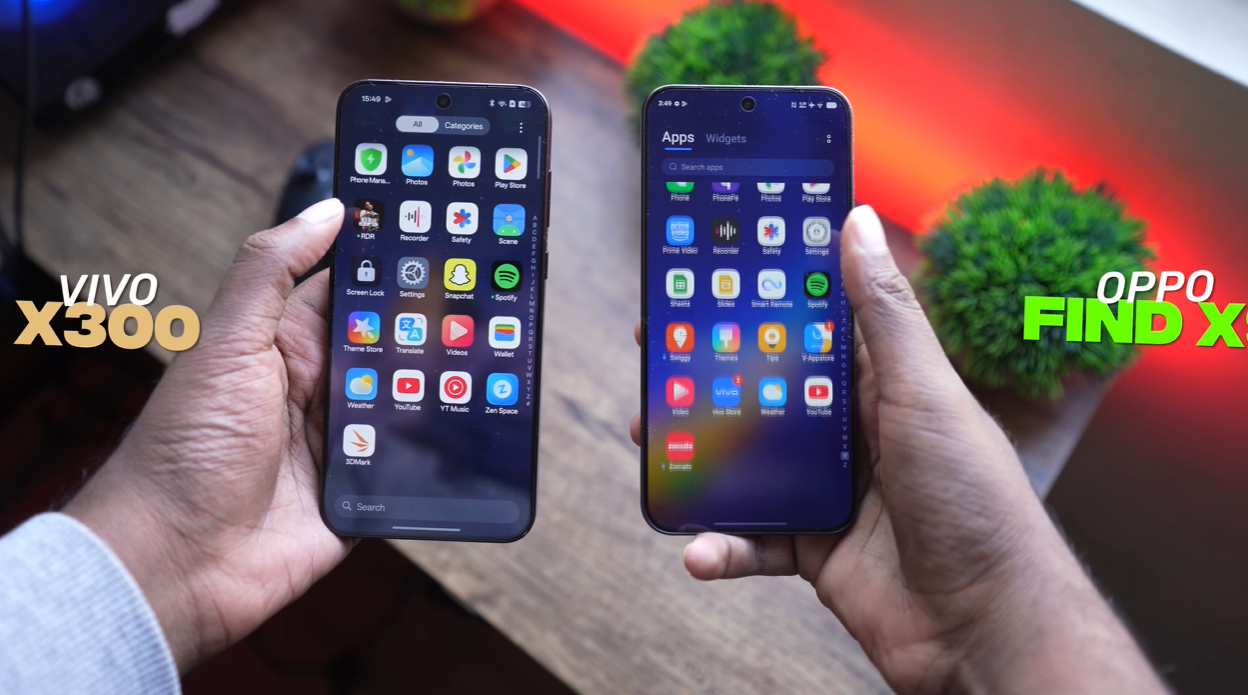
The OPPO Find X9 and Vivo X300 represent the compact flagship options from their respective Pro lineups, separated by just ₹1,000 in price. Both promise excellent cameras, solid battery life, and pocketable designs—but which one deserves your money?
After extensive hands-on testing, including camera shootouts, gaming benchmarks, and real-world usage scenarios, we’re here to clear your confusion and help you make the right choice.
Spoiler: There’s no clear loser here—both are excellent phones. Your decision comes down to specific priorities: compact size vs battery life, photography presets vs videography features, and how you’ll actually use the device daily.
Quick Comparison Overview
Before diving deep, here’s what separates these two compact flagships:
| Feature | OPPO Find X9 | Vivo X300 | Winner |
|---|---|---|---|
| Price Difference | ₹1,000 more | Baseline | – |
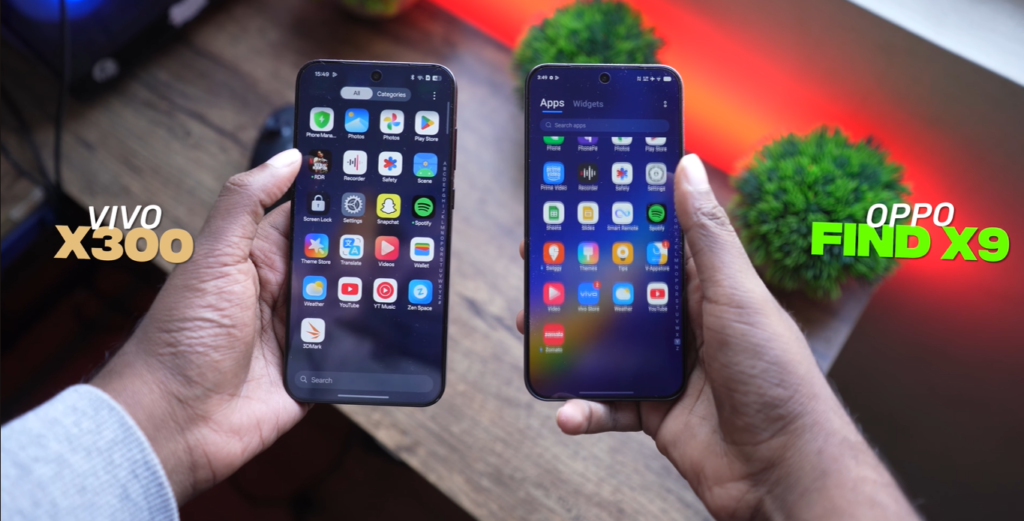
| Size | 6.59-inch display | 6.31-inch display | Vivo (more compact) |
| Battery | 7,025 mAh | 6,040 mAh | OPPO (longer life) |
| Main Camera | 50MP | 200MP | Vivo (higher resolution) |
| Video Recording | 4K 120fps + Dolby Vision | 4K 60fps max | OPPO (better video) |
| Gaming | 90fps locked in BGMI | 120fps stable | Vivo (better optimization) |
| Display Type | Standard AMOLED | LTPO AMOLED | Vivo (adaptive refresh) |
| Weight | Slightly heavier | Lighter | Vivo (easier one-hand use) |
Design and Build Quality: Premium Feel on Both
Material Quality and Construction
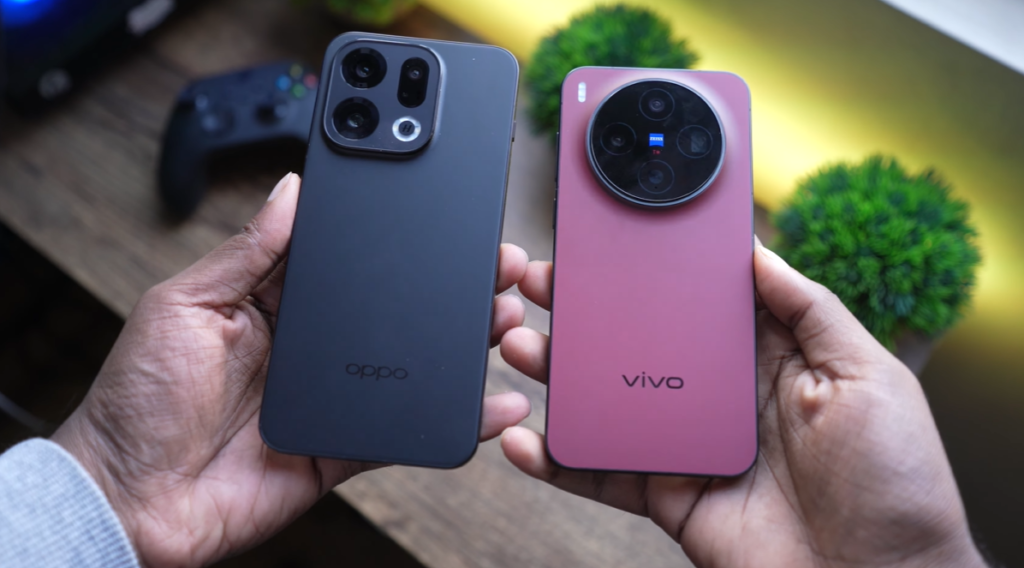
Both phones use premium materials with excellent build quality that justifies their flagship pricing. You won’t feel shortchanged with either device in terms of construction.
Common Features:
- IP68 + IP69 water resistance (both phones)
- Fingerprint-resistant back panels (excellent)
- Premium glass and metal construction
- Solid, gap-free assembly
Size and Form Factor: The Deciding Factor
This is where personal preference becomes critical.
Vivo X300: The True Compact
- 6.31-inch display (smaller screen)
- Lighter weight (easier extended holding)
- More pocketable (fits comfortably in most pockets)
- Superior one-handed usability
- Easier in-hand feel for daily use
OPPO Find X9: The Larger Compact
- 6.59-inch display (more screen real estate)
- Slightly heavier (more substantial feel)
- Still manageable but less pocketable than Vivo
- Better for media consumption
Our Take: The Vivo X300 wins if compactness and portability are priorities. The Find X9 offers a better screen-to-body experience but sacrifices some pocketability.
Critical Recommendation: Visit a store and physically hold both phones. This isn’t a spec-sheet decision—how they feel in your hand and pocket matters more than numbers suggest.
Color Options: Subtle and Sophisticated
Vivo X300 (Red Variant Tested):
- Not overly loud or flashy
- Sophisticated red tone
- Fingerprint resistant
OPPO Find X9 (Black Variant Tested):
- Very subtle and professional
- Classic black that works everywhere
- Fingerprint resistant
Winner: Tie—both offer excellent, understated color choices.
Unique Feature: Alert Slider (OPPO Exclusive)
The OPPO Find X9 includes a customizable alert slider on the side—a feature missing from the Vivo X300.
Alert Slider Functions:
- Switch between silent/ring/vibrate modes
- Turn on flashlight
- Open camera app
- Other customizable shortcuts
Is It a Dealbreaker? No, but it’s genuinely useful for quick actions without unlocking the phone. If you’re used to iPhones or OnePlus devices with alert sliders, you’ll miss this convenience on the Vivo.
Camera Comparison: The Main Event
Both phones are camera-focused flagships, but they take different approaches to photography.
Camera Specifications
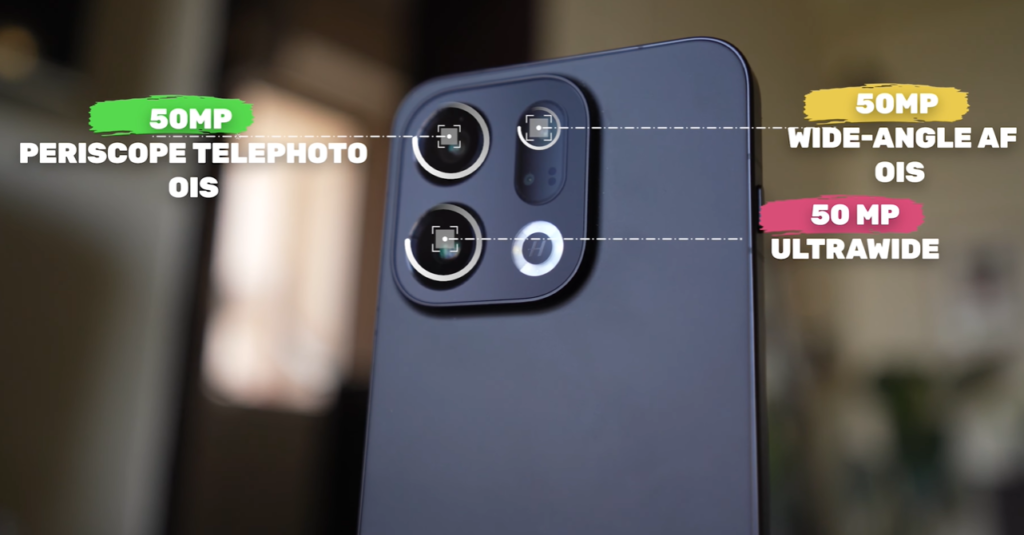
OPPO Find X9:
- Main Camera: 50MP (Hasselblad color tuning)
- Telephoto: 50MP periscope (3x optical zoom)
- Ultra-Wide: 50MP
- Features: Hasselblad color science, expand mode, high-res mode
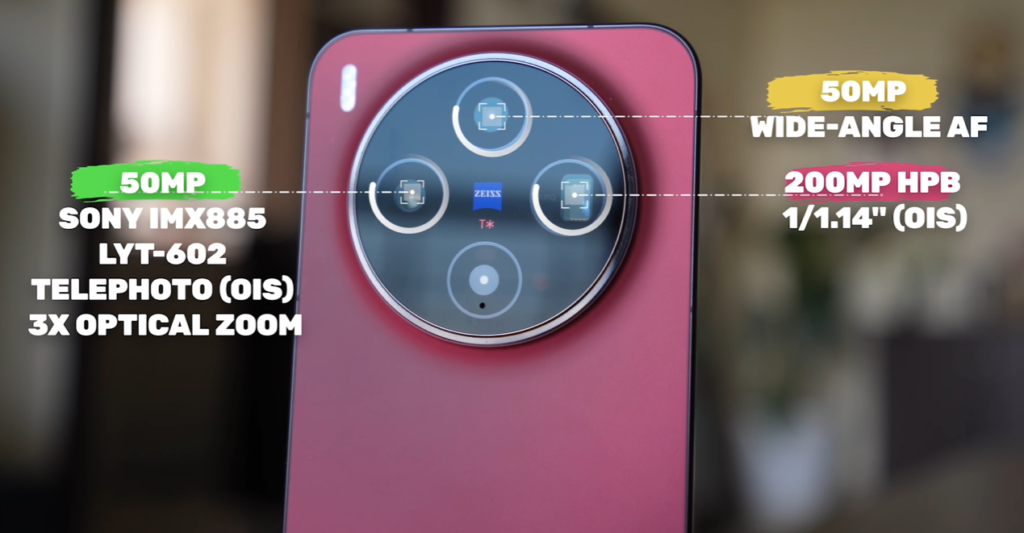
Vivo X300:
- Main Camera: 200MP sensor
- Telephoto: 50MP periscope (3x optical zoom)
- Ultra-Wide: 50MP
- Features: ZEISS modes for portraits, ZEISS tuning
Daylight Photography: Different Color Science
Color Processing:
OPPO Find X9:
- Warm, reddish tones consistently across frames
- Hasselblad color tuning applied
- More “enhanced” look
- Consistent output across different scenes
Vivo X300:
- Natural, cooler tones throughout
- ZEISS color science
- More neutral, true-to-life colors
- Consistent output philosophy
Detail Rendering:
When zooming into photos:
- OPPO Find X9: Details look more natural, less processed
- Vivo X300: Details appear slightly artificial with processing applied
Winner: OPPO for detail lovers who prefer natural textures. Vivo for those who prefer cooler, more neutral color tones.
Ultra-Wide Photography
Vivo X300 Advantage:
- 200MP sensor delivers more detail
- Less distortion on both phones
- Color science maintains consistency with main camera
OPPO Find X9:
- Good detail but lower resolution
- Minimal distortion
- Consistent Hasselblad color tuning
Winner: Vivo X300 (higher megapixel count provides flexibility for cropping and detail extraction).
Portrait Mode: Opposite Approaches
OPPO Find X9:
- Reddish skin tones (Hasselblad processing)
- Excellent edge detection
- Flawless across all conditions
- Works well in night portraits
Vivo X300:
- Neutral, cooler skin tones (ZEISS tuning)
- Excellent edge detection (mostly)
- One edge detection miss observed (blurred camera body in frame—likely one-off bug)
- Works well in night portraits
Winner: Tie—choose based on preferred skin tone rendering. OPPO for warmer tones, Vivo for neutral colors.
Low-Light Photography
OPPO Find X9:
- Better light handling in challenging conditions
- Brighter overall exposure
- Night mode activates automatically
- Superior 3x optical low-light shots
Vivo X300:
- Good low-light performance
- Night mode activates automatically
- Slightly darker exposure than OPPO
Winner: OPPO Find X9 (more confident low-light performance).
Selfie Camera
OPPO Find X9:
- Better skin tone accuracy
- Maintains natural colors
- More flattering results
Vivo X300:
- Tends to dry out colors slightly
- Still good quality
- Cooler color rendering
Winner: OPPO Find X9 (better skin tone handling).
Video Recording: Clear Winner
OPPO Find X9: ✅ 4K 120fps support
✅ Dolby Vision recording (HDR video)
✅ Log video recording (professional color grading)
✅ Excellent stabilization
✅ 8K video support
Vivo X300: ✅ 4K 60fps (max capability)
✅ Excellent stabilization
❌ No 8K video recording
❌ No Dolby Vision recording
❌ No 4K 120fps
Winner: OPPO Find X9 dominates videography with professional features content creators will appreciate.
Camera Verdict
For Photography: Both excel, but choose based on color preference (warm/reddish vs cool/neutral)
For Videography: OPPO Find X9 is the clear winner with superior recording capabilities
For Versatility: OPPO Find X9 offers more creative tools
Performance: Same Chip, Different Results
Hardware Specifications
Both phones feature:
- MediaTek Dimensity 9400 chipset
- 16GB RAM (tested configurations)
- 512GB UFS 4.1 storage (tested configurations)
Expectation: Performance should be nearly identical.
Reality: Differences emerge due to thermal management and optimization.
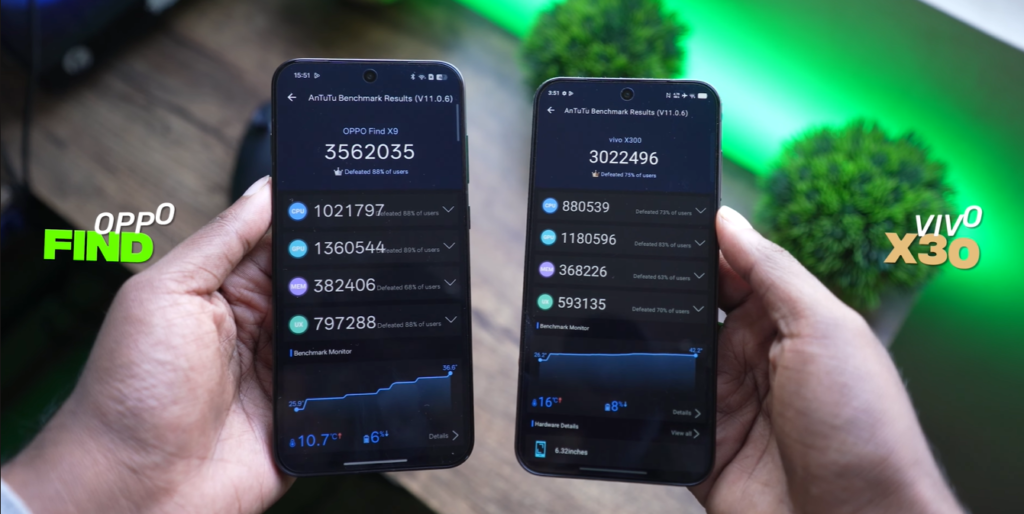
Benchmark Results
AnTuTu Benchmark:
| Phone | Score | Temperature |
|---|---|---|
| Vivo X300 | ~3 million | 42°C (throttled) |
| OPPO Find X9 | ~3.5 million | 36°C (cooler) |
Analysis: The Vivo X300’s smaller form factor limits heat dissipation space, causing earlier thermal throttling. The Find X9’s slightly larger body handles sustained performance better.
Geekbench 6:
Vivo X300: Slight edge in both multi-core and single-core scores
OPPO Find X9: Very close, marginal difference
3DMark Wildlife Stress Test:
Vivo X300: Surprisingly good stability despite earlier AnTuTu throttling
OPPO Find X9: Better scores overall
Storage Speed:
Both phones use UFS 4.1 storage with nearly identical read/write speeds—no meaningful difference.
CPU Throttling Test (20-Minute Stress Test)
OPPO Find X9:
- 50% throttling after 20 minutes
- Temperature increase: +20°C
- Performance dropped from green to red zone
Vivo X300:
- Minimal throttling (surprising given AnTuTu results)
- Better sustained performance than expected
- More stable across extended stress
Daily Usage Performance
Verdict: No noticeable difference in real-world use. Both phones are smooth, fast, and handle multitasking excellently. Benchmark differences don’t translate to daily usage frustrations.
Gaming Performance: Unexpected Results
BGMI (Battlegrounds Mobile India) Testing
Settings Used:
- Smooth + Ultra Extreme (120fps mode)
- Performance boost enabled (Pro Gamer on Find X9, Boost on Vivo)
OPPO Find X9:
❌ Could not hit 120fps
❌ Locked at 90fps throughout testing
✅ Minimal heating (stayed warm, not hot)
Vivo X300:
✅ Achieved 120fps consistently
✅ Average 117fps (minor drops but stable)
✅ Minimal heating (stayed warm, not hot)
Temperature Note: Testing conducted during Delhi winter (cold ambient temperatures), which helps thermal management. Results may vary in hotter climates.
Gaming Verdict
Winner: Vivo X300 for better current optimization. However, the Find X9’s FPS issue appears to be a software optimization bug rather than a hardware limitation. An OTA update should resolve this.
Update Promise: We’ll update this comparison in the comments once OPPO releases optimization updates for BGMI.
Software: Similar Experiences, Different Skins
Operating Systems
Vivo X300:
- OriginOS 6 (replaces FunTouch OS)
- Based on Android 15
- 5 years of OS updates
- 7 years of security patches
OPPO Find X9:
- ColorOS 16
- Based on Android 15
- 5 years of OS updates
- 6 years of security patches
Winner: Vivo X300 (one extra year of security support).
User Experience
Customization Options:
- Both offer extensive customization
- Smooth transition animations on both
- ColorOS control center feels slightly more organized
Detailed Software Comparison: If you want an in-depth ColorOS 16 vs OriginOS 6 comparison covering UI differences, features, and customization options, let us know in the comments. We’ll create a dedicated video.
Display: Size Matters
Display Specifications
| Specification | OPPO Find X9 | Vivo X300 |
|---|---|---|
| Size | 6.59 inches | 6.31 inches |
| Panel Type | AMOLED | LTPO AMOLED |
| Resolution | Higher (sharper) | Standard |
| Peak Brightness | 1,570 nits | 1,829 nits |
| Minimum Brightness | 5 nits | 15 nits |
| HDR Support | HDR10+ | HDR10+ |
| Dolby Vision (Netflix) | ✅ Yes | ❌ No |
Key Differences Explained
LTPO Advantage (Vivo X300):
LTPO (Low-Temperature Polycrystalline Oxide) allows the display to dynamically adjust refresh rate based on content, dropping as low as 1Hz when idle to save battery.
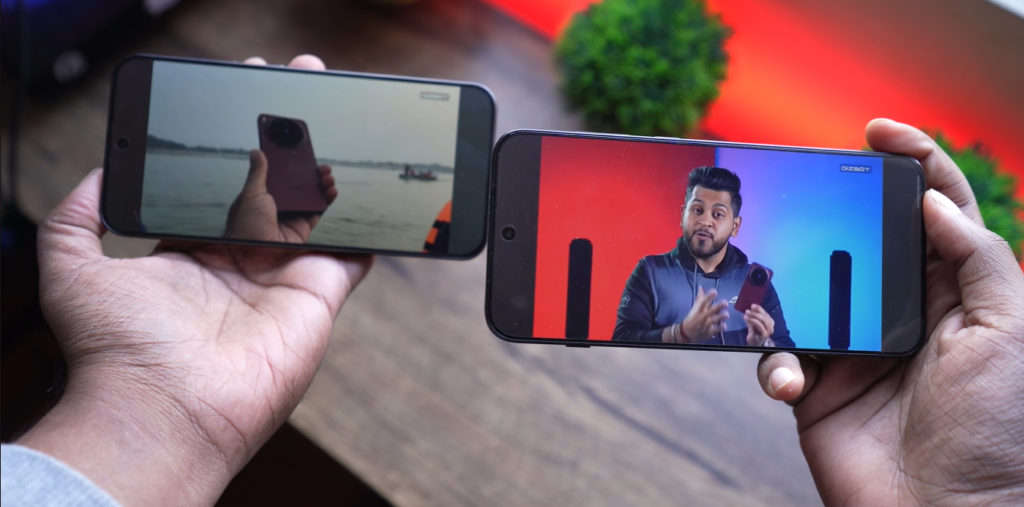
Why This Matters: Better battery efficiency without sacrificing smoothness. It’s surprising the Find X9 skipped this feature, as LTPO is standard on most flagships.
Resolution and Sharpness:
OPPO Find X9: Sharper display due to higher resolution packed into a larger screen.
Outdoor Visibility:
Vivo X300: Higher peak brightness (1,829 nits vs 1,570 nits) makes it slightly better in direct sunlight.
Low-Light Comfort:
OPPO Find X9: Lower minimum brightness (5 nits vs 15 nits) is easier on eyes in dark environments.
Content Consumption:
OPPO Find X9: Dolby Vision on Netflix enhances HDR content viewing.
Display Verdict
Winner: Tie with trade-offs.
- Vivo X300: Better battery efficiency (LTPO), brighter outdoors
- OPPO Find X9: Sharper, better low-light viewing, Dolby Vision support
Battery Life and Charging: Clear Difference
Battery Capacity
Vivo X300: 6,040 mAh
OPPO Find X9: 7,025 mAh
Why the Difference? The Vivo X300 sacrifices battery capacity to maintain its compact form factor. The larger Find X9 has room for a substantially bigger battery.
Real-World Battery Test (50% Brightness)
| Phone | Battery Life | Advantage |
|---|---|---|
| OPPO Find X9 | 22 hours 12 minutes | +3 hours |
| Vivo X300 | 19 hours 10 minutes | Standard |
Daily Usage:
Vivo X300: Easily lasts 1-2 days of moderate use
OPPO Find X9: Confidently delivers better battery life across all scenarios
Winner: OPPO Find X9 (no contest—substantially longer battery life).
Charging Speeds
OPPO Find X9:
- 80W wired fast charging
- 50W wireless charging
- Reverse wireless charging support
- Full charge: Just over 1 hour
Vivo X300:
- 90W wired fast charging (faster)
- 40W wireless charging
- Reverse wireless charging support
- Full charge: 50-55 minutes
Winner: Vivo X300 for faster wired charging, but the 10-15 minute difference rarely matters in real-world use. OPPO offers faster wireless charging.
Final Verdict: Which Should You Buy?
There’s No Loser Here
Both the OPPO Find X9 and Vivo X300 are excellent compact flagships. Your choice depends entirely on your priorities and use case.
Buy the Vivo X300 If:
✅ Compactness is priority #1 (true one-handed phone)
✅ You want the lighter, more pocketable device
✅ Gaming performance matters (better BGMI optimization currently)
✅ You prefer LTPO display for battery efficiency
✅ Photography with ZEISS presets appeals to you
✅ You like cooler, neutral color tones in photos
✅ Smaller screen size doesn’t bother you
Buy the OPPO Find X9 If:
✅ Battery life is crucial (substantially longer endurance)
✅ You’re a content creator who needs 4K 120fps and Dolby Vision
✅ Videography is as important as photography
✅ You prefer larger display for media consumption
✅ Dolby Vision on Netflix matters
✅ You like warmer, Hasselblad-tuned colors
✅ The alert slider is a must-have convenience feature
The ₹1,000 Difference
With just ₹1,000 separating these phones, both are safe picks. The decision boils down to:
Size vs Battery: Compact portability or longer battery life?
Photography vs Videography: Still photo presets or professional video features?
Display Tech: LTPO efficiency or Dolby Vision content?
Quick Decision Matrix
I want the smallest flagship possible → Vivo X300
I need all-day+ battery life → OPPO Find X9
I shoot lots of videos → OPPO Find X9
I prefer one-handed use → Vivo X300
I game competitively → Vivo X300 (for now)
I watch Netflix often → OPPO Find X9 (Dolby Vision)
I prefer ZEISS color science → Vivo X300
I prefer Hasselblad colors → OPPO Find X9
Price and Availability
OPPO Find X9: ₹76,999 (₹1,000 more expensive)
Vivo X300: ₹75,999 (baseline pricing)
Both phones are available through:
- Official brand stores
- Major online retailers (Amazon, Flipkart)
- Authorized retail partners
Recommendation: Check for launch offers, bank discounts, and exchange deals that can significantly reduce the effective price difference.
What We’re Testing Next
Want more detailed comparisons? Let us know in the comments:
- Full software comparison: ColorOS 16 vs OriginOS 6 deep-dive
- Camera shootout: vs Realme GT 8 Pro, OnePlus 15
- Long-term review: After 3 months of daily use
- Gaming performance: More titles tested
- Video quality comparison: Side-by-side video footage
Final Thoughts: Both Are Winners
The OPPO Find X9 and Vivo X300 represent the best compact flagships you can buy right now. Neither is a bad choice—they simply cater to slightly different priorities.
Our Take:
If we had to choose one for ourselves:
- For daily driver: Vivo X300 (compactness and one-handed comfort)
- For content creation: OPPO Find X9 (superior video capabilities)
- For all-rounder: OPPO Find X9 (battery life edges it ahead)
The Truth: You’ll be happy with either phone. Visit a store, hold both, take some photos, and trust your gut. The ₹1,000 difference is negligible—choose based on which feels right for your daily usage.
Specifications Comparison Table
| Specification | OPPO Find X9 | Vivo X300 |
|---|---|---|
| Display Size | 6.59 inches | 6.31 inches |
| Display Type | AMOLED | LTPO AMOLED |
| Processor | Dimensity 9400 | Dimensity 9400 |
| RAM | 16GB | 16GB |
| Storage | 512GB UFS 4.1 | 512GB UFS 4.1 |
| Main Camera | 50MP (Hasselblad) | 200MP |
| Telephoto | 50MP (3x optical) | 50MP (3x optical) |
| Ultra-Wide | 50MP | 50MP |
| Video | 4K 120fps, Dolby Vision | 4K 60fps max |
| Battery | 7,025 mAh | 6,040 mAh |
| Wired Charging | 80W | 90W |
| Wireless Charging | 50W | 40W |
| OS | ColorOS 16 (Android 15) | OriginOS 6 (Android 15) |
| OS Updates | 5 years | 5 years |
| Security Patches | 6 years | 7 years |
| Water Resistance | IP68 + IP69 | IP68 + IP69 |
| Special Features | Alert slider, Dolby Vision | LTPO display, lighter weight |
Which phone are you leaning towards? Let us know in the comments! And if you want specific, detailed comparisons, tell us what to test next.