E-bikes have never been more popular — or more confusing to buy. The market is flooded with options at every price point, reviewers who will happily tell you everything is brilliant, and enough technical jargon to make your head spin before you have even sat on a single bike.
After reviewing over 100 e-bikes, the same five mistakes come up again and again from first-time buyers. Some cost money. Some cost time. And a couple could actually land you in legal trouble.
Here is what to avoid — and what to do instead.
Mistake 1: Buying the Wrong Style of E-Bike for How You’ll Actually Use It
This is the most common mistake of all, and it happens before most buyers have looked at a single spec sheet. People fall in love with how a bike looks rather than whether it suits their actual life.
There are three main styles to understand before you spend a penny:
Folding E-Bikes
If you use public transport regularly — commuting by train or bus — a folding e-bike is almost essential. Most train and bus operators in the UK do not allow non-folding bikes on board. A lightweight folding e-bike solves this completely and is perfectly suited to city commuting at the legal 15.5 mph limit.
The trade-off: folding e-bikes are generally built for comfort and portability, not raw power. If you want something faster or more capable on hills, a folding bike is unlikely to satisfy you.
Fat Tyre and Chunky E-Bikes
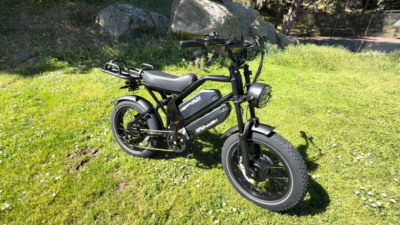
The chunky, fat-tyre e-bikes you see all over YouTube and social media tend to pack more powerful motors and can often be unlocked for higher speeds (more on the legality of that shortly). They are heavier, less practical for public transport, but genuinely capable machines for mixed terrain and longer rides.
Cafe Racer Style
Low-slung, mini-motorbike-style e-bikes look incredible — and they are comfortable to ride. But there is a catch most buyers only discover after purchase: because the saddle sits low and cannot be raised much, you cannot pedal efficiently. You will be ghost pedalling — feet going around but putting in zero real effort — for the entire journey. That is fine if you are using it purely for leisure. It is a problem if you want any real exercise, or if you ever end up in a situation where the battery dies mid-commute.
What to do instead: Before you look at a single bike, ask yourself one question — how will I actually use this 90% of the time? Public transport commuter needs a folder. Recreational rider who wants performance needs a fat-tyre or mid-drive bike. Daily leisure rider who wants comfort and style might love a cafe racer. Know your use case first, then look at the bikes.
Mistake 2: Not Understanding the Difference Between Cadence and Torque Sensors
This is the most underrated technical mistake first-time buyers make. Almost nobody talks about it in the showroom. Almost everybody wishes they had known before buying.
Every pedal-assist e-bike uses one of two types of sensors to determine when and how much electric power to give you. The sensor type has a bigger impact on how the bike actually feels to ride than almost any other specification.
Cadence Sensor — How It Works
A cadence sensor simply detects when the pedals are turning. The moment you complete a rotation, the bike registers that you are pedalling and delivers a fixed amount of power based on the assist level you have selected. If you are in level 3 and the bike tops out at 15 mph in that mode, it gives you 100% of the power needed to reach 15 mph the moment you start pedalling.
The benefit: you can ghost pedal — put in minimal physical effort — and still get the full electric assist. Perfect for commuting to work without arriving sweaty.
The downside: starting from a standstill on a hill can be genuinely difficult. Because the sensor only triggers after a full rotation, you may have to physically push the bike into motion before the motor kicks in. On a steep hill, that moment before the power arrives can feel almost impossible.
Torque Sensor — How It Works
A torque sensor is more sophisticated. It measures how much pressure you are putting down on the pedals — not just whether you are pedalling. Push hard and you get more power. Ease off and the power reduces proportionally. It creates a much more natural, intuitive riding experience that feels closer to a high-end conventional bike with assistance added.
The benefit: from a standstill on a hill, the torque sensor responds instantly the moment you push down. No waiting for a full rotation. No awkward lurch. Just smooth, progressive power delivery that matches your effort.
The downside: because the sensor is always looking for real pressure input, ghost pedalling only gets you so far. If you want to sit back and cruise at full speed without putting in any real effort, many torque-sensor bikes will only let you get to around 10 or 12 mph in that mode. To reach 15 mph, you actually have to pedal properly — which means you can arrive at work slightly sweaty. Depending on the quality of the torque sensor, this experience varies significantly.
The Best of Both Worlds
Some bikes — like the Cyrusher Zenith — now offer dual sensor technology, letting you switch between cadence and torque sensing depending on what you need. This is the ideal setup. You get the smooth natural feel of torque sensing when you want it, and the effortless ghost-pedal commuting capability of cadence sensing when you do not want to break a sweat. If you find a bike with dual sensor capability at your price point, it is worth paying extra for.
What to do instead: Ask specifically which sensor type a bike uses before you buy. If you are a commuter who cannot arrive sweaty, prioritise cadence sensing or dual sensing. If you want the most natural, enjoyable riding experience and do not mind a bit of effort, a quality torque sensor will be more satisfying in the long run.
Mistake 3: Getting the Legality Wrong — and Buying a Bike That Could Be Seized
This is where a lot of buyers either panic unnecessarily or get themselves into genuine trouble. The UK e-bike legal framework is actually straightforward — but the grey areas around unlocking have caused real confusion.
What Makes an E-Bike Legal in the UK
For an e-bike to be road-legal in the UK as an EAPC (Electrically Assisted Pedal Cycle) — meaning no licence, no registration, no insurance required — it must meet three criteria:
- Motor rated at no more than 250W
- Speed limited to 15.5 mph (25 km/h) — motor assistance must cut off above this speed
- No throttle that works independently of pedalling above 4 mph
Here is something important that most buyers do not know about the 250W rating: motor manufacturers are allowed to self-certify their own wattage ratings. There is no mandatory third-party government testing. This means a motor that produces significantly more than 250W of real-world output can legally be sold as a 250W motor if the manufacturer classifies it that way.
In practical terms, this is good news for buyers. Many of the powerful e-bikes on the market — those with 60, 70, 80, or 95 Newton metres of torque — are legally sold as 250W motors. A bike producing 95Nm of torque is capable of getting you up steep hills with almost no effort. A basic Halfords-style 250W motor is not. Both are legally 250W. Torque numbers tell you far more about real-world capability than the wattage rating alone.
The Unlocking Grey Area
Many e-bikes on the market can be unlocked to remove the 15.5 mph speed limiter. This is where buyers need to be clear-eyed about the risk they are taking.
If your bike can be unlocked via a simple button combination on the display — something most police officers could figure out in seconds if they stopped you — you are in a genuinely vulnerable position if pulled over. An officer who wants to pursue it could unlock the bike on the spot and establish it as an unregistered motor vehicle.
If your bike requires a separate app to unlock — as some models do — an officer who does not have access to the app cannot unlock it on the roadside. If the bike reads as legal when tested, you are on solid ground.
Some bikes, like certain Cyrusher models, require physically unscrewing part of the controller housing and disconnecting a wire to unlock. If you are riding it in locked mode, nobody can prove you have ever run it unlocked. You would have to be very unlucky and face a very determined officer to have a problem.
If you want absolute, airtight legal certainty: buy a bike that cannot be unlocked at all. But be aware — even bikes sold by major UK retailers like Halfords can technically be unlocked. This is part of why the grey area exists in the first place.
What to do instead: Ride sensibly. Stay off pavements. If your bike has a throttle, make sure it is factory-limited to work only below 4 mph. If you want to unlock for private land use, understand the risk level of your specific unlocking method. And if 100% legal certainty matters to you, buy a bike where unlocking is not possible.
Mistake 4: Trusting the Wrong Reviews
E-bike reviews are a minefield. This is not an exaggeration — it is the single most honest thing you can hear before you start your research.
The problem has two sides. On one side, you have reviewers who are testing their very first e-bike and are genuinely excited about everything. They are not lying. They have simply never had anything to compare it to, so a mediocre bike with a few real problems gets described as amazing. First impressions from first-time reviewers tend to be overwhelmingly positive — not because they are paid to say that, but because they genuinely do not yet know what they are looking at.
On the other side, you have tech channels and lifestyle channels that occasionally review an e-bike as a one-off. These reviewers know their core subject well, but they do not have the accumulated knowledge of someone who has ridden 50 or 100 different bikes back to back. They lack the reference points to tell you whether the motor is genuinely strong or just adequate, whether the brakes are good for the price or a liability, or whether the build quality will hold up after a year of daily use.
How to Use Reviews Properly
First, find established e-bike specific reviewers who have covered dozens or hundreds of different bikes. These reviewers have the reference points to make genuinely useful comparisons. They know what a good motor feels like versus a weak one. They know which brands have solid customer service and which do not. Their opinions carry real weight.
Second — and this is arguably more valuable than any YouTube review — read owner reviews. Not just a handful of them. Read a lot of them, across multiple platforms: Amazon, Trustpilot, Reddit communities (r/ebikes is particularly useful), and Facebook groups dedicated to the specific brand you are considering. Owner reviews from people who have used a bike for six months or a year will tell you things no first-impression reviewer can — long-term reliability, what goes wrong after real-world use, how the company actually handles warranty claims and customer support problems.
Third, apply the same critical reading to owner reviews that you would to any crowd-sourced feedback. The people most motivated to write a review are those who had a bad experience. A four-and-a-half star average with a handful of scathing one-star reviews often means a genuinely good product that occasionally fails some people — not a product to avoid. Conversely, a suspiciously high volume of five-star reviews with generic, similar-sounding language should make you question whether some of those reviews are genuine.
What to do instead: Use established e-bike YouTube reviewers as your starting point for understanding what is good and bad about a specific bike. Then seek out owner reviews and Facebook groups for that brand to understand the long-term ownership experience. Treat both sources with appropriate scepticism and look for patterns across multiple opinions rather than relying on any single voice.
Mistake 5: Buying Online Without Understanding the Support Reality
Online e-bikes — particularly the Chinese brands that dominate the market at the £800–£1,500 price point — often offer genuinely excellent value for money. The hardware quality of these bikes is frequently comparable to or better than what you find from established Western brands at the same price. Buying online is not the mistake.
The mistake is buying online without understanding how the customer support process actually works when something goes wrong — and being unprepared for the reality of it.
How Online E-Bike Support Actually Works
When your bike develops a fault — and at some point over several years of ownership, some kind of fault is likely — here is the realistic process you will go through:
You contact customer support, usually via email. The company asks you to document the problem with a photo or video. They escalate it to a technical team for diagnosis. They send you a replacement part. You receive the part and either fit it yourself or find a local bike shop willing to do it.
Each of those steps takes time. Email turnaround from Chinese-headquartered companies often runs on a 24-hour cycle due to time zone differences. The diagnosis stage can take days. Shipping replacement parts can take a week or more. If the repair requires a local bike shop, you may find that some shops refuse to work on brands they did not sell — particularly if the fault is battery or electrical related.
Halfords will not work on most battery issues from third-party e-bike brands. Some independent bike shops will help enthusiastically. Others — particularly shops that resent cheaper online competition — may flatly refuse. The person you encounter matters enormously, and it is not something you can predict in advance.
Most repairs that come up in the first year are simpler than they sound — often just unplugging and replugging a connector, replacing a cable, or swapping a small component. A friend with basic mechanical confidence can handle many of them. But you need to be mentally prepared for the process.
Local Shops Are Not Automatically Better
Buying locally solves the post-purchase support problem — you can ride the bike in, hand it to someone who knows it, and ride it home repaired. But local shops are more expensive, offer a narrower selection, and cannot match the value that online brands provide at the lower and mid price points.
If your budget is under £1,500, you are genuinely limited in what local shops can offer at that price. Above £1,500, particularly above £2,000, the calculus starts to shift and local specialist shops begin to offer real advantages in quality and ongoing support.
What to do instead: Before buying any online e-bike, research the brand’s customer support reputation specifically — not just the product reviews. Look for owner accounts of what happened when things went wrong. A brand that handles problems well and ships replacement parts quickly is worth significantly more than one that disappears when you need help. Factor in whether you have a trusted local mechanic or a technically confident friend who can handle basic repairs. And keep realistic expectations: online e-bikes require a bit more patience when things go wrong, but the value they offer means that patience is usually worthwhile.
The Bottom Line — Buy Smart, Not Fast
Buying an e-bike in 2026 is exciting. The technology has genuinely matured, the value at every price point is better than it has ever been, and a good e-bike has the very real ability to change how you get around, how much exercise you get, and how much you enjoy your daily commute.
But it is a significant purchase, and the five mistakes above catch out a surprising number of buyers who rush in without doing their homework.
Get your use case clear before you look at a single bike. Understand the difference between cadence and torque sensing. Know exactly where you stand legally. Find established reviewers and back everything up with long-term owner feedback. And if you are buying online, go in with realistic expectations about how support works.
Do those five things and you are in an excellent position to find the right bike for your budget — one that you will still be happy with a year from now.
Frequently Asked Questions — Buying an E-Bike in 2026
Are e-bikes legal in the UK without a licence?
Yes. An e-bike that meets the UK EAPC standard — 250W motor rating, speed assistance limited to 15.5 mph, no independent throttle above 4 mph — can be ridden on public roads and cycle paths without a licence, registration, or insurance. It is treated the same as a conventional bicycle in law.
Is a torque sensor better than a cadence sensor on an e-bike?
Neither is universally better — it depends on your use case. A torque sensor provides a more natural, intuitive ride and responds better from a standstill on hills. A cadence sensor lets you ghost pedal at full speed with minimal effort, which is ideal for commuting without getting sweaty. The best option is a bike with dual sensor technology that lets you switch between both modes.
Can I buy a good e-bike online in 2026?
Yes. Many of the best value e-bikes available in 2026 are online-only brands, predominantly from Chinese manufacturers who offer excellent hardware at prices local shops cannot match. The trade-off is a more involved customer support process if something goes wrong. Research the brand’s after-sales reputation thoroughly before buying and be prepared to handle minor repairs yourself or with local help.
How do I know if an e-bike motor is powerful enough for hills?
Ignore the wattage rating alone — manufacturers self-certify their own wattage figures and a 250W rated motor can vary enormously in real-world power. Instead, look at the torque figure in Newton metres. A motor producing 60 to 70Nm or above will handle most UK hills comfortably with minimal rider effort. Below 50Nm and you will likely need to contribute significant pedal effort on steeper climbs.
How should I use YouTube reviews when buying an e-bike?
Use them as a starting point, not a final verdict. Look specifically for reviewers who have covered dozens or hundreds of e-bikes — they have the reference points to make genuinely useful comparisons. For any bike you are seriously considering, supplement YouTube reviews with long-term owner reviews from Reddit communities, Trustpilot, Amazon, and brand-specific Facebook groups. The combination of expert first impressions and real-world ownership experience gives you a much more complete picture.