ONE-LINE VERDICT
The Tesway X7 Pro is the Honda Gold Wing of budget fat tyre folding e-bikes — a touring-focused, passenger-capable, enormous-battery machine that impresses on range and comfort but underwhelms slightly on hill climbing performance and has a few practical annoyances that need addressing before the next version.
RATING: 3.5 / 5
WHO SHOULD READ THIS
This review is for three specific types of buyers. First, anyone who wants a fat tyre folding e-bike but finds the standard 10-20Ah batteries limiting for longer range. Second, families or couples who want to carry a passenger on an e-bike without buying a dedicated cargo bike. Third, anyone comparing the Tesway X7 Pro against alternatives like the Engwe Pro 2 or Vitilan i7 Pro 2 who wants a real riding verdict rather than a spec sheet comparison.
QUICK SPECS — AT A GLANCE
- Motor: 1,200W nominal, 1,600W peak
- Battery: 60Ah, 52V — 3,120Wh total capacity
- Tyre size: 20-inch x 4-inch fat tyres (actual measured diameter approximately 22 inches)
- Gears: 7-speed Shimano Suspension: Lockable front fork, rear monoshock air
- Suspension Brakes: Hydraulic Weight: 49kg Claimed
- top speed: 27-28 mph (after wheel size correction in computer)
- Claimed range: Up to 200 miles
- Charging: 6A charger included — approximately 10 hours from flat
- Lights: Front and rear included — front light mounted on frame, not rack. Mudguards: Plastic, front and rear. Pedal assist
- sensor: Cadence sensor Throttle: Included — removable
- Display: Colour screen with road-style display graphic Passenger
- capability: Yes — rear seat, backrest, and foot pegs included in box
THE MOST IMPORTANT THING TO UNDERSTAND BEFORE ANYTHING ELSE
The Tesway X7 Pro is built around one specific selling point — a battery so large it changes the fundamental economics of e-bike ownership.
Here is the context most reviews skip. Standard e-bikes come with batteries ranging from 10Ah to 20Ah. The biggest batteries most buyers encounter are around 20Ah. The Tesway X7 Pro has a 60Ah battery. That alone does not tell the full story, because voltage matters equally.
The real capacity calculation: multiply voltage by amp hours to get watt hours. A 48V 20Ah battery gives you 960Wh. The Tesway X7 Pro has a 52V 60Ah battery — 3,120Wh. That is 3.12 kWh of stored energy. To put that in perspective, that is more than many small electric vehicles carry as usable capacity.
For an e-bike, 3,120Wh is genuinely extraordinary. It is why 200 miles of claimed range is plausible rather than marketing fiction. In 14 miles of real-world testing at full speed and with a passenger for a significant portion, only one battery bar was lost. At 14 miles per bar, that projects to approximately 70 miles even at full throttle. At assist level one and solo riding, the full 200-mile claim becomes more credible.
When you consider that the battery represents a significant portion of any e-bike’s cost, the X7 Pro’s value argument becomes clear. Buying a standard fat tyre folder at a similar price gets you perhaps a third of the battery capacity. The X7 Pro’s price buys you the battery above all else — and everything else is a bonus.
DESIGN AND BUILD — A FAT TYRE FOLDER THAT LOOKS DIFFERENT FROM THE REST
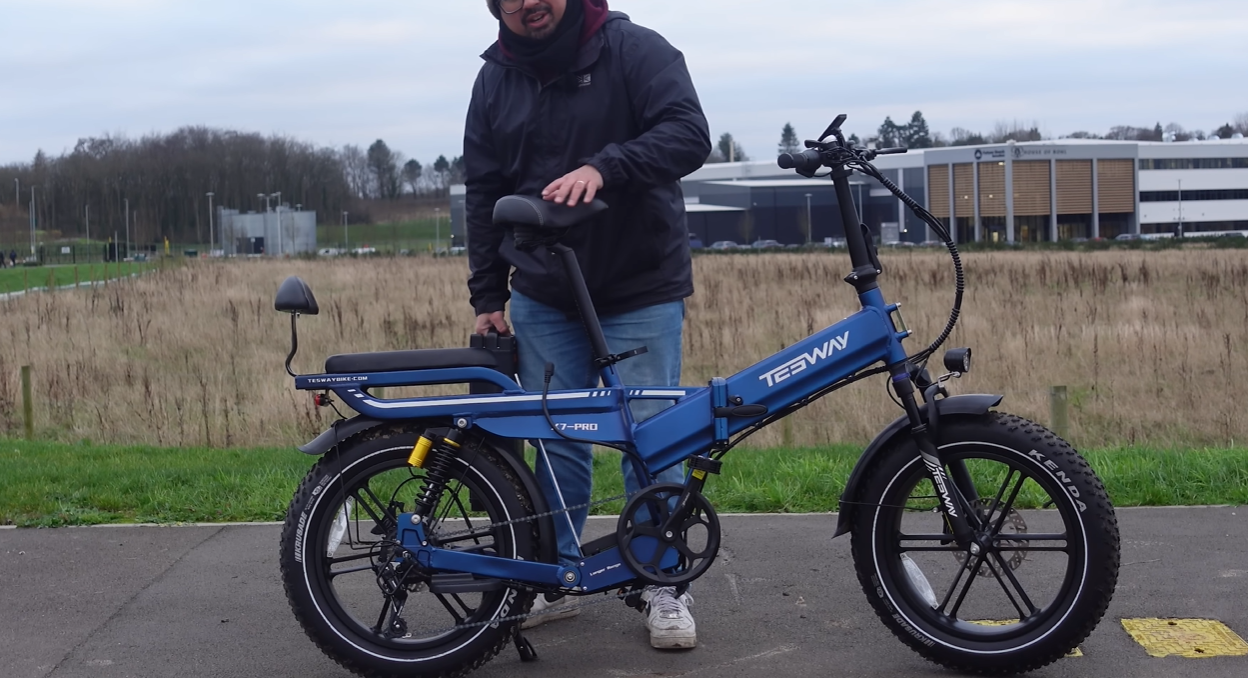
The Tesway X7 Pro does not look like a standard fat tyre folding e-bike. The rear suspension unit — a proper monoshock air spring that looks directly borrowed from a motorbike — is the most visually striking design element. Combined with the 49kg weight and the integrated rear rack structure, the X7 Pro reads more as a lightweight motorbike than a folding bicycle from a distance.
The rear rack is notably different from the bolt-on additions common on comparable bikes. It is integrated into the frame design rather than added as an afterthought. This gives the X7 Pro a more cohesive, intentional appearance and also provides a more stable mounting point for passenger loads.
Build quality for the price is reasonable. The colour display is bright and visible in daylight. Plastic mudguards front and rear are in black — a deliberate choice that means no rust and less visible rattling than chrome or silver plastic alternatives. The tyres are Kenda branded puncture-resistant units which is a step above generic rubber.
One important detail that benefits the X7 Pro over the Phatfour T2 Longtail and similar alternatives: the front light is mounted on the frame itself, not on the front rack. This means the light illuminates where you are going regardless of whether you use the front rack for cargo. On rack-mounted lights, adding a front basket or bag can block the beam. The X7 Pro’s frame-mounted light is a practical improvement.
The hand grips are a minor disappointment — standard straight grips without the flared ergonomic profile that reduces hand fatigue on longer rides. They are easy and cheap to replace but should have been better specified on a bike sold partly on its touring and long-range credentials.
THE SPEED COMPUTER ISSUE — IMPORTANT TO KNOW BEFORE YOUR FIRST RIDE
This is one of the most practically useful things in this review and most buyers will not find it elsewhere.
Out of the box, the Tesway X7 Pro’s speed computer is set with incorrect wheel size measurements. The bike reports speeds approximately 3 mph higher than actual GPS-measured speed. During testing, the bike displayed 27 mph while GPS showed 24 mph — a consistent 3 mph discrepancy.
The reason: the manufacturer entered wheel size measurements corresponding to approximately 24 inches in the computer, when the actual measured diameter of the 20-inch x 4-inch fat tyres is closer to 22 inches. Every wheel rotation registers as slightly more distance than actually covered, inflating the displayed speed.
The fix is straightforward. Access the computer settings and change the wheel circumference measurement to match the actual 22-inch diameter. After making this adjustment, the displayed speed matched GPS readings accurately. This is a five-minute fix but it is not mentioned in the manual and most buyers will not know to check.
Why does this matter? E-bike speed limits are enforced based on the bike’s own speed readings in many jurisdictions. An inflated speed reading means you may be managing your assist level based on incorrect information. Fix this before your first proper ride.
BATTERY AND RANGE — THE HEADLINE THAT DELIVERS
The 60Ah 52V battery is the reason to consider the X7 Pro over alternatives. Here is what real testing revealed.
In 14 miles of riding at full speed — no throttling back for range optimization — with a passenger for a significant portion, the battery lost one bar of five. Projecting linearly, that suggests approximately 70 miles of real-world range at full performance with mixed passenger and solo use.
The manufacturer’s 200-mile claim is achievable under specific conditions. Riding in pedal assist level one, solo, on flat ground, at moderate speed — the enormous battery capacity makes 200 miles plausible. For a commuter who rides 15-20 miles per day, this battery potentially covers a full week of commuting without charging.
There was no voltage sag observed during the hill climb test — the battery held at five bars throughout, which is an important indicator of battery quality. Cheap batteries often show significant voltage drop under load, reducing power delivery precisely when you need it most. The X7 Pro’s battery maintained consistent output.
CHARGING THE 60AH BATTERY
The standard 2A charger that comes with most e-bikes would take over 30 hours to charge a 60Ah battery from flat. Tesway includes a 6A fast charger. This reduces full charge time to approximately 10 hours. A 3-hour partial charge delivers more usable range than a full charge on most standard e-bikes — a useful comparison for anyone who cannot always charge overnight.
HOW TO REMOVE THE BATTERY — THE ONE ANNOYANCE
Battery removal requires removing the saddle first. Some e-bikes have a lever at the base of the battery housing that allows the battery to tilt forward and slide out without touching the seat. The X7 Pro does not have this. The saddle is quick-release which reduces the inconvenience, but the additional step of removing the saddle every time you want to remove the battery for indoor charging is a genuine daily irritation that should have been designed out.
PERFORMANCE — HONEST RESULTS FROM REAL TESTING
MOTOR — 1,200W NOMINAL, 1,600W PEAK
The motor numbers are impressive on paper. In real riding, they deliver competent rather than spectacular performance.
Top speed after wheel size correction: approximately 28 mph on flat ground. That matches what was advertised. GPS confirmed a maximum of 32 mph on a downhill section. For a 49kg bike carrying a rider, these speeds are reasonable.
HILL CLIMB TEST — SANDY LANE RESULT
The hill climb test on Sandy Lane — a demanding real-world gradient used to benchmark e-bikes — completed in 1 minute and 9 seconds. This is not a terrible result but it is not the impressive result the 1,200W motor and claimed 100 Newton metres of torque would suggest.
The honest explanation is weight. At 49kg, the X7 Pro is among the heaviest fat tyre folding e-bikes in its class. Cold conditions during testing also reduce battery output. The combination of extreme weight and cold temperature explains the slightly underwhelming hill performance without excusing it entirely. Buyers who live in hilly areas and want to carry a passenger up significant gradients should factor this in.
Speed at the hardest point of the climb dropped to 8 mph before recovering across the line. The bike completed the climb — it did not stall or stop — but a lighter bike with the same motor would have done it faster and more convincingly.
CADENCE SENSOR — NOT A TORQUE SENSOR
The Tesway X7 Pro uses a cadence sensor for pedal assist rather than a torque sensor. This is a genuine preference point rather than a universal flaw.
Cadence sensors activate assist based on whether the pedals are turning. Torque sensors activate assist based on how hard you are pushing. Torque sensors feel more natural and responsive. Cadence sensors have a slight delay — approximately half a pedal rotation — before assist kicks in.
The practical implication: when pulling away from a standstill at traffic lights or starting on an uphill, the cadence sensor delay means you need to manage your starting technique. Getting into a higher gear before stopping, giving a slight push to get the wheel turning, and then allowing the sensor to engage assist produces smoother starts than simply pushing the pedal from a stationary.
The throttle eliminates this for stationary starts — just twist and go. Riders who plan to use pedal assist primarily on longer rides rather than frequent stop-start urban commuting will barely notice the cadence sensor behaviour.
RIDE QUALITY AND COMFORT — GENUINELY IMPRESSIVE
This is where the Tesway X7 Pro earns its touring bike comparison. Ride quality is excellent for a fat tyre folder.
The combination of front lockable suspension, rear monoshock air suspension, and 4-inch wide fat tyres absorbs road imperfections genuinely well. Pothole sections that would transmit sharp impacts through a rigid or lightly suspended bike pass under the X7 Pro with comfortable absorption. The only audible rattling during testing appeared to come from the saddle rather than the suspension or frame — a setup issue rather than a structural one.
At speed on flat ground the bike feels stable and controlled. Confidence builds quickly because the bike does not feel nervous or unpredictable. Hydraulic brakes provide strong, progressive stopping power — tested from 23 mph and achieving approximately 4 metres stopping distance, which is a strong result.
The saddle is large — noticeably larger than typical fat tyre folder saddles — because of its dual function as both rider seat and passenger system anchor. This actually improves solo rider comfort on longer rides as a side effect of the passenger-focused design.
PASSENGER CAPABILITY — REAL FAMILY TESTING
The rear passenger seat, backrest, and foot pegs were tested with a real child passenger over several miles of riding. This is the kind of test most reviews do not do and the result matters for buyers specifically considering the X7 Pro for family use.
The passenger assessment from the real child tester: comfortable, sturdy, rated 7 out of 10, with the main limitation being the lack of grab handles. The passenger held onto the rider’s saddle rather than dedicated handles, which reduces the feeling of security. A grab handle bar or hip handles would significantly improve the passenger experience and is an obvious upgrade for a future version.
Foot pegs are included in the box and are properly integrated into the frame rather than clamped on as an afterthought. This is an important distinction — foot pegs that are properly part of the bike design handle passenger load more safely than those that grip the frame with a clamp.
The bike’s behaviour with a passenger is notably stable. No significant change in handling or motor performance was detected during mixed solo and passenger riding over 14 miles. The 49kg bike weight and long wheelbase contribute to stability under load.
Comparison point: the X7 Pro rated a 7 versus a 9 for the Phatfour T2 Longtail when evaluated by the same child passenger. The Longtail’s enclosed cage structure and dedicated passenger system provide better security and confidence. The X7 Pro is a reasonable alternative when a full cargo bike is not wanted or practical.
FOLDING — IT WORKS, WITH CAVEATS
The folding mechanism is straightforward in principle. Fold the pedals, release the safety clip, fold the main frame. In practice, the weight of the bike at 49kg makes this physically demanding. The folded bike is also not well-balanced — it wants to tip to one side and does not stand stably in the folded position.
The handlebar fold leaves the bars in an awkward position relative to the folded frame. The overall folded package is very large and very heavy for something described as a folding bike. In practice, the folding capability is useful for transport in a van, loading into a large vehicle boot, or storage in a tight space — but this is not a bike you will casually fold and carry onto public transport or lift up stairs alone.
For buyers who specifically need to fold and carry the bike regularly, 49kg is a genuine practical barrier. For buyers who need to fold it occasionally for transport or storage, the mechanism works adequately.
ASSEMBLY — LARGE BOX, SOME CHALLENGES
The box is exceptionally large — unavoidably so given the battery size and frame dimensions. Moving the box before assembly requires assistance because the cardboard handles provided are inadequate for the weight involved.
Assembly sequence: straighten and tighten handlebars, align with the front wheel, install pedals with covers, mount the rear backrest, remove the existing hand grip to install the throttle, and connect the wiring.
Notable detail from assembly: the throttle replaces the existing grip on the right side rather than adding alongside it, and also serves as the mounting point for the horn. Without the throttle installed, the horn is not functional — a slightly unusual arrangement that is worth knowing during setup.
Once assembled and with the wheel size corrected in the computer, the bike performs as tested and described throughout this review.
GEARS — SHIMANO 7-SPEED, WELL ADJUSTED
Seven-speed Shimano gearing is present. The gear changes tested smoothly through all seven ratios. The test bike arrived with well-adjusted derailleur settings. New bikes sometimes require adjustment — the two limit screws on the derailleur handle this and take patience but are not complex.
The limitation of seven speeds is that the gaps between ratios are larger than on an 8, 9, or 11-speed system. On a primarily electric-assist bike this matters less than on a standard bicycle because the motor covers the gaps in human power delivery. For riders who enjoy pedalling actively rather than using motor assist predominantly, a wider gear range would be welcome.
PROS AND CONS
PROS:
- 3,120Wh battery — three times larger than the biggest standard e-bike batteries
- Only one battery bar lost in 14 miles at full speed with a passenger — extraordinary efficiency
- No voltage sag observed during hill climb — quality battery construction
- Rear monoshock air suspension — genuine comfort improvement over coil or no suspension
- Lockable front suspension — adjustable for road versus off-road use
- Hydraulic brakes — strong, progressive, approximately 4 metre stopping from 23mph
- Passenger system properly integrated into frame with foot pegs
- Front light mounted on frame, not rack — illuminates correctly with or without front cargo
- Kenda puncture-resistant tyres — above generic alternatives
- Colour display — visible in daylight
- 6A charger included — 10 hours to full vs 30+ hours with standard 2A
- 28 mph real-world top speed confirmed by GPS
- Removable throttle — can be removed for legal compliance if required
- Integrated rear rack design — more cohesive than bolt-on alternatives
CONS:
- 49kg weight — very heavy for a folding e-bike
- Saddle must be removed to access the battery — poor ergonomic design
- Speed computer pre-set incorrectly — requires wheel size correction before first ride
- Hill climb result (1 min 9 sec on Sandy Lane) is underwhelming for the stated power
- Rear passenger lacks grab handles — reduces passenger security feeling
- Folded bike unstable — does not stand well in the folded position
- Hand grips are basic — uncomfortable for longer rides without replacement
- No indicators — only a horn
- The assembly box handles are inadequate for the weight
- Cadence sensor rather than torque sensor — slight delay in pedal assist engagement
- Maximum saddle height may challenge shorter riders
WHO SHOULD BUY THE TESWAY X7 PRO
Buy it if: You want the maximum possible e-bike range in a folding fat tyre format. You plan to carry a passenger regularly and want that capability built into the frame. You do mostly flat or gently rolling terrain rather than steep hills. You can charge at home and 10-hour overnight charging is acceptable. You are over approximately 5ft 4 and comfortable with a higher saddle position.
Skip it if: You regularly face steep hills and need strong hill-climbing performance. You need to carry the bike frequently — 49kg is very heavy. You want a quick-fold, easy-carry commuter bike. You are shorter than 5ft 4 and cannot adjust the bike to a comfortable riding position.
HOW IT COMPARES — QUICK REFERENCE
Tesway X7 Pro vs Engwe Pro 2: Similar price bracket. Engwe Pro 2 is lighter and a stronger all-round performer. Tesway X7 Pro wins decisively on battery capacity and range. Choose X7 Pro if range is the priority.
Tesway X7 Pro vs Vitilan i7 Pro 2: Similar fat tyre folding category. Vitilan i7 Pro 2 is better balanced for performance. Tesway X7 Pro wins on battery and passenger capability. Choose X7 Pro if you need passenger capacity alongside extended range.
Tesway X7 Pro vs Phatfour T2 Longtail: The Longtail is a dedicated cargo and passenger bike with a proper cage system. The passenger rated the Longtail 9 versus the X7 Pro’s 7. The X7 Pro wins on range. Choose Longtail for primary passenger use. Choose X7 Pro for range-first use with occasional passenger capability.
In testing at full speed with a passenger for part of the ride, one battery bar was lost in 14 miles. Projecting across five bars, that suggests approximately 70 miles at full performance.
FINAL VERDICT
The Tesway X7 Pro is a niche product that serves its niche exceptionally well. As a long-range fat tyre folding e-bike with genuine passenger capability, there are very few alternatives that match what it offers for the price.
The 3,120Wh battery is the product. Everything else — the motor, the suspension, the passenger system, the lights — is the supporting cast. When you evaluate the X7 Pro through that lens, the value case becomes clear. Comparable fat tyre folders at similar prices carry perhaps a third of the battery capacity. The X7 Pro’s price is the battery price, and the rest of the bike comes with it.
The weaknesses are real. 49kg is heavy and the hill climbing performance reflects that weight more than the motor specification would suggest. The battery removal requiring saddle removal is a poor ergonomic decision. The speed computer needs correcting before first use. The rear passenger experience would benefit from dedicated grab handles. The folded stability is poor.
None of these are dealbreakers for the buyer who specifically needs this product. If you want maximum range in a fat tyre folder with passenger capability built into the frame, the Tesway X7 Pro is one of the most compelling options in its price bracket.
For everyone else, lighter, more agile alternatives with smaller batteries serve the average e-bike use case better.
RATING: 3.5 / 5
BEST FOR: Long-range riders who need maximum battery capacity in a folding format. Families who want occasional passenger capability without buying a dedicated cargo bike. Riders who do flat terrain and distance rather than hill climbing.
NOT IDEAL FOR: Steep hill climbing. Short riders. Anyone who needs to carry the bike regularly. Urban commuters who need quick folding and light weight.
Reviewed by Reo R | My PitShop 6+ years hands-on tech and automotive reviewing experience Zero brand bias — honest verdicts, every time Category: E-Bike Review | Read time: 10 min | Last updated: April 2026