TL;DR — Quick Verdict
The Slate Truck flips the usual EV pricing logic on its head. Instead of starting expensive and loading you with features you’ll never use, it starts at a genuinely bare-bones $24,950 — no power windows, no display, no infotainment — and lets you bolt on exactly what you want, when you want it, often years after buying. After getting hands-on time and an actual first drive, my honest take: it’s more fun to drive than the spec sheet suggests, smartly built around affordable customization, and could be one of the most interesting first-EV options to hit the market in years. It’s not a “real” pickup truck for hauling and towing, but it was never trying to be one.
The Idea Behind the Slate Truck
Here’s the problem Slate is trying to solve: electric vehicles are typically expensive, and a big part of that cost comes from features you may not actually want. Heated seats you’ll never use. A massive infotainment screen when you just want a phone mount. Premium speakers, when a Bluetooth speaker would do fine.
Slate’s pitch is simple — what if you could choose exactly which bells and whistles you get, and skip paying for the rest?
That’s the entire philosophy behind this truck, and after spending real time with it — walking around it, sitting in it, and actually driving it — I think it’s one of the more genuinely original ideas in the EV space right now.
Pricing and the “Blank Slate” Concept
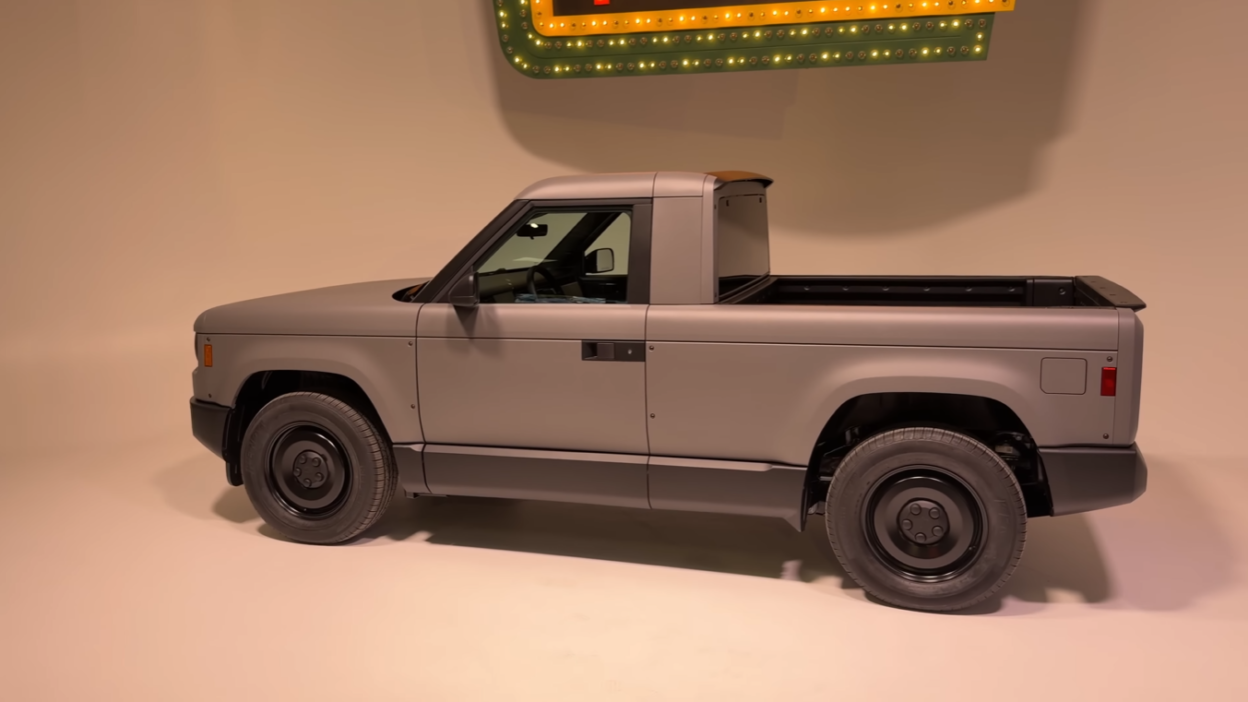
The headline number is $24,950 for the base configuration, which Slate calls the “Blank Slate.” And that name is literal — every single truck rolls off the factory line in the exact same slate gray color, with the exact same minimal feature set.
Every color variant you’ve probably seen in photos or videos? Those are all vinyl wraps applied after the fact, not factory paint options. This is actually a clever signal about what this truck really is: one base hardware platform that gets transformed through add-ons, wraps, and bolt-on modules rather than dozens of expensive factory trims.
What You Actually Get at the Base Price
The base Slate Truck comes with:
- Rear-wheel drive
- A roughly 65 kWh battery
- Charging speeds up to 120 kW via a NACS port
- 181 horsepower
- An estimated 205 miles of range
- Steel wheels, 245/65 R17, all four corners
- A 5-foot truck bed
- Cloth interior seats
- Manual (non-power) windows
- No center display, aside from a single small screen behind the steering wheel showing speed, range, and odometer
That’s it. No power windows by default. No speaker system beyond an optional single Bluetooth unit. No touchscreen infotainment. This is about as stripped-down as a modern vehicle gets — and that’s entirely the point.
Exterior Design: Compact, Friendly, and Surprisingly Good-Looking
Walking around the truck front to back, the overall shape has a slightly Bronco-inspired look — boxy, upright, and approachable rather than aggressive.
The front end houses a genuinely useful front trunk (frunk), which matters more than people realize in pickup trucks — closed, lockable storage space is usually a premium feature, and Slate has included a solid amount of it even on this compact frame.
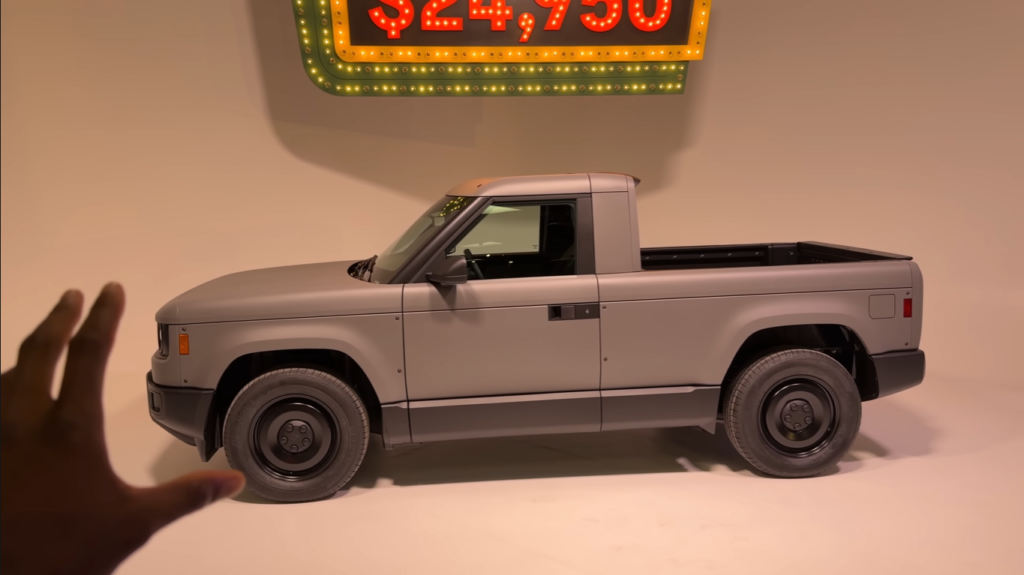
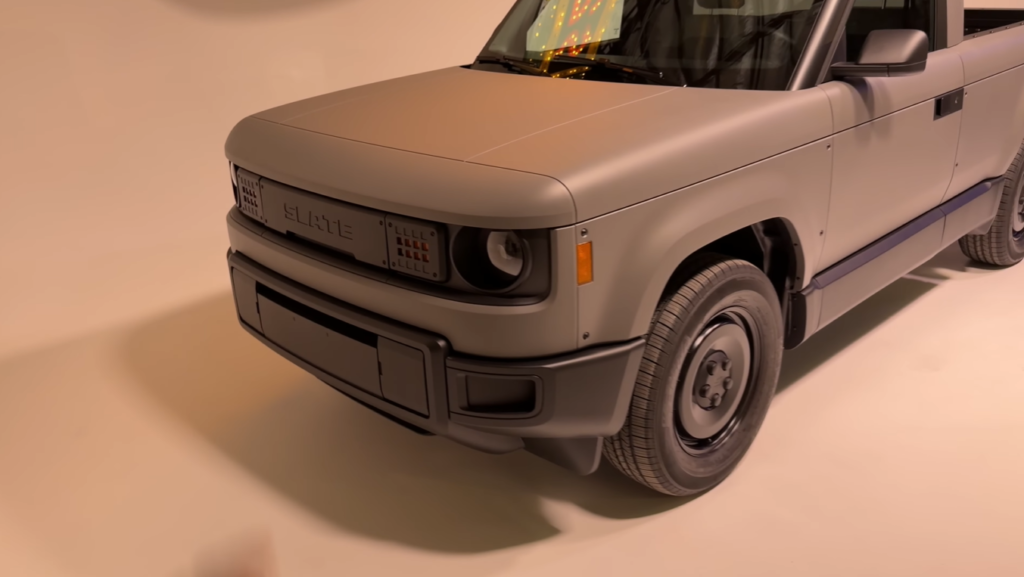
The proportions work well together: the bed, the two-seat cabin, and the frunk all feel balanced relative to the wheel size. If anything, the rear of the truck might be its most attractive angle — bar-style tail lights and a small spoiler give it a clean, intentional look, at least in its standard truck configuration.
The NACS charging port sits at the rear-left corner — exactly where you’d want it for easy charging access.
Interior: Minimal in the Best Way
Stepping inside through flush door handles, the cabin immediately reflects the truck’s philosophy — cloth seats (upgradeable to seat covers, including faux leather options), a small steering wheel-mounted display, basic cruise control and blinker controls, and that single gauge cluster screen behind the wheel showing your essentials.
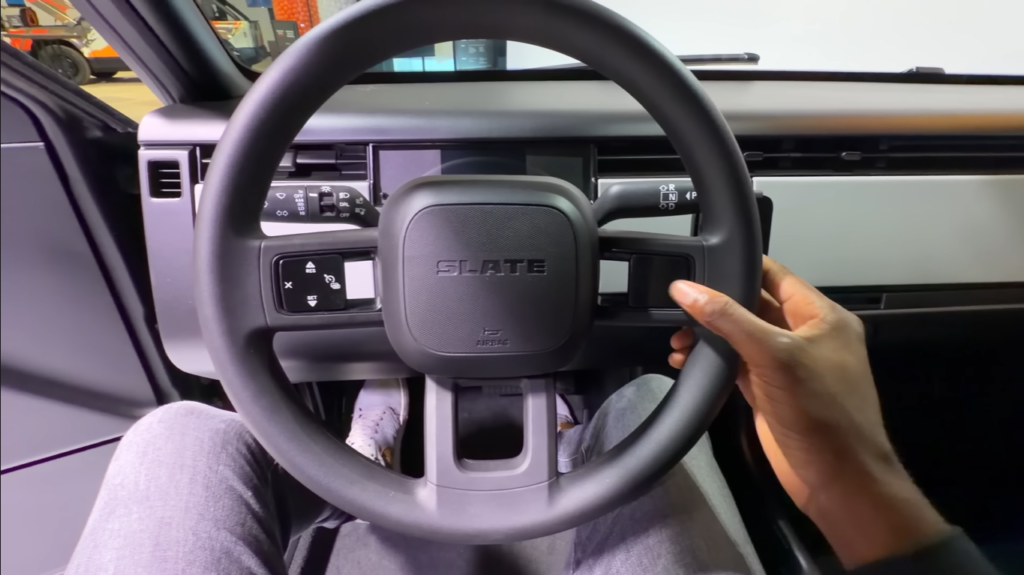
Here’s the surprising part: the interior manages to feel both roomy and compact simultaneously. At 6’3″, there was plenty of headroom and legroom with the seat pushed back — but it was also possible to reach across and touch the passenger door, something that doesn’t happen in most pickup trucks. Compact, but comfortable.
The center console is minimal but functional, with the option to add a second stackable console on top for a more natural armrest position. Storage cubbies exist behind certain panels even in this base configuration.
A phone mount is available as an option, and notably, that same mounting point can alternatively be configured for an iPad if you’d prefer a tablet-based display setup.
Starting the truck is refreshingly simple: a physical key slides into a slot, you push it in, and the EV powers on. No app-based key fob gimmicks, no proximity sensors — just a deliberately analog touch in an otherwise high-tech vehicle.
The Customization System: This Is the Real Story
The base truck is genuinely just the starting point. Slate has built an entire ecosystem of modular accessories designed to transform this same underlying hardware into wildly different vehicles.
Vinyl wraps are the most accessible customization — a full-body wrap starts around $500–$700, compared to traditional vinyl wrap jobs that can easily run $5,000–$6,000 elsewhere. That price difference alone makes customization genuinely viable for average buyers, not just enthusiasts with deep pockets.
Roll cage and SUV conversion is where things get really interesting. Owners can bolt on a roll cage (which includes built-in airbags) along with a second row of seats, transforming the two-seat truck into a five-seater SUV-style vehicle. This can be done either at the time of purchase through the configurator, or added later as an aftermarket upgrade.
One demo unit showed this conversion in a fully open-air format — no windows, no rear doors, with a fold-down front passenger seat providing access to the rear bench. It’s an unconventional design, but one that clearly shows how far the modularity extends.
Mounting rails and fasteners run throughout the vehicle — visible mounting points in the cabin, the bed, and structural areas — designed for both Slate’s own accessory lineup and likely a wave of third-party and DIY accessories from the broader community.
Audio upgrades scale from a single JBL Bluetooth speaker (probably sufficient for a cabin this small) up to a full multi-channel premium sound system with distinct center, left, and right channels — a noticeably more substantial setup for buyers who care about audio quality.
The variety of finished looks on display ranged from subtle — decals on the wheels, a small accessory roof bar, off-road tires — to a half-wrap configuration (slate gray top, colored bottom half) — all the way to fully wrapped, heavily customized trucks that look like an entirely different vehicle from the base model.
Slate estimates there could be thousands of possible configuration combinations once wraps, panels, seat options, and modules are all factored in.
Driving Experience: More Fun Than the Spec Sheet Suggests
This is where the Slate Truck genuinely surprised me.
On paper, 181 horsepower and rear-wheel drive doesn’t sound exciting. But riding as a passenger first, it became clear this truck has real torque and zip for everyday driving — enough that it felt noticeably peppier than the numbers suggested.
Getting behind the wheel myself confirmed it. The cabin experience while driving matches the truck’s overall minimalism — no heads-up display, no paddle shifters, no extra buttons or alert chimes competing for attention. Just the small gauge cluster, the steering wheel, and the road ahead.
One-pedal driving comes standard and cannot be turned off, but it’s tuned well — closer to Tesla’s firmer regenerative braking feel than a gentler implementation. Lifting off the accelerator brings the truck to a confident, controlled stop, which felt genuinely satisfying rather than abrupt or jarring.
There’s no sport mode or alternate drive modes — every Slate Truck ships with the identical single-motor, rear-wheel-drive setup producing roughly 180 horsepower. And despite the modest numbers, it consistently felt quicker than expected. Being a smaller, lower-riding vehicle than a typical full-size pickup also means you feel more connected to the road at speed, rather than feeling like you’re piloting a large, disconnected vehicle.
Suspension uses MacPherson struts at the front across every configuration. It leaned slightly firmer than expected over smaller bumps and road imperfections, though it handled larger dips and undulations confidently. For a nearly-final production prototype in the $25,000–$30,000 price range, there’s genuinely little to complain about here.
What This Truck Is Not
It’s important to set expectations correctly. This is not a vehicle built for serious towing or heavy cargo hauling — don’t expect full-size pickup truck capability here. It’s better understood as a compact utility vehicle: ideal for tossing groceries or gear into the bed or frunk, running errands, and general daily driving, where you’ll quickly forget it’s even a truck until you glance back and notice the 5-foot bed.
It’s also worth noting that the base “Blank Slate” configuration only seats two — so if you need family seating from day one, you’ll either need the SUV roll-cage conversion or to factor that into your initial build.
Who Should Consider the Slate Truck?
This makes sense if you: want your first-ever EV without committing to a fully loaded, expensive package, like the idea of customizing your vehicle over time rather than all at once, mainly need a compact utility vehicle for errands and light hauling rather than heavy-duty truck work, and enjoy the idea of a DIY-friendly, accessory-driven ownership experience.
Look elsewhere if you: need serious towing or payload capacity, want a fully-loaded vehicle out of the gate without aftermarket additions, require family seating from day one without paying for the SUV conversion, or want multiple drive modes and a more traditional, feature-rich cabin experience.
Final Verdict
The Slate Truck is a genuinely new idea in the EV space — not just a cheaper EV, but a fundamentally different ownership philosophy. Instead of paying upfront for features you might never use, you get a capable, surprisingly fun-to-drive base vehicle and the freedom to build it into whatever you actually need, whenever you decide you need it.
At well under $30,000 for a sensibly-optioned build — say, adding the phone mount, power windows, and a few vinyl touches — this becomes a genuinely compelling first EV for a lot of buyers who’ve been priced out of the segment until now.
It won’t replace your family hauler, and it’s not built for serious towing. But as an honest, affordable, and legitimately fun entry point into EV ownership — with the door open to grow and customize over time — the Slate Truck earns a cautiously excited recommendation from My PitShop. We’re rooting for this one to make it to production close to what we tested.
The base “Blank Slate” configuration starts at $24,950, with no optional add-ons included.
It uses a roughly 65 kWh battery offering an estimated 205 miles of range, with DC fast charging up to 120 kW via a NACS port.
Yes. Owners can add a bolt-on roll cage (with built-in airbags) and a second row of seats to convert the two-seat truck into a five-seat, SUV-style configuration — either at purchase or as a later upgrade.
Reviewed by Reo R — Tech & Auto Reviewer with 6+ years of hands-on experience. My PitShop delivers honest reviews with zero brand bias.
Disclosure: This review is based on a hands-on first look and first drive of a near-final production prototype. Final specifications, pricing, and options may change before the Slate Truck reaches full production.