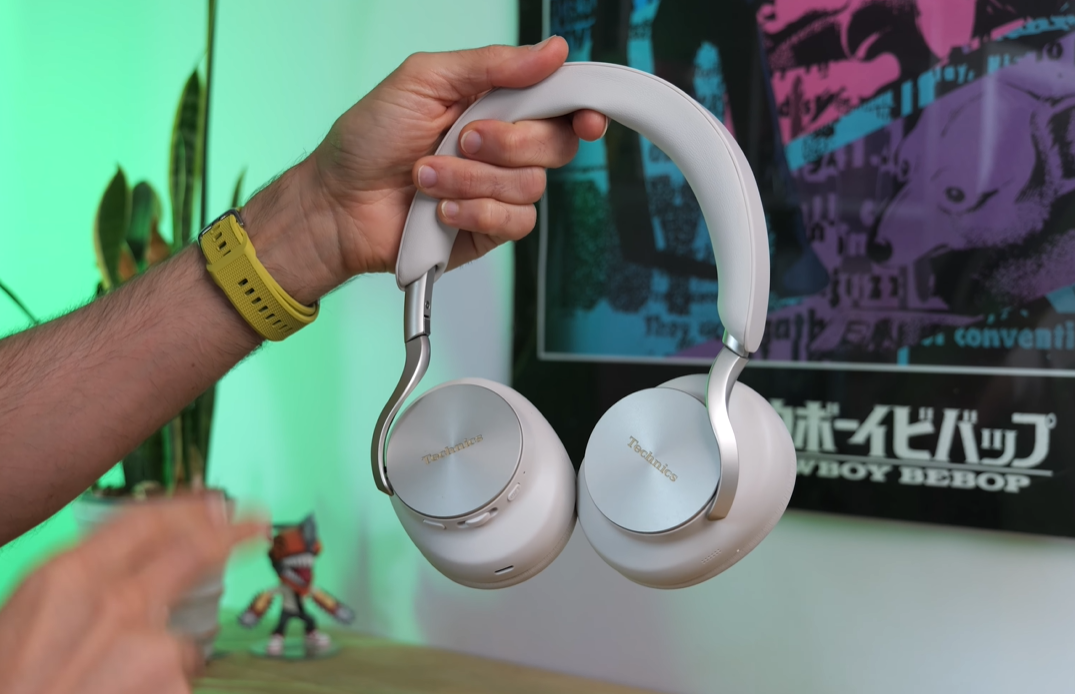
Technics’ flagship wireless headphones for 2026, the EAH-A1000, launch at $449.99 / £399 / €449, going on sale September 30, 2026 in Black and a new “Platinum Greige” colorway. After two weeks of real-world testing — including a 14-hour flight and a few days navigating Tokyo’s chaos — one thing stood out above the spec sheet: this is a headphone built around comfort and noise cancellation first, feature-count second.
5 Things This Review Adds That the Spec Sheet Won’t Tell You
- Real-world battery life beats the marketing number. Technics rates the A1000 at 45 hours with ANC on. In testing, after a 14-hour flight plus 2-3 hours on trains — all with ANC and LDAC running — over 50% charge remained. That’s roughly 22 hours of hard use for less than half the rated battery, meaning the real-world figure tracks close to, or slightly ahead of, the official claim rather than falling short of it, which is the more common outcome with ANC battery claims.
- The play/pause button is the one real complaint after two weeks of daily use. All physical controls are clustered on the right cup rather than split across both sides, and the central push-button is easy to miss-press, especially while walking. Nothing else about the control layout or design drew a complaint in two full weeks of use — which, for a $450 flagship, is a notably short list of gripes.
- Multipoint switching is genuinely seamless, not just spec-sheet seamless. Connected simultaneously to two phones plus a laptop and a Nintendo Switch, the A1000 switched from a video on one device to an incoming call on another without any manual reconnecting or app fiddling — a feature most headphones list but few execute this cleanly.
- The noise cancellation handles voices, not just engine rumble. Most ANC headphones are tuned around low-frequency drone (planes, trains, traffic) and struggle with the higher-frequency chatter of a crowd. In dense, noisy environments — Tokyo’s Akihabara district among them — the A1000 suppressed surrounding voices well enough to listen to an audiobook at a normal volume, which is a harder test than the engine-noise demo most reviews rely on.
- A rare minor bug worth flagging: occasional crackling on head movement. On London Underground testing, a brief crackly artifact appeared intermittently when turning the head — noted as possibly tied to pre-release firmware ahead of full launch. Worth checking for in early production units and updating firmware if it persists.
Design and Comfort
The EAH-A1000 ships in Black or Platinum Greige (Technics’ term for a warm grey-beige blend) — a more restrained palette than some rivals, but the circular spun-metal finish on the ear cups reads as genuinely premium rather than merely “black plastic, but nicer.” The cups rotate flat and fold compact enough for a bag, and the included carry case is properly stitched, with a separate pouch for the USB-C cable and bundled 3.5mm cable.
Comfort is where the A1000 separates itself from most flagship ANC headphones: extended wear — including that 14-hour flight — produced no clamping pressure or ear fatigue, aided by generously padded cups and a refined headband.
Audio Engineering
The A1000 is built around a newly developed 40mm Magnetic Fluid Driver with SST Edge, paired with a carbon-fiber diaphragm, a “Baffle Flat Structure,” and an Acoustic Control Chamber — Technics’ way of engineering a more spacious, less boxed-in soundstage than a standard driver enclosure typically produces.
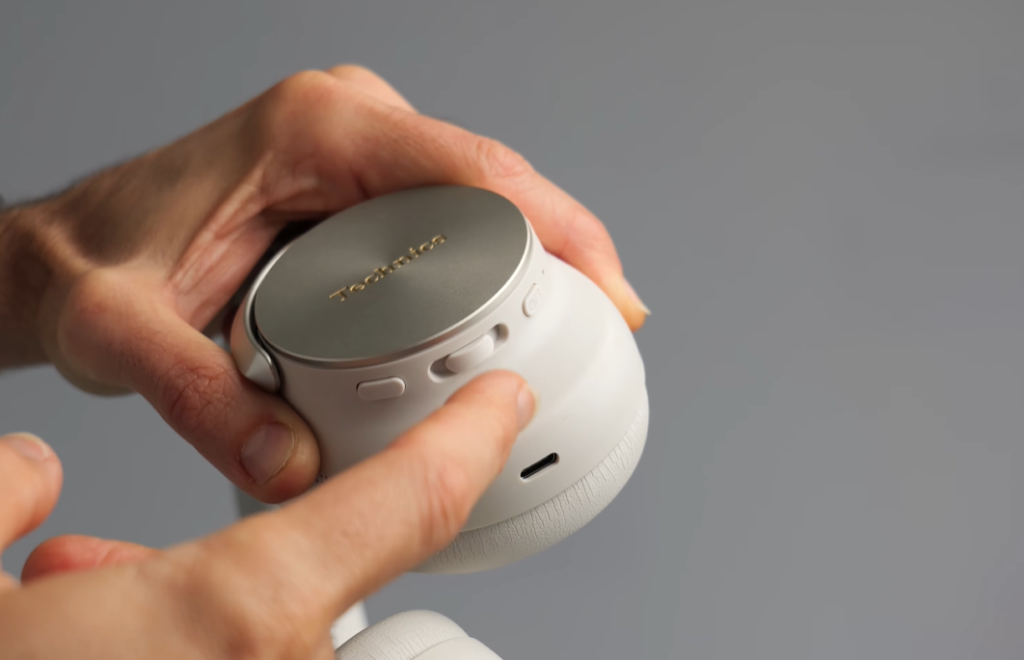
Codec support covers LDAC for high-res Bluetooth streaming, LE Audio with the LC3 codec, and USB Audio for wired lossless playback, plus Dolby Atmos support with head tracking for spatial audio. A 9-band custom EQ is available in the Technics Audio Connect app alongside genre presets (vocal-forward, bass/treble boosters), and even the default tuning handles both bass-heavy pop and dense, layered metal without either muddying the low end or losing separation in busier mixes — a tuning balance that’s harder to hit than it sounds, since most consumer headphones lean toward one extreme or the other. One gap: there’s no built-in hearing-test feature to auto-calibrate EQ to your own hearing, a feature several rivals now include.
Noise Cancellation
Technics’ Adaptive Noise Cancellation uses four microphones per side and adjusts in real time to ambient conditions, with an Ambient Mode toggle for quick environmental awareness. In testing, it held up against wind noise, traffic, and train rumble at a level competitive with Sony and Bose flagships, with the added strength of cutting down surrounding voices particularly well in crowded environments — noted above as point #4.
Call quality benefits from AI-assisted beamforming microphones, tested deliberately next to simulated heavy traffic noise, with vocals staying clear despite the background rumble.
Battery Life
| Mode | Battery Life |
|---|---|
| ANC on (LDAC) | Up to 45 hours |
| ANC off (LDAC) | Up to 80 hours |
| ANC on (AAC) | ~45 hours |
| ANC on (wired, USB-C) | ~30 hours |
| Fast charge | 15 minutes → up to 4 hours playback |
These are Technics’ official figures, and real-world testing over a demanding travel day (14-hour flight, ANC and LDAC on throughout) landed consistent with the claim rather than falling short of it — worth noting since ANC battery claims are one of the most commonly overstated specs in this category.
Connectivity
- Bluetooth multipoint: up to 3 devices simultaneously
- Wired: USB-C (lossless) and 3.5mm analog cable included
- Wear detection: automatically pauses/resumes playback, customizable in-app
How It Compares to the Competition
| Spec | Technics EAH-A1000 | Sony WH-1000XM6 |
|---|---|---|
| Price | $449.99 | ~$390-450 |
| Driver | 40mm Magnetic Fluid Driver | 30mm |
| Battery (ANC on) | Up to 45 hours | Up to 30 hours |
| Codecs | LDAC, LC3, USB Audio | SBC, AAC, LDAC, LC3 |
| Multipoint | 3 devices | Yes |
| Fast charge | 15 min → 4 hrs | Yes |
| Weight | Not officially published | 254g |
The A1000’s headline advantage over Sony’s flagship is battery life — 45 hours vs. 30 hours with ANC engaged, a 50% gap that matters for multi-day trips without a charger. Sony holds a slight edge in broader codec support (SBC/AAC alongside LDAC) for wider device compatibility. If your priority is squeezing the most hours out of one charge, the A1000 wins; if you need the widest device compatibility across older Bluetooth codecs, the XM6 is the safer pick.
Verdict
After two weeks of daily use across flights, trains, and one of Tokyo’s busiest districts, the Technics EAH-A1000’s strongest asset isn’t any single spec — it’s how few compromises show up in real use. Comfort during long sessions, noise cancellation that handles both drone and voices, and battery life that holds up to its own claims are the three pillars here. The only recurring friction point is the play/pause button placement, and even that’s a minor gripe against an otherwise clean control scheme.
Buy it if: you want the longest ANC battery life in the flagship class, all-day comfort, and noise cancellation that handles crowds as well as engine noise.
Consider the Sony WH-1000XM6 instead if: you need broader legacy codec support or prefer Sony’s more mature companion app ecosystem.
Sources:


