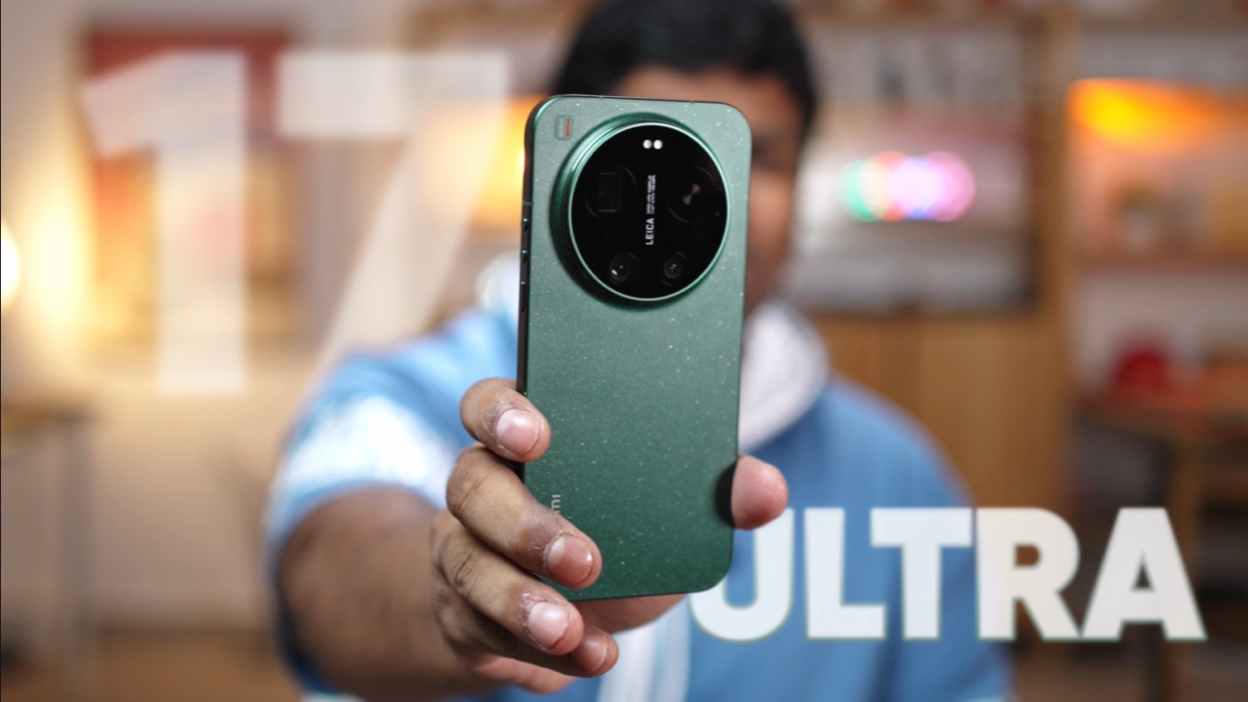
TL;DR: The Xiaomi 17 Ultra at a Glance
The Verdict: The Xiaomi 17 Ultra is a 2026 flagship powerhouse that prioritizes camera innovation over spec-padding. By moving to a continuous optical zoom and a LOFIC-powered 1-inch sensor, it offers a professional photography experience that currently outclasses the iPhone 17 Pro in dynamic range and framing flexibility.
- 🏆 Best For: Professional mobile photographers, power users, and Leica enthusiasts.
- 🚀 Key Upgrade: First “Ultra” with Snapdragon 8 Elite Gen 5 and a massive 6,800mAh battery.
- 📸 Camera Star: Revolutionary 75mm–100mm continuous optical zoom (no digital cropping between 3.2x and 4.3x).
- 💰 Price: Starts at ¥6,999 (~$960) for 512GB (Global launch expected March 2026).
In the world of flagship smartphones, “Ultra” has become more than just a marketing term—it’s a promise. A promise of no compromises, cutting-edge technology, and cameras that push the boundaries of what’s possible in a pocket-sized device. The Xiaomi 17 Ultra arrives in 2025 as the company’s bold statement in this ultra-competitive segment, and it’s the first Ultra phone to launch with Qualcomm’s Snapdragon 8 Elite Gen 5 processor.
But here’s what makes this launch particularly interesting: Xiaomi didn’t just iterate on last year’s formula with incremental upgrades. Instead, they made a controversial decision with the camera system—one that has photographers and tech enthusiasts debating whether it’s brilliant innovation or a risky gamble. After extensive testing, comparing it against flagships like the iPhone 17 Pro, and pushing all three cameras to their limits, it’s time to break down whether the Xiaomi 17 Ultra is the new standard everyone else needs to beat.
Unboxing: Premium Presentation with Practical Inclusions
The Xiaomi 17 Ultra arrives in packaging that reflects its premium positioning. The base variant now starts at 12GB RAM with 512GB storage—a notable change from the previous generation that we’ll discuss later.
What’s in the Box:
White Insert Section:
- SIM ejection tool
- Quick start guide
- Transparent hard shell case (a welcome inclusion that protects your investment from day one)
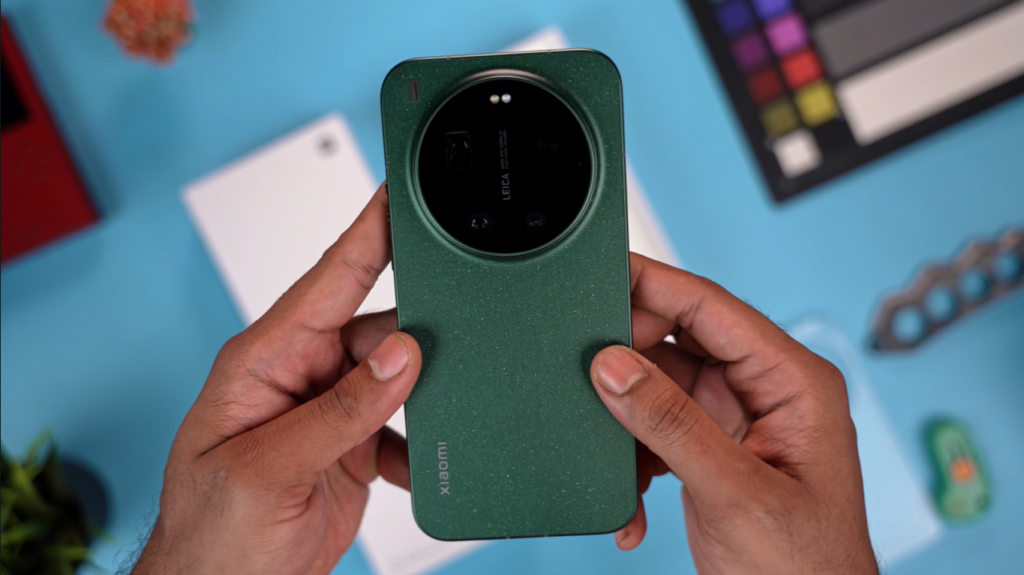
The Phone: Available in four colorways, with the standout being a stunning green variant featuring a sparkly finish on the back. Alternative options include black, white, and purple, catering to different aesthetic preferences.
Charging Accessories:
- USB Type-A to Type-C cable with distinctive orange accents
- 100W charging brick (despite the phone supporting 90W wired charging)
The inclusion of a 100W charger for a phone that charges at 90W might seem odd, but it ensures you have enough power headroom and future-proofs the accessory for other devices.
Design Evolution: Familiar Yet Refined
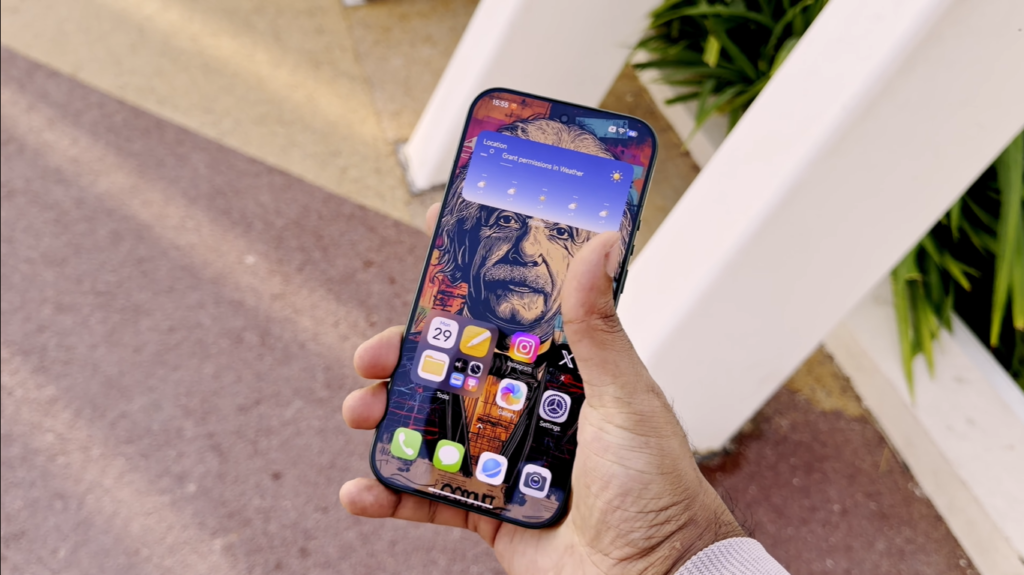
The Xiaomi 17 Ultra follows 2025’s dominant design language—flat display, flat back, flat metal sides with rounded edges and curved corners. While this design isn’t groundbreaking, Xiaomi has executed it with premium materials and thoughtful refinements.

Build Quality and Materials
The fiberglass back features a matte finish that serves a practical purpose—it resists fingerprints remarkably well, keeping the phone looking clean throughout daily use. The metal frame adds rigidity and premium feel, though the overall design prioritizes aesthetics over ergonomics. This is not an easy phone to hold comfortably due to its size and flat surfaces, but it undeniably feels premium in hand.
Physical Buttons and Port
The power and volume buttons have been completely redesigned. The new layout bears a striking resemblance to a certain fruit-branded competitor—an observation that’s hard to ignore. Functional placement remains optimal, with buttons positioned for easy thumb access.
The USB Type-C port supports USB 3.2 Gen 2 with video output capability, enabling connection to external displays and fast data transfer speeds—crucial for photographers moving large RAW files off the device.
Durability: IP69 Rating
Xiaomi has equipped the 17 Ultra with an IP69 rating, providing comprehensive protection against dust and water. This is among the highest IP ratings available on smartphones, offering peace of mind for users who shoot in challenging weather conditions or near water.
Display: Bigger, Brighter, and Completely Flat
One of the most significant design changes from the previous generation is the move to a completely flat display. In fact, Xiaomi uses the same panel found in the Xiaomi 17 Pro Max, which is excellent news for quality consistency.

Display Specifications:
- Size: 6.9 inches (larger than the previous generation)
- Type: AMOLED with LTPO technology
- Resolution: 1.5K (2880 x 1440 pixels)
- Refresh Rate: 120Hz adaptive
- Protection: Dragon Crystal Glass
- PWM Dimming: 2160Hz
- Subpixel Arrangement: Superior configuration (avoids pentile drawbacks)
Real-World Performance
The display gets impressively bright for outdoor usage, making it comfortable to shoot and review photos even in direct sunlight. For users sensitive to PWM flicker (which can cause eye strain), the 2160Hz PWM dimming is among the highest available, significantly reducing flicker perception. Additionally, Xiaomi includes a DC-like dimming option for those who prefer alternative dimming methods.
The flat display represents a significant departure from the curved edges that dominated previous Ultra models. This change improves:
- Edge touch accuracy
- Screen protector compatibility
- Overall durability (reduced likelihood of edge cracks)
- Viewing experience without color distortion at edges
Dimensions: Thinner Despite Everything
Here’s an impressive engineering achievement: despite the display growing larger and the battery capacity increasing substantially, the Xiaomi 17 Ultra is over a millimeter thinner than its predecessor while maintaining approximately the same weight. This is the kind of refinement that might not jump out from a spec sheet but makes a tangible difference during daily use.
The camera array, while still protruding, is slightly smaller than last year’s, providing a natural finger rest without being overly obtrusive. This reduction in camera bump size is particularly noteworthy given what Xiaomi accomplished with the optics—which brings us to the most interesting aspect of this phone.
The Camera System: A Controversial Three-Sensor Approach
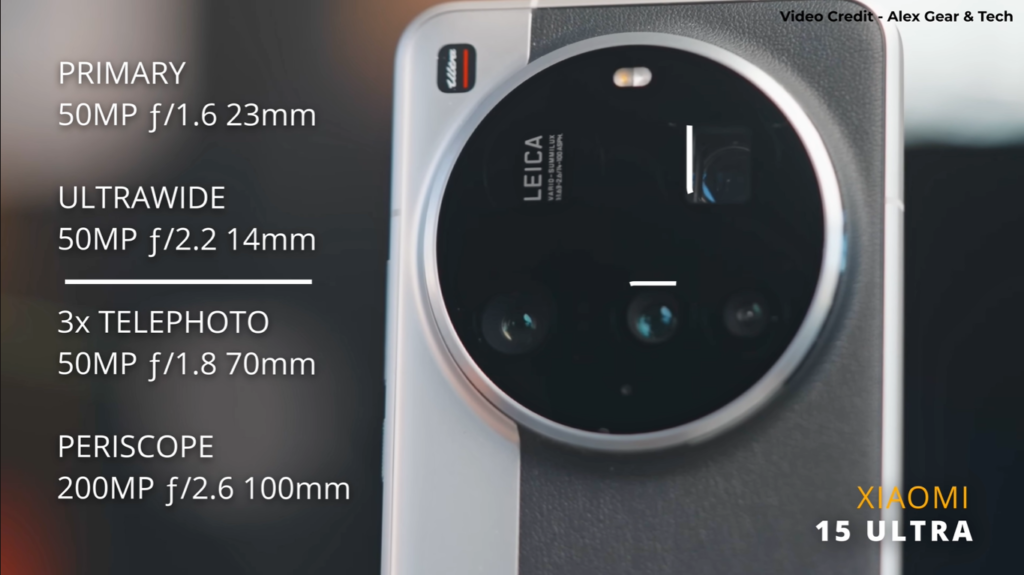
This is where the Xiaomi 17 Ultra gets really interesting. Xiaomi made a decision that initially seems counterintuitive in the megapixel and sensor arms race: they reduced the camera count from four sensors to three.
Understanding the Change
The Xiaomi 15 Ultra featured four rear cameras, including two separate telephoto lenses for different zoom ranges. The 17 Ultra consolidates those two telephotos into a single, far more sophisticated system utilizing continuous optical zoom. This isn’t just a cost-cutting measure—it’s a fundamentally different approach to smartphone photography.

The Revolutionary Telephoto: Continuous Optical Zoom
To understand why this matters, we need to understand zoom lens technology.
Types of Zoom Lenses
External Zoom: The lens physically extends to change focal length. This is what you see on traditional cameras and even some smartphones like the Samsung Galaxy S4 Zoom from nearly a decade ago. The lens barrel literally moves in and out, increasing the overall length of the camera module.
Internal Zoom: The lens length remains constant, but optical elements inside move to change the focal length. These lenses are typically more expensive and complex to manufacture. Sony recently implemented this technology in their flagship phones, and now Xiaomi has brought their own interpretation to the 17 Ultra.
Xiaomi’s Implementation
Sensor: 200-megapixel Samsung HP1 (1/1.4-inch)
Focal Length Range: 75mm to 100mm equivalent
Zoom Range: Continuous optical zoom between 3.2x and 4.3x
Maximum Lossless Zoom: 8.6x (via sensor crop and digital zoom combination)
This is a periscope-style continuous zoom system, meaning the lens maintains quality throughout the entire zoom range rather than jumping between fixed focal lengths.
Real-World Zoom Performance
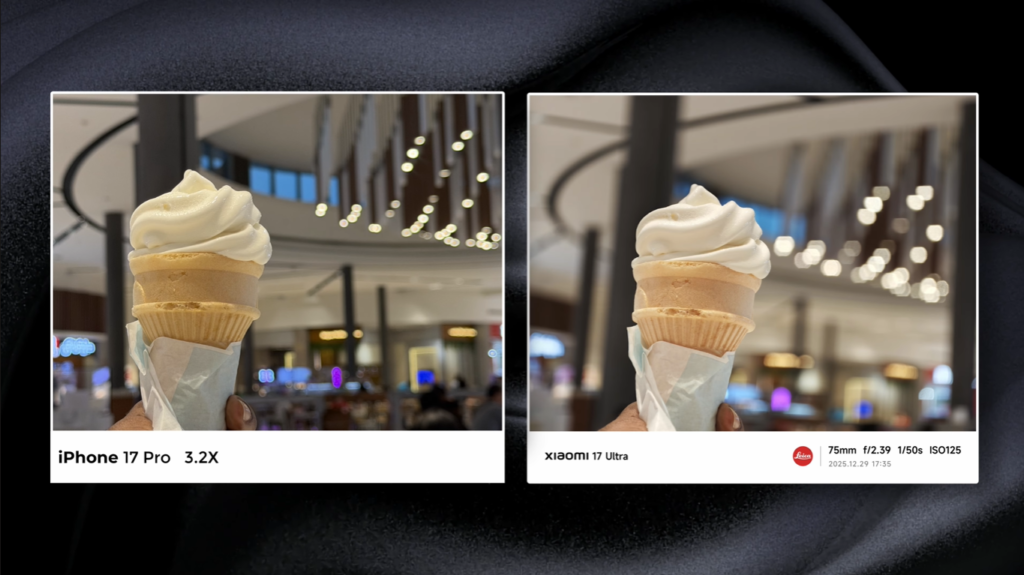
The zoom results are nothing short of impressive. The ability to smoothly transition between 3.2x and 4.3x optical zoom provides photographers with precise framing control that discrete focal lengths simply cannot match. You’re no longer forced to compromise between a 3x and 5x shot—you can nail the exact composition you want.
At 8.6x zoom, the system achieves lossless quality by utilizing the center portion of the 200-megapixel sensor. There’s potential for Xiaomi to expand this capability in future software updates, potentially offering continuous lossless zoom from 6.4x to 8.6x via sensor cropping—an exciting possibility for wildlife and sports photographers.
200-Megapixel Mode: When Detail Matters
Beyond the optical zoom capabilities, that 200-megapixel sensor enables a dedicated high-resolution mode. While processing takes a few seconds (you don’t need to hold the phone perfectly still during the animation), the results are spectacular.
The level of detail captured is extraordinary—perfect for situations where you need maximum resolution for cropping or large-format printing. The example of capturing fur texture demonstrates the sensor’s ability to resolve fine details that would be lost on lower-resolution sensors.
Extended Reach with AI Enhancement
For extreme zoom situations, the telephoto provides genuine long-reach capability. The AI processing kicks in at 20x zoom, cleaning up images remarkably well. While digital zoom artifacts are inevitable at this magnification, the AI processing makes 20x+ shots more usable than you’d expect from a smartphone.
Unique Bokeh Character
Due to the internal zoom optical design, the circular bokeh in out-of-focus areas appears slightly cut off or has a distinctive shape. Rather than viewing this as a flaw, it gives the Xiaomi 17 Ultra a unique photographic signature. It’s a characteristic that will make images from this phone immediately recognizable to photography enthusiasts.
Ultra-Wide Camera: Reliable and Versatile
The ultra-wide camera remains unchanged from the previous generation, which isn’t necessarily a negative—if it works well, why change it?
Specifications:
- Sensor: 50-megapixel Samsung JN5 (1/2.75-inch)
- Lens: Ultra-wide with autofocus
- Special Feature: Dual-purpose macro capability
The inclusion of autofocus on the ultra-wide is crucial—it enables the lens to double as a macro camera, getting exceptionally close to subjects for detailed close-up photography. This versatility eliminates the need for a dedicated macro camera that would only add bulk without contributing much to overall imaging capability.
The Primary Camera: Best-in-Class Dynamic Range
After using the same 1-inch primary sensor for multiple generations, Xiaomi has finally upgraded to a new 1-inch sensor from OmniVision—identified as either the OV1050L or OV50X depending on the source.
What Makes It Special: LOFIC Technology
The key innovation is LOFIC (Lateral Overflow Integration Capacitor) technology. Traditional HDR imaging requires capturing multiple exposures and computationally merging them, which can cause artifacts with moving subjects. LOFIC enables true HDR capture in a single frame by using dual conversion gains within each pixel.
Practical Benefits:
- No HDR ghosting with moving subjects
- Best-in-class dynamic range
- Faster capture (no multi-frame processing delay)
- More natural-looking HDR images
Real-World Image Quality
This is the kind of upgrade that doesn’t show up prominently on spec sheets but becomes immediately apparent when you start shooting. The camera is simply a joy to use.
Image Characteristics:
- Exceptional detail retention
- Rich color reproduction
- Outstanding dynamic range in high-contrast scenes
- Strong background blur from the large sensor and f/1.6 aperture
Low-Light Performance: iPhone 17 Pro Comparison
Low-light photography is where flagship smartphones truly differentiate themselves, and the Xiaomi 17 Ultra excels here.
Compared to iPhone 17 Pro:
- More natural colors (avoiding the overly warm tone Apple sometimes applies)
- Superior dynamic range (preserving highlights and shadows simultaneously)
- Better detail retention in shadows
- More accurate white balance across various lighting conditions
The side-by-side comparisons consistently show the Xiaomi producing images that look more true to life while maintaining technical excellence. The large sensor combined with computational photography that doesn’t over-process creates images with a professional quality that stands out.
Enhanced Camera UI: More Control, More Creativity
Xiaomi has completely overhauled the camera user interface, providing photographers with more creative options without overwhelming casual users.
New UI Features
Scene Selection: Tapping a small arrow reveals different scene modes optimized for specific shooting situations. The silhouette mode is particularly clever, leveraging the exceptional dynamic range to create dramatic backlit portraits and landscapes that would typically require significant post-processing.
Live Cinematography Mode: This feature offers several creative options for capturing “living” photos:
- Red Carpet: Standard live photo with a slow-motion ending and dynamic zoom effect
- Portrait: Close-up hero shot that zooms out at the end for reveal effect
- Freestyle: Choose from three zoom ranges for customized zoom shots
- Live Ultra HD: Combines live photo with 4K video quality
The ability to capture live photos in portrait mode or even during video recording adds versatility that professional content creators will appreciate.
Video Capabilities: Professional Features with Minor Quirks
The Xiaomi 17 Ultra is a serious video camera that happens to fit in your pocket.
Video Recording Specifications
Resolution and Frame Rate Options:
- 8K at 30fps (all three cameras)
- 4K at 60fps (all three cameras)
- 4K at 120fps (primary and telephoto only)
The ability to shoot 4K 120fps across multiple cameras is exceptional for slow-motion b-roll and capturing fast action with flexibility in post-production.
Video Quality Analysis
The footage quality is impressive, with excellent detail retention even in low-light conditions. However, there’s still a slight EIS (Electronic Image Stabilization) jitter that’s noticeable when compared to the iPhone 17 Pro’s exceptionally smooth stabilization.
iPhone 17 Pro Comparison: For pure video recording, particularly handheld walking shots, the iPhone still maintains a slight edge in stabilization smoothness. For professional videographers, this might be the deciding factor when choosing a primary video camera.
However, the Xiaomi offers advantages elsewhere:
- More natural background blur
- Superior detail in shadows
- 4K 120fps LOG recording capability
- Full manual controls
Professional Video Features
This is where the Xiaomi 17 Ultra truly shines for serious videographers:
LOG Recording: Shoot 4K 120fps in LOG format for maximum color grading flexibility in post-production. This flat color profile preserves more information in highlights and shadows, essential for professional workflows.
Audio Control: Multiple audio recording options allow you to choose the best microphone configuration for your shooting scenario.
Monitoring Tools:
- Focus peaking for manual focus accuracy
- Zebra patterns for exposure monitoring
- Histogram for technical exposure analysis
- Multiple aspect ratio guidelines
- Level indicators
Low Fake Mode: A unique feature that pushes dynamic range even further by optimizing the processing pipeline. This is accessible by tapping the triangle icon under the video mode.
Important Ergonomic Consideration
Due to the massive telephoto module, the primary and ultra-wide cameras are positioned at the bottom of the camera array. This means you need to be extremely careful about finger placement when shooting. It’s easy to accidentally obstruct these lenses if you’re not mindful of where you’re gripping the phone—a quirk that takes some time to adjust to but becomes second nature after a few days of use.
Selfie Camera: Front-Facing Excellence
The 50-megapixel selfie camera performs admirably for both photos and video.
Video Capability: 4K at 60fps
Quality: Excellent detail, accurate colors, and good dynamic range even in challenging lighting
For vloggers and content creators who rely on the front camera, the Xiaomi 17 Ultra delivers professional-quality results that don’t require extensive post-processing.
Optional Accessories: Photography Kit and Leica Edition
While not included with the standard phone, Xiaomi offers premium accessories for photography enthusiasts.
Photography Kit
Functionally similar to the kit offered for the Xiaomi 15 Ultra, but with notable improvements:
Features:
- Physical camera controls
- Ergonomic grip
- Built-in 2,000mAh battery (extends shooting time without draining phone battery)
Reception: The response in China has been mixed. Some photographers appreciate the carbon fiber finish for its modern aesthetic and lightweight properties, while others preferred the vegan leather from the previous generation for its premium feel and better grip.
Leica Edition Xiaomi 17 Ultra
For Leica enthusiasts, there’s a special edition that commands a premium of approximately ¥10,000 (~$1,400 USD) over the standard model.
Exclusive Features:
- Programmable ring around the camera module
- Customizable per shooting mode
- Can control zoom, aperture simulation, or various camera functions
- Leica-themed icons throughout the UI
- Leica lens cap included
- Red wrist strap (signature Leica accessory)
- Special camera modes mimicking popular Leica camera looks
Worth It? Unless you’re a devoted Leica fan who values the brand heritage and exclusive modes, the premium is difficult to justify. The standard Xiaomi 17 Ultra delivers identical image quality and core functionality at a significantly lower price point.
Core Specifications: Flagship Everything
Beyond the cameras, the Xiaomi 17 Ultra is a 2025 flagship in every respect, incorporating all the features found in the Xiaomi 17 Pro Max.
Processor and Performance
Snapdragon 8 Elite Gen 5: The Xiaomi 17 Ultra is the first Ultra phone to launch with Qualcomm’s latest flagship processor. This gives it a performance advantage over competitors still using previous-generation chips.
Expected Performance:
- Industry-leading CPU performance
- Exceptional GPU capabilities for gaming
- Advanced AI processing for computational photography
- Superior power efficiency
Operating System
HyperOS 3 built on Android 16, providing:
- Clean, customizable interface
- Extensive personalization options
- Optimized performance and battery management
- Regular security updates
Connectivity and Features
Complete Feature Set:
- Stereo speakers for immersive audio
- Wi-Fi 7 for fastest wireless connectivity
- NFC for contactless payments
- IR blaster for universal remote functionality
- Ultrasonic fingerprint scanner with optimal placement under the display
The ultrasonic fingerprint technology is faster and more reliable than optical alternatives, working even with wet fingers or in bright sunlight.
Battery and Charging: All-Day Power with Rapid Refueling
Battery life is critical for a camera-focused flagship, and Xiaomi has delivered substantial improvements.
Battery Capacity
6,800mAh battery—a significant increase over the previous generation. This massive capacity ensures:
- Full day of heavy use including extensive photography
- Multiple days with moderate use
- Confidence for travel without constant charging anxiety
Charging Speeds
Wired Charging: 90W
Wireless Charging: 50W
Reverse Wireless Charging: Supported (charge accessories or other phones)
Real-World Charging Performance:
- 0 to 50% in just 25 minutes
- Full charge in approximately one hour
These speeds mean you can top up during a lunch break and have enough power for an afternoon of photography. The 50W wireless charging is among the fastest available, making cable-free charging actually practical for daily use.
Pricing Strategy: Same Cost, More Storage
Pricing strategy reveals Xiaomi’s market positioning and value proposition.
Pricing Comparison
Xiaomi 15 Ultra: Started at ¥6,499 RMB
Xiaomi 17 Ultra: Starts at ¥6,999 RMB
However, there’s an important detail: The 15 Ultra’s starting price was for a lower storage configuration. The 17 Ultra starts at 512GB storage (no 256GB option), and the 512GB variant of the 15 Ultra cost approximately the same as the 17 Ultra’s starting price.
Effective Result: The price remains consistent generation-to-generation, but Xiaomi has eliminated the entry-level storage tier, forcing buyers into the more practical 512GB minimum.
Why This Makes Sense
Given the surge in RAM and storage component prices globally, maintaining the same effective price point while doubling base storage is actually favorable to consumers. For a camera-focused phone where users will capture hundreds of high-resolution photos and 4K video, 512GB is the practical minimum anyway.
Storage Configurations Available:
- 12GB RAM + 512GB storage (base)
- 16GB RAM + 512GB storage
- 16GB RAM + 1TB storage (maximum)
The Verdict: Setting the Tone for 2025
After extensive testing across various shooting scenarios, comparing against top competitors, and living with the Xiaomi 17 Ultra as a daily driver, here’s the assessment:
What Xiaomi Got Right
Camera Innovation: The continuous optical zoom isn’t just a gimmick—it’s a genuinely useful feature that provides framing flexibility impossible with discrete focal lengths. The new 1-inch sensor with LOFIC technology delivers best-in-class dynamic range and image quality.
Build Quality: Despite increasing the display size and battery capacity, Xiaomi made the phone thinner while maintaining premium materials and IP69 water resistance.
Performance: Being first to market with the Snapdragon 8 Elite Gen 5 provides a performance advantage that will last throughout the device’s lifecycle.
Battery Life: The 6,800mAh battery combined with efficient components ensures true all-day usage even with heavy camera use.
Remaining Quirks
Size and Weight: This is undeniably a large, heavy phone. The flat design prioritizes aesthetics over ergonomics, making one-handed use challenging.
Video Stabilization: While excellent, there’s still slight EIS jitter that keeps the iPhone 17 Pro ahead for pure video work.
Price: At approximately ¥6,999+ RMB (~$960+ USD), this is an expensive phone, though pricing is competitive within the Ultra segment.
Camera Placement: The bottom-mounted primary and ultra-wide cameras require careful finger placement to avoid obstruction.
Who Should Buy the Xiaomi 17 Ultra?
Highly Recommended For:
- Photography Enthusiasts: The camera system is genuinely excellent with industry-leading capabilities
- Tech Early Adopters: First access to Snapdragon 8 Elite Gen 5 and latest innovations
- Power Users: Massive battery, ample storage, and top-tier performance
- Android Loyalists: Best-in-class Android flagship with extensive customization
- Content Creators: Professional video features and exceptional still photography
Consider Alternatives If:
- Budget is Primary Concern: Ultra phones command ultra prices
- Prefer Compact Devices: This is decidedly not a small phone
- Video is Priority: iPhone still leads in stabilization smoothness
- Want Simpler Interface: Less overwhelming camera options elsewhere
Final Thoughts: The Ultra Everyone Else Has to Beat
The Xiaomi 17 Ultra represents a phone manufacturer making deliberate, confident choices rather than playing it safe with incremental updates. The decision to replace two telephoto cameras with a single continuous zoom system is bold—and based on real-world testing, it’s a decision that pays off.
This isn’t just about specs on paper. The LOFIC sensor delivers genuinely better images. The continuous zoom provides real creative flexibility. The refined camera UI makes advanced features accessible without overwhelming casual users.
Is it perfect? No phone is. The size won’t suit everyone, the price is substantial, and some video quirks remain.
But here’s what matters: If cameras are high on your priority list in 2025 or 2026, the Xiaomi 17 Ultra isn’t just competitive—it’s the phone setting the standard that everyone else now has to respond to.
Xiaomi hasn’t just made another Ultra phone. They’ve redefined what Ultra should mean, prioritizing real-world photographic results over simply adding more sensors. That’s the kind of innovation the smartphone industry needs more of.
Overall Rating: 4.6/5 stars
Standout Features: Revolutionary continuous zoom, best-in-class dynamic range, professional video capabilities, massive battery
Consider Carefully: Large size, premium pricing, video stabilization refinement needed
The question isn’t whether the Xiaomi 17 Ultra is a good phone—it clearly is. The question is whether competitors can respond with something equally innovative, or if they’ll simply add their own continuous zoom and call it a day. Only time will tell, but for now, Xiaomi has drawn first blood in the 2025 Ultra phone wars.
5 Reasons to Avoid Xiaomi 17 Ultra in India
Top 10 Reasons to Buy Xiaomi 17 Ultra
What’s your take on the continuous zoom versus multiple fixed telephoto lenses? Would you prefer the flexibility of the 17 Ultra’s approach, or do you miss having dedicated 3x and 5x cameras like the 15 Ultra? Let me know your thoughts in the comments.