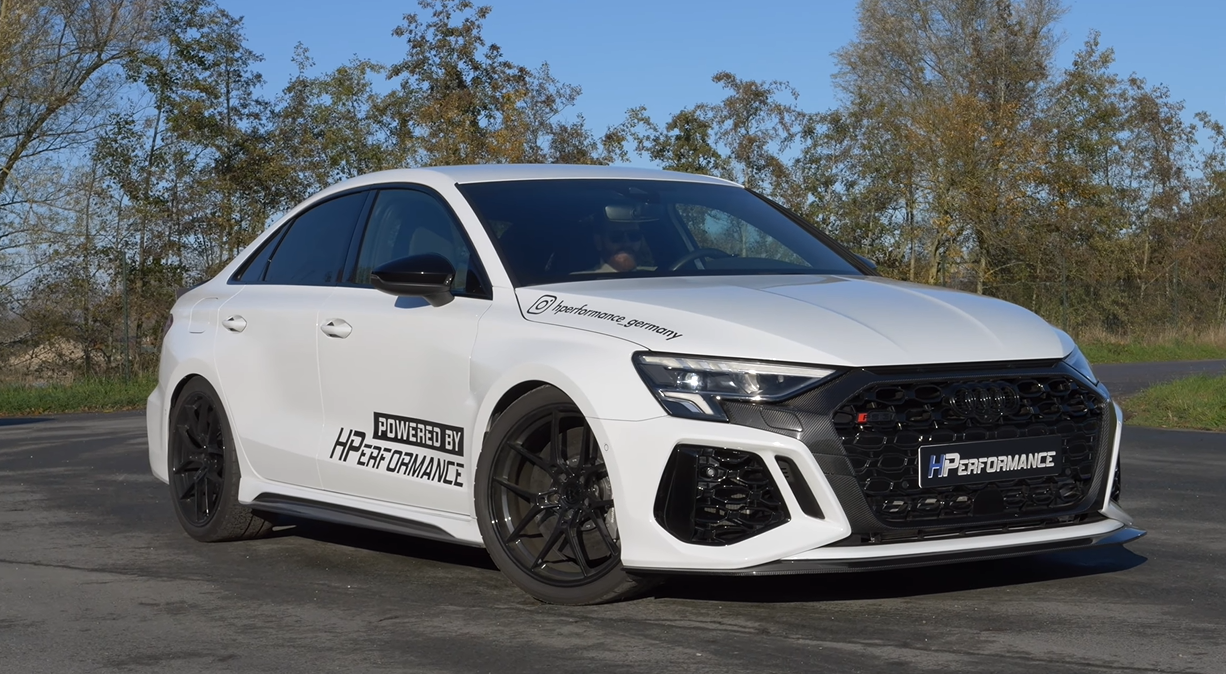
H&R Performance turns the Audi RS3 into an 840-horsepower five-cylinder beast capable of 200mph. We tested it on the German Autobahn to see if it’s genius or madness.
When boost season officially begins in Germany—clear blue skies, temperatures hovering around 3-4°C, and bone-dry autobahn stretches—enthusiasts know it’s time to unleash modified monsters. Today, we’re experiencing one of the most extreme Audi RS3 builds ever created: an 840-horsepower, five-cylinder turbocharged weapon built by H&R Performance.
This isn’t your typical stage 2 tune. This is a comprehensively re-engineered RS3 that maintains surprising daily drivability while delivering hypercar-level performance. Let’s dive into what makes this build special, what it’s like to drive, and whether 840 horsepower in a compact sedan is pure insanity or engineering brilliance.
Quick Overview
Base Vehicle: 2023 Audi RS3 8Y (Sedan)
Tuner: H&R Performance (Germany)
Power Output: 840hp on E50 fuel
Torque: ~900+ Nm
0-100 km/h (0-62mph): ~3 seconds (estimated)
100-200 km/h (62-124mph): 4.4 seconds (tested)
Top Speed: 320+ km/h (200+ mph)
Fuel: E50 (RON 102 + ethanol blend)
Key Modifications:
- H&R Performance 808 package (840hp variant)
- TC Turbos X8 turbo upgrade
- Forged internals (rods, pistons, valve springs)
- Full 4-inch turbo-back exhaust with valved system
- Carbon ceramic brakes (front)
- Automotive Passion carbon fiber body kit
- Bilstein B16 coilover suspension
- Tuned DQ500 gearbox (world’s first 8Y gearbox tune)
The H&R Performance Philosophy: Specialization Matters
Five-Cylinder Experts
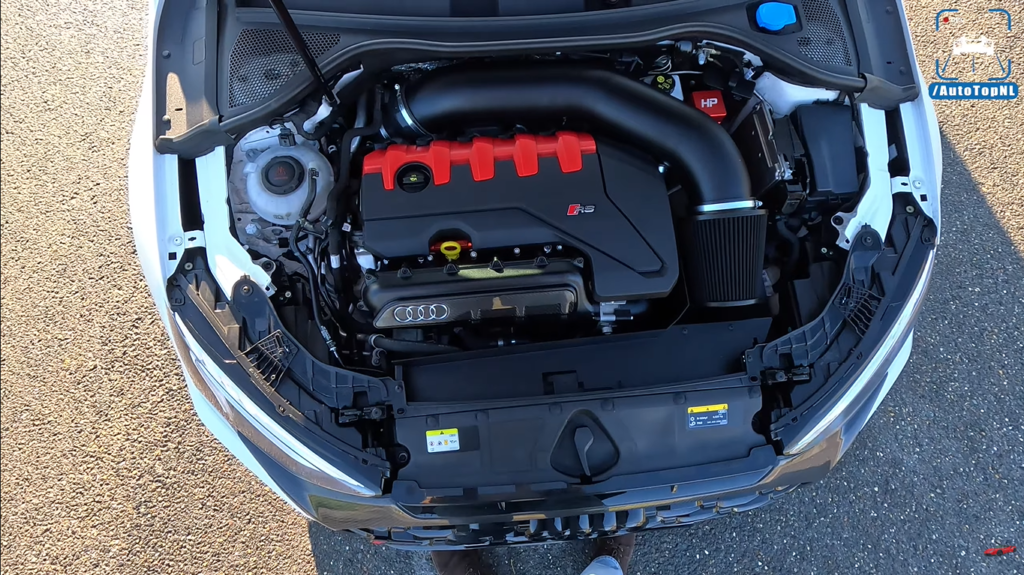
H&R Performance isn’t a jack-of-all-trades tuner. They focus almost exclusively on Audi’s legendary five-cylinder engines, with 99% of their builds centered on this platform.
Why This Matters:
When a tuner specializes this deeply, they develop: ✅ Platform-specific knowledge – Understanding exact limitations
✅ Proven solutions – Tested modifications that work together
✅ Refined tuning – Software calibration perfected over hundreds of builds
✅ Predictable behavior – Known how to make power safely
H&R Portfolio:
- Audi RS3 builds (like this 840hp example)
- Audi TT RS builds (including 1,000+ hp examples)
- Cupra Formentor VZ5 tuning
- Audi TT builds (900hp on E85 examples exist)
This specialization shows in the final product—the RS3 feels polished, well-managed, and thoughtfully engineered rather than simply powerful.
The Build: 840HP Package Breakdown
Engine Modifications (2.5L Five-Cylinder Turbo)
Forced Induction:
- TC Turbos X8 turbo – Massive upgrade over stock
- Open wastegate – Better boost control and signature sound
- 5-inch open intake system – Maximum airflow throughout
- Turbo inlet pipe – Optimized flow to turbo
Internal Fortifications:
- Upgraded rods – Handle increased cylinder pressure
- Forged pistons – Withstand higher boost and temps
- Upgraded valve springs – Control valve float at high RPM
- Bigger fuel injectors – Supply adequate fuel for power
Air Management:
- Billet intake manifold with elbow – Better flow and boost response
- Upgraded boost pipe – Handles increased pressure
- Larger intercooler – Critical for consistent power with air guides for maximum efficiency
- Guided air intake – Channels fresh air directly to intake system
Fuel System:
- Upgraded fuel rail – Maintains pressure under load
- Upgraded fuel pump – Supplies high-flow fuel demand
- E50 fuel capability – RON 102 + ethanol blend for 840hp
Exhaust System:
- Full 4-inch turbo-back – Minimal restriction from turbo to tips
- H&R Performance downpipe – High-flow catalytic converter delete
- Valved rear silencer – Dual-mode: quiet or loud
- Unique design – Two paths: small silencer (closed) or massive straight-through (open)
Transmission:
- Upgraded clutch and flywheel – Handle increased torque
- Tuned DQ500 gearbox – World’s first 8Y RS3 gearbox tune (H&R + TVS Engineering collaboration)
Ancillaries:
- Oil catch can – Protects gearbox from oil contamination
- Upgraded cooling – Handles sustained high-power operation
The TÜV-Approved Alternative: 707 Package
H&R Performance also offers a TÜV-approved 707 package with approximately 730 horsepower that retains:
- OPF catalytic converters (emissions compliant)
- TÜV certification (legal in Germany)
- 700+ horsepower in a street-legal RS3
This is remarkable—legally approved 700+ horsepower while maintaining emissions compliance.
Exterior Modifications: Carbon Fiber Aggression
Automotive Passion Carbon Fiber Body Kit
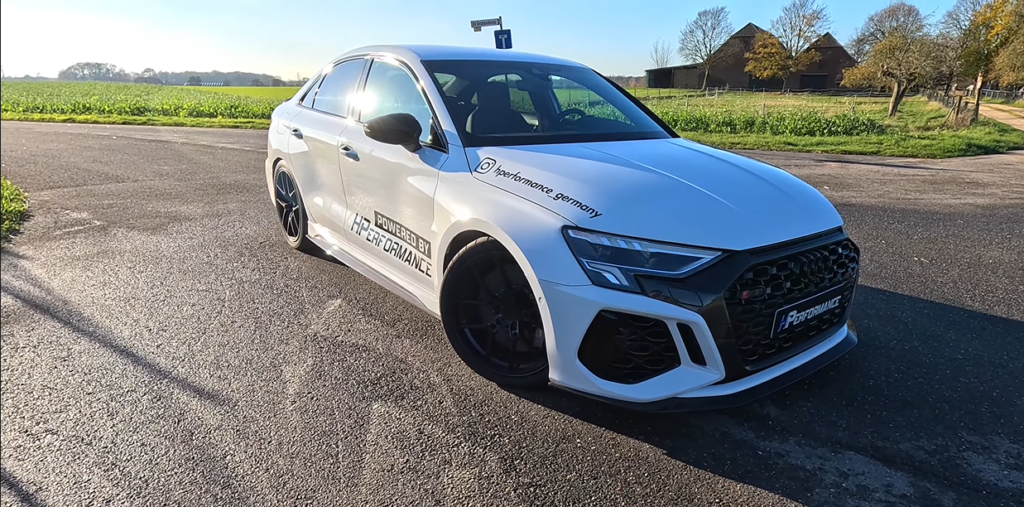
The RS3 wears a complete carbon fiber aero package from Automotive Passion:
Front End:
✅ Carbon fiber grille surround – Aggressive, racy appearance
✅ Front splitter – Functional downforce and visual aggression
✅ Angry front fascia – Race-inspired design language
Side Profile:
✅ Carbon fiber side skirts – Cohesive body kit integration
✅ Factory wide-body front fenders – 8Y RS3’s signature air extraction vents
✅ Muscular, beefy proportions – Short, wide, aggressive stance
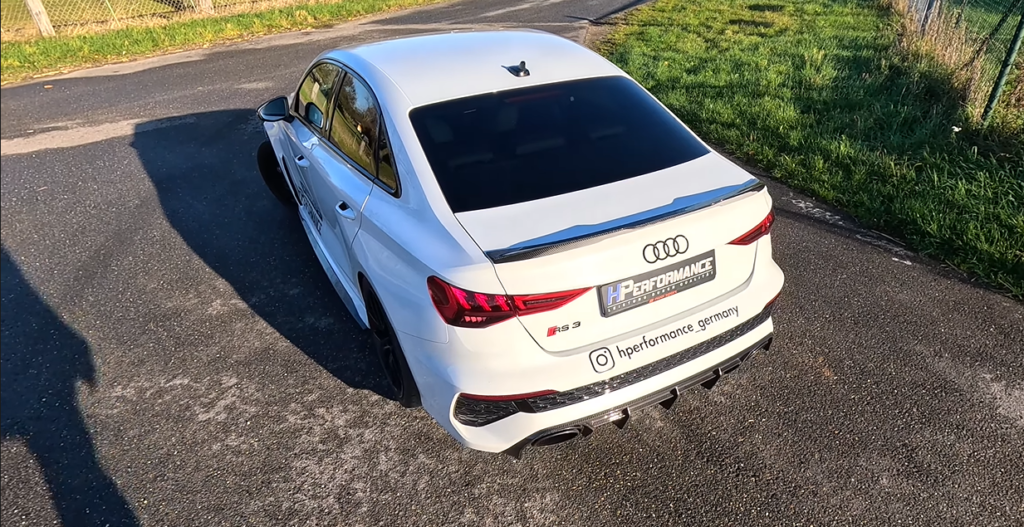
Rear End: ✅ Carbon fiber trunk spoiler – Subtle but effective
✅ Carbon fiber diffuser – Complements quad exhaust exits
✅ Integrated exhaust tips – 4-inch system visible
Sedan vs Hatchback Debate
The tester (Max from AutoTopNL) strongly prefers the sedan body style:
Sedan Advantages:
- More understated, “sleeper” appearance
- Muscular, chunky proportions
- “Little sedan that could” charm
- Less obviously sporty, more sophisticated
Hatchback Characteristics:
- More obviously sporty from all angles
- Aggressive rear end with prominent diffuser
- Slightly more practical cargo space
Verdict: The sedan offers a unique blend of understated menace—it doesn’t scream “840 horsepower” until the exhaust opens up.
Chassis & Suspension: Bilstein B16 Setup
Coilover Specifications
Bilstein B16 Damping Adjustable Coilovers:
- Adjustable compression and rebound
- Lowered ride height
- Optimized for high-performance street and occasional track use
Real-World Handling Assessment
Ride Quality: ✅ “Nice and solid” – Planted, confidence-inspiring
✅ “Feels tight” – Minimal body roll, precise responses
✅ “Not too firm” – Surprisingly compliant for performance coilovers
High-Speed Behavior:
Despite 840 horsepower, the chassis remains composed:
- Predictable weight transfer
- Manageable under acceleration (with driver skill)
- Stable at high speeds (tested to 300+ km/h)
- Brakes effectively despite extreme speeds
Traction Management:
The RS3’s Quattro all-wheel-drive system works overtime:
- Constantly distributing power between axles
- Managing electronic differentials
- Fighting to put 840hp down through relatively small contact patches
- “Wrestling a wild horse” sensation (in a good way)
Wheels, Tires & Brakes: Critical Contact Points
Wheel & Tire Setup
Specifications:
- Wheels: Motech forged 19-inch
- Front tires: 265-width Yokohama ADVAN A052
- Rear tires: 245-width Yokohama ADVAN A052
Wait, Wider Fronts?
Yes, this RS3 runs wider tires at the front than the rear (265mm vs 245mm). This is intentional for AWD traction management and reflects the front-biased power delivery during hard acceleration.
Yokohama ADVAN A052:
- Near-semi-slick compound
- Exceptional dry grip
- Very good wet performance (for a near-slick)
- Track-capable but street-legal
- Requires heat to perform optimally
Carbon Ceramic Brakes (Front Only)
Specification:
- Carbon ceramic discs on front axle only
- Steel rotors retained on rear axle
- RS3 factory configuration (front CCB only)
Why Carbon Ceramics Matter:
With 840 horsepower pushing the RS3 to 200+ mph, stopping power becomes critical:
✅ Fade resistance – Maintains performance lap after lap
✅ High-speed confidence – Massive stopping power from extreme speeds
✅ Weight reduction – Lighter unsprung mass improves handling
✅ Longevity – Outlast steel rotors dramatically
Real-World Effectiveness:
Testing involved repeated high-speed runs (300+ km/h) followed by heavy braking. The carbon ceramics showed:
- Zero fade
- Consistent pedal feel
- Confidence-inspiring deceleration
- Essential given the car’s performance level
Interior: Understated Performance
Stock Interior Philosophy
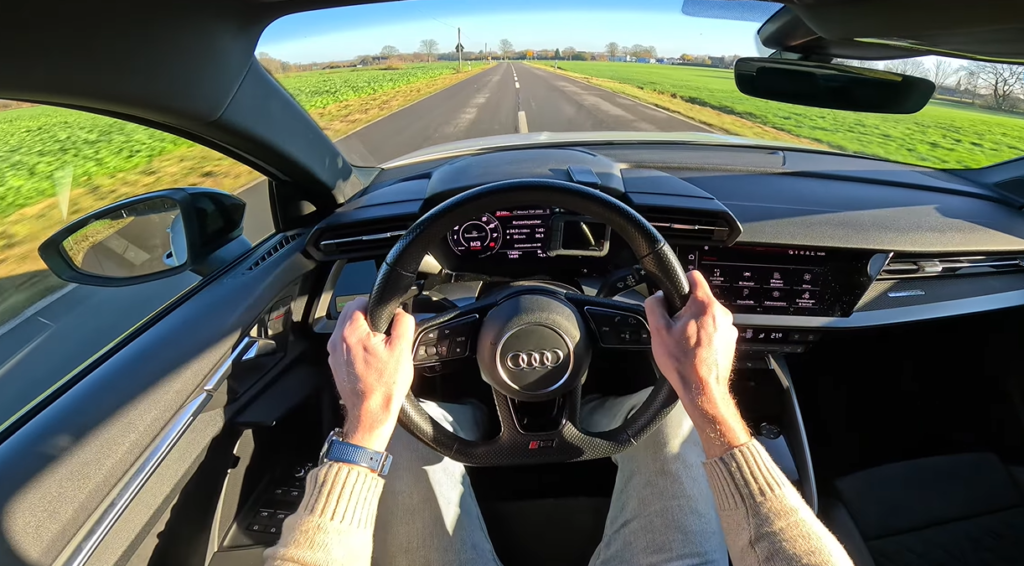
The interior remains largely stock Audi RS3, which is actually refreshing:
What’s Retained:
✅ Supportive sport seats – “Pretty good, not great, but supportive enough”
✅ Physical HVAC controls – No frustrating touchscreen climate adjustments
✅ Logical button layout – Everything falls to hand naturally
✅ Premium materials – Audi’s usual high-quality fit and finish
✅ Driver-focused ergonomics – Everything angled toward the driver
The One Upgrade: Magnetic Shift Paddles
The only interior modification is magnetic shift paddles, which provide:
- Crisp, tactile feedback
- Quick paddle response
- Premium feel during spirited driving
- Essential for manual gear control at high speeds
Why Keep It Stock?
Philosophy: This RS3 prioritizes driving experience over interior bling. The focus is on engine, transmission, suspension, and traction management—not carbon fiber dashboard trim or Alcantara headliners.
Result: A cohesive, OEM-quality interior that doesn’t distract from the driving mission.
The Exhaust: Dr. Jekyll and Mr. Hyde
Dual-Mode System Design
The H&R Performance exhaust system is brilliantly engineered with a valved dual-path design:
Valves Closed (Comfort Mode):
- Exhaust gases route through small silencer
- “Pretty much stock” sound levels
- Suitable for residential areas, early mornings
- TÜV version even quieter (with cats and OPF)
Valves Open (Dynamic Mode):
- Exhaust gases bypass small silencer entirely
- Route through massive straight-through pipe (“Look at this big boy!”)
- Full five-cylinder turbo symphony
- Loud blowoff valves, turbo whistle, and exhaust snarl
The Sound Character
What You Hear:
✅ Five-cylinder warble – Iconic off-beat exhaust note
✅ Turbo whistle – Prominent, ominous when valves closed
✅ Blowoff sounds – Massive compressed air releases
✅ Wastegate chatter – Open wastegate configuration
✅ Crackling overrun – Pops and bangs on deceleration
The Nostalgia Factor:
Max notes: “The nostalgia that comes with five-cylinder turbo with all that blowoff and turbo sound—it’s just something special. It really is.”
The combination of turbo noises and five-cylinder symphony creates an addictive aural experience that never gets old.
Driving Experience: Controlled Chaos
On B-Roads: Surprisingly Manageable
Initial Expectations: “I was expecting it to behave badly and be a handful even if you’re not driving it hard.”
Reality: “It’s actually very doable.”
Despite 840 horsepower, the RS3 remains civilized when not provoked:
✅ Manageable at part-throttle – Smooth, progressive power delivery
✅ Daily drivable – Comfortable at normal speeds
✅ Well-calibrated throttle – Not twitchy or unpredictable
✅ Refined at cruise – Doesn’t feel like a time bomb
The “Beast at the Bars” Sensation:
Even when driving gently, you sense latent violence:
- Transmission ready to shift aggressively
- Turbos building pressure
- Chassis tensed for action
- “A beast shaking at the bars, waiting to be released”
Full Throttle: Wrestling a Wild Horse
Character Under Load:
When the throttle opens fully, personality transforms:
⚠️ Explosive acceleration – “Shoots into the distance”
⚠️ Constant vigilance required – “You need to keep the leash short”
⚠️ Moves around dynamically – Under load, off-throttle, and during braking
⚠️ Small car, big power – The RS3’s compact dimensions amplify sensations
The Yellowstone Reference:
Max quips: “It’s like wrestling a wild horse. Luckily, I’ve watched all of Yellowstone, so I am now very proficient in breaking horses.”
This perfectly captures the experience—you’re not fighting the car, but you are actively managing tremendous force.
Traction Management Reality
Despite Quattro AWD:
Even with all-wheel drive working overtime:
- Traction control off reveals raw power
- Wheels scramble for grip even in third gear
- Fourth gear required for full-throttle runs
- Damp patches become instant hazards
The Grip Balance:
With heat in the Yokohama A052 tires:
- Traction improves dramatically
- Car “just grips” from 100 km/h roll
- Still requires respect and attention
- “Monster inside that wants to escape through all four corners”
Autobahn Performance: 320KM/H Reality
The Perfect Testing Ground
Conditions:
- Clear blue skies
- 3-4°C ambient temperature (dense air = more power)
- Friday afternoon (moderate traffic)
- Mostly dry surface with occasional damp patches
Why Boost Season Matters:
Cold, dense air means: ✅ More oxygen per intake charge
✅ Cooler intercooler temps
✅ Consistent power output
✅ Less risk of heat soak
Acceleration Testing: 100-200 km/h
Measured Result: 4.4 seconds
Context:
- H&R Performance claims 4.3 seconds
- Tested in less-than-ideal conditions (5°C, some moisture)
- Still experiencing minor traction issues
- Incredibly impressive given circumstances
For Perspective:
- Porsche 911 Turbo S: ~4.0 seconds
- Lamborghini Huracán: ~4.5 seconds
- BMW M5 CS: ~4.7 seconds
This tuned RS3 is matching supercars in mid-range acceleration.
Top Speed Runs: 300+ KM/H Achieved
Circumstances:
- Limited autobahn stretches due to Friday traffic
- Brief clear sections captured
- Multiple runs to 300+ km/h (186+ mph)
- Car stable and composed throughout
The 300 KM/H Surprise:
Max notes: “That was 300 already. And I was not expecting that. I thought I’ll get a little bit of a gap so I can do the flyby for the overpass, but I saw this group of cars already.”
The RS3 reaches 300 km/h so quickly that planning overtakes becomes challenging—it closes gaps faster than anticipated.
High-Speed Stability
At 200+ MPH:
✅ Stable platform – No terrifying moments
✅ Effective aero – Carbon kit provides adequate downforce
✅ Brake confidence – Carbon ceramics inspire trust
✅ Some movement – Small car physics mean some squirminess
✅ Driver involvement – Requires active management but not exhausting
Wet Patch Concerns:
At 300+ km/h, wet patches become dangerous:
- Immediate throttle lift required
- Braking in wet sections avoided
- Constant visual scanning for surface conditions
- Risk management essential
The Gearbox: World’s First 8Y Tune
DQ500 Transmission Characteristics
The Audi RS3 8Y uses VW Group’s DQ500 seven-speed dual-clutch transmission.
Stock Transmission Issues:
- Can feel “mushy” in transitions
- Not the sharpest-feeling gearbox
- Struggles with increased torque from tuning
- Software limits performance potential
H&R Performance + TVS Engineering Solution
H&R Performance partnered with TVS Engineering (Netherlands) to create the world’s first RS3 8Y gearbox tune.
What the Tune Addresses:
✅ Shift speed – Dramatically quicker gear changes
✅ Shift firmness – More decisive, mechanical feel
✅ Clutch pressure – Optimized for higher torque
✅ Launch control – More aggressive off-the-line behavior
✅ Torque management – Prevents clutch slipping under load
Real-World Impact:
“It does make a big difference because stock it can feel a little bit mushy… it can definitely do with the tune.”
The transmission transformation is immediately noticeable:
- Shifts crack off quickly
- Downshifts are aggressive and rev-matched perfectly
- Power delivery is seamless through gears
- Feels like a proper performance transmission
Drivability Verdict: Genius Engineering
The Surprising Daily Driver Potential
Expected: Unmanageable, violent, exhausting to drive
Reality: Surprisingly civilized when not provoked
Key Drivability Factors:
✅ Progressive power delivery – Not on/off switch
✅ Manageable throttle response – Linear, predictable
✅ Compliant suspension – Firm but not punishing
✅ Refined at cruise – Quiet with valves closed
✅ Stock interior comfort – No race car compromises
The Balance:
“It still feels pretty doable when you’re not full throttle, which I think is pretty incredible.”
This RS3 achieves the difficult balance of:
- Hypercar-level performance when demanded
- Daily driver civility when cruising
- No significant compromises in either direction
The “Polished Build” Assessment
What Sets This Apart:
Max’s conclusion: “It feels very polished and well-managed, well thought-out.”
Evidence of Excellence:
✅ No heating issues – Cooling systems adequate
✅ No weird behaviors – No unexpected quirks
✅ Predictable character – Know what to expect
✅ Reliable operation – Confidence-inspiring
✅ OEM integration – Feels factory-engineered
H&R’s Specialization Shows:
“They do a lot of these five-cylinder builds. They are really specialized in this platform and you really feel that.”
When a tuner focuses on one platform exclusively, the refinement level increases exponentially.
The Five-Cylinder Experience: Nostalgic Perfection
Why Five-Cylinders Matter
The Audi five-cylinder engine is legendary for specific reasons:
Unique Characteristics:
✅ Off-beat exhaust note – Not V6, not four-cylinder
✅ Turbo-friendly configuration – Excellent exhaust scavenging
✅ Compact packaging – Transverse fitment in small cars
✅ Heritage – Audi Quattro rally legacy
✅ Tuning potential – Proven to handle 1,000+ hp
The Emotional Factor:
“The nostalgia that comes with five-cylinder turbo with all that blowoff and the turbo sound—it’s just something special.”
Modern Five-Cylinder Rarity
Current Options:
- Audi RS3 (sedan and hatchback)
- Audi TT RS
- Cupra Formentor VZ5
That’s it. The five-cylinder is endangered, making RS3 builds like this even more special.
Why It Matters:
In an era of downsized four-cylinders and hybrid V6s, the turbocharged five-cylinder represents:
- Mechanical character
- Unique soundtrack
- Tuning potential
- Enthusiast appeal
Cost Considerations: What Does 840HP Cost?
Build Investment
While exact pricing wasn’t disclosed, consider typical costs:
H&R Performance 808 Package (estimate):
- Engine build: €30,000-40,000
- Turbo system: €8,000-12,000
- Exhaust system: €5,000-7,000
- Gearbox tune: €3,000-5,000
- Supporting mods: €5,000-10,000
Additional Modifications:
- Carbon ceramics: €8,000-10,000 (if not factory)
- Body kit: €5,000-8,000
- Wheels/tires: €5,000-7,000
- Suspension: €3,000-5,000
Total Investment (estimated): €70,000-100,000+ in modifications
Base RS3 8Y: €60,000-70,000
All-In Cost: Approximately €130,000-170,000 for a complete build like this.
Value Proposition
For Context:
What else offers 840 horsepower for €130,000-170,000?
Competitors:
- Porsche 911 Turbo S: €220,000+ (640hp)
- Lamborghini Huracán: €250,000+ (640hp)
- McLaren 720S: €280,000+ (720hp)
- Nissan GT-R: €150,000+ (570hp stock)
The RS3 Advantage:
✅ Comparable or superior performance
✅ Significantly lower total cost
✅ Practical daily driver with rear seats
✅ Understated appearance (“sleeper”)
✅ Proven Audi reliability (with proper maintenance)
✅ Lower running costs than exotics
Who Should Build an 840HP RS3?
Perfect For:
✅ Five-cylinder enthusiasts – Love the unique character
✅ Autobahn regulars – Need genuine high-speed capability
✅ Track day enthusiasts – Want competitive lap times
✅ Sleeper car lovers – Appreciate understated performance
✅ Audi loyalists – Trust the platform and brand
✅ Daily driver performance – Need one car for everything
✅ Those with deep pockets – €100,000+ modification budget
Consider Alternatives If:
❌ You want turn-key supercar experience
❌ You need ultimate refinement (Porsche 911 Turbo)
❌ You prioritize warranty coverage
❌ You’re new to high-performance cars
❌ You don’t have access to autobahn or track
❌ You want maximum exotic appeal
❌ You need absolute reliability guarantee
Maintenance & Reliability Considerations
The Reality of 840HP Daily Driving
What to Expect:
⚠️ Increased maintenance – More frequent oil changes, inspections
⚠️ Premium fuel required – E50 blend for full power
⚠️ Tire wear – High-performance tires wear quickly
⚠️ Brake service – Even carbon ceramics need pads eventually
⚠️ Engine stress – Forged internals help but nothing is bulletproof
Recommended Maintenance:
- Oil changes every 5,000 km (3,000 miles)
- Frequent cooling system checks
- Regular transmission fluid changes
- Monitor boost pressures
- Track tire condition closely
- Annual comprehensive inspections
The Tuner Support Factor
H&R Performance’s Expertise:
Because they specialize in five-cylinder Audis: ✅ Known failure points identified
✅ Proven solutions implemented
✅ Parts availability excellent
✅ Support network established
✅ Long-term reliability data available
This specialization dramatically improves reliability versus general tuners attempting one-off builds.
Final Verdict: Engineering Triumph
What H&R Performance Achieved
The Accomplishment:
Creating an 840-horsepower RS3 that: ✅ Remains daily drivable
✅ Feels refined and polished
✅ Doesn’t exhibit terrifying behavior
✅ Maintains OEM-like integration
✅ Achieves genuine 200+ mph capability
✅ Looks understated yet purposeful
The “Taming” Success:
“Wrestling a wild horse” is the perfect metaphor:
- You’re actively managing tremendous power
- But you have control, not fighting for survival
- The car responds predictably to inputs
- The experience is thrilling, not terrifying
Should You Build One?
Yes, if:
- You have the budget (€100,000+ for modifications)
- You appreciate five-cylinder character
- You have access to unrestricted roads or tracks
- You want ultimate point-to-point speed
- You can handle the maintenance commitment
No, if:
- You want worry-free ownership
- You need maximum refinement
- You don’t have supporting infrastructure
- You’re seeking turn-key exotic experience
The Bottom Line
The 840hp Audi RS3 by H&R Performance represents modern tuning at its finest:
Core Achievement: Taking a compact sport sedan and delivering genuine hypercar performance without sacrificing daily usability.
Rating: 9.5/10
Deductions:
- Running costs will be substantial
- Some might want more exotic appeal
- Pushing limits carries inherent risks
Excellence:
- Engineering refinement is exceptional
- Performance-to-cost ratio unmatched
- Driving experience memorable and engaging
- Build quality rivals OEM standards
Final Thought: This RS3 proves that with proper expertise, specialized knowledge, and quality parts, it’s possible to create a 840-horsepower street car that doesn’t want to kill you. That’s remarkable.
Technical Specifications Summary
| Category | Specification |
|---|---|
| Base Car | 2023 Audi RS3 8Y Sedan |
| Engine | 2.5L inline-5 turbo |
| Power | 840hp on E50 fuel |
| Torque | ~900+ Nm |
| Turbo | TC Turbos X8 |
| Transmission | DQ500 7-speed DCT (tuned) |
| Drivetrain | Quattro AWD |
| 0-100 km/h | ~3.0 seconds (est) |
| 100-200 km/h | 4.4 seconds (tested) |
| Top Speed | 320+ km/h (200+ mph) |
| Suspension | Bilstein B16 coilovers |
| Brakes | Carbon ceramic (front), steel (rear) |
| Wheels | Motech forged 19-inch |
| Tires | Yokohama ADVAN A052 265F/245R |
| Body Kit | Automotive Passion carbon fiber |
Estimated €70,000-100,000+ in modifications alone, plus the €60,000-70,000 base car = €130,000-170,000 all-in
The 840hp Audi RS3 8Y proves that with expertise, quality components, and meticulous tuning, you can create a hypercar-killer that remains remarkably civilized. It’s engineering brilliance wrapped in an understated German sedan body—and that’s exactly what makes it so special.
Special thanks to H&R Performance Germany for providing this exceptional RS3 for testing and to AutoTopNL (Max) for the detailed Autobahn evaluation.