Samsung launched the Galaxy Buds 4 Pro on March 11, 2026 at $249.99 — the same price as its predecessor. And right out of the gate, it is making a strong case as the best pair of Android earbuds money can buy.
But the more interesting question is whether the Galaxy Buds 4 Pro can compete with Apple’s AirPods Pro 3 — the gold standard for premium wireless earbuds. After testing both extensively in real-world conditions, the answer is more surprising than you might expect.
This is a full, detailed review covering everything: sound quality, ANC performance, microphone quality, design, features, battery life, and the final verdict on whether the Galaxy Buds 4 Pro at $249 is worth your money in 2026.
Samsung Galaxy Buds 4 Pro — Quick Verdict
The Samsung Galaxy Buds 4 Pro is the best-sounding Samsung earbud ever made — and for Samsung Galaxy users specifically, it is the best premium TWS earbud available at this price. The dual-driver audio hardware, custom EQ support, and Samsung’s Scalable UHQ codec (which streams 24-bit/96kHz audio wirelessly to compatible Galaxy devices) combine to deliver a listening experience that genuinely beats the AirPods Pro 3 on pure audio quality.
Where the AirPods Pro 3 pulls ahead: slightly better ANC, better microphone naturalness, better per-earbud battery life, and the added heart rate monitor. Where the Buds 4 Pro wins: sound quality, soundstaging, custom EQ flexibility, comfort for long sessions, and overall driver performance.
The catch — and it is a real one — is that the Buds 4 Pro works best inside the Samsung ecosystem. Non-Samsung Android users get SBC or AAC only, which significantly limits the audio advantage. If you have a Galaxy phone, this is an easy recommendation. If you don’t, keep reading.
Samsung Galaxy Buds 4 Pro — Full Specs
- Price (US): $249.99
- Release date: March 11, 2026
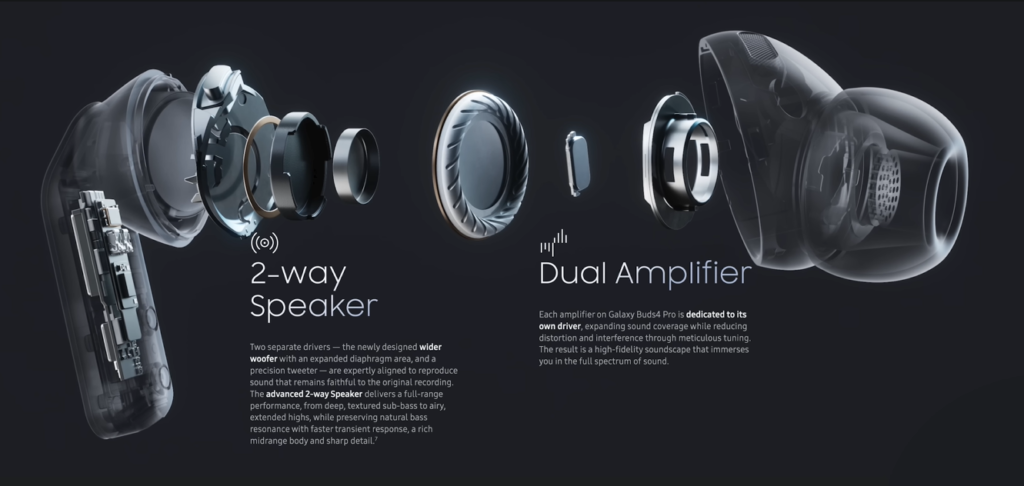
- Driver setup: 11mm dynamic driver (woofer) + 5.4mm planar tweeter — dual driver per earbud
- Woofer upgrade: 20% larger effective area vs Buds 3 Pro
- Codec support: Samsung Scalable Codec (SSC) with UHQ (24-bit/96kHz on compatible Galaxy devices), SBC, AAC
- EQ: 9-band customizable equalizer
- ANC: Adaptive ANC 2.0 with Galaxy AI
- Microphones: 6 microphones total — including bone conduction mic
- Transparency mode: Yes — Ambient Sound mode
- Battery (earbuds): 61mAh per earbud — up to 7 hours with ANC off
- Battery (case): 580mAh — up to 30 hours total
- Charging: USB-C wired + wireless charging (Qi and Samsung wireless)
- Water resistance: IP57 — earbuds and case
- Bluetooth: 5.4
- Spatial audio: 360 Audio with head tracking
- Special features: Head gesture controls (nod to accept, shake to decline calls), Live Translate (22 languages), Find My Earbuds, Galaxy AI integration, per-app listening profiles
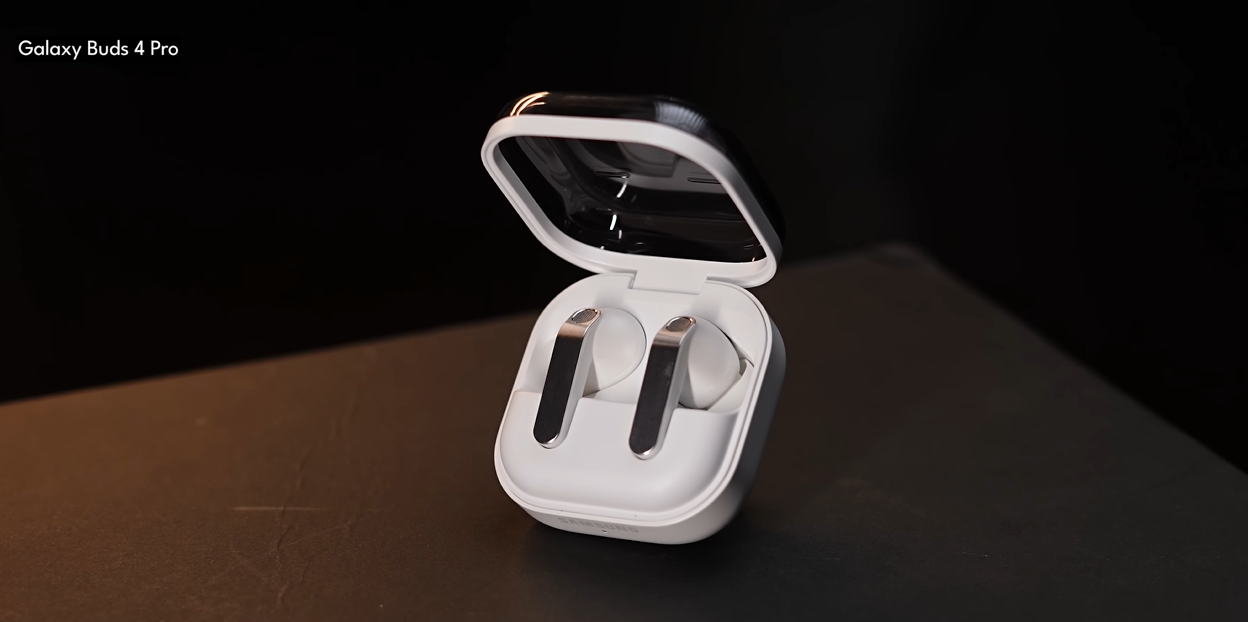
- Design: Blade stem design with brushed metal plating, flat clamshell case with transparent lid
- Colors: Black, Silver, White
- Compatible with: All Bluetooth devices. Best experience on Samsung Galaxy S26, Galaxy S26+, Galaxy S26 Ultra, Galaxy S26 Edge, Galaxy Z Fold 7, Galaxy Z Flip 7, Galaxy Tab S10 series, Galaxy Book
Design and Comfort — A Refined but Familiar Look
What Changed From the Buds 3 Pro
The Galaxy Buds 4 Pro keeps the blade stem design introduced with the Buds 3 Pro but refines it in two meaningful ways. The stem is now flat-sided rather than triangular, with a clearly defined pinch area on the front face for gesture controls — making it noticeably easier to grip and operate than the Buds 3 Pro’s stems. Samsung ran over 10,000 simulations to optimise the fit, and the earbuds sit more snugly in the ear as a result.
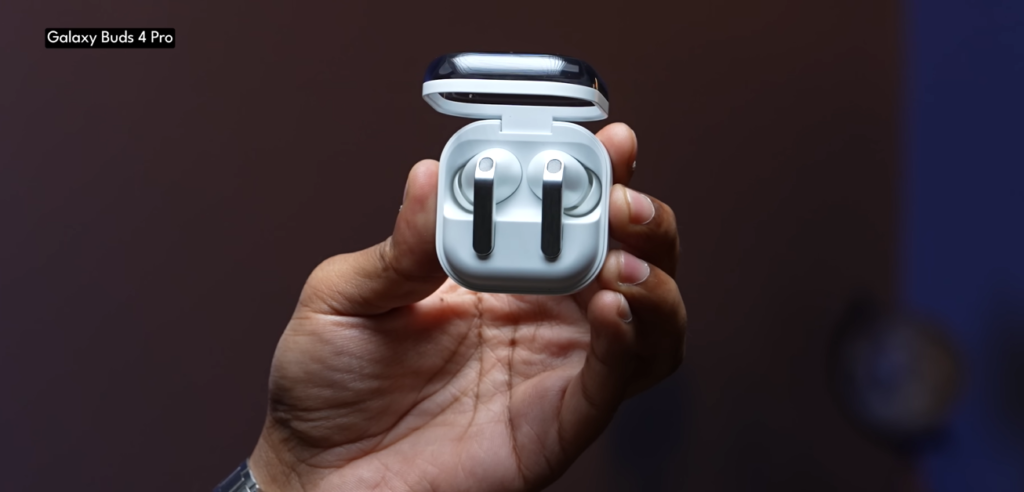
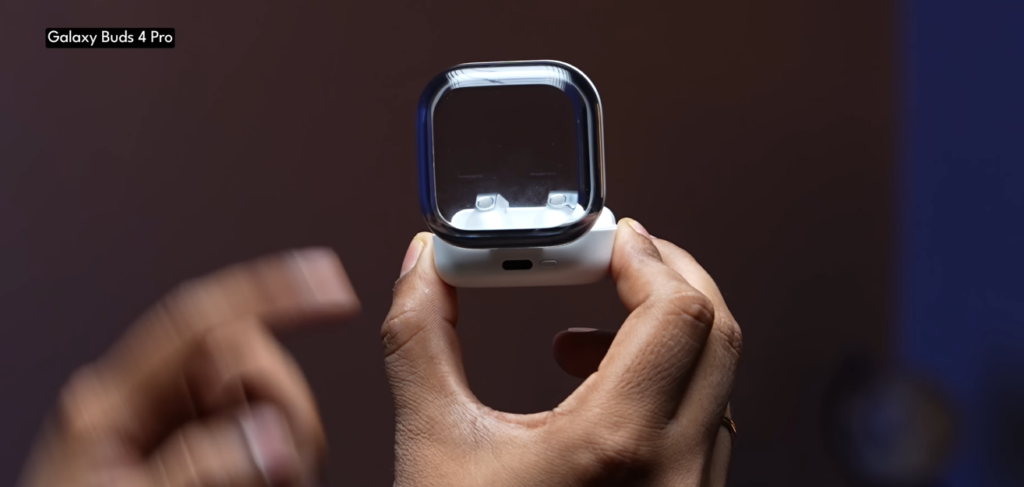
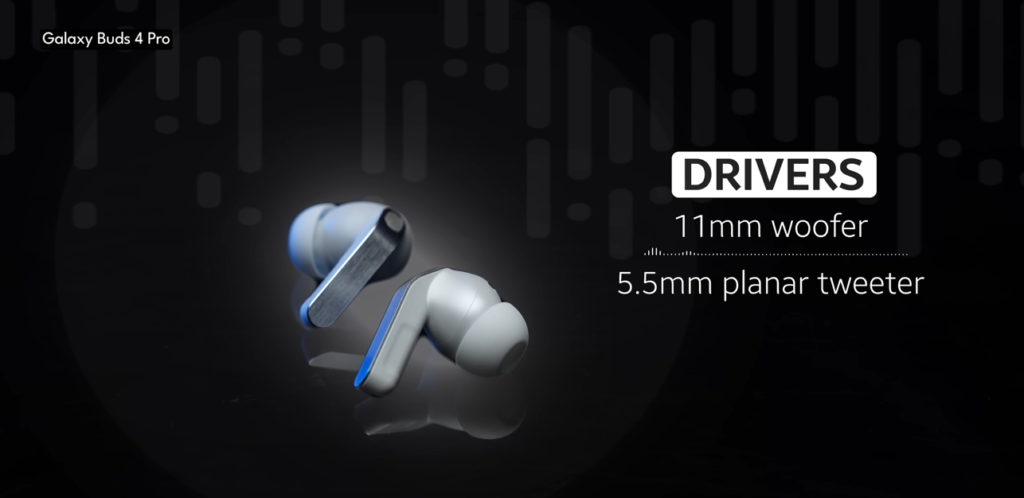
The Blade Lights are gone. The flashy LED accent strips that divided opinion on the Buds 3 Pro have been replaced with a brushed metal finish across the stem — which looks and feels more premium even if it is less distinctive. The metal plating gives the Buds 4 Pro a more refined, grown-up aesthetic that works better for professional environments.
The charging case returns to the flat clamshell format — Samsung went away from this with the Buds 3 and is back. The flat case is genuinely easier to use than the vertical cradle: opening, dropping the buds in, and cleaning the case are all simpler. The transparent lid looks great but picks up fingerprints and fine scratches easily. Handle with a bit of care.
Fit and Comfort
The silicone ear tips (included in three sizes: small, medium, large) create a proper seal that delivers both better passive isolation and improved bass response compared to open-fit earbuds. The redesigned earbud body is slightly smaller than the Buds 3 Pro, and in extended listening sessions of two hours or more, the Buds 4 Pro is noticeably more comfortable than Apple’s AirPods Pro 3 — which can begin to feel slightly uncomfortable or create a mild itching sensation for some users after extended wear. This is personal and will vary, but it is worth noting if you plan to wear your earbuds for long work-from-home sessions or flights.
Sound Quality — Where the Buds 4 Pro Genuinely Wins
Sound quality is the most important factor in any earbud purchase, and it is where the Galaxy Buds 4 Pro makes its strongest argument over everything else in the $249 category — including the AirPods Pro 3.
The Hardware Advantage — Dual Driver Setup
Each Buds 4 Pro earbud contains two independent drivers: an 11mm dynamic driver acting as the woofer for bass and midrange, and a 5.4mm planar tweeter for high-frequency detail. The woofer’s effective area has been increased by 20% compared to the Buds 3 Pro — delivering more bass authority without muddying the midrange.
The AirPods Pro 3 uses a single 10.7mm dynamic driver per earbud with Apple’s multiport acoustic architecture to improve airflow. Apple’s engineering is impressive but the hardware configuration is fundamentally simpler than Samsung’s dual-driver design.
Samsung Scalable UHQ Codec — The Game Changer
For Samsung Galaxy users, the Scalable UHQ codec is the feature that makes the Buds 4 Pro’s audio advantage concrete and measurable. When paired with a compatible Galaxy device — the Galaxy S26 series, Galaxy Z Fold 7, Z Flip 7, Galaxy Tab S10 series, or recent Galaxy Books — the Buds 4 Pro stream audio at 24-bit/96kHz wirelessly over Bluetooth. This is Hi-Res Audio territory over wireless, and it is something neither the AirPods Pro 3 (which is limited to AAC at its best) nor most Android competitors can match.
Standard Bluetooth codecs (SBC, AAC) compress audio significantly before transmission. The SSC UHQ codec preserves substantially more of the original recording’s detail — resulting in more precise imaging, better transient response, and finer instrument separation.
If you have a non-Samsung Android phone, you are limited to SBC or AAC. The Buds 4 Pro does not support LDAC or aptX, which means non-Samsung Android users do not get to hear the full capability of these earbuds. This is the most important limitation to understand before purchasing.
Sound Signature and Real-World Listening
Out of the box, the Galaxy Buds 4 Pro has a U-shaped sound signature — bass and treble are elevated, midrange is slightly recessed. This is a popular tuning for consumer earbuds and sounds impressive immediately. The AirPods Pro 3 uses a similar out-of-box signature.
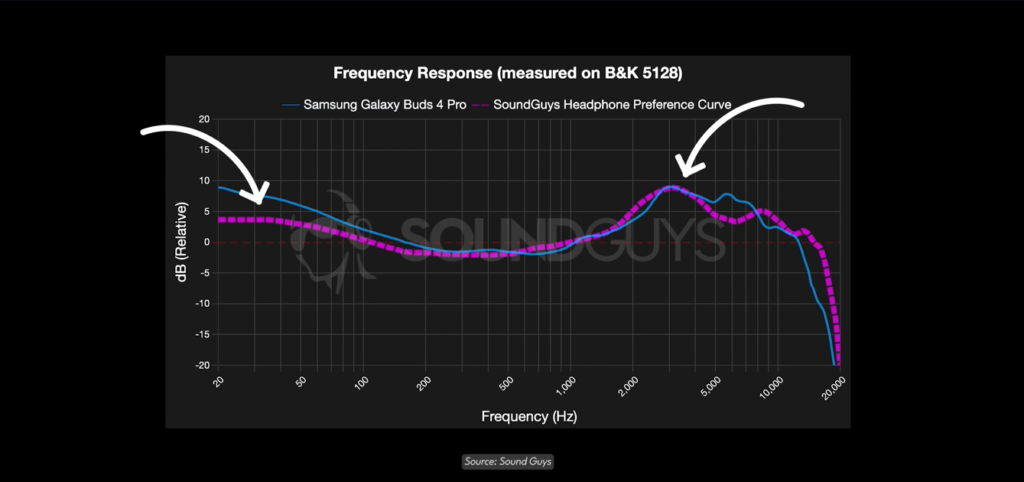
What separates the Buds 4 Pro in real-world listening:
- Bass precision: Fast attack with good definition. Bass hits hard when the track calls for it but does not bleed excessively into the midrange. The AirPods Pro 3’s bass, by comparison, is slightly less controlled and bleeds more noticeably into the mids on bass-heavy electronic tracks.
- Soundstaging and imaging: The Buds 4 Pro creates a noticeably wider soundstage than the AirPods Pro 3. Instruments are more distinctly placed in the stereo field. On orchestral recordings and complex multi-instrument tracks, this difference is clearly audible.
- Detail retrieval: The Buds 4 Pro resolves fine detail more clearly. Subtle background elements — a slight breath before a vocal line, a faint string resonance after a note, room ambience — are more distinct and easier to hear.
- Treble extension: The high-frequency extension on the Buds 4 Pro reaches further without becoming harsh on most content. The AirPods Pro 3 can sound slightly compressed and occasionally edgy on highly processed electronic tracks with complex high-frequency content.
Custom EQ — A Significant Advantage Over AirPods
The Galaxy Wearable app provides a full 9-band parametric equalizer for the Buds 4 Pro. You can adjust specific frequency bands precisely to match your hearing profile and musical preferences. This level of customisation is simply not available with the AirPods Pro 3, which offers only preset EQ options — a handful of fixed profiles with no ability to manually adjust individual frequencies.
The practical impact of this is significant. With a small reduction at 8kHz and 10kHz from the default +5 to +4, the Buds 4 Pro’s sound opens up noticeably — the slight sibilance in the default tuning softens, the midrange becomes more present, and the overall tonality becomes more balanced and engaging for long listening sessions.
The Adapt Sound feature — which analyses your hearing profile based on age and ear characteristics to customise the frequency response — is also available and provides a useful starting point for personalisation.
Active Noise Cancellation — AirPods Still Has a Slight Edge
ANC performance is the one area where the AirPods Pro 3 maintains a clear advantage over the Buds 4 Pro. That said, the gap is smaller than it was between the Buds 3 Pro and AirPods Pro 2.
The Buds 4 Pro’s ANC 2.0 with Galaxy AI does an excellent job on consistent low-frequency noise — aircraft engine hum, HVAC systems, fans, traffic. In these scenarios it performs nearly as well as the AirPods Pro 3, which is a meaningful improvement over its predecessor.
Where the AirPods Pro 3 pulls ahead is on irregular, mid-frequency noise — conversations, office chatter, crowds. Apple’s ANC processing handles these less predictable sounds more effectively, resulting in a quieter overall environment when you need to focus in busy spaces.
For commuters, frequent flyers, and anyone working in a consistently noisy environment, the AirPods Pro 3’s ANC advantage is real and worth factoring into the decision.
Transparency Mode — Essentially Identical
Both the Buds 4 Pro and AirPods Pro 3 deliver excellent transparency (ambient sound) performance. In both cases, wearing the earbuds in transparency mode sounds natural — the world around you comes through clearly without the hollow or robotic quality that affects lesser implementations. You can hear conversations, traffic, and announcements clearly at your normal voice level without removing the earbuds. For the Buds 4 Pro, a new emergency siren detection feature automatically switches the earbuds to Ambient mode if it detects a nearby siren — a practical safety addition for city use.
Microphone Quality — AirPods Sounds More Natural
The Buds 4 Pro carries six microphones including a bone conduction mic, and call quality in Samsung’s ecosystem is genuinely good — voice comes through clearly and wind noise rejection is excellent. The combination of bone conduction and environmental microphones allows the Buds 4 Pro to isolate the caller’s voice effectively in noisy environments.
However, the aggressive environmental noise cancellation processing has a side effect: it can slightly alter the natural sound of your voice. Callers on the other end receive a clean, clear signal, but it may not sound exactly like your natural voice.
The AirPods Pro 3 applies less aggressive processing and as a result sounds more natural to the person you are speaking with — your voice sounds like you. The trade-off is slightly more background noise audible to the other party.
For professional calls where voice naturalness matters — business meetings, podcasts, recorded calls — the AirPods Pro 3 has the edge. For calls in noisy environments where isolation matters more, the Buds 4 Pro wins.
Battery Life — Earbuds vs Case
Battery life is an interesting comparison between these two products because each has a different strength.
Per-earbud battery life: AirPods Pro 3 wins. Apple’s earbuds offer longer playback time per charge — approximately 30 minutes more per session with ANC enabled. If you need your earbuds to last through a long flight or an extended work session without reaching for the case, the AirPods Pro 3 holds the advantage.
Total battery life with case: Buds 4 Pro wins. The 580mAh case holds enough charge for up to 30 hours of total listening time, compared to the AirPods Pro 3’s smaller case. This means more complete recharge cycles available from the case before you need to plug in.
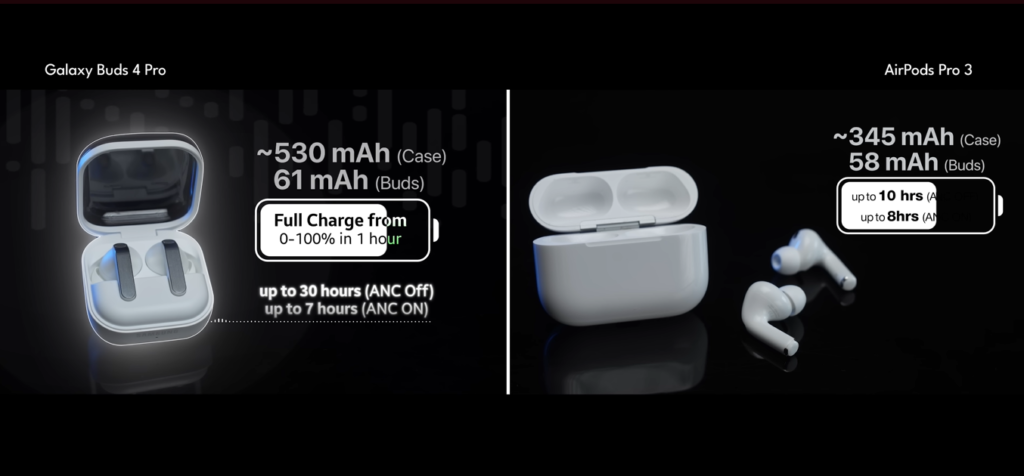
Both support fast charging and wireless charging on the case. A quick charge of a few minutes provides enough power for around an hour of additional listening time on both products.
Features — What the Buds 4 Pro Adds
Head Gesture Controls
Nod your head to accept incoming calls. Shake your head to decline. This feature, borrowed from the AirPods playbook, works reliably on the Buds 4 Pro when paired with a Galaxy device. Latency on the head gesture detection is slightly slower than on the AirPods Pro 3, but the feature works consistently in everyday use.
Live Translate
When used with the Samsung Phone app on a Galaxy S26 series device, the Buds 4 Pro delivers real-time translation across 22 languages directly into your ear. In face-to-face conversations, your spoken words appear on your phone screen in the other person’s language simultaneously. This is a genuinely useful feature for travel and international business.
360 Audio with Head Tracking
Spatial audio with head tracking creates an immersive listening environment for supported content. The Buds 4 Pro’s 360 Audio implementation has improved meaningfully over the Buds 3 Pro, partly due to the improved driver performance. For movie watching and spatial audio music content, it creates a convincing sense of space that approaches — and in some listening scenarios equals — the AirPods Pro 3’s spatial audio.
Galaxy AI Integration
Paired with the Galaxy S26 series, the Buds 4 Pro works hands-free with Galaxy AI for voice-driven tasks — taking notes, setting reminders, searching for information, and more. The integration is seamless enough that the earbuds function effectively as an always-available AI interface without needing to touch the phone.
What AirPods Pro 3 Has That Buds 4 Pro Does Not
The AirPods Pro 3 include a built-in heart rate monitor that activates during workouts. This is a health-tracking feature the Buds 4 Pro does not have and contributes to the AirPods’ value proposition for fitness-focused users alongside the Apple Watch. If health and fitness tracking from your earbuds matters to you, it is worth noting.
Samsung Galaxy Buds 4 Pro vs AirPods Pro 3 — Head to Head
Galaxy Buds 4 Pro Wins On:
- Sound quality — better bass precision, wider soundstage, superior detail retrieval
- Treble extension — cleaner high frequencies on complex electronic content
- Custom EQ — full 9-band parametric control vs fixed presets on AirPods
- Codec quality — 24-bit/96kHz SSC UHQ on Samsung devices vs AAC on AirPods
- Comfort for long sessions — smaller earbud body, better long-wear feel for many users
- Total case battery — more charge cycles from the case
- Price — same $249 but no price increase from last year
AirPods Pro 3 Wins On:
- ANC performance — especially on mid-frequency irregular noise like conversation and crowds
- Microphone naturalness — voice sounds more like you to the other person
- Per-earbud battery life — longer individual session time
- Heart rate monitor — unique health tracking feature
- Head gesture latency — slightly faster response
- Cross-device ecosystem — works seamlessly across all Apple devices
Who Should Buy the Samsung Galaxy Buds 4 Pro?
- Samsung Galaxy users — If you own a Galaxy S26, S25, Z Fold 7, Z Flip 7, or Galaxy Tab, the Buds 4 Pro is the best premium TWS earbud you can pair with your device. The SSC UHQ codec alone justifies the upgrade from any previous Samsung earbuds.
- Audio enthusiasts on Android who value sound quality above all else and own a Samsung Galaxy device
- Frequent music listeners who want full custom EQ control and the best possible sound signature customisation
- Long-session users who need comfort over 2+ hour wearing periods
- International travellers who will use Live Translate with a Galaxy phone
Who Should Skip the Galaxy Buds 4 Pro?
- Non-Samsung Android users — Without SSC UHQ codec support, you are limited to AAC or SBC. At $249, better options exist for OnePlus, Pixel, or other Android users — consider the Sony WF-1000XM5 or OnePlus Buds Pro 3 which support LDAC.
- iPhone users — The AirPods Pro 3 is a better fit within Apple’s ecosystem for the same price
- Fitness-focused users who want heart rate monitoring from their earbuds
- Users who prioritise ANC above everything else — AirPods Pro 3 remains the best in class for noise cancellation
The Samsung Galaxy Buds 4 Pro are priced at $249.99 in the United States. Samsung did not increase the price from the Buds 3 Pro, keeping it at the same $249.99 entry point.
Samsung announced the Galaxy Buds 4 Pro at Galaxy Unpacked on February 25, 2026, alongside the Galaxy S26 series. Pre-orders opened the same day and the earbuds went on general sale on March 11, 2026.
For Samsung Galaxy users, yes — the Buds 4 Pro delivers better sound quality, superior soundstaging, full custom EQ control, and Hi-Res 24-bit/96kHz audio via SSC UHQ codec. The AirPods Pro 3 has better ANC, more natural microphone sound, longer per-earbud battery life, and a heart rate monitor. For iPhone users, the AirPods Pro 3 is the better choice. For Samsung Galaxy users who care about sound quality above all else, the Buds 4 Pro wins.
Final Verdict — Samsung Galaxy Buds 4 Pro
The Samsung Galaxy Buds 4 Pro is the best Samsung earbud ever made — and for Galaxy device owners in the US, it is the clearest recommendation in the $249 premium TWS category.
The dual-driver hardware, the SSC UHQ Hi-Res codec, the 9-band custom EQ, the improved comfort, and the wide soundstage combine to deliver an audio experience that genuinely surpasses the AirPods Pro 3 on pure listening enjoyment. The improvements over the Buds 3 Pro are real and meaningful — better fit, better sound, better case design, and better Galaxy AI integration.
The ANC and microphone naturalness advantage of the AirPods Pro 3 is real. If you are primarily buying earbuds for noise cancellation or call quality in professional settings, that matters. But if you buy earbuds because you love music — and you own a Samsung Galaxy phone — the Buds 4 Pro is the one that will make you fall in love with your music library all over again.
At $249.99 with no price increase from last year, it is an outstanding value for Samsung ecosystem users.
Rating: 9 / 10
- ✅ Best sound quality in the $249 TWS category for Samsung users
- ✅ 24-bit/96kHz Hi-Res Audio via SSC UHQ codec on Galaxy devices
- ✅ Full 9-band custom EQ — far more flexible than AirPods
- ✅ 20% larger woofer area — better bass precision vs Buds 3 Pro
- ✅ Superior soundstage and detail retrieval vs AirPods Pro 3
- ✅ IP57 on earbuds and case
- ✅ Live Translate in 22 languages
- ✅ Comfortable fit for long sessions
- ✅ $249.99 — no price increase from Buds 3 Pro
- ❌ ANC slightly behind AirPods Pro 3 on irregular noise
- ❌ Microphone voice naturalness behind AirPods Pro 3
- ❌ No LDAC or aptX — non-Samsung Android users limited to AAC/SBC
- ❌ No heart rate monitor
- ❌ Shorter per-earbud battery life vs AirPods Pro 3
- ❌ Transparent case lid scratches and shows fingerprints easily