BYD’s luxury spin-off Denza just walked into Europe’s most exclusive neighbourhood — £100,000 territory occupied by BMW, Mercedes, Audi, and Porsche — and knocked on the door with 1,140 horsepower, a 9-minute charge time, and a party trick that lets it park itself by walking sideways. The Denza Z9 GT is either the most impressive Chinese car ever built or a very expensive statement that nobody asked for. We drove it in France to find out which.
MyPitShop Quick Verdict
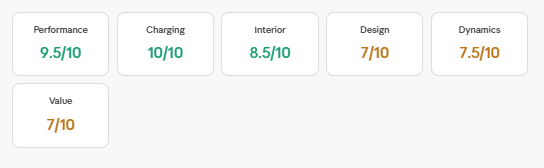
- 1,140hp from three electric motors — launch control is genuinely, absurdly fast with no wheelspin drama
- 9-minute 10–97% charge using Denza’s Flash Charger is the most significant EV charging achievement in production history
- Crab walk, pencil compass turn, and drift mode are real features — not renders — and they work
- Interior quality is a legitimate premium — Nappa leather, real wood, crystal buttons, 20-speaker Devialet audio
- At ~£100,000 in Europe, it costs the same as a Porsche Panamera but 3× more than in China — and that pricing gap is hard to ignore
- Design hasn’t won everyone over yet — it looks like a very fast hatchback, not a £100K statement car
- Suspension and brake pedal feel need European recalibration — both confirmed for production UK cars
What exactly is Denza — and why should European buyers care?
Denza is not a startup. It began in 2010 as a joint venture between BYD and Mercedes-Benz before BYD took full ownership. Think of the relationship like Lexus to Toyota, or Genesis to Hyundai — a premium halo brand built to carry a mainstream parent’s engineering into prestige territory. The Z9 GT is Denza’s European debut car, and it was not chosen by accident. It is the most technologically extreme thing BYD has ever built, launched at the Paris Opera House alongside Daniel Craig — BYD’s brand ambassador — to make absolutely certain nobody misses the statement being made.
The Z9 GT is built on Denza’s proprietary e³ platform, uses BYD’s second-generation Blade Battery, and was designed by Wolfgang Egger — the German designer responsible for the Alfa Romeo 8C Competizione and several Audi concept cars. The combination of Chinese engineering ambition and European design DNA is the core pitch.
The Price Context Nobody Talks About
In China, the Denza Z9 GT starts at approximately £39,000 (269,800 yuan). In Europe it costs £100,000+. That is a 2.5× to 3× markup that goes significantly beyond what EU tariffs on Chinese EVs (27%) and import duties can explain. Denza is deliberately choosing to price at parity with Porsche and BMW rather than undercutting them — a strategic bet that brand prestige, not price, will win European buyers. Whether that bet pays off is the central question of this entire launch.
Full specifications
| Body style | Shooting brake / GT — 5,195mm long, 1,990mm wide, 1,480mm tall, 3,125mm wheelbase |
| Powertrain (EV) | 3 electric motors — 309bhp front + 416bhp rear (×2) = 1,140bhp / 892lb ft total |
| Powertrain (PHEV) | 2.0L petrol + 3 electric motors = ~920bhp, ~50-mile EV range |
| Battery (EV) | 122kWh BYD Blade Battery 2.0 — Cell-to-Body architecture |
| Range (WLTP) | 372 miles (599km) EV | CLTC: 644 miles (China spec) |
| Charging (Flash) | 10–97% in 9 minutes at Denza Flash Charger (megawatt-level) |
| DC charging | Up to 1,500kW capable | 800V architecture |
| 0–62mph | 2.7 seconds (EV) | 2.8 seconds (PHEV) |
| Top speed | 168mph |
| Weight | ~2.9 tonnes |
| Suspension | Double wishbone front + 5-link rear, dual-chamber air springs (hard/soft) |
| Steering | 4-wheel steering — 4.6m turning circle (tighter than a London black cab) |
| Brakes | Carbon ceramic — standard fitment |
| Wheels | 20-inch standard |
| Screens | 17.3-inch central + 13.2-inch driver display + 13.2-inch passenger screen |
| Audio | 20-speaker Devialet surround system |
| Boot | 495L + 53L frunk + underfloor storage |
| UK price (est) | ~£100,000 EV | ~£95,000 PHEV |
| Europe price | €115,000 (Germany/France) — orders open now |
| China price | ~£39,000 (269,800 yuan) |
| UK availability | Showrooms from July 2026 | Orders open now in France, Germany, Italy, Spain, UK |
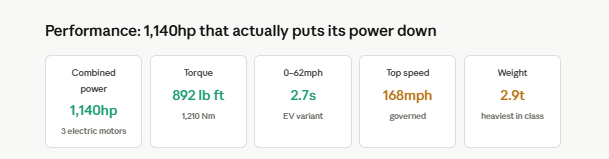
The headline power figure of 1,140bhp — comparable to an Aston Martin Valhalla — is meaningless unless the car can deploy it without drama. Many high-power EVs, including the Lotus Emeya, struggle with wheelspin and traction loss under hard launch. The Z9 GT does not. In race mode with launch control engaged, the three-motor setup — two independent rear motors plus one front — distributes power with electronic precision that results in clean, linear, violent forward thrust. No drama. No wheelspin. Just acceleration that redefines what “fast” means in a 2.9-tonne estate car.
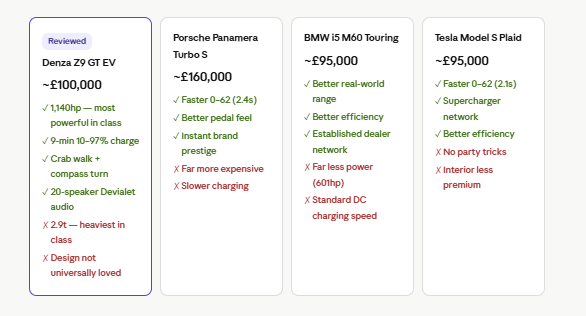
The 0–62mph time of 2.7 seconds is slightly slower than both the Porsche Taycan Turbo S (2.4s) and Tesla Model S Plaid (2.1s). The Z9 GT’s additional half-tonne of mass over those rivals is the primary factor. It is still quicker than virtually everything else on sale at this price — but if outright 0–62 bragging rights matter to you, the Taycan Turbo S retains the crown.
The accelerator response has a deliberate, brief delay before full power delivery — approximately 0.3–0.5 seconds. This is intentional, not a flaw. It gives the driver’s body time to brace for what is coming. Without it, the violent thrust would arrive before occupants had registered it was happening. It is a thoughtful calibration decision that makes the performance more usable, not less impressive.
Five driving modes — Eco, Normal, Sport, Snow, and Race — adjust throttle response progressively. Even in Eco, this car is fast. The difference between modes is primarily in response sharpness, not in the ultimate performance available. Carbon ceramic brakes are standard fitment — a meaningful decision given the stopping task required for a 2.9-tonne projectile at these speeds. They are strong, though the pedal requires more travel than ideal before the main braking force engages — a known issue confirmed by multiple European reviewers that Denza is addressing for production UK cars.
The charging technology — the most important thing about this car
Everything else about the Denza Z9 GT — the power, the party tricks, the interior — is impressive. The charging technology is historic.
In a live demonstration, the Z9 GT charged from 10% to 97% in just over 9 minutes using Denza’s Flash Charger. The charging rate peaked at 2km of range added per second — at its slowest, 1km per second. After 4 minutes, the battery exceeded 75%. This is not a theoretical figure. It was observed and timed across multiple journalist drives.
How Denza achieves megawatt charging without requiring a power station
The technical problem with ultra-fast charging has always been grid power — delivering 1,000kW+ requires infrastructure that most locations simply don’t have. Denza’s solution is elegant: each Flash Charger unit contains BYD’s second-generation Blade Battery packs as onboard energy storage. A modest grid connection of a few hundred kilowatts charges the storage batteries continuously. When a car connects, those batteries discharge at megawatt speeds into the vehicle. The grid never has to deliver the peak power — the storage system does. This is the same battery-buffer principle used in some grid-scale energy projects, miniaturised into a car charger.
Denza plans to install 3,000 Flash Chargers across Europe within 12 months, including 300 in the UK. The Z9 GT’s battery is also notably cold-resistant — at -30°C, the charge time extends by only 3 minutes to reach the same state of charge. This is a direct consequence of LFP-derived Blade Battery chemistry, which maintains electrochemical performance across a far wider temperature range than NMC alternatives.
To put the 9-minute charge in a practical context: a typical petrol fill-up takes 4–6 minutes at a busy station. Denza has effectively made EV charging faster than petrol for the first time in any production car — provided you find a Flash Charger. The infrastructure build-out in the next 12 months will determine how transformative this technology is in practice.
The party tricks — crab walk, pencil compass, and drift mode explained
Intelligent Crab Walk
All four wheels turn in the same direction simultaneously, allowing the car to drive diagonally. Maximum 5° of steering lock before it cancels. Genuine urban manoeuvrability use case — not just a demo trick.
Pencil Compass Turn
Front wheels lock. Rear motors spin in opposite directions. The car rotates on its own axis — effectively a zero-radius U-turn. Also enables nose-in parallel parking where the rear follows the front into the space.
Drift Mode
Rear motor torque vectoring bias enables controlled oversteer. Not tested personally in this review, but demonstrated by Denza engineers — the car genuinely throws shapes for a 2.9-tonne GT.
4.6m Turning Circle
Rear-wheel steering turns opposite to front wheels at low speed. The resulting 4.6m turning circle is tighter than a London black cab (7.62m) — remarkable for a 5.2-metre car.
All four tricks come with a caveat: tyre wear. The crab walk and pencil compass turn generate lateral scrubbing forces on the tyres that are significantly higher than normal driving. Denza acknowledges this. Buyers who use these features regularly will need to factor in accelerated tyre replacement costs — and at 20-inch fitment on a 2.9-tonne car, those costs are not trivial.
Design: the one area where the Z9 GT hasn’t won yet
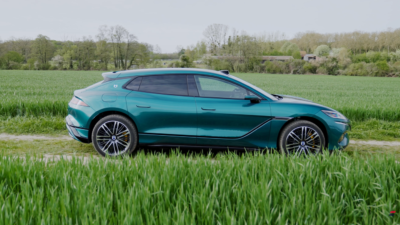
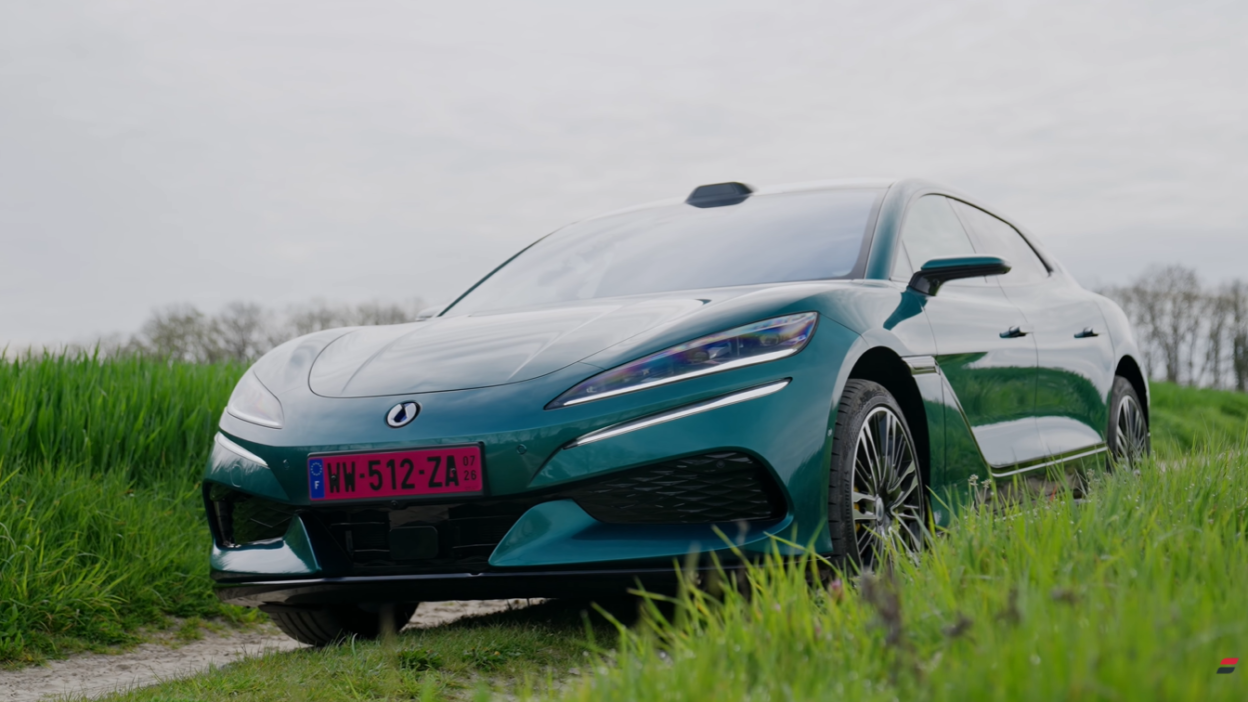
The Z9 GT was designed by Wolfgang Egger, whose portfolio includes the Alfa Romeo 8C Competizione — one of the most beautiful cars of the 21st century. The Z9 GT is not that. It is a large, low-slung shooting brake with a waistline Denza describes as inspired by flowing silk, split LED headlights with a lowercase-H DRL signature, and a rear spoiler that makes its intentions clear. In profile, the proportions are clean. Face-on, the headlights give it a distinctive identity.
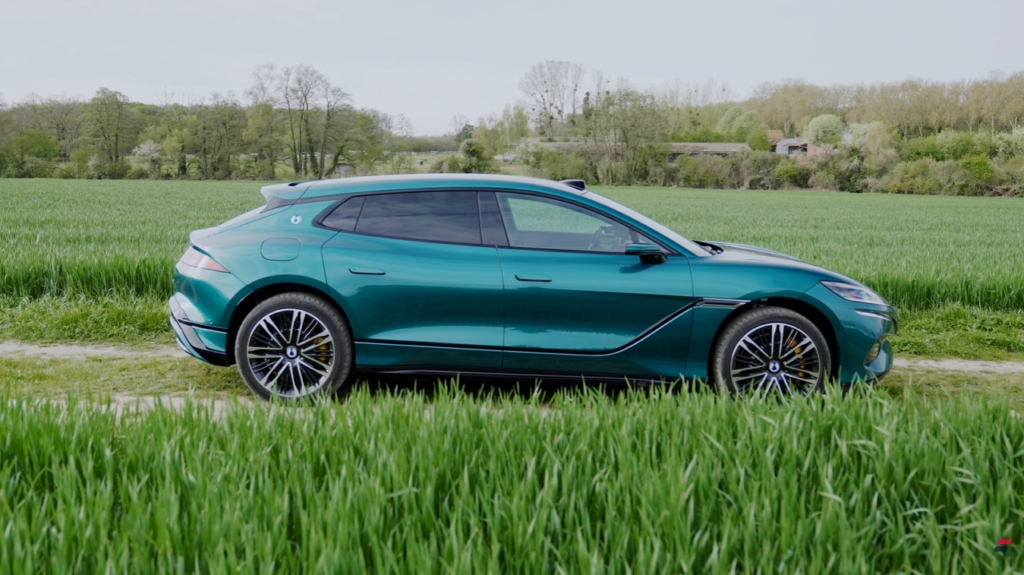
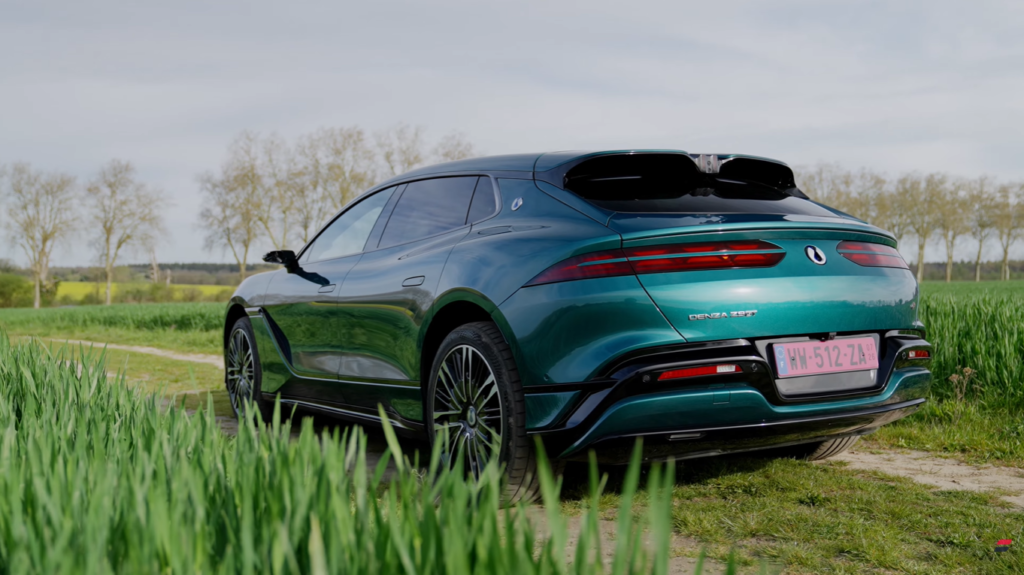
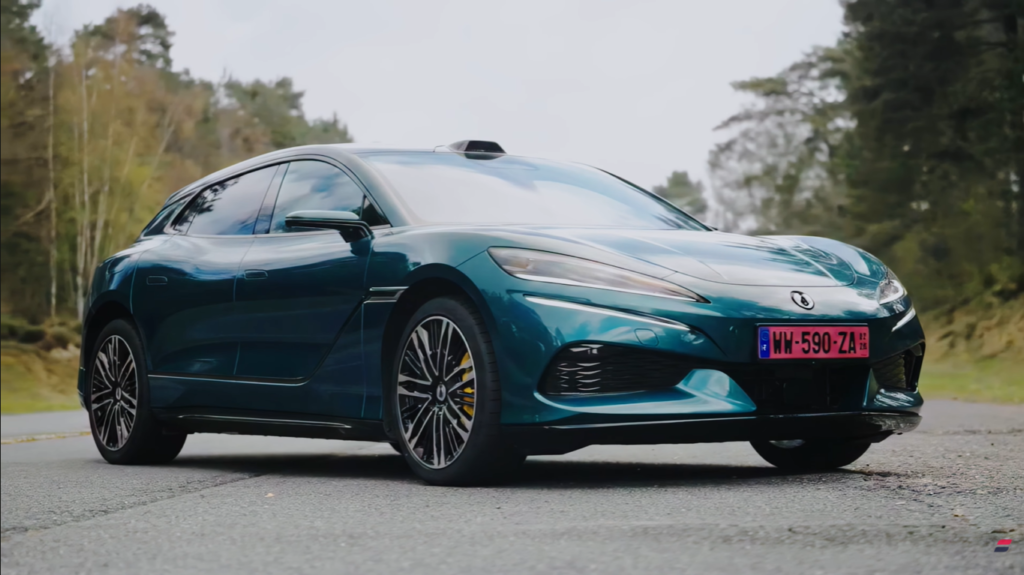
The honest truth is that at £100,000, the design does not yet generate the instant emotional response that BMW M5 Touring, Porsche Panamera Sport Turismo, or Mercedes AMG GT 4-Door produce at a glance. Those cars make people stop in the street. The Z9 GT makes people wonder what it is first. Whether that becomes an asset or a liability depends on whether the brand achieves enough visibility to make the design familiar and desirable over time.
Colour-mirror cameras replace traditional door mirrors as standard fitment. This forces the driver to look down and inward rather than outward when checking surroundings — a habit adjustment that takes several days to feel natural. Camera-based mirrors are legal in Europe but remain a polarising design choice at this price point where legacy rivals still offer traditional mirrors as default.
Interior: where the Z9 GT genuinely impresses
Step inside and the design argument fades. The cabin of the Z9 GT is a legitimate premium environment — not an attempt at premium, not premium-for-a-Chinese-car, but genuinely on par with or exceeding what BMW and Mercedes deliver at this price point in terms of material quality and feature density.
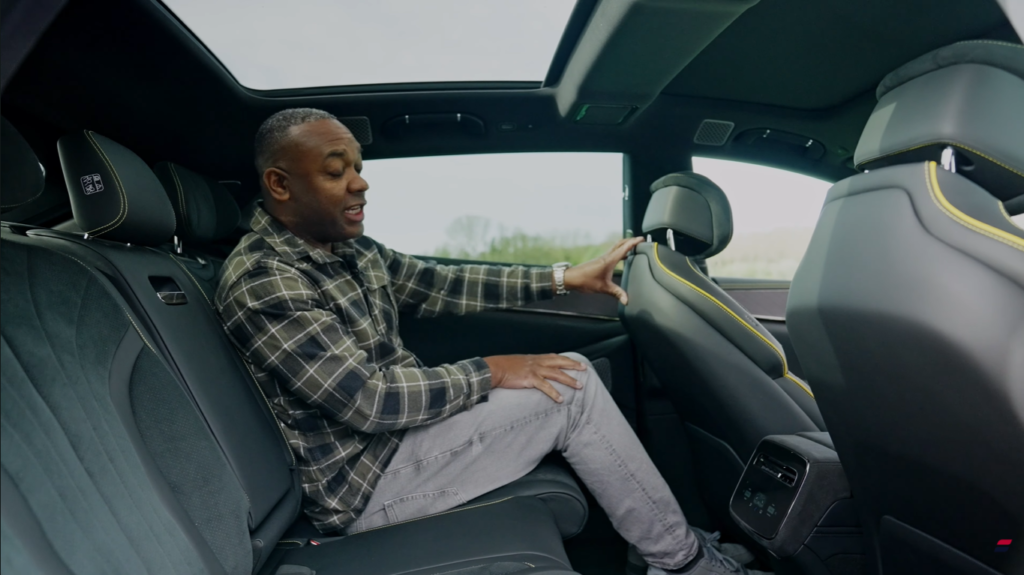
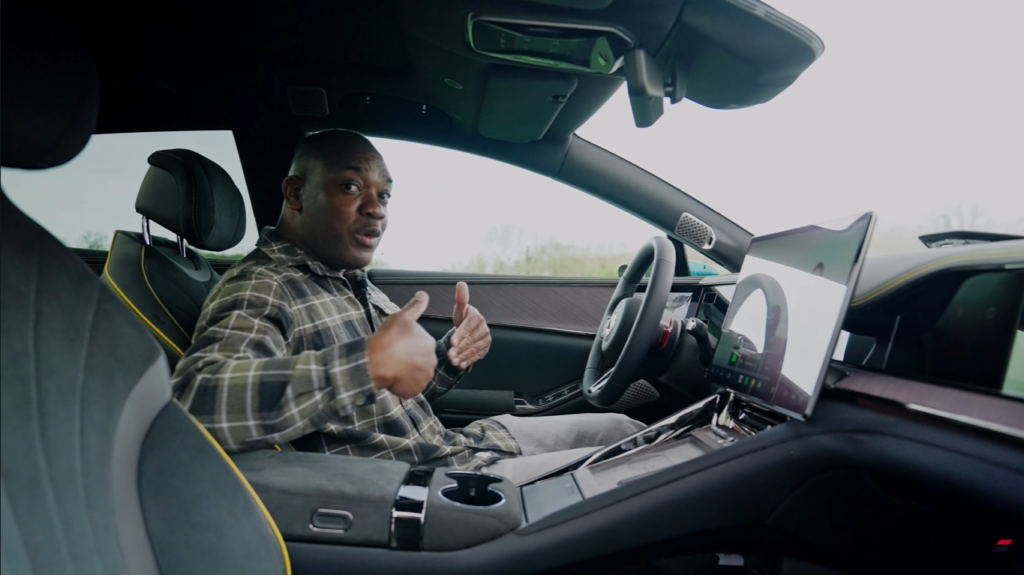
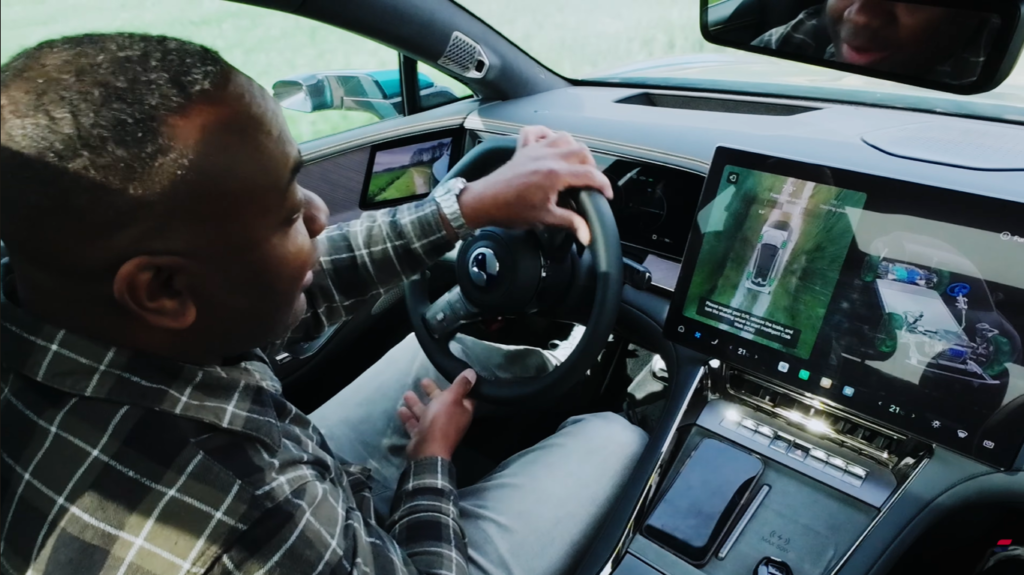
Nappa leather covers every surface that matters. Real wood features on the dashboard. The stitching is precise. There are no hollow-sounding panels, no scratchy plastics anywhere in reach. Build quality inspires immediate confidence — no squeaks, no rattles across the test drive. The 20-speaker Devialet audio system is exceptional — Devialet is a French audiophile brand whose speakers retail for thousands standalone.
Technology inside
Three screens dominate: a 17.3-inch central touchscreen, a 13.2-inch driver display, and a separate 13.2-inch passenger screen that runs independent media including YouTube, gaming, and karaoke. A massive heads-up display spans nearly the full width of the windscreen. Crystal-style physical shortcut buttons control the most-used functions — defroster, drive modes, suspension, hazards. These buttons are a deliberate and welcome departure from fully screen-dependent controls, though their haptic-only feedback means they require visual confirmation to operate accurately.
Rear seat experience
The Z9 GT is a strict four-seater. All four positions include heating, cooling, and massage. The rear two seats also recline. Legroom for a 5’11” (180cm) passenger is generous. An illuminated vanity mirror — essentially a built-in ring light — serves the rear right seat. Power door buttons close all four doors simultaneously when the driver presses the brake, then the driver’s seat and steering wheel automatically adjust to the driving position. It is the most theatrical entry-to-departure sequence available in any production car right now, including Rolls-Royce.
A double-hinged refrigerator in the centre console cools to sub-zero (capable of making ice) or heats to keep coffee warm. Two 50W wireless phone chargers sit front and centre. Rear passengers control the system via a touchscreen in the centre armrest.
Handling, ride, and dynamics — the honest picture
The Z9 GT’s handling is competent and, in many respects, impressive given its 2.9-tonne mass. Body roll is well controlled for the weight — corners are approached with more flatness than the mass suggests possible. The dual-chamber air suspension adjusts between sport and comfort settings meaningfully. Rear-wheel steering makes the car feel significantly more agile in urban environments than a 5.2-metre car has any right to feel.
The test car was a Chinese-specification pre-production vehicle driven on French roads. Denza has confirmed that European production cars will receive retuned suspension (firmer, more suited to European road surfaces and driving expectations), revised steering calibration (sharper), and brake pedal adjustments (shorter initial travel). Until European-spec production cars are tested on UK roads, any handling verdict must carry this caveat.
The brake pedal has a known two-stage feel — initial travel that builds resistance slowly before the main braking force engages sharply. For a car of this performance capability, this pedal modulation is genuinely frustrating and requires adaptation. Multiple reviewers across European press events flagged this as the single most important dynamics issue to address before UK sales begin.
Range and efficiency — the honest numbers
372 miles WLTP is a respectable but not class-leading range for a 122kWh battery. The BMW i5 M60 delivers approximately 500 miles with a smaller battery. The Porsche Taycan Turbo S does around 300 miles. The Z9 GT sits in the middle — not range-anxious for daily use, not exceptional for long-distance touring. Real-world energy consumption in testing was approximately 3.0mi/kWh, which matches Denza’s official claim. For context, established European rivals achieve better efficiency ratios with less power.
The 2.9-tonne kerb weight is the primary efficiency limiter. Physics is undefeated — moving more mass requires more energy, regardless of how efficiently the motors operate. The Z9 GT chose performance and feature density over outright efficiency, and the range figure reflects that choice honestly.
How it compares to direct rivals
Pros and cons
What works
- 9-minute charging — genuinely game-changing
- 1,140hp deployed cleanly — no wheelspin
- Carbon ceramic brakes standard
- Nappa leather, real wood — legitimate premium
- 20-speaker Devialet audio
- All 4 seats: heat, cool, massage, recline
- 4.6m turning circle — tighter than a black cab
- Automatic doors — full Rolls-Royce theatre
- Onboard fridge standard
- 3,000 Flash Chargers planned in Europe
What doesn’t
- £100K in Europe vs £39K in China
- Design lacks immediate emotional pull
- 2.9 tonnes — heaviest in class
- Brake pedal two-stage feel — frustrating
- Camera mirrors require adaptation
- 372mi range — not class-leading
- Crystal buttons don’t feel premium to touch
- Flash Charger network doesn’t exist yet
- European suspension tuning unconfirmed
- Tyre wear from party tricks is real
Who should buy the Denza Z9 GT?
Buy it if you…Want the most technologically extreme premium EV available, prioritise interior luxury and feature density over brand legacy, and do most driving near Flash Charger infrastructure.
Skip it if you…Need the emotional pull of an established German badge on your driveway, regularly drive long country routes far from charging infrastructure, or find the design underwhelming at this price.
Consider the PHEV if…Range anxiety in areas without Flash Chargers is a genuine concern — the PHEV version retains 3-motor AWD at around £95,000 with a 2.0L petrol safety net and approximately 50 miles EV range.
Wait if…You want to be certain the European suspension tune and brake pedal calibration have been resolved before committing. The first confirmed UK production deliveries are due from mid-2026 — reviews of those cars will give a definitive dynamics answer.
MyPitShop final verdict
The Denza Z9 GT is not the car that beats BMW, Mercedes, and Porsche at their own game. Not yet. The design hasn’t landed the emotional gut-punch those brands deliver. The brake pedal needs work. The Flash Charger network is a promise more than a reality right now. And pricing it at £100,000 — the same as a Porsche Panamera — removes the value proposition that made every previous Chinese EV easy to consider.
But the charging technology alone rewrites the rules of EV ownership. 9 minutes from 10% to 97% is not an incremental improvement — it is a category shift. It makes range almost irrelevant if the infrastructure arrives as planned. And the performance, the interior quality, the party tricks, and the sheer technical ambition of this car are impossible to dismiss.