When you mention BYD sedans, most people immediately think of the Seal 5 DM-i. It gets the headlines, the social media buzz, and the showroom traffic. But quietly sitting in BYD dealerships, often overlooked, is a car that arguably deserves just as much attention — the BYD Seal.
The specific variant we’re reviewing today is the 2026 BYD Seal Advanced Rear-Wheel Drive, priced at ₱1,998,000. At that price point, it goes up directly against some serious competition — the Tesla Model 3 Standard, the Honda Civic RS eHEV, and the Toyota Corolla Altis HEV. So the question is simple: is the forgotten BYD Seal actually worth it?
Let’s find out.
Exterior Design: Ocean Series Elegance With a Few Caveats
Family Resemblance to the Seal Lion 6
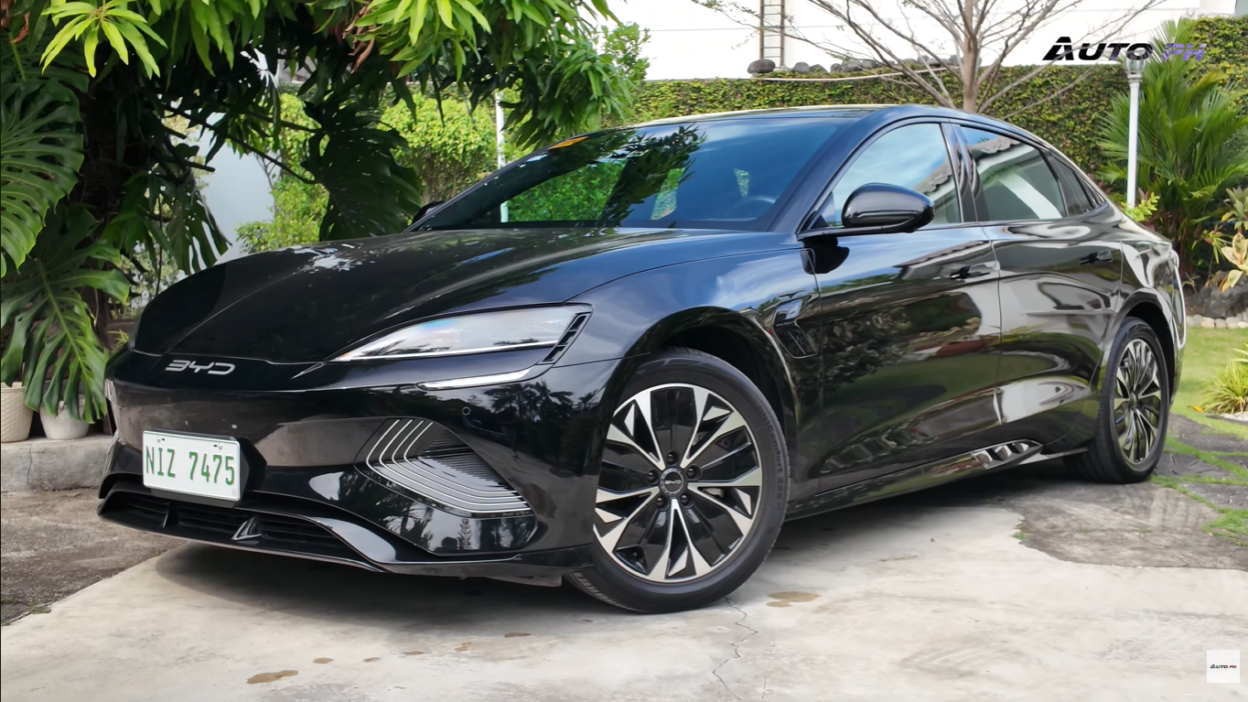
The BYD Seal is part of BYD’s Ocean series, and it shows. The front end shares a strong family resemblance with the very popular Seal Lion 6 — sleek headlights, a low-slung stance, and smooth, flowing body lines that give it a distinctly aerodynamic character.
The Signature “Whiskers”
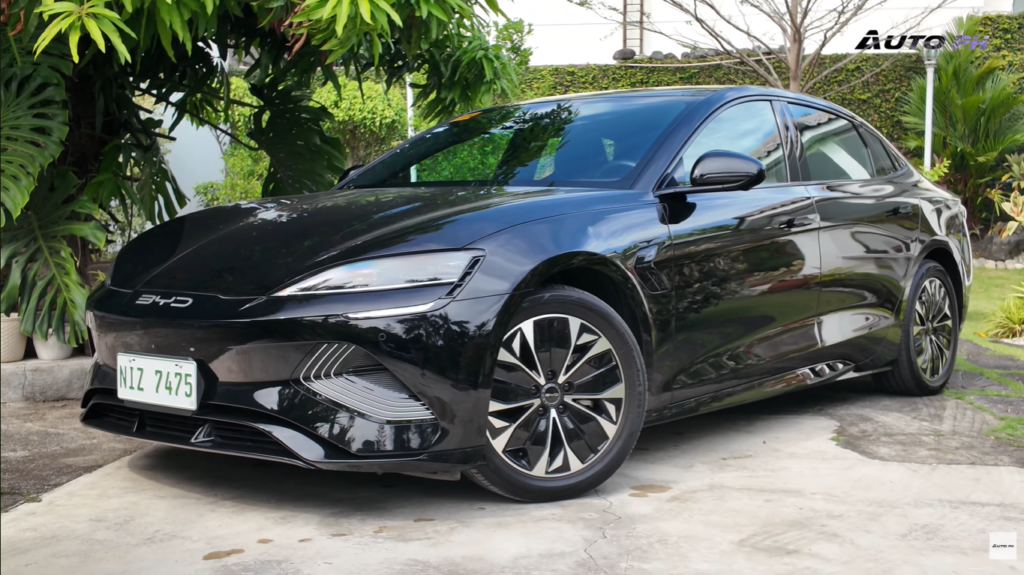
True to its name, the Seal gets a unique design detail at the front — signature whisker-style lighting elements that serve as the car’s visual identity. It’s a clever, playful nod to its namesake animal and makes it instantly recognizable among BYD’s lineup.
Color & Wheel Notes
The reviewed unit comes in Cosmos Black — the same color used on the BYD Atto 3. Honestly? The color doesn’t do the car justice. The Seal looks significantly better in white, silver, or the Harbor Grey that BYD offers. The black finish, combined with the 18-inch two-tone alloy wheels (standard on the rear-wheel drive variant), makes the car feel slightly less premium than it actually is. Larger, single-finish wheels would elevate the look considerably.
Side Profile & Mirrors
- Electric door handles — flush-fitting and clean, though manual emergency operation raises questions
- NFC card reader integrated into the side mirror housing — lets you lock and unlock without a key fob
- Side skirt aerodynamic elements running along the lower body
Rear End
The tail end is where the Seal genuinely impresses. A full-width LED light bar with a distinctive diamond pattern stretches across the rear, looking striking and unique — especially at night. Combined with the sporty diffuser-style rear bumper, the back of this car looks properly athletic.
Trunk & Frunk
Trunk:
- No visible external release — opens via a hidden button
- Decent boot space, though under 400 litres due to a relatively high floor
- No spare tire (standard for full EVs)
Frunk:
- Hidden behind a panel designed to look like an engine cover
- Large enough to store the charging cable
- A useful bonus for a full EV sedan
Interior: Premium Materials, Older Interface
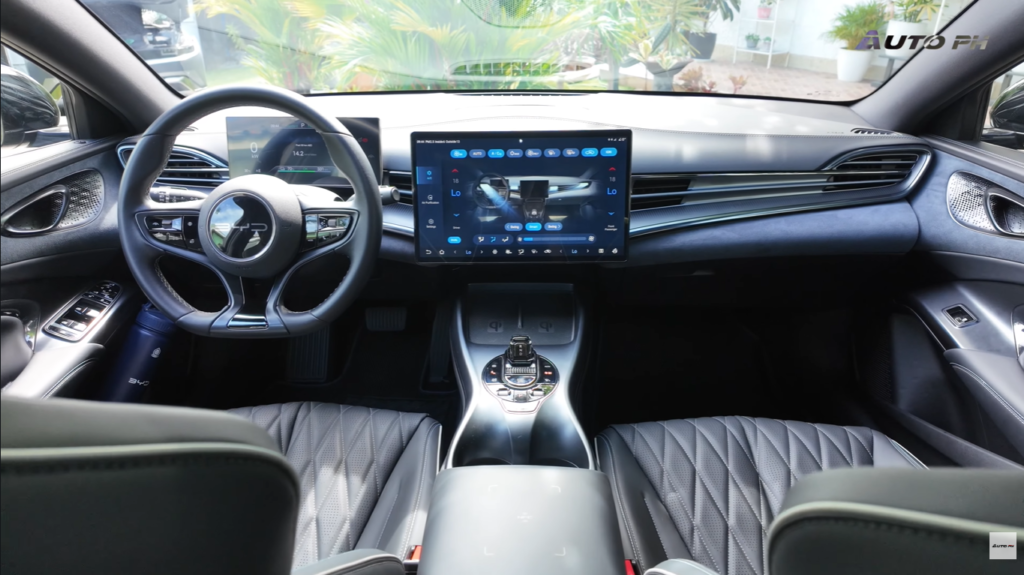
Step inside the BYD Seal Advanced and the first impression is genuinely good. The cabin uses a swoopy, driver-focused design with quality materials throughout.
Dashboard & Material Quality
- Full soft-touch dashboard with contrast stitching in light blue and gray
- Suede inserts on the dashboard and door panels — a genuine highlight that feels premium
- Leatherette armrests and matte dark gray center console (no gloss black, thankfully — except for a few buttons)
- Chrome-accented trim pieces that avoid feeling tacky
Steering Wheel
A flat-bottom, three-spoke design with a wing-style cut-out. It offers tilt and telescopic adjustment, which is appreciated. One design complaint — the adaptive cruise control and music track buttons are positioned at the very edges of the wheel, making accidental presses while cornering a real possibility.
Instrument Cluster & Infotainment
Instrument Cluster:
- 10.25-inch digital display
- Multiple theme options available
- Design feels slightly dated compared to newer BYD models — one of the clearest signs this is an older generation interior
Infotainment Screen:
- 15.4-inch rotating touchscreen
- Supports Apple CarPlay and Android Auto
- UI leans toward the cartoonish side — not as refined as BYD’s newer interface
- Relatively easy to learn and navigate, comparable to Tesla’s approach
- Air vent direction must be controlled through the screen (no manual vents) — a Tesla-like setup that takes adjustment
Sound Personality
One fun feature — the Seal lets you choose its vehicle prompt sound profile. In standard mode, you get a normal EV hum and conventional turn signal clicks. Switch to Brand mode and the car plays welcome and goodbye music with a guitar melody, and your turn signals switch to a distinctive electronic sound. Quirky, but charming.
Center Console
- Jewel-style electronic gear selector — looks genuinely premium
- Physical buttons for climate control and defogger (no screen-diving required)
- Drive mode selector: Eco / Normal / Sport
- Volume toggle and hazard button
- Two cup holders
- Large storage compartment with felt lining underneath
- NFC card reader built into the console — start the car without the key fob
Seats
- Sport-style seats with perforated leatherette
- Comfortable despite being single-piece sport buckets
- Light blue and gray stitching with white piping — matches the dashboard theme
- Soft BYD-branded headrests
- No seat ventilation or heating on this variant
Glass Roof
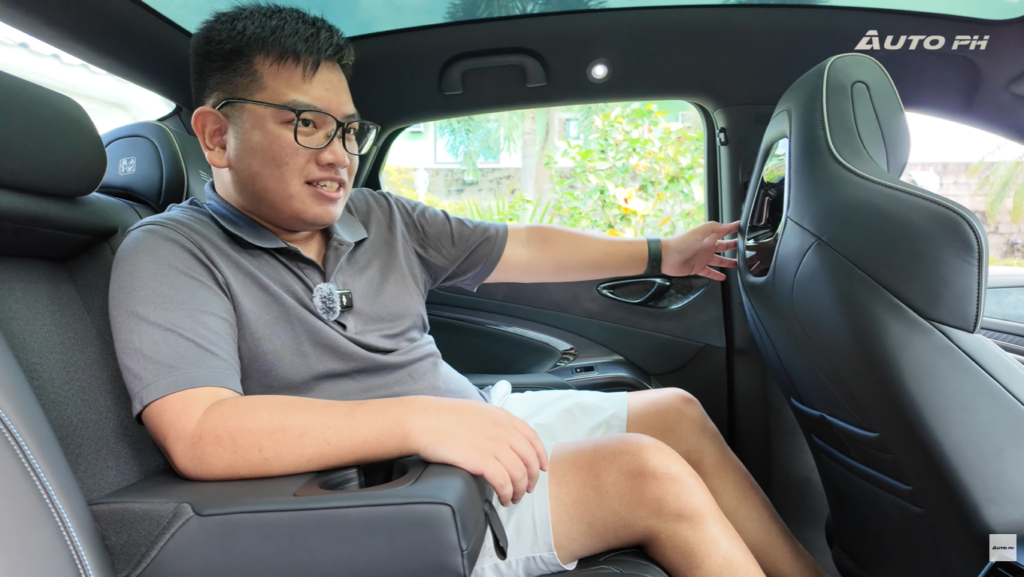
The Seal comes with a large panoramic glass roof — no power shade included, though BYD lists a manual sunshade in the spec sheet. The glass roof adds to the sense of space, especially appreciated in the rear.
Rear Seat Space: Surprisingly Generous
This is where the BYD Seal genuinely surprises. Despite competing against compact sedans like the Civic and Corolla, the Seal’s dimensions push it closer to mid-size sedan territory — approaching Toyota Camry proportions.
Rear Passenger Highlights
- Generous knee room — well above what compact rivals offer
- Headroom is adequate (tested at 5’7″)
- The low sport seating position reduces under-thigh support somewhat
- Two air con vents at the rear
- Two USB ports (USB-A and USB-C) hidden under a cover
- Center armrest with two cup holders
- Large underfloor storage compartment
For a car priced against compact sedans, the rear space is a notable competitive advantage.
Powertrain & Performance: Rear-Wheel Drive Makes All the Difference
Specs
| Feature | Details |
|---|---|
| Motor Configuration | Single Rear-Mounted Electric Motor |
| Power Output | 203 hp |
| Torque | 310 Nm |
| Battery Capacity | 61.4 kWh |
| Claimed Range | 510 km |
| Drivetrain | Rear-Wheel Drive |
| Charging | Type 2 + CCS2 |
| Fast Charge (10–80%) | Approximately 30 minutes |
How It Drives
The Seal Advanced is marketed as a sports sedan, and the rear-wheel drive layout plays a significant role in delivering on that promise.
Acceleration: Immediate, torquey, and characteristically EV-quick. But what’s different here compared to most EVs is the absence of torque steer. Because power goes to the rear wheels, hard acceleration feels planted and composed — the car stays arrow-straight rather than pulling or writhing under load.
Steering: Light but surprisingly engaging. There’s genuine road feel and feedback despite the low effort required. In Sport mode (selectable via the infotainment screen), the steering adds a little more weight without becoming artificially heavy. It genuinely encourages you to push the car.
Braking: One of the better EV braking systems tested. Many electric cars feel artificial or overly aggressive under braking — the Seal’s pedal feel is natural and progressive. The regenerative braking is adjustable, and even on the highest setting, it doesn’t lurch the car to a stop. There’s no dedicated one-pedal driving mode, but the regen tuning compensates well.
Ride Quality: Perhaps the biggest surprise. For a sports sedan, the Seal rides remarkably smoothly. It’s firm enough to feel controlled and connected, but never harsh or punishing. Daily driving comfort is genuinely excellent — a car that’s equally happy on a weekend back road and a weekday commute.
NVH (Noise, Vibration, Harshness): Tire noise is well-insulated — better than expected for an EV without engine noise to mask it. The cabin is quiet and free of rattles. One genuine annoyance: air conditioning compressor vibration is noticeable through the steering wheel and seat when the climate system is working hard. It’s more pronounced than expected from a BYD product and something a software or hardware update should address.
Real-World Range: Honest Numbers
The Seal Advanced delivered an honest, real-world range assessment during this test:
- Delivered at 99% charge with approximately 495–496 km of estimated range showing
- After approximately 150–160 km of mixed driving, the battery sat at 63% remaining
- Extrapolates to roughly 400–430 km of real-world range
While not class-leading efficiency (the Tesla Model 3 edges it out here), the range is more than adequate for daily driving and most weekend trips. The CCS2 fast charging compatibility means finding a charger is rarely a problem, and the 30-minute 10–80% charge time keeps downtime reasonable.
Driver Assistance (ADAS)
The Seal Advanced comes with BYD’s full ADAS suite despite being the lower variant — a generous inclusion. The system covers the expected bases: adaptive cruise control, lane keeping, and automatic emergency braking.
That said, in its current state, BYD’s ADAS is not class-leading. The system can be inconsistent and would benefit from refinement — ideally via an over-the-air software update. It’s usable, but users coming from more polished ADAS implementations (like Honda Sensing or Toyota Safety Sense) may find it underwhelming.
Key Competitors Comparison
| Feature | BYD Seal Advanced | Tesla Model 3 Std | Honda Civic RS eHEV | Toyota Corolla Altis HEV |
|---|---|---|---|---|
| Price | ₱1,998,000 | Similar | Similar | Similar |
| Powertrain | Full EV RWD | Full EV RWD | Hybrid FWD | Hybrid FWD |
| Power | 203 hp | ~208 hp | 184 hp | 196 hp |
| Range/Efficiency | ~430 km real | ~480 km+ real | Hybrid | Hybrid |
| Interior Size | Near mid-size | Compact | Compact | Compact |
| Screen | 15.4″ rotating | 15.4″ | 9″ | 8″ |
| ADAS | Full suite | Full suite | Honda Sensing | Toyota Safety Sense |
What We Like ✅
- Rear-wheel drive layout — genuinely fun and torque-steer free
- Surprisingly spacious cabin approaching mid-size proportions
- Premium interior materials — suede, soft-touch surfaces, quality stitching
- Smooth, natural braking feel
- Comfortable ride quality for a sports sedan
- CCS2 fast charging compatibility
- Full ADAS suite on the base variant
- Large panoramic glass roof
- Honest, usable real-world range
What We Don’t Like ⚠️
- Cosmos Black color undersells the design — lighter colors suit it far better
- Two-tone 18-inch wheels feel visually underwhelming
- Infotainment UI looks dated and cartoonish compared to newer BYDs
- Air conditioning compressor vibration noticeable through steering wheel and cabin
- No seat ventilation or heating on this variant
- Air vent direction requires screen input — no manual adjustment
- ADAS needs improvement
- Boot space under 400 litres — rivals offer more
Final Verdict
The 2026 BYD Seal Advanced is, without question, an underrated and overlooked car. In a market fixated on the Seal 5 DM-i, the original Seal quietly offers a more driver-focused, rear-wheel drive experience that punches well above its price class.
It’s not perfect. The interior is showing its age compared to BYD’s newer models, the compressor vibration is an irritant, and the boot space won’t win any awards. But the driving dynamics, cabin space, material quality, and charging infrastructure compatibility make a compelling case.
If you’re cross-shopping against a Honda Civic Hybrid or Toyota Corolla Altis Hybrid, the Seal offers a fundamentally different — and genuinely exciting — driving experience. And against the Tesla Model 3, it gives up some efficiency and software polish, but offers comparable space, dynamics, and a more expressive interior personality.
The BYD Seal isn’t the obvious choice. But it might just be the right choice.
“It’s proof that EVs can be fun. It’s proof that they can be sporty while still maintaining the comfort they’re known for.”
Overall Rating: 8.0 / 10 ★★★★☆
| Category | Score |
|---|---|
| Exterior Design | 7.5 / 10 |
| Interior Quality | 8.5 / 10 |
| Performance & Handling | 8.5 / 10 |
| Ride Comfort | 8.0 / 10 |
| Range & Efficiency | 7.5 / 10 |
| Tech & Features | 7.5 / 10 |
| Value for Money | 8.5 / 10 |
Have questions about the 2026 BYD Seal Advanced? Drop them in the comments. If you found this review helpful, share it with someone who’s considering making the switch to an EV sports sedan.