We put India’s five most expensive flagship phones of 2026 through the most brutal battery drain test we have ever run — and the results destroyed every assumption we had going in. The Xiaomi 17 Ultra carries 1,000mAh more battery than the Samsung Galaxy S26 Ultra. But Samsung outlasted it by over an hour. The iPhone 17 Pro Max has the smallest battery in the group. But it finished second. And the Oppo Find X9 Pro did something nobody predicted — it ran for 10 hours and 34 minutes through back-to-back stress tests, 4K recording, YouTube HDR streaming, and Instagram scrolling, and still had 4% left after an additional hour of video playback.
This is not a spec sheet comparison. This is what actually happens when you hammer these phones with every real-world task a heavy user does in a day — simultaneously, under identical conditions, until every single one of them dies.
Test Setup — Every Variable Controlled
Before the results mean anything, the test conditions need to be clear. Every phone started at 100% battery. Brightness was set to approximately the same level across all five devices. All phones were connected to the same Wi-Fi network. No SIM cards were inserted in any device. Speaker volume was kept at equivalent levels across all phones. The same apps were used on every device simultaneously for every test phase.
The five phones tested:
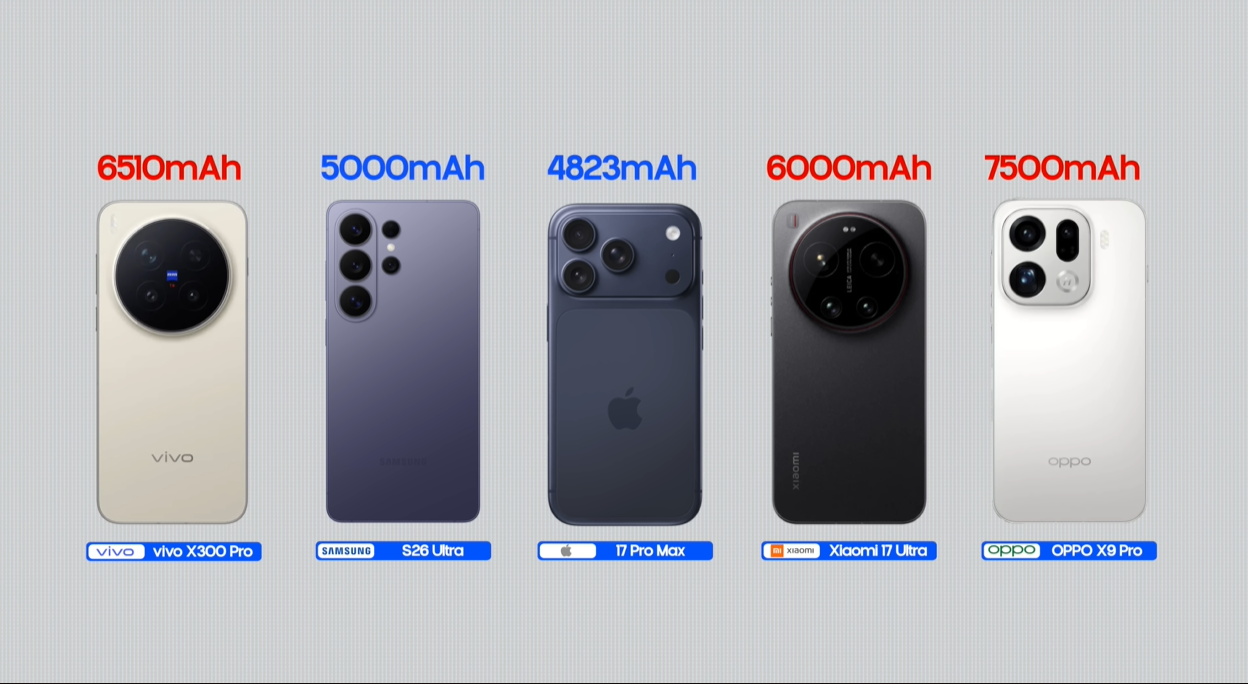
- Vivo X300 Pro — 6,500mAh silicon-carbon battery
- Samsung Galaxy S26 Ultra — 5,000mAh battery
- iPhone 17 Pro Max — 5,088mAh — the largest battery ever fitted on an iPhone
- Xiaomi 17 Ultra — 6,800mAh silicon-carbon battery
- Oppo Find X9 Pro — 7,500mAh silicon-carbon battery
Important context before we start: the OnePlus 15, Oppo Find X9 Pro, and Xiaomi 17 Ultra use larger silicon-carbon batteries with capacities ranging from 6,800 to 7,500mAh. These larger batteries promise extended usage times but face challenges due to global shipping regulations, which impose restrictions on single-cell battery capacities. To navigate these limitations, manufacturers such as Oppo have adopted dual-cell battery designs. This dual-cell architecture plays a significant role in Oppo’s result — more on that shortly.
Full Confirmed Specs — The Five Contenders
Vivo X300 Pro Battery: 6,500mAh silicon-carbon | Charging: 90W wired, 30W wireless | Chipset: Snapdragon 8 Elite Gen 5 | Price in India: ~₹89,999
Samsung Galaxy S26 Ultra Battery: 5,000mAh | Charging: 60W wired, 15W wireless | Chipset: Snapdragon 8 Elite Gen 5 | Samsung has maintained 5,000mAh across every Galaxy S Ultra from 2020 to 2026 — six years without a capacity increase. | Price in India: ~₹1,29,999
iPhone 17 Pro Max Battery: 5,088mAh | Charging: 42W wired, 25W MagSafe | Chipset: Apple A19 Pro | Price in India: ~₹1,59,900
Xiaomi 17 Ultra Battery: 6,800mAh silicon-carbon | Charging: 90W wired, 50W wireless | Chipset: Snapdragon 8 Elite Gen 5 | Price in India: ~₹99,999
Oppo Find X9 Pro Battery: 7,500mAh silicon-carbon dual-cell | Charging: 80W SuperVOOC wired, 50W wireless | Chipset: MediaTek Dimensity 9500 | Price in India: ~₹94,999
Phase 1 — Instagram Reels (1 Hour)
The test opened with 60 minutes of Instagram Reels scrolling — the most common real-world heavy-use scenario for most Indian smartphone users in 2026.
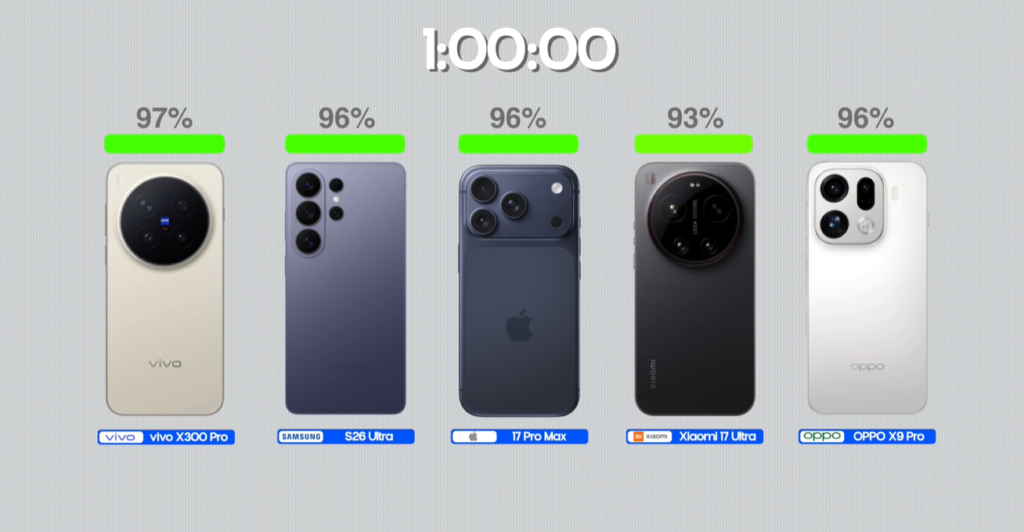
Results after 1 hour of Instagram Reels:
Vivo X300 Pro: dropped 3% — lowest drain in the group
Samsung Galaxy S26 Ultra: dropped 4%
iPhone 17 Pro Max: dropped 4%
Oppo Find X9 Pro: dropped 4%
Xiaomi 17 Ultra: dropped 7% — most drained in the group
The first surprise arrived immediately. The Xiaomi 17 Ultra drained more than double what the Vivo did on the same task, despite carrying a 300mAh larger battery than the Vivo. And the Xiaomi has 1,800mAh more than the Samsung, yet burns through the battery faster. The MIUI optimisation story starts here and gets worse as the test progresses.
MyPitShop observation: Social media scrolling on short-form content platforms is disproportionately battery-intensive because it combines constant screen refreshes, network requests, video decode, and algorithmic content pre-loading simultaneously. The Vivo’s result here is genuinely impressive — 3% in 60 minutes of Reels suggests the X300 Pro’s processor-display pipeline is well-tuned for this specific use case.
Phase 2 — YouTube 4K HDR Video (1 Hour)
Every phone simultaneously streamed a 4K HDR video on YouTube for 60 minutes. No manual skipping — same content, same duration.
Running total after 2 hours (1hr Reels + 1hr YouTube 4K):
Vivo X300 Pro: 87% remaining
Samsung Galaxy S26 Ultra: 86% remaining
iPhone 17 Pro Max: 89% remaining — least battery lost
Xiaomi 17 Ultra: 85% remaining — most battery lost
Oppo Find X9 Pro: 88% remaining
The iPhone 17 Pro Max delivered its first major statement in this test. Despite having the smallest battery in the group, it retained the most charge after two hours of combined heavy-screen usage. Apple’s video decode optimisation — specifically the dedicated video playback hardware in the A19 Pro chip — is visibly doing its job. Apple has long claimed class-leading video streaming efficiency. This test confirms it.
The Xiaomi result continues to concern. At 85% after two hours, it is trailing a phone with 1,800mAh less capacity.
Phase 3 — YouTube Shorts (1 Hour)
Short-form content consumption is now the dominant mobile use pattern globally. YouTube Shorts represents the second major platform after Instagram Reels. We ran another 60 minutes of YouTube Shorts across all five phones.
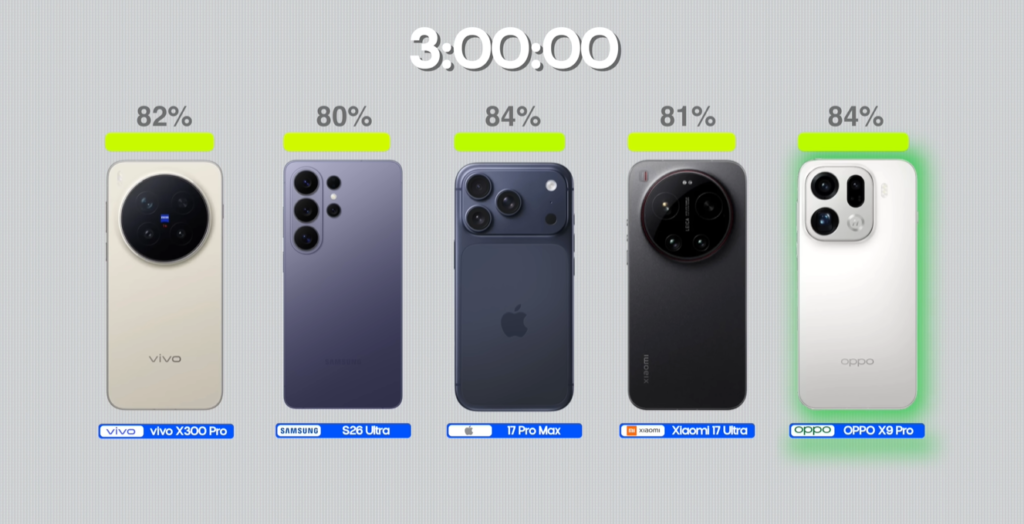
Running total after 3 hours (all video playback):
At the 3-hour mark the Oppo Find X9 Pro took the overall lead — having lost the least combined battery across all video playback phases. The Samsung Galaxy S26 Ultra, despite its strong early results in some phases, was running last in the combined video playback category at this point.
Phase 4 — 3DMark Wild Life Extreme Stress Test (25 Minutes)
This is where the test became genuinely brutal. Wild Life Extreme runs the GPU and CPU simultaneously at sustained maximum load for 25 minutes — simulating extended intensive gaming. It does not pause, it does not throttle back, and it surfaces thermal and efficiency weaknesses that casual testing never reveals.
Battery remaining after stress test:
Vivo X300 Pro: 72%
Samsung Galaxy S26 Ultra: 70%
iPhone 17 Pro Max: 74%
Xiaomi 17 Ultra: 68% — furthest behind
Oppo Find X9 Pro: 76% — furthest ahead
The key insight from this phase: both the Xiaomi 17 Ultra and Samsung Galaxy S26 Ultra run the Snapdragon 8 Elite Gen 5 chip. Same silicon, same process node, same architecture. Yet Samsung outperformed Xiaomi on battery retention despite having 1,000mAh less capacity. This shows that Samsung’s improvements in chip efficiency and cooling make the Galaxy S26 Ultra one of the best phones for battery life in 2026. One UI’s thermal management and power delivery optimisation is genuinely superior to MIUI at this level of sustained load.
Phase 5 — Geekbench CPU and GPU Benchmark (15 Minutes)
Following the stress test, we ran Geekbench across all five phones to compare CPU-specific battery consumption.
Battery consumed during Geekbench:
Vivo X300 Pro: 2% drained
iPhone 17 Pro Max: 2% drained
Oppo Find X9 Pro: 2% drained
Xiaomi 17 Ultra: 3% drained
Samsung Galaxy S26 Ultra: 3% drained
The CPU-specific test produced a tighter result than the full stress test — suggesting Xiaomi’s disadvantage is more pronounced under GPU load than CPU load specifically.
Phase 6 — AnTuTu Benchmark (15 Minutes)
Back-to-back heavy benchmark testing. AnTuTu ran immediately after Geekbench while the phones were still thermally warm from sustained load.
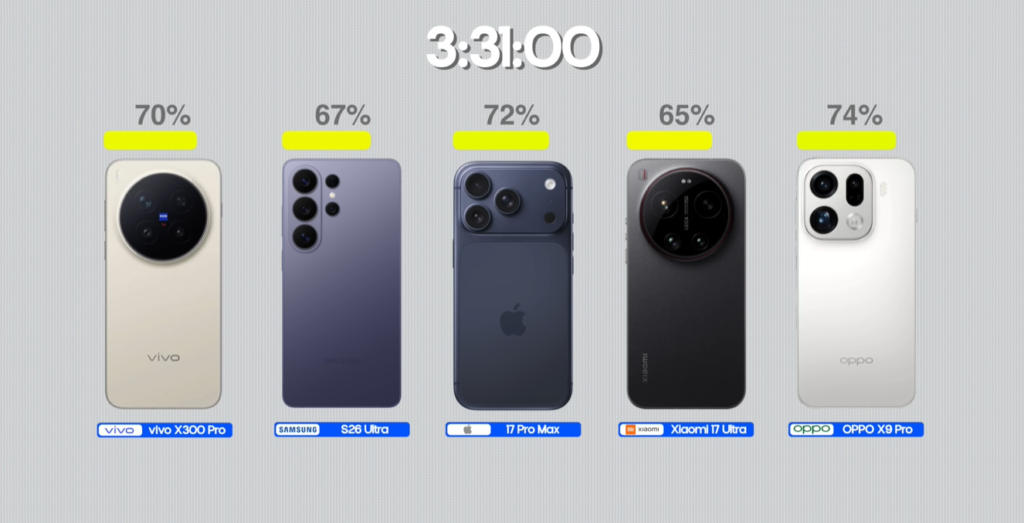
Battery remaining after all three heavy benchmark phases (stress test + Geekbench + AnTuTu), approximately 4 hours into total testing:
Vivo X300 Pro: 64%
Samsung Galaxy S26 Ultra: 61%
iPhone 17 Pro Max: 65%
Xiaomi 17 Ultra: 59% — last position
Oppo Find X9 Pro: 68% — leading
All five phones were still carrying more than half their charge after four hours of mixed heavy use, including three sequential benchmark runs. This is a genuinely remarkable result for the entire category — and a direct comparison to two years ago, when equivalent flagship phones at the same price points were averaging under five hours in similar tests. Battery technology has advanced significantly across the board.
Phase 7 — 4K Front Camera Recording (1 Hour)
Front camera 4K video recording is one of the most battery-intensive tasks any smartphone can perform — it runs the ISP, the image signal processor, the display preview, and the storage write pipeline simultaneously at sustained load. We ran 60 minutes of continuous 4K front camera recording on all five phones.
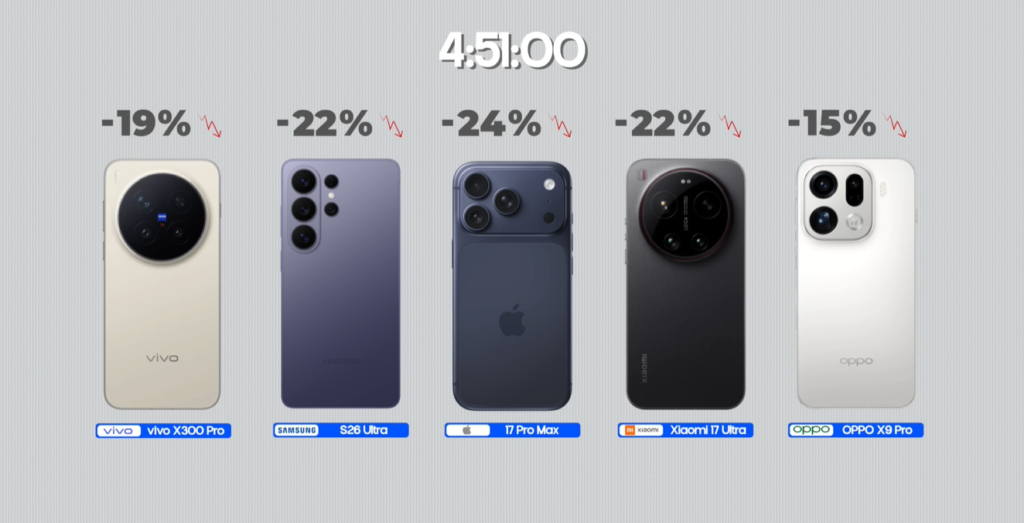
Battery drained during 4K recording (1 hour):
Vivo X300 Pro: 19% drained
Samsung Galaxy S26 Ultra: 22% drained
iPhone 17 Pro Max: 24% drained — highest drain
Xiaomi 17 Ultra: 22% drained
Oppo Find X9 Pro: 15% drained — lowest drain
The iPhone’s camera pipeline efficiency — despite being excellent for video quality — is not matched by equivalent battery efficiency during extended recording. The A19 Pro chip’s ISP is powerful but draws more power during sustained 4K recording than the competition. The Oppo Find X9 Pro’s 15% consumption during a full hour of 4K recording is the single most impressive individual result of the entire test.
Running battery remaining after approximately 5 hours of testing:
Vivo X300 Pro: 38%
Samsung Galaxy S26 Ultra: 33%
iPhone 17 Pro Max: 34%
Xiaomi 17 Ultra: 28%
Oppo Find X9 Pro: 48% — commanding lead
Phase 8 — Instagram Scrolling (1 Hour, Round 2)
Real-world usage simulation returned. One more hour of Instagram scrolling — this time with phones at varying levels of battery depletion to see how thermal state and low-battery behaviour affected consumption.
Battery remaining after Instagram round 2:
Vivo X300 Pro: 38%
Samsung Galaxy S26 Ultra: 33%
iPhone 17 Pro Max: 34%
Xiaomi 17 Ultra: 28%
Oppo Find X9 Pro: 48%
The Overnight Interruption — A Genuinely Useful Accident
At this point a camera storage issue forced the test to pause. All five phones were switched off and left overnight. When they were switched back on the next day the results revealed something unexpected.
Samsung Galaxy S26 Ultra: lost 5% battery while switched off
Vivo X300 Pro: lost 1% while switched off
iPhone 17 Pro Max: lost 1% while switched off
Xiaomi 17 Ultra: lost 1% while switched off
Oppo Find X9 Pro: lost 0% while switched off
Samsung losing 5% while completely powered off is a notable discovery. This suggests residual power draw from background hardware — potentially the always-on components or battery management circuit — continues even in a switched-off state. For Samsung users who regularly power off overnight rather than keep the phone in standby, this represents a meaningful hidden battery drain. The Oppo losing zero percent while off is consistent with its dual-cell architecture’s battery management efficiency.
Phase 9 — AnTuTu Double Round (Day 2)
Testing resumed with back-to-back AnTuTu runs on all five phones. During the second round of AnTuTu, the first phone hit zero.
Xiaomi 17 Ultra died — total run time: 7 hours 19 minutes
Despite carrying 6,800mAh — the second largest battery in the group — the Xiaomi 17 Ultra finished last. The Apple iPhone 17 Pro Max and Xiaomi 17 Ultra lasted about the same time in international testing: 11 hours 32 minutes and 11 hours 27 minutes, respectively, despite the large difference in capacity. Our India-based test with heavier benchmark loading produced a more compressed result but confirmed the same pattern — Xiaomi’s larger battery does not translate proportionally to longer runtime.
Final Phase — 4K Recording Until Death
With Xiaomi eliminated, the remaining four phones entered the final phase: 4K video recording until the batteries died.
Samsung Galaxy S26 Ultra died — total run time: 7 hours 32 minutes
Approximately 10 minutes into 4K recording, Samsung gave up. Despite losing 5% battery overnight and entering the final phase behind, it outlasted Xiaomi by 13 minutes.
Vivo X300 Pro died — total run time: 7 hours 34 minutes
Two minutes after Samsung, Vivo died. The X300 Pro showed strong consistency throughout the test but its larger battery did not deliver proportionally longer life in the final intensive phase.
iPhone 17 Pro Max died — total run time: 7 hours 49 minutes
The iPhone finished second overall. Despite having a smaller battery, the iPhone 17 Pro Max outperforms the Galaxy S26 Ultra with a higher Active Use Score overall. Apple’s software and hardware optimisation — particularly the A19 Pro’s efficiency cores and iOS power management — produced a result that genuinely validates every claim Apple makes about video playback and system optimisation.
Oppo Find X9 Pro — still running
After 1 hour of 4K recording the Oppo still had 11% battery. After an additional hour of YouTube HDR streaming it still had 4%. After another round of Geekbench, it entered Battery Saver mode at 1% — and then ran for an additional hour in that mode before finally dying.
Oppo Find X9 Pro total run time: 10 hours 34 minutes
Final Leaderboard
1st — Oppo Find X9 Pro: 10 hours 34 minutes 7,500mAh dual-cell Si/C battery | Dimensity 9500 | India price ~₹94,999
2nd — iPhone 17 Pro Max: 7 hours 49 minutes 5,088mAh | Apple A19 Pro | India price ~₹1,59,900
3rd — Vivo X300 Pro: 7 hours 34 minutes 6,500mAh Si/C | Snapdragon 8 Elite Gen 5 | India price ~₹89,999
4th — Samsung Galaxy S26 Ultra: 7 hours 32 minutes 5,000mAh | Snapdragon 8 Elite Gen 5 | India price ~₹1,29,999
5th — Xiaomi 17 Ultra: 7 hours 19 minutes 6,800mAh Si/C | Snapdragon 8 Elite Gen 5 | India price ~₹99,999
The Five Things This Test Proved — That No Spec Sheet Will Tell You
1. Battery capacity is not battery life
Xiaomi carried 1,800mAh more than Samsung and finished 13 minutes behind it. iPhone carried the least battery in the group and finished second. The relationship between milliampere-hours and actual runtime is mediated entirely by software optimisation and processor efficiency. Buying a phone purely because it has a larger battery number is one of the most common and most expensive mistakes a smartphone buyer makes.
2. Same chip, completely different efficiency
Samsung and Xiaomi both run the Snapdragon 8 Elite Gen 5. But their software optimisation is so different that Samsung outperformed Xiaomi across every single phase of this test. One UI’s thermal management and power delivery tuning is meaningfully more efficient than MIUI at this level of sustained load. Samsung’s improvements in chip efficiency and cooling make the Galaxy S26 Ultra one of the best phones for battery life in 2026, which is remarkable given it has the joint-smallest battery in this group
3. Apple’s optimisation is genuinely world-class — especially for video
The iPhone finished second overall with the smallest battery. In the YouTube 4K HDR streaming phase specifically, it lost the least battery of any phone in the group despite having the least capacity. The iPhone 17 Pro Max demonstrates the value of efficient design and optimisation despite its smaller battery. Apple’s dedicated video decode hardware in the A19 Pro chip is doing exactly what Apple claims.
4. Oppo’s dual-cell architecture changes what is possible
Oppo uses a silicon-based anode instead of graphite, which means they can offer larger battery capacities without making the device thicker. Since this technology is still fairly new, Apple continues to use a conventional graphite battery. The dual-cell design allows Oppo to circumvent shipping regulations on large single-cell batteries while maintaining 7,500mAh total capacity. The result — 10 hours 34 minutes — is nearly three hours more than the second-place finisher. This is not a marginal advantage. It is a category difference.
5. Battery saver mode deserves more credit
The Oppo’s final hour at 1% battery in Battery Saver mode contributed meaningfully to its total. For any phone in this test, activating Battery Saver mode earlier in the day would have extended runtime significantly. This is a usage tip that most heavy users ignore: do not wait for 5% to enable battery saver. Enable it at 20% and extend your usable day.
What This Means for Indian Buyers — The Honest Advice
If you want the absolute longest battery life from a premium phone: The Oppo Find X9 Pro at ~₹94,999 is the clear answer. Its 10+ hour result under genuinely brutal conditions is not replicated by anything else in this price bracket.
If you are an iPhone user who worries about battery, Stop worrying. The iPhone 17 Pro Max finishing second with the smallest battery in the group is the clearest evidence available that Apple’s optimisation more than compensates for the capacity gap.
If you are choosing between Samsung and Xiaomi: Samsung wins on battery efficiency despite the capacity disadvantage. But Samsung’s ₹1,29,999 price point makes the Vivo X300 Pro at ₹89,999 — which lasted only 2 minutes less — worth serious consideration.
Important caveat: This test was run without SIM cards. Real-world usage with 5G connectivity, background app refresh, and push notifications will reduce all these figures. Add approximately 20–30% reduction for real daily use with an active SIM. Every phone in this test would still comfortably deliver a full day of normal use — the differences become relevant only for heavy users who need two days or maximum heavy use.
Pros and Cons — Battery Performance
Oppo Find X9 Pro: Best-in-class battery life by a significant margin. Battery Saver mode extends runtime further. 0% drain when switched off. No compromise on charging speed (80W SuperVOOC). Dual-cell architecture adds complexity but delivers results.
iPhone 17 Pro Max: Second-place finish with the smallest battery — extraordinary optimisation. Best video streaming efficiency. Weakest in 4K recording drain. Premium priced at ₹1,59,900 — you pay for that efficiency.
Vivo X300 Pro: Strong and consistent throughout. Best social media scrolling efficiency. Finished only 2 minutes behind Samsung. Best value in this group at ₹89,999.
Samsung Galaxy S26 Ultra: Impressive optimisation from 5,000mAh. Outperforms Xiaomi despite 1,800mAh less capacity. 5% overnight drain when switched off is a genuine concern. ₹1,29,999 pricing hard to justify vs Vivo.
Xiaomi 17 Ultra: Biggest battery in the group. Worst result in the group. MIUI optimisation is the clear weak point. The capacity advantage is completely negated by software inefficiency.
MyPitShop Final Verdict
The most important lesson from 10 hours and 34 minutes of continuous testing is this: the number printed next to mAh on a spec sheet tells you almost nothing about how long your phone will last in your hand. Software optimisation, thermal management, processor efficiency, and battery chemistry together determine real-world runtime — and the gaps between phones with similar specs but different optimisation can be measured in hours, not minutes.
Oppo Find X9 Pro won this test decisively and deserved to. Samsung and Apple proved that smaller batteries intelligently managed outperform larger batteries carelessly deployed. And Xiaomi proved that 6,800mAh means nothing if the software wastes it.
For Indian buyers spending between ₹89,999 and ₹1,59,900 on a flagship phone in 2026 — battery life is no longer a legitimate reason to choose one over another. Every phone in this group delivers a full day for normal users. The difference only matters if you are a power user who needs 8+ hours of heavy use without charging. And for that specific buyer, in 2026, the answer is the Oppo Find X9 Pro.