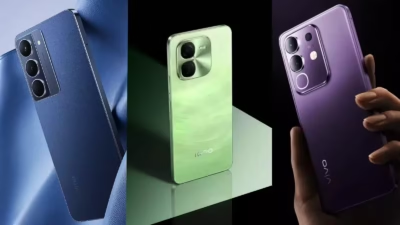
Quick Verdict: Samsung has split its foldable lineup into two distinct designs this generation. The Z Fold 8 Ultra keeps the familiar tall, narrow foldable shape refined from the Fold 7, while the standard Z Fold 8 switches to a new squat, wide form factor closer to Google’s original Pixel Fold. Beyond design, the Ultra gets a better camera system and a slightly larger battery, while the regular Fold 8 is lighter, cheaper, and arguably more comfortable for one-handed typing and reading.
Samsung Z Fold 8 vs Z Fold 8 Ultra: Quick Comparison Table
| Spec | Galaxy Z Fold 8 | Galaxy Z Fold 8 Ultra |
|---|---|---|
| Design | Squat, wide (Pixel Fold-style) | Tall, narrow (familiar Fold shape) |
| Cover screen | 5.5″ (10:6 aspect ratio) | 6.5″ (narrow) |
| Internal screen | 7.6″ (4:3 aspect ratio) | ~8″ (near-square) |
| Thickness (unfolded) | 4.5mm | 4.1mm |
| Weight | 201g | Heavier, but not bulky for its size |
| Chipset | Snapdragon 8 Elite Gen 5 for Galaxy | Snapdragon 8 Elite Gen 5 for Galaxy |
| Battery | 4,800mAh (silicon-carbon) | 5,000mAh (silicon-carbon) |
| Main camera | 50MP sensor | 200MP HP2 sensor |
| Ultra-wide camera | 50MP | 50MP |
| Telephoto camera | None | 10MP |
| Charging | 45W wired / 25W wireless | 45W wired / 25W wireless |
| Starting price (UK) | £1,699 | £1,899 |
(Both models are also available in higher-tier configurations up to 1TB storage and 16GB RAM.)
Design: A Genuinely Different Approach This Year
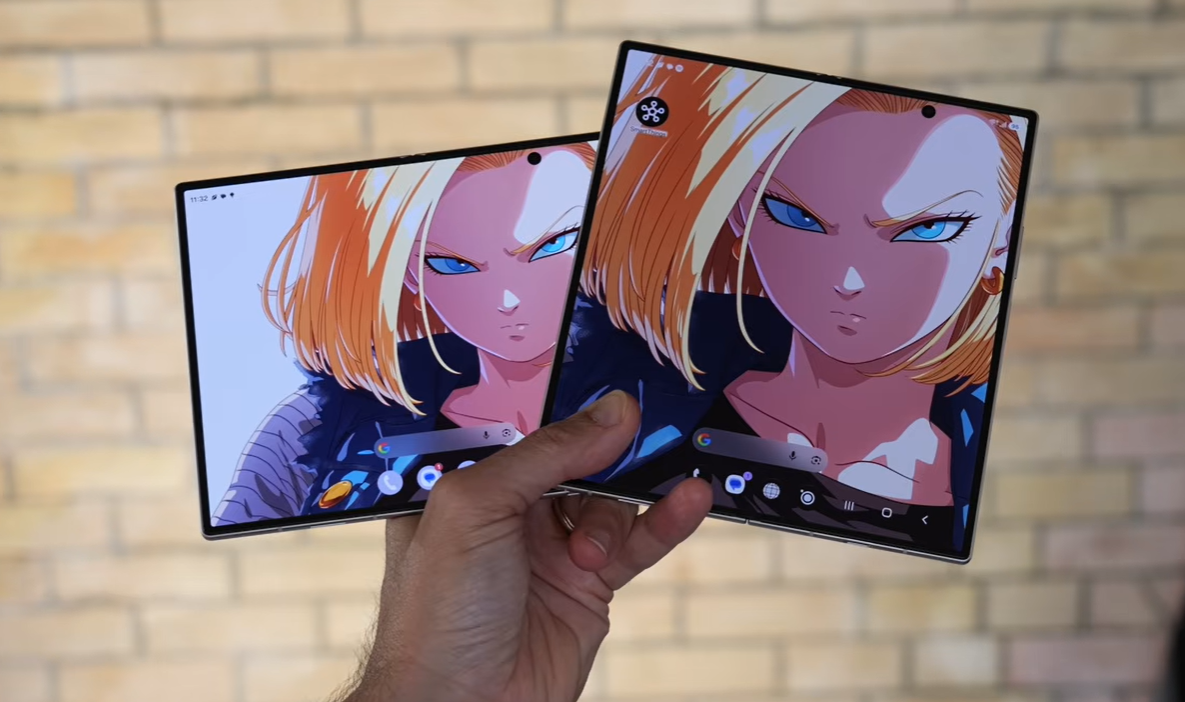
The clearest difference between the two phones is that Samsung isn’t just offering a bigger/smaller version of the same design — it’s offering two different foldable shapes entirely.
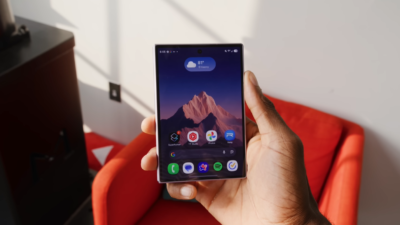
The Z Fold 8 Ultra carries over the tall, narrow form factor familiar from the Fold 7, with a 6.5-inch cover screen that opens into an almost perfectly square 8-inch internal display.
The standard Z Fold 8 switches things up with a new squat, wide design — a smaller 5.5-inch cover screen with a 10:6 aspect ratio, opening into a 7.6-inch internal display with a 4:3 aspect ratio, similar in spirit to Google’s original Pixel Fold.
Despite the design difference, both phones are similarly thin when unfolded (4.1mm for the Ultra, 4.5mm for the standard model, excluding the camera housing), and the standard Fold 8 is notably lighter at 201g — close to flip-style foldable weights despite its larger size. Both phones ship in a matte glass and metal frame finish, with the Ultra offered in violet shadow, cream, black, and green shadow, and the standard model in lavender, cream, black, and pistachio.
Both models also get an upgraded hinge that feels easier to open and close than previous generations, along with Samsung’s new “Flex Titanium” reinforcement beneath the internal display — a titanium plate and titanium alloy film roughly a third the thickness of a human hair, claimed to be around 20 times stiffer than the standard plastic protective film used previously.
Which Cover Screen Is Better for Everyday Use?
This is where the design split really shows its trade-offs:
- The standard Z Fold 8’s wider 5.5-inch cover screen is noticeably more comfortable for typing, since the on-screen keyboard has more horizontal room to work with. It’s also better suited for web browsing and reading, though smaller text can be harder to read comfortably on the compact display.
- The Ultra’s narrower, taller cover screen is a better fit for one specific thing: watching video. Its aspect ratio suits movies and widescreen content far better than the standard Fold 8, which suffers from heavy letterboxing or cropping when watching films on either screen.
For general reading and comic/manga-style content, the internal displays on both phones work best in portrait mode, while landscape orientation is better suited to running two apps side by side.
Display Technology
Both phones use Dynamic AMOLED panels inside and out, described as vivid and punchy, with an anti-reflective coating on the internal displays — though glare is still noticeable on both under certain lighting. Peak brightness reaches 3,000 nits on both models, aided by Samsung’s Vision Booster feature for outdoor visibility.
The crease down the center of the internal display is only really visible under glare when the phone is tilted at certain angles, and running a finger across the fold reveals only a minimal bump — comparable to what’s found on recent foldables from Oppo and Honor.
Performance: No Difference Here
Both the Z Fold 8 and Z Fold 8 Ultra use the same Snapdragon 8 Elite Gen 5 for Galaxy chipset — the same silicon found in the Galaxy S26 Ultra, and one of the most powerful mobile platforms available in 2026. Multitasking and general responsiveness should be strong on both, and demanding titles like Wuthering Waves are expected to run well even at maximum graphics settings, assuming Samsung’s cooling solution holds up under sustained load (full performance testing pending in-depth reviews).
Battery Life: Both Get a Meaningful Upgrade
Battery capacity was a notable weak point on the Z Fold 7, which shipped with just 4,400mAh — often forcing power-saving mode by evening on heavier use days. Both new models address this directly:
- Z Fold 8 Ultra: 5,000mAh (silicon-carbon battery tech)
- Z Fold 8 (standard): 4,800mAh (silicon-carbon battery tech)
Neither figure matches the largest batteries found in rival foldables from Oppo’s Find N series or Honor’s Magic series, but both represent a real step up from the Fold 7 and should meaningfully improve all-day battery life — full verification pending hands-on testing. Charging remains at 45W wired and 25W wireless on both models.
Software: Identical Across Both Phones
There’s no meaningful software difference between the two. Both run the latest One UI with Samsung’s current AI feature set, including:
- Now Nudge — contextual notification nudges, requiring Samsung’s own keyboard and apps to function (previously limited in usefulness on the Galaxy S26 series, reportedly improved here)
- Gemini integration — more capable in supported regions, including automating tasks like hotel bookings (not yet available in all markets)
- Call screening — a carryover feature from the Galaxy S26 series, letting users screen out spam calls automatically
Camera: The Biggest Real-World Difference
This is where the two phones diverge most significantly:
- Z Fold 8 Ultra: 200MP HP2 main sensor (carried over from the Fold 7), 50MP ultra-wide, and a 10MP telephoto lens
- Z Fold 8 (standard): 50MP main sensor (unspecified origin), 50MP ultra-wide, no telephoto lens
The absence of a telephoto lens on the standard Fold 8 is a notable omission, especially since most competing full-sized foldables include one. A higher-resolution main sensor on the standard model (even without a dedicated telephoto) could have partially offset this through digital cropping, but Samsung didn’t carry that over either.
Both phones support up to 8K video recording, or 4K at 60fps with HDR, along with Samsung’s Pro Visual Engine processing for improved night video and horizontal lock stabilization — effectively the same video feature set found on the Galaxy S26 flagships.
Samsung Z Fold 8 vs Z Fold 8 Ultra: Which Should You Buy?
- Choose the standard Z Fold 8 if you want a lighter, more pocketable foldable with a genuinely more usable cover screen for typing and reading, and don’t mind giving up the telephoto lens.
- Choose the Z Fold 8 Ultra if camera versatility matters to you, you frequently watch video content on the cover screen, or you simply prefer the familiar tall foldable shape Samsung has used since the original Fold.
Both phones address the previous generation’s most common complaint — battery life — and neither compromises on performance, since they share the same flagship chipset.
The primary difference is design: the standard Z Fold 8 uses a new squat, wide form factor, while the Ultra keeps the familiar tall, narrow foldable shape. The Ultra also gets a 200MP main camera and telephoto lens that the standard model lacks.
No. Only the Z Fold 8 Ultra includes a telephoto lens; the standard Z Fold 8 has just a main and ultra-wide camera.
The Z Fold 8 Ultra has a slightly larger 5,000mAh battery compared to the standard model’s 4,800mAh, though both use silicon-carbon battery technology and represent a notable upgrade over the Z Fold 7’s 4,400mAh cell.
No, both phones use the identical Snapdragon 8 Elite Gen 5 for Galaxy chipset — the same one found in the Galaxy S26 Ultra
Which design are you leaning toward — the new compact Z Fold 8 or the familiar Z Fold 8 Ultra shape? Let us know in the comments below.