By Reo R | My PitShop | May 2026 | Foldable Phone Review
Introduction
At $1,900, the Samsung Galaxy Z Fold 8 is not a small purchase. That’s the kind of money that could get you a real passport and a round-trip flight to another continent. So before you drop nearly two grand on Samsung’s latest and greatest foldable, there’s one question that matters more than any spec sheet: how tough is it, really?
We put the Galaxy Z Fold 8 through a full durability test — scratch tests, burn tests, bend tests — to find out if the titanium screen claim is real, how the new hinge holds up against dust, and whether this phone actually survives daily life. Here’s everything we found.
First Impressions — Why Everyone Loves This Form Factor
The Z Fold 8 immediately makes a strong case for itself the moment you pick it up. At 5.5 inches on the cover screen, this is genuinely the sweet spot for a foldable cover display — wide enough to be useful, compact enough to be pocketable.
Samsung is calling this their lightest Fold ever, and it shows in hand. The passport-style form factor feels premium, dense, and well-balanced.
What’s in the Box
- Samsung Galaxy Z Fold 8
- SIM card ejector tool
- USB-C charging cable
No charger. No case. For a $1,900 phone, the box contents are minimal — which is worth noting upfront.
The Titanium Screen Claim — Let’s Be Honest About This
Samsung has made a big deal about the titanium substrate under the inner foldable display on the Z Fold 8. And yes, there is a titanium layer underneath the pixels.
But here’s the truth: it doesn’t change the most important part.
The permanent plastic layer on top of the inner display is still plastic. That means the inner screen still scratches at a level 2 on the Mohs hardness scale — the same as every previous generation of Samsung foldable. Coins, keys, and fingernails can all leave marks.
The titanium underneath may help with structural rigidity and crease visibility, but it doesn’t protect the surface you’re actually touching every day. Samsung’s own warning label — still present on the Fold 8 — confirms this:
- Do not press the inner screen with your fingernails
- Do not fold the phone with anything inside
- The phone is not dust resistant
- Do not immerse in salt water
- Do not remove the inner protective screen layer
- Keep away from implanted medical devices
Eight generations in, and the inner screen warnings remain essentially unchanged. That’s the honest reality of flexible display technology in 2026.
Scratch Test Results
Outer Cover Screen
The exterior 5.5-inch display is made with Corning Gorilla Glass Ceramic 3 — the same glass used on the Motorola Razr Fold’s cover screen.
- Scratches at level 6 on the Mohs scale
- Deeper grooves at level 7
This is solid protection for a cover glass. Normal daily carry in a pocket with coins and keys will not damage this screen.
Inner Foldable Display
- Scratches at level 2 — fingernail-level hardness
- Damaged by coins, keys, and sharp objects
- The titanium substrate underneath does not prevent surface scratches
Samsung does offer one free inner screen protector replacement within the first 12 months, and subsequent plastic layer replacements cost just $19. So while the scratches look alarming, they’re financially manageable — but protection from day one is still the smart move.
Frame
The outer frame is armor aluminum — not titanium, despite the titanium buzzword used in marketing. The fingerprint scanner power button is fixed in place, but the volume rocker is removable — typical Samsung construction.
Camera Area
One notable finding: the camera plateau on the back of the Z Fold 8 is made from plastic — a first for Samsung on a Fold device. Previous generations used metal here. The camera lens rings are still metal and can be levered off relatively easily, which is actually useful for lens replacements but raises minor concerns about long-term dust sealing around the optical image stabilisation unit.
The back panel itself is still glass.
Dust Resistance Test
The Z Fold 8 carries an IP48 rating — protected against dust intrusion and water immersion. The SIM card tray has a rubber gasket ring to assist with the water resistance seal.
In the dust test, the hinge performed well — keeping out fine particulate matter just as effectively as last year’s Fold 7. Metallic dust particles were visible collecting on the corner magnets, confirming the magnetic hinge closure system is doing its job.
The dust protection is not perfect — Samsung explicitly states the phone is not fully dust resistant — but in real-world testing, the hinge is holding up well against the kind of dirt and lint you’d encounter in daily life.
Display Specs — Inner and Outer
| Screen | Size | Resolution | Refresh Rate | Brightness |
|---|---|---|---|---|
| Inner Foldable | 7.6 inches | — | 120Hz | 3,000 nits peak |
| Outer Cover | 5.5 inches | 428 PPI | 120Hz | — |
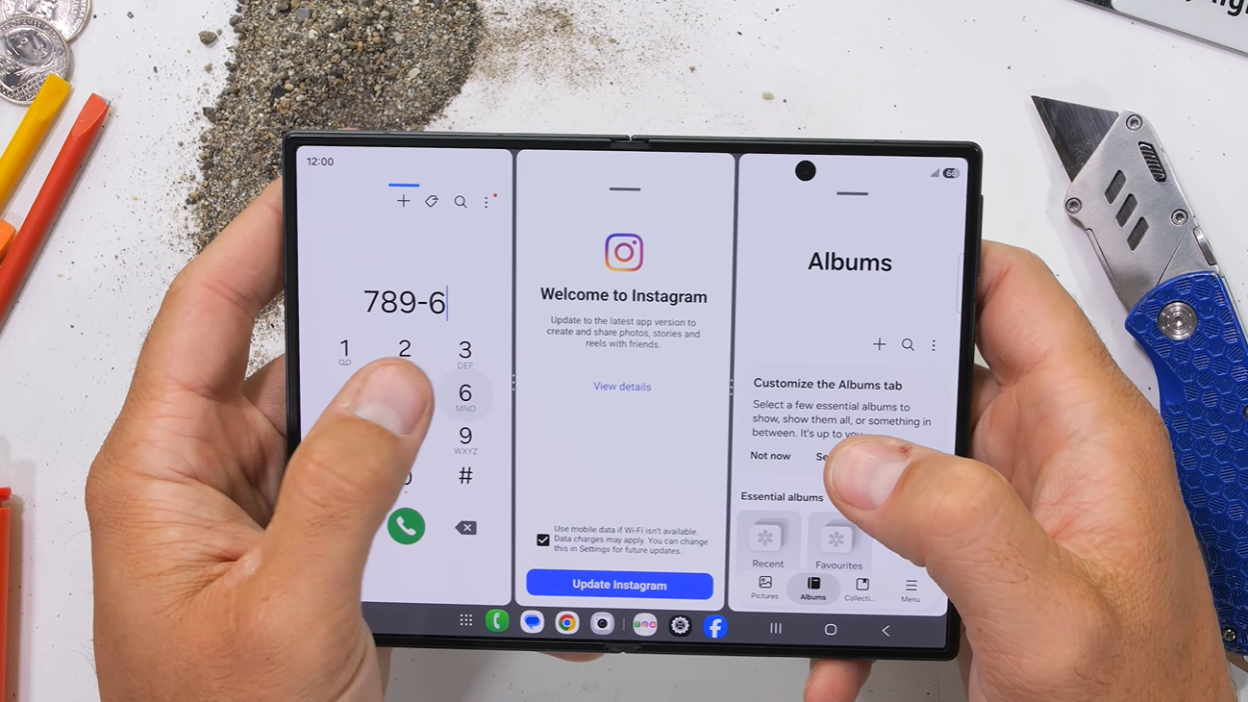
The 3,000 nits peak brightness on the inner display is impressive — outdoor visibility should be excellent. The 7.66-inch inner screen also supports running up to three apps simultaneously side by side, making the multitasking experience genuinely laptop-adjacent.
The inner selfie camera is a hole-punch design at 10MP — not the hidden under-display camera seen on Fold 3 through 6. The outer selfie camera is also 10MP, glass-protected, and not hidden.
Hinge — Wider, Thinner, Flatter
Samsung has redesigned the Z Fold 8 hinge to be:
- Wider — more stable when open
- Thinner — reduces overall device thickness
- Flatter — makes the crease less visible
Combined with the titanium substructure, the crease on the Z Fold 8 is reportedly less noticeable than previous generations. In testing, the hinge felt solid throughout its range of motion and showed no signs of wobble or play.
The phone has also been lab-tested to 500,000 folds — which at 200 screen checks per day (the average for Americans) theoretically translates to about a decade of use.
One Impressive Upgrade Nobody Is Talking About — The Fingerprint Scanner
This deserves its own section because it’s genuinely excellent.
The Z Fold 8 uses a new fingerprint scanning method on the power button. Instead of a static tap, you roll your finger around the button to register your fingerprint during setup. The result? The fastest fingerprint response time of any phone tested — even under heavy abuse to the button itself. Instant. Every time.
It’s a small change with a massive daily impact. Thumbs up from us.
Burn Test
Inner Display
The 7.66-inch titanium flex display started permanently burning after approximately 7 seconds from a lighter flame. The titanium substrate did not meaningfully improve heat resistance at the surface level.
Outer Display
The exterior 5.5-inch glass display lasted slightly longer — approximately 10 seconds — before going permanently black and green without recovering. The glass layer distributes heat better than the plastic inner screen, which explains the marginal difference.
Neither screen recovers from direct flame exposure. Don’t put your phone near open flames. (Obviously.)
The Bend Test — The Moment of Truth
This is where Samsung’s engineering really proves itself.
Closed Position
When folded shut, the Z Fold 8 has virtually no flex — front or back. This is a meaningful real-world benefit. It means the phone can survive being sat on in your back pocket while closed without any structural concern. Pocket-safe when closed.
Open Position
When fully open and subjected to the bend test:
- Substantial rearward flex was recorded
- No cracks at the antenna lines — unlike the Pixel Fold which failed here
- No screen popping out — unlike Motorola’s folding phone which suffered this
- The glass back panel separated from the body before any damage reached the inner screen — acting almost like a sacrificial layer
The Z Fold 8 survived the full bend test. No structural failure. No screen damage.
Samsung’s foldable engineering continues to be best-in-class. Whatever material and construction techniques they’re using in those hinge assemblies, it works. The Z Fold 8 joins every previous Samsung Fold (excluding the tri-fold, which was an anomaly) in passing a full durability test intact.
Charging & Ports
- 45W USB-C 3.2 port at the bottom
- No expandable memory via microSD
- No wireless charging spec mentioned in this test (check full spec sheet)
- Two noise-cancelling microphones on the top edge
- Stereo speakers — one on top edge, one on bottom edge
45W wired charging on a $1,900 phone feels a little conservative in 2026, but it’s functional.
Should You Use a Screen Protector?
Yes. Absolutely. From day one.
Given the inner screen scratches at a level 2 hardness, any real-world debris in your pocket — even dust particles — can potentially leave marks over time. A quality glass screen protector applied immediately after purchase is the single best investment you can make for long-term screen health.
Samsung offers one free replacement of the inner screen layer within the first 12 months. After that, replacements cost $19 — reasonable for a phone this expensive.
Pros & Cons — Durability Perspective
What’s Strong:
- Gorilla Glass Ceramic 3 on cover screen — excellent scratch resistance
- Survived full bend test without structural failure
- New wider, flatter hinge — reduced crease visibility
- IP48 rating — good real-world water and dust protection
- Fastest fingerprint scanner ever tested — genuinely impressive
- Glass back acts as sacrificial layer protecting inner screen
- 500,000 fold lab certification
- 3,000 nits peak inner display brightness
What to Watch:
- Inner screen still scratches at level 2 — same as all previous folds
- Titanium substrate does not protect the plastic surface layer
- Camera plateau is now plastic — first time for Samsung on a Fold
- Frame is armor aluminum, not titanium — marketing vs. reality
- Burn resistance is average
- No dust resistance warranty despite IP48 rating
- No charger or case included at $1,900
Final Verdict
The Samsung Galaxy Z Fold 8 is a durability success story — with one honest caveat. Samsung’s marketing around “titanium screen” needs to be taken with context. Yes, there is titanium in the structure. No, it does not make the surface of the inner screen more scratch resistant. The plastic layer on top remains plastic, and that’s a fundamental limitation of flexible display technology, not just a Samsung problem.
That said, structurally? The Z Fold 8 is remarkable. It survived a full bend test. The hinge handles dust as well as ever. The cover screen is properly tough. And the new fingerprint scanner is the best in the business right now.
For $1,900, you’re getting a polished, refined, genuinely durable foldable from a brand that has been perfecting this form factor for eight generations. Just buy a screen protector on day one. Non-negotiable.
My PitShop Durability Rating: 8.5 / 10
Impressive engineering. Honest limitations. Still the benchmark for book-style foldables.