Quick Verdict: Samsung heavily marketed a titanium layer reinforcing the Z Fold 8’s inner display, but a full teardown found the panel scratched more easily than expected during durability testing before the phone was even opened up. Once inside, a heat-based oxidation test confirmed the material genuinely does discolor the way real titanium does — so it’s authentic — but Samsung’s claimed “honeycomb hollow” micro-pattern wasn’t visible, and the phone doesn’t survive the disassembly process intact. Here’s everything the teardown revealed, from the hinge engineering to the battery chemistry to what it actually costs to fix if you break it.
Why Question the Titanium Claim at All?
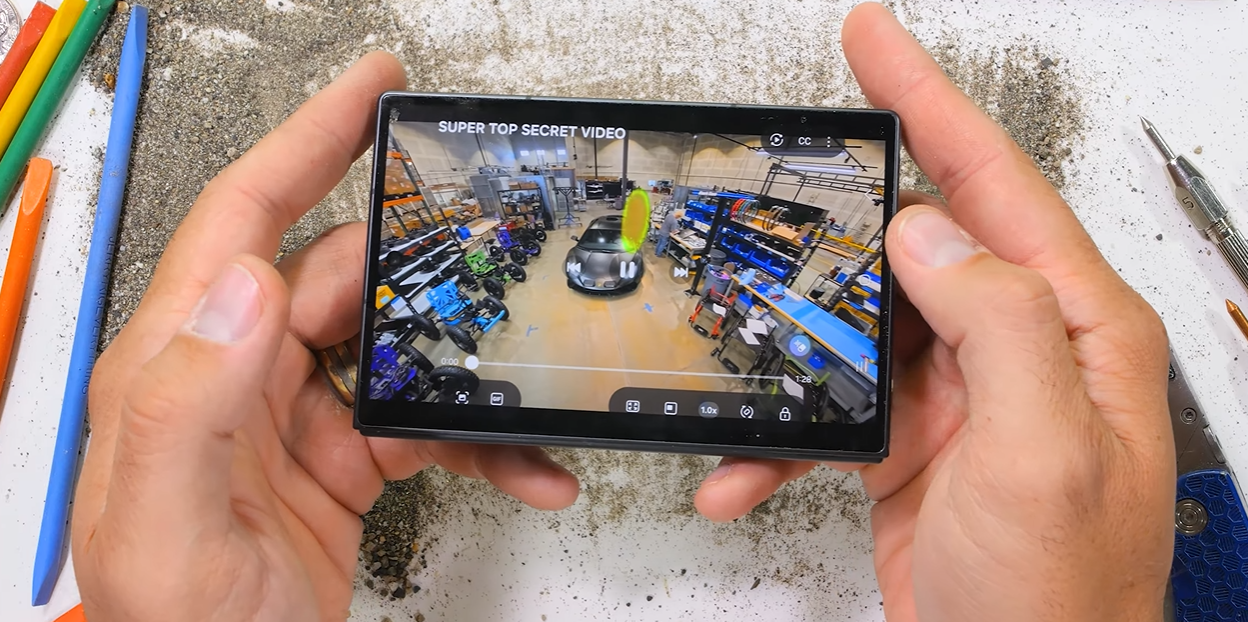
Before any disassembly began, a standard scratch-resistance test raised the first red flag: the display scratched at a level two on the standard hardness pick test, with deeper grooves appearing at a level three — a result that felt inconsistent with Samsung’s marketing around a reinforced titanium layer protecting the panel. That discrepancy is what prompted a full teardown to check whether the titanium claims held up.
Getting In: A Genuinely Difficult, Expensive Mistake to Make
Removing the outer cover screen in one piece proved essentially impossible. That’s a meaningful real-world detail: Samsung prices an out-of-pocket outer screen replacement at $579 in the US — roughly in line with buying a new mid-range smartphone outright.
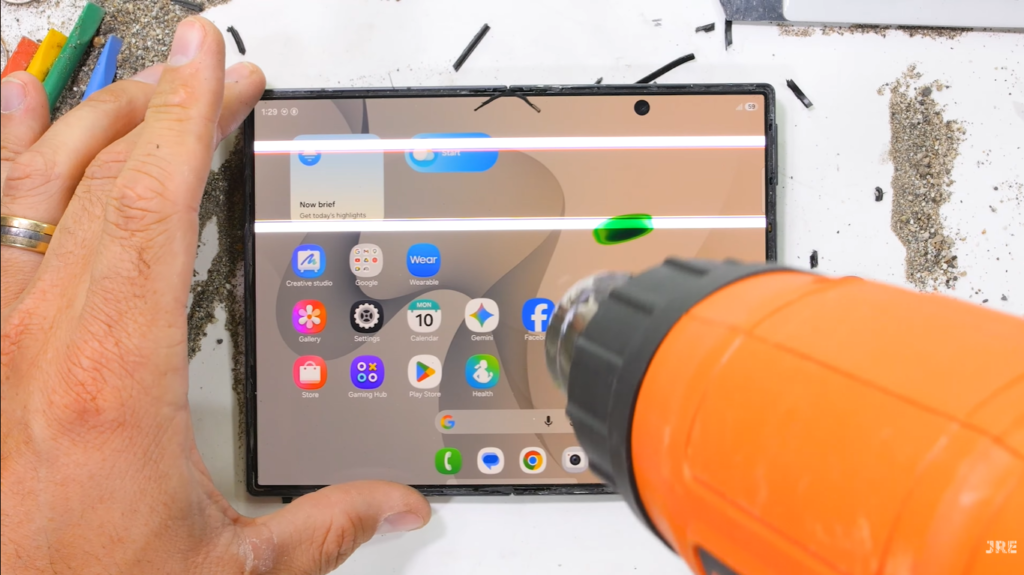
The plastic border framing the flexible 7.6-inch inner display is both what secures the screen to its foam backing and what provides the phone’s water and dust resistance. It’s firmly glued down, requiring careful blade work to remove — and even minor contact with the screen’s edge during that process killed an entire line of display pixels, a costly and easy mistake to make on this particular design.
Once removed, isopropyl alcohol was used to soften the adhesive holding the display’s back layer in place, while bending the flexible screen along only one plane at a time to avoid cracking it further. Unfortunately, since this specific model hadn’t been torn down before, the display’s ribbon cable — routed unexpectedly along the left edge rather than a more typical position — was accidentally torn off entirely during this step, ending the phone’s functionality for the rest of the teardown.
What’s Actually Under the Screen
With the top layers removed, the internal metal structure supporting the display became visible. Layer by layer, from the top down:
- Permanent screen protector — the outer layer, replaceable only by Samsung, at roughly $20
- Top plastic display layer — removing this exposes the OLED material to open air, which effectively kills it
- Ultra-thin glass (UTG) — visible cracking appeared in this layer once exposed
- The titanium backing — still firmly adhered to the OLED panel itself, not designed to be separated
Notably, Samsung’s Unpacked presentation had described a “honeycomb hollow” micro-pattern within this titanium layer — something that wasn’t visible on close inspection here, raising the possibility that this specific structural detail may be exclusive to the higher-tier Z Fold 8 Ultra model rather than the standard Z Fold 8.
The Titanium Verification Test
Since the honeycomb pattern wasn’t visually confirmable, a different method was used to verify the material itself: applying concentrated heat to the panel and comparing the resulting discoloration pattern against a known grade-5 titanium reference plate. Genuine titanium develops a distinctive, colorful oxidation gradient when heated — and the Z Fold 8’s panel produced that same characteristic discoloration, confirming the material is authentic titanium, even without the visible micro-patterning Samsung described.
Front Screen and Repair Costs
The phone’s front (cover) display didn’t survive the process either — in this case, the front screen was also non-functional by this stage, unlike some past foldable teardowns where one of the two screens sometimes remained operational. Samsung prices a standalone cover-screen replacement in the US at $138.
A note for Indian buyers: these figures are US out-of-pocket repair pricing. Samsung India’s historical out-of-warranty foldable screen repair costs have varied significantly by model — inner display replacements on past Z Fold generations have run anywhere from roughly ₹28,000 to ₹70,000 depending on the specific model and part complexity, according to third-party and community repair pricing data, with official Samsung India Care+ protection plans (covering accidental damage, including screens) available as an alternative to paying for repairs out of pocket. Exact Z Fold 8 repair pricing for India hadn’t been independently confirmed at the time of this teardown — check Samsung India’s official site or an authorized service center for current figures before assuming cost parity with the US pricing above.
Battery: Confirmed Silicon-Carbon, But Samsung Isn’t Shouting About It
Getting to the batteries required removing the glass back panel (a similar heat-and-pry process to the front screen) and navigating a genuinely dense internal layout — 40 screws just to clear the initial internal components.
Two separate battery cells were found:
- Battery 1: 2,393mAh
- Battery 2: 2,267mAh
- Combined rated total: 4,660mAh (Samsung’s advertised “typical” capacity is 4,800mAh)
Samsung has replaced some of the battery’s internal graphite with silicon, which increases how many lithium ions the cell can store in the same physical space — a genuine capacity improvement. Despite the “silicon carbon” branding Samsung used around this technology, the actual battery cells found during teardown don’t reference silicon carbon materials on their labeling in English — a minor inconsistency between marketing language and what’s printed on the component itself, though this doesn’t call into question whether the technology is present.
Wireless Charging and Speaker Engineering
The wireless charging coil sits in the bottom-left quadrant of the phone when opened — notably lower than expected. It supports 20W wireless charging, a genuine upgrade over the 15W cap that every prior generation of Samsung foldable had been limited to, and can reverse-wireless-charge accessories like earbuds at 4.5W.
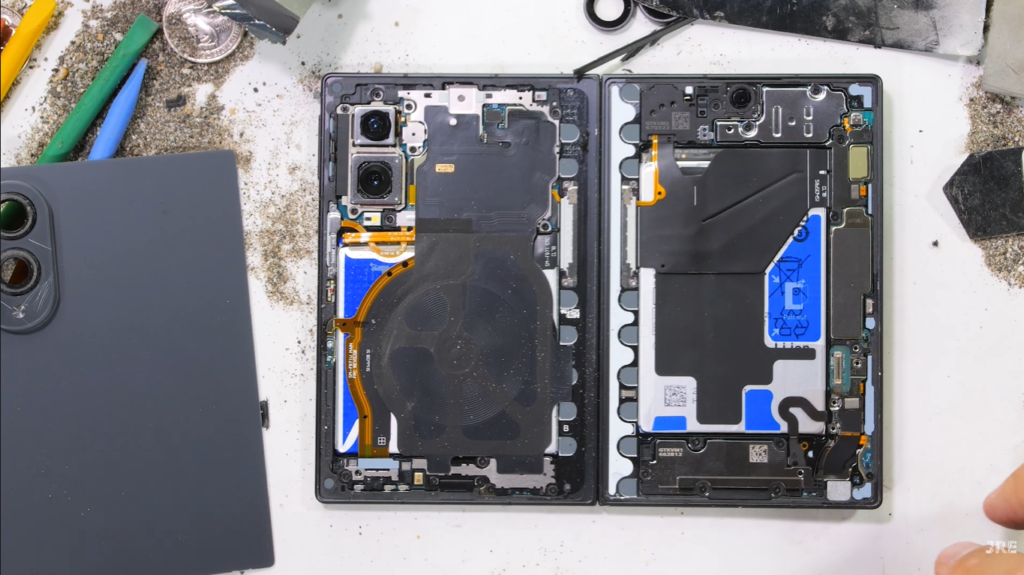
Both stereo speakers are positioned on the same physical side of the device (appearing on the right when viewed from the back, left when viewed from the inner screen). Despite the phone’s extreme thinness, Samsung has managed to include small internal resonance chambers around the speaker modules — extra hollow space that gives sound more surface area to reverberate against, making the audio output sound larger than the actual speaker hardware would suggest. The lower speaker module in particular uses a full-body waterproofing ring around its entire housing rather than a smaller seal, since a more compact conventional seal would have added too much thickness to the design.
Camera and Chipset Findings
With the motherboard exposed, the internals confirmed:
- Ultra-wide camera (50MP): No optical image stabilization (OIS) — typical for ultra-wide sensors
- Main camera (50MP): Does include OIS
- No telephoto lens — consistent with the standard Z Fold 8 lacking the triple-camera setup found on the Z Fold 8 Ultra
A small thermal interface pad was found routing heat away from the Snapdragon 8 Elite Gen 5 chipset toward a graphite cooling pad beneath the motherboard — notably, there’s no copper vapor chamber in this configuration, and no dual DCIC thermal system either, a feature Samsung did implement on the higher-tier Z Fold 8 Ultra but appears to have omitted from the standard model.
The Hinge: Genuinely Clever Modular Engineering
The most technically impressive discovery came from the hinge itself. After removing an additional 18 screws to access it (bringing the total screw count across the teardown to 56), the internal hinge spine revealed three individual geared “vertebrae” segments connecting the visible exterior spine to the rest of the mechanism.
What makes this notable: these vertebrae segments appear to be modular and shared across Samsung’s foldable lineup. The previous-generation Z Fold 7 used four of these segments for its taller design; the Z Fold 8 simply removes one segment to achieve its shorter, squatter form factor. The Z Flip 8, meanwhile, uses just two of the same segments in its much smaller hinge.
This shared modular design suggests Samsung’s hinge engineering across its entire 2026 foldable lineup was likely finalized well in advance, allowing the company to bring its new squat “wide-fold” form factor to market with reused, already-validated hinge components rather than engineering an entirely new mechanism from scratch — likely a meaningful factor in how quickly Samsung was able to ship this new form factor.
What This Teardown Confirms
- The titanium is real, verified independently through oxidation testing, even though the specific “honeycomb hollow” micro-pattern Samsung described wasn’t visually present on the standard Z Fold 8 (it may be exclusive to the Ultra model).
- Durability has real limits — the display’s susceptibility to scratching at a relatively low hardness level, combined with how difficult and destructive full disassembly proved to be, suggests this remains a phone to handle carefully despite the titanium reinforcement.
- The silicon-based battery technology is genuine, even if Samsung’s own component labeling doesn’t fully reflect the marketing terminology used at launch.
- The hinge engineering is the most impressive part of the phone from a pure engineering standpoint — a shared, modular system scaled across three different foldable form factors in Samsung’s 2026 lineup.
FAQ
Yes. A heat-based oxidation test confirmed the material discolors the same way genuine titanium does, though the specific micro-patterned “honeycomb” structure Samsung described at launch wasn’t visually confirmed on the standard Z Fold 8 model.
In the US, Samsung prices an out-of-pocket outer screen replacement at $579 and a cover screen replacement at $138. Exact India pricing for the Z Fold 8 specifically wasn’t confirmed at the time of this teardown; past Z Fold generations have seen India repair costs ranging roughly ₹28,000–₹70,000 depending on model and provider.
Yes, it supports 20W wireless charging, up from the 15W cap on all four previous generations of Samsung foldables.
No, based on this teardown — it has a 50MP main camera (with OIS) and a 50MP ultra-wide camera (without OIS), with no telephoto lens included, unlike the higher-tier Z Fold 8 Ultra
Surprised the titanium claims mostly checked out despite the scratch test results? Share your thoughts on Samsung’s material choices in the comments below.